This is an excerpt from CoinDesk newsletter ‘Daybook.’Sign up here, if you haven’t already.
While bitcoin BTC$80,949.32 remains pinned above $80,000, another interest rate-sensitive corner of the crypto market is booming and may suck capital out of other coins.
The total value locked in tokenized Treasuries has surged to $15.35 billion, topping the mid-April peak of around $15.10 billion, according to rwa.xyz data.
This comes as markets price in a higher probability of a Federal Reserve interest-rate hike (yes, an increase in borrowing costs), a stark shift from expectations for rapid rate cuts baked in earlier this year.
“The June cut just got significantly harder to defend, and the allocator positioning we flagged – capital sat in [BlackRock’s] BUIDL and tokenized T-bills rather than spot crypto – is going to look prescient by Friday,” Iggy Ioppe, co-founder of Polygon Ventures, said in an email.
Flows into yield-bearing tokenized Treasuries could rise further if today’s U.S. producer price index (PPI) points to persistent inflationary pressures in the pipeline. Consensus is for the April print to come in at 4.9% year-on-year, up from 4.0% in March.
An elevated reading would add to Fed rate-hike expectations and pose a headwind to risk assets. How bitcoin reacts remains to be seen, especially as it held largely steady above $80,000 after Tuesday’s hotter-than-expected CPI print.
While noting BTC’s resilience, analysts at Marex warned that further gains may be difficult if inflation continues to climb.
“That is the constraint for crypto: it can hold, but it will struggle to trend higher if real [inflation] rates keep grinding up,” analysts at Marex said.
Miners, too, present a potential headwind.
“If large miners are reporting big losses and pivoting toward AI, it usually means they may need to manage balance sheets more actively, which can translate into more spot supply on rallies. That is not a crash trigger, but it can cap upside in a choppy macro tape,” they noted.
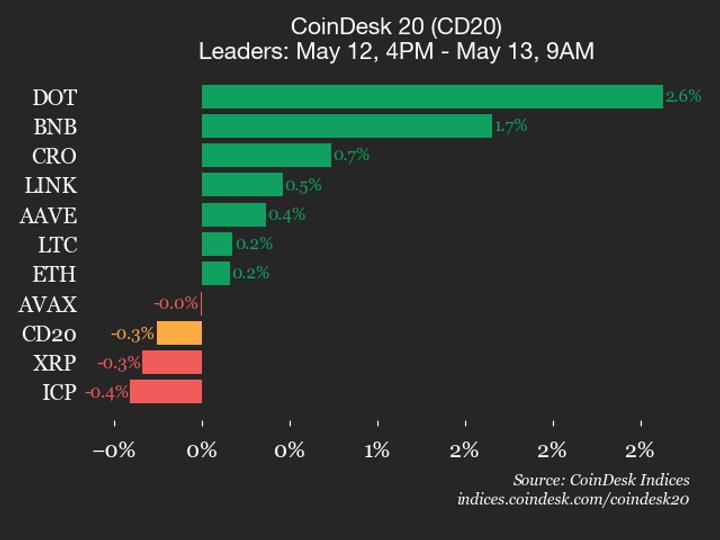
In the broader market, smaller coins such as ING, DOT, ATOM and TRUMP added 5% or more, pointing to a rotation of capital into selective tokens. Majors like ether (ETH), solana (SOL), and XRP remain choppy.
Bitcoin and ether volatility indexes continue to point to near-term calm ahead of three major events: the PPI report, the Clartiy Act vote and the meeting between President Donald Trump and his Chinese counterpart, Xi Jingping.
In traditional markets, WTI crude oil futures bounced back above $100, while copper rose to near-record highs, both pointing to more commodity-led inflation ahead. Stay alert!
Read more: For analysis of today’s activity in altcoins and derivatives, see Crypto Markets Today . For a comprehensive list of events this week, see CoinDesk’s “Crypto Week Ahead.”
What’s trending
Today’s signal
BTC’s daily chart with the 200-day SMA. (TradingView)
Bitcoin BTC$80,949.32 appears to be at an inflection point, with the recovery from February lows stalling near the 200-day simple moving average (SMA) at around $82,300 and the upper boundary of a rising channel.
The momentum has stalled just as macro uncertainty around inflation and Federal Reserve policy intensifies.
A bearish resolution would involve BTC failing to break above the 200-day average and slipping below $75,000, which was widely cited as a key level in February-March. That could encourage systematic sellers back to the market, particularly if rising Treasury yields continue to tighten financial conditions and weigh on risk appetite.
On the bullish side, a decisive move above the 200-day average would confirm a bull market, potentially yielding a rally to as high as $92,000.
At the Money20/20 Asia event in Bangkok, the primary transformation identified in the financial services sector, both in APAC and globally, is the widespread adoption of AI agents. Zor Gorelov, Chief Executive Officer at Blue Language Labs, detailed how this shift is unfolding across two distinct use cases. First, internal enterprise agents are being deployed to significantly improve productivity and operational efficiency. Second, businesses are increasingly adopting agents to drive growth, creating a new requirement for financial institutions to support these autonomous entities in their expanding operations.
Blue Language Labs is addressing this shift by helping banks bridge the gap between their existing systems and these new AI-driven workflows. The company focuses on making payment infrastructure both highly usable and safe before exposing it to a bank’s merchant clients. By providing the necessary layers of security and accessibility, the firm allows financial institutions to act as a secure foundation for the next generation of automated business growth, ensuring that as merchants integrate AI agents into their operations, the underlying financial movements remain protected and efficient.
For banks and fintechs adopting this technology over the next 12 months, the results are focused on security, merchant success, and balance sheet growth. By implementing these solutions, institutions can offer a level of safety and security that traditional infrastructures may lack when facing autonomous agent interactions. Consequently, banks are better positioned to help their merchants grow, which leads to a direct increase in deposits for the institution. This creates a symbiotic relationship where the bank’s investment in secure AI infrastructure directly fuels the commercial expansion of its client base.
Key Highlights from Zor Gorelov:
The Agent Shift: Gorelov identifies the adoption of AI agents as the single biggest change currently impacting financial services in APAC and worldwide.
Enterprise Productivity: A look at how internal agents are being utilized within the enterprise to streamline workflows and improve overall productivity.
Supporting Merchant Growth: How financial institutions are using AI to help their business clients grow and scale their operations.
Safe Infrastructure Exposure: The role of Blue Language Labs in making bank payment infrastructure usable and secure for merchant exposure.
Deposit Increases: Why adopting secure AI technology leads to business growth for merchants and increased deposits for the banks that support them.
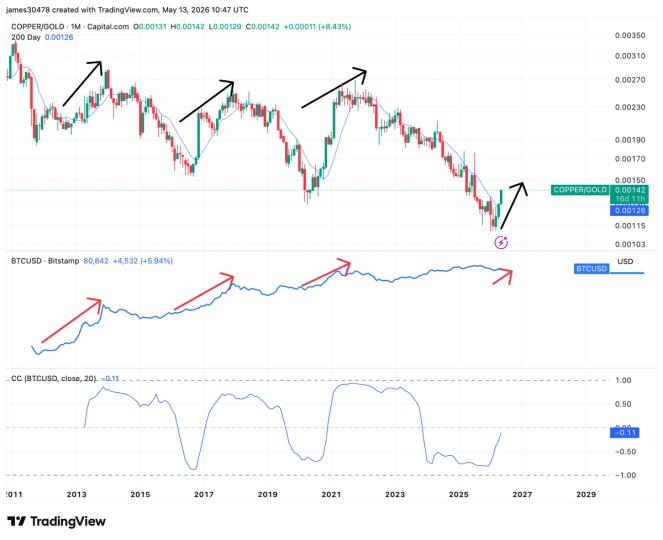
The copper-to-gold ratio has broken above its 200-day moving average for the first meaningful time since September 2020, a development that has historically coincided with the early stages of bitcoin BTC$80,492.82 bull markets.
The ratio currently stands at 0.00142, with copper trading at $6.65 per pound and gold near $4,700 per ounce. Previous surges in the ratio during 2013, 2017, and 2021 aligned with major gains in bitcoin prices.
The correlation coefficient between bitcoin and the copper-to-gold ratio currently sits at -0.11, though it has rebounded sharply from -1.00. This suggests the two assets are not yet positively correlated, but the relationship is beginning to strengthen. Historically, during bitcoin’s strongest bull runs, the correlation has moved toward or above 1.0.
The current negative reading largely reflects the earlier divergence phase, when the ratio was falling and bitcoin typically declined faster than copper. As the ratio recovers, that relationship has historically converged alongside improving market conditions.
Historically, the copper-to-gold ratio has led bitcoin by several weeks to months, suggesting the current move may still be in its early stages.
The copper-to-gold ratio is widely viewed as a gauge of economic momentum and investor risk appetite. Copper is closely tied to industrial demand and tends to outperform during periods of economic expansion, while gold is traditionally associated with defensive positioning. A rising ratio therefore signals a more risk-on macro environment.
Privacy-first stablecoin neobank Zoth and regulated digital asset infrastructure company Bakkt have officially signed an MOU to establish a strategic partnership framework.
The partnership directly combines Bakkt’s comprehensive US licensing stack with Zoth’s established emerging-market payment corridors and last-mile infrastructure. By joining forces, the two companies aim to provide enterprise money transfer operators (MTOs) with a fully compliant route to move stablecoin-based cross-border payments at scale.
Bridging the compliance gap
While the foundational infrastructure for stablecoin cross-border payments already exists, regulatory compliance has historically acted as a major blocker for large MTOs and financial institutions requiring global coverage. Under the new MOU, Zoth will officially operate as an Authorized Agent within the licensing structure of Bakkt Financial Solutions I, LLC.
This integration grants Zoth’s enterprise MTO pipeline access to a US-licensed counterparty, providing the structural compliance advantage necessary to clear regulatory gates and close enterprise deals.
Bakkt Financial Solutions I, LLC brings a robust suite of regulatory credentials to the table, which includes:
Pan-US Money Transmitter Licenses.
The New York BitLicense, which is widely considered the most stringent and comprehensive digital asset licensing regime in the United States.
Federal registration under the Bank Secrecy Act as a FinCEN Money Services Business (MSB).
Targeting high-volume remittance corridors
While Bakkt provides the necessary regulatory framework, Zoth delivers the operational depth, local partnerships, and platform infrastructure required to move money efficiently across the Global South. The partnership specifically targets some of the highest-volume payment flows globally, bridging US-licensed digital asset infrastructure with major emerging market corridors.
Together, the firms will cover major remittance routes, including:
USA to South Asia: Recognized as the single largest remittance corridor globally and a primary growth market for US-licensed payment operators.
UAE to South Asia: The largest remittance corridor operating within the entire Middle East.
USA to the Middle East: A high-growth corridor that serves the Gulf Cooperation Council’s (GCC) large expatriate workforce base.
USA to the Philippines and Nigeria: Ranked among the highest-volume US outbound corridors globally.
Sub-Saharan Africa: Encompassing key markets such as Uganda, Kenya, Nigeria, Ghana, and South Africa.
Scaling to $1billion
Currently, Zoth boasts $300million in annualized Total Payments Volume (TPV) and has already sold over $75million in yield products. Backed by prominent investors including SOSV, Taisu Ventures, Borderless Capital, and the Blockchain Founders Fund, Zoth is leveraging the Bakkt partnership to scale its TPV to $1billion annually.
Pritam Dutta, co-founder and CEO of Zoth, highlighted the immediate industry impact of the collaboration.
“Stablecoin infrastructure is ready,” Dutta stated. “What large institutions have been waiting for is the regulatory configuration that gives them confidence to sign. By combining Bakkt’s US licensing stack with Zoth’s payment infrastructure and on-the-ground market operations, we are creating a template for how cross-border payments in the Global South move from pilots to production at scale.”
Dutta noted that the strategic partnership ultimately benefits every enterprise partner that has been waiting for a compliant, credentialed solution built for active operation.
Bitcoin may have a roughly 77% chance of reaching new all-time highs within a year if historical BTC price patterns repeat.
Key points:
Bitcoin reduces its drawdown from all-time highs from 50% to 35% with its rebound to $80,000.
History shows that new all-time highs have come within a year during similar events.
The Buffett indicator could be calling Bitcoin’s new $160,000 record highs in advance.
BTC price drawdown: Odds favor new all-time high
New research from network economist Timothy Peterson released on Tuesday shows what happens when BTC/USD claws back significant losses.
“I looked at every time Bitcoin went from a -50% drawdown to a -35% drawdown (the situation we are in today),” he revealed in a post on X.
Bitcoin dipped below $60,000 in late February, a move that brought its drawdown versus its $126,200 all-time highs beyond 50%.
Since then, conditions have eased, and price currently trades around $81,000. Against its October 2025 peak, the pair is 35% lower, per data from TradingView.
As Peterson confirms in an accompanying chart, such moves have characterized price action throughout its past bear markets. What is more exciting for Bitcoin bulls, however, is what traditionally comes next.
He added that “7 out of 9 times it hit a new all-time high within a year.”
The last time that a similar recovery took place was at the end of the 2022 bear market, which saw a maximum drawdown of just over 70%.
Data from onchain analytics platform Glassnode shows that it took until December 2023 for that correction to become 35% against all-time highs from two years prior.
Bitcoin’s new record high then came in March 2024.
BTC price drawdowns from all-time highs. Source: Glassnode
Bitcoin “looks cheap” amid $160,000 target
Despite uncertainty over geopolitical and macroeconomic conditions going forward, Bitcoin is not without its bullish predictions this month.
Related: BTC price target becomes $85K next: Five things to know in Bitcoin this week
Examining Bitcoin versus gold, Matthew Sigel, head of digital asset research at VanEck, offered $160,000 per coin as a conservative estimate.
Sigel reported that the so-called Buffett indicator — the ratio of the total US stock market to GDP named after Warren Buffett — implies a BTC comeback move.
“Bitcoin looks cheap,” he told X followers on Monday.
“If it regains the 35x XBT/XAU cross implied by current levels of the Buffett Indicator, we’re looking at $160k, and that’s just catching up to where equities already are.”
BTC/USD versus Buffett indicator. Source: Matthew Sigel/X
Trusted Editorial content, reviewed by leading industry experts and seasoned editors. Ad Disclosure
The US Senate Banking Committee’s crypto market structure push is running into a dense wall of amendments ahead of Thursday’s markup, with lawmakers filing more than 100 proposed changes to the CLARITY Act. The amendment rush puts stablecoin rewards, crypto firms’ access to the Federal Reserve system and even the use of digital assets for tax payments at the center of Washington’s latest fight over crypto regulation.
According to Politico, committee members submitted more than 100 amendments before the markup vote. Crypto journalist Eleanor Terrett reported that Senator Elizabeth Warren alone filed more than 40 amendments, including one that would prevent the Federal Reserve from issuing master accounts to crypto companies. Terrett also flagged an amendment from Senator Jack Reed that would “prohibit crypto from being used as legal tender, for example, to pay taxes.”
That language would cut directly against one of the industry’s longer-running policy goals: expanding digital assets beyond investment and trading into payments, settlement and public-sector use cases. Terrett noted the contrast with prior pro-Bitcoin tax-payment proposals, writing that Representative Warren Davidson had introduced a bill last year “to do that very thing” with BTC.
Crypto Bill Enters High-Stakes Senate Markup
The latest clash comes after Senate Banking Committee Chairman Tim Scott, Senator Cynthia Lummis and Senator Thom Tillis released new market structure text that will serve as the basis for the committee markup. The committee said the text reflects negotiations with Democrats and input from lawmakers, regulators, law enforcement, financial institutions, innovators and consumer advocates. Scott framed the bill as a consumer-protection and national-competitiveness measure.
“Over the past year, we have listened, negotiated, and strengthened this bill because families, small businesses, investors, and innovators all benefit from clear rules of the road,” Scott said. “This bill reflects serious, good-faith work across the Committee and delivers the certainty, safeguards, and accountability Americans deserve.”
The most immediate fault line remains stablecoin rewards. The Senate text would ban rewards on idle stablecoin balances that closely resemble bank deposits, while allowing rewards tied to transaction-based activity, such as stablecoin payments. The SEC, CFTC and Treasury Department would be tasked with issuing joint rules to implement that provision.
Banks are not satisfied. Brendan Pedersen reported that Reed and Senator Tina Smith filed an amendment that would incorporate bank-requested changes to stablecoin yield restrictions, forcing lawmakers to choose between the crypto and banking industries. The amendment would target rewards “substantially similar” to deposit interest, a phrase that goes to the core of the banking lobby’s argument: that crypto platforms should not be allowed to compete with deposits through yield-like incentives while avoiding bank-style regulation.
Terrett reported separately that American Bankers Association members had sent more than 8,000 letters to Senate offices urging lawmakers to revise the stablecoin-yield compromise. The ABA has argued that the current language does not adequately close what it calls a loophole allowing exchanges and other digital asset service providers to bypass the GENIUS Act’s ban on interest or yield on payment stablecoins.
The bill also reaches well beyond stablecoins. Digital commodity exchanges, brokers and dealers would be treated as financial institutions under the Bank Secrecy Act, bringing them into anti-money-laundering, customer-identification and due-diligence regimes. The text would also allow crypto companies to raise up to $50 million annually, and up to $200 million total, without SEC registration, while clarifying that tokenized securities remain subject to securities law.
The political path is still fragile. Terrett said Senate Minority Leader Chuck Schumer appeared engaged in a Democratic member meeting and eager for members to reach a “yes” on the CLARITY Act, but stressed that ethics negotiations needed to move further before Thursday’s markup. Warren, the committee’s top Democrat, has been pressing that issue hard, saying the bill “puts investors, our national security and our entire financial system at risk” and would “turbocharge Donald Trump’s crypto corruption” without stronger conflict-of-interest provisions.
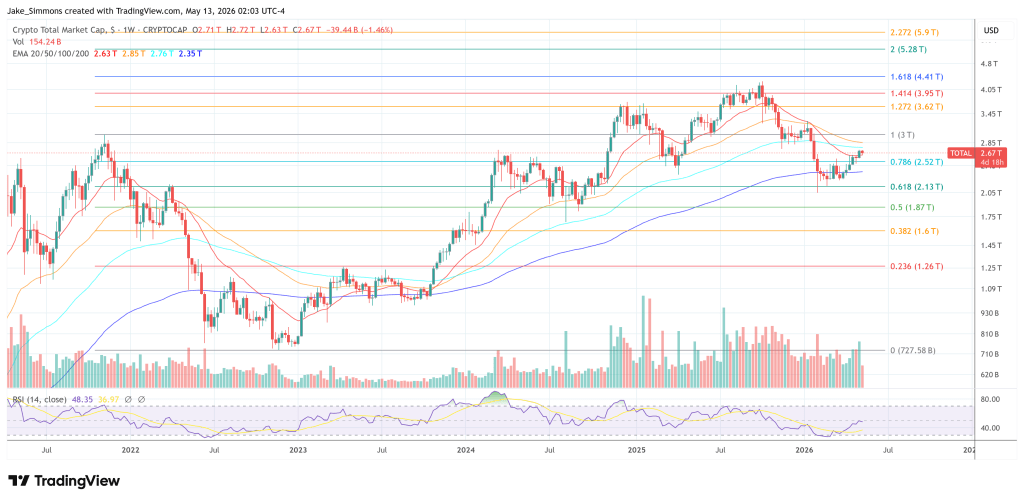
At press time, the total crypto market cap stood at $2.67 trillion.
Total crypto market cap faces the 100-week EMA, 1-week chart | Source: TOTAL on TradingView.com
Featured image created with DALL.E, chart from TradingView.com
Editorial Process for bitcoinist is centered on delivering thoroughly researched, accurate, and unbiased content. We uphold strict sourcing standards, and each page undergoes diligent review by our team of top technology experts and seasoned editors. This process ensures the integrity, relevance, and value of our content for our readers.
Charles Schwab, the brokerage giant that manages around $12 trillion in client assets, began the rollout of its spot cryptocurrency trading service for retail customers in the U.S.
An initial group of clients can now trade bitcoin BTC$80,949.32 and ether (ETH) on the Schwab Crypto platform, the company posted on X on Tuesday.
In July last year, CEO Rick Wurster said the company planned to introduce crypto trading in the near future, with a timeframe of first-half 2026 confirmed last month.
The Westlake, Texas-headquartered firm already offers crypto investments through exchange-traded funds (ETFs) and futures trading.
The ability to directly trade the actual assets through a company with the scale of Schwab could be a pivotal accelerator for mainstream crypto adoption.
As one of the largest brokerage firms in the world, Schwab could offer its roughly 35 million clients the opportunity to trade BTC and ETH in an environment they already recognize rather than having to register with a standalone crypto exchange.
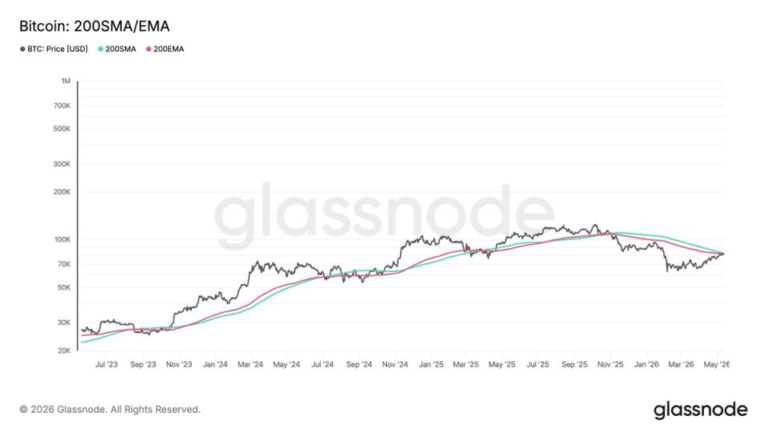
Bitcoin BTC$80,785.91 is fighting a key technical battle and is trading just below two closely watched long-term trend indicators: the 200-day Simple Moving Average (200SMA) at $82,455 and the 200-day Exponential Moving Average (200EMA) at $82,027, according to Glassnode data.
The 200SMA calculates the average closing price across the last 200 days, weighting each day equally. The 200EMA uses the same 200-day window but places greater emphasis on more recent prices, making it slightly more responsive to current market conditions.
Together, they form a confluence resistance zone around $82,000–$82,500 that bitcoin must convincingly reclaim to signal a recovery of its long-term uptrend. Bitcoin first lost the 200DMA in late November 2025, when the price rolled over from $108,000. A brief recovery attempt in January failed to reclaim the level around $97,000 and by early February 2026 bitcoin had fallen to $60,000.
What gives bulls reason for cautious optimism is that bitcoin is holding above several significant cost basis levels, according to CheckonChain. The 128-day Moving Average sits at $75,700, representing the average price paid by buyers over that shorter timeframe and a level BTCX has successfully defended.
The True Market Mean, currently at $78,200, reflects the average price of every bitcoin at the time it last moved onchain, essentially representing the aggregate cost basis of the entire active market.
The Short-Term Holder Cost Basis at $78,400 tracks the average acquisition price of investors who bought within the last 155 days, a group historically prone to panic selling when underwater.
Bitcoin trading above all three suggests the majority of recent buyers remain in profit, reducing sell pressure from forced liquidations or panic selling. The key zone to watch is whether bitcoin can flip the $82,000-$82,500 into support.
What have been the developments of the fintech, digital and wider economic development that is driving the economy and society of the North African nation of Morocco?
Morocco has long occupied a distinctive place in North Africa’s economic story. It is not the region’s largest market, nor its most hydrocarbon-rich, yet it has steadily built a reputation for institutional reform, industrial diversification, and outward-facing connectivity. In previous research I wrote about, Morocco’s fintech ecosystem in 2024 was already showing meaningful momentum. This was supported by a modernising banking sector, a growing startup base, and an increasingly ambitious digital agenda.
At present, that trajectory has become more defined: Morocco is no longer simply adopting fintech trends, but trying to shape a broader digital-financial model of its own.
The Moroccan economy remains anchored in a diversified mix of manufacturing, agriculture, phosphates, automotive production, aerospace, tourism, and services. Casablanca continues to serve as the country’s principal financial hub, reinforced by the role of Casablanca Finance City as a bridge between Morocco, Africa, Europe, and the Mediterranean. In banking, Attijariwafa Bank remains one of the country’s most influential institutions and describes itself as a leader in Morocco’s financial sector.
Despite progress, the country’s gross domestic product (GDP) per capita is over $4,000. It fares better than much of its African peers but still has room for further growth.
The growing fintech sector
View over Casablanca, Morocco IMAGE SOURCE GETTY
That wider economic base has helped Morocco build one of the more substantial fintech ecosystems in Africa. The exact number varies by methodology, but recent estimates suggest the market ranges from more than 40 active fintech solutions to around 95 fintech companies. That spread reflects the reality of a market in transition: some counts focus on operational startups, while others include broader fintech-linked companies.
Either way, the direction is clear. Morocco’s ecosystem is larger and more varied than it was only a few years ago, spanning payments, lending, regtech, merchant services, digital banking enablement, and emerging embedded-finance models. Examples of fintechs in the country are: OnePay (online bill payments), MeilleurCreditmmo (comparison platform), and SYPEX (trade management solutions).
What is especially striking at present is that Morocco’s fintech story now sits inside a much wider national digital transformation push. The government’s Digital Morocco 2030 strategy presents digital technology as a driver of social and economic development, with goals around public-service modernisation, digital inclusion, startup creation, and stronger digital exports. Reporting around the strategy has highlighted ambitions such as creating 1,000 startups by this year and 3,000 by 2030, alongside broader support for innovation financing and ecosystem development. In other words, fintech in Morocco is no longer an isolated sectoral story; it is part of a larger state-backed vision of economic modernisation.
The financial sector sits at the centre of that transition. Bank Al-Maghrib (the country’s central bank) has continued to modernise the country’s payment architecture, which includes interbank payment systems as well as retail and securities-settlement infrastructure. The past few years has seen the central bank move further into areas that increasingly define next-generation finance. In late 2024, Governor Abdellatif Jouahri said a draft law regulating crypto-assets was moving through the adoption process, even though cryptocurrencies have been banned since 2017. By mid-last year, the bank was also actively exploring a central bank digital currency (CBDC) for peer-to-peer and cross-border payments, in cooperation with international institutions including the International Monetary Fund (IMF) and World Bank.
At the retail level, payments innovation has accelerated. Morocco’s payment market has been opening up further, with increasing room for licensed payment institutions and partnerships designed to expand acceptance and usage. One example came last year, when Vantage Payment Systems and Mastercard announced a collaboration to advance payment innovation and financial inclusion in Morocco. This matters because Morocco’s fintech evolution is still, above all else, a payments-led story: a market where digitising everyday transactions remains one of the clearest paths to broader inclusion and commercial adoption.
Financial and digital inclusion
Financial inclusion remains a core part of the narrative. Public reporting on Bank Al-Maghrib data showed that 58 per cent of adult residents had at least one active bank account by the end of 2024, up from 54 per cent a year earlier. That is meaningful progress, but it also underlines the distance still to travel in a country where millions remain outside the formal financial system. Earlier financial inclusion reporting also highlighted persistent gaps affecting women and rural communities, showing that account ownership growth alone does not eliminate structural disparities. Morocco’s challenge in 2026 is therefore twofold: increase access further, while also ensuring that access translates into regular, useful digital financial usage.
Institutionally, the ecosystem has become more organised. Early last year, public and private stakeholders established the Morocco Fintech Center, an association designed to support fintechs through mentoring, incubation, acceleration, skills development, regulatory guidance, and access to financing. That is an important marker of maturity. Morocco is no longer relying solely on individual startups or bank initiatives; it is building connective tissue around the ecosystem. Programmes such as the Morocco Fintech Accelerator have added to that momentum, while partnerships between banks and fintech support bodies suggest a more collaborative market structure than a purely disruptive one.
There are now several examples of Moroccan fintechs and fintech-adjacent firms attracting attention. Beyond examples mentioned earlier, recent profiles include companies such as PayTic (payment operations automation), Agenz (applies digital tools to real estate transactions), and Chari (embedded finance). These examples suggest an ecosystem that is becoming more diverse, even if payments and infrastructure remain its centre of gravity.
Beyond finance narrowly defined, Morocco is trying to position itself as a wider digital hub. Early this year, Reuters reported that the country was targeting a $10 billion AI contribution to GDP by 2030, alongside AI centres, expanded data infrastructure, and a larger digitally skilled workforce. That ambition complements the logic already visible in fintech: Morocco is betting that digital capability, institutional credibility, and regional connectivity can reinforce one another. Yet the country still faces constraints, including uneven inclusion, funding gaps for startups, and the challenge of translating policy ambition into broad-based daily usage.
Morocco’s real strength lies in how it combines market size, reform momentum, regulatory evolution, and African-facing connectivity. Morocco’s fintech journey is moving from potential to structure. With stronger institutions, a clearer digital strategy, and a growing support ecosystem, it has real momentum. The next phase will depend on widening inclusion, deepening everyday digital payments usage, and turning policy ambition into scale that reaches well beyond Casablanca.
Richie is a global economic development advisor and Managing Partner of Santos-Diaz LLC, specializing in international trade and foreign direct investment across the UK, Middle East, and North America. With over 15 years of experience and a Masters from SOAS University of London, he has advised high-level governments and multinational corporates while contributing to major outlets like Forbes and the World Economic Forum. Currently based in Dubai, he leverages his background in emerging markets and RegTech to bridge the gap between global policy and private sector growth.
View all posts
Executive Economic Development Advisor (Emerging Markets) | Contributor