
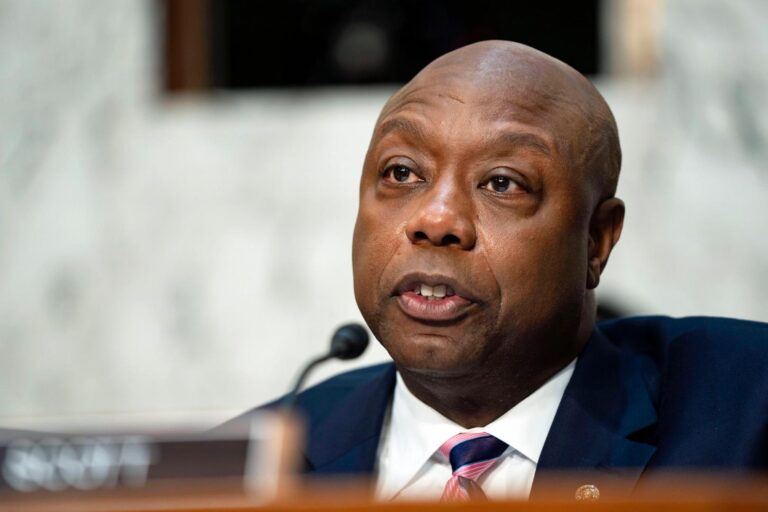
After a bipartisan approval in the Senate Banking Committee, the crypto market structure bill now advances to a final overhaul aimed at Senate and House passage.
US Senate Banking Committee Votes to Advance Crypto Market Structure Bill

US lawmakers in the Senate Banking Committee held a markup for a long-awaited crypto market structure bill, marking a pivotal step toward Congress’ effort to establish regulatory clarity for digital asset companies and markets.
In a Thursday session of the US Senate Banking Committee, all 13 Republican members and two Democrats voted to advance the Digital Asset Market Clarity Act (CLARITY), with nine Democrats also voting no on the bill.
Senators Ruben Gallego and Angela Alsobrooks sided with Republicans to vote yay. The vote came after lawmakers proposed more than 100 amendments to the crypto bill, ranging from provisions on stablecoin yield to ethics restrictions.
In opening statements before the vote, committee chair Tim Scott said that the bill was focused on protecting consumers, keeping innovation in the US, and safeguarding national security in regards to digital assets.
Ranking member Elizabeth Warren said that the bill was “written by the crypto industry for the crypto industry,” adding that it would allow Republican lawmakers to “grease the skids” for US President Donald Trump’s “crypto grift.” “Nothing made it into this bill that wasn’t approved by the crypto industry,” said Warren.
Senator Elizabeth Warren addressing lawmakers at the Thursday markup. Source: US Senate Banking Committee
Senator Cynthia Lummis, one of the legislation’s chief Republican advocates, pushed back against many of Warren’s concerns, saying CLARITY was a “pro law enforcement” and “pro consumer” bill.
Senator Jack Reed, a Democrat, said that the bill was not an example of bipartisan work, given that Scott had “arbitrarily” dismissed consideration of amendments Democrats had proposed.
Related: Ethics remain sticking point as crypto market structure bill goes to markup
With the advancement of CLARITY in the banking and agriculture committees to address laws and regulations in the Securities and Exchange Commission (SEC) and Commodity Futures Trading Commission (CFTC), respectively, the bill is expected to head for a floor vote in the Senate soon.
The bill will need 60 votes to pass. the Senate. The US House of Representatives will then need to approve the amended legislation.
“I think it’s so difficult to get Senate floor time, and if they get something through the Senate that has the votes, I think the House will probably pass that identical language, and then it will be able to go on to the president’s desk for a signature,” Solana Policy Institute President Kristin Smith told Cointelegraph before the markup.
Several amendments were debated and dismissed at markup
Many of the amendments proposed at markup were either adopted or failed along partisan lines, addressing different aspects of regulating the crypto industry.
Among those considered at markup included provisions on sandboxes for AI by Scott and ones on “tokenization loopholes” and money laundering by Warren, who cited reports that Iran was collecting tolls in crypto for ships using the Strait of Hormuz and otherwise evading sanctions.
Lummis said that CLARITY would address the regulation of crypto mixers in response to Warren’s proposed amendment. Scott’s amendment was included, while Warren’s failed.

Senator Cynthia Lummis addresses the Senate Banking Committee. Source: US Senate Banking Committee
Another amendment by Warren included a demand for US banking regulators to report on information related to deceased sex offender Jeffrey Epstein, whom she described as an “early backer of crypto.”
Lummis said the provision was not related to digital assets and should not be included. Lawmakers voted along party lines, and the amendment failed to pass. Republicans also voted against amendments proposed by Reed on stablecoins and digital dollars.
Senator Catherine Cortez Masto, a Democrat who expressed general support for the CLARITY Act at the markup, introduced an amendment that would give law enforcement more authority over crypto-related cases. The amendment failed along party lines.
Democratic Senator Tina Smith proposed an amendment to prohibit federal agencies from bailing out crypto companies if another market crash were to occur. Calling it a “preventative measure” in response to volatility in the crypto markets, Smith and all Democrats voted in favor of the amendment, which failed along party lines.
Ethics still a concern for Democrats
The committee also considered an amendment from Democratic Senator Chris Van Hollen over Trump’s potential conflicts of interest with the crypto industry through his family’s World Liberty Financial business and memecoins.
Republican Senator Bernie Moreno and Scott defended the president, accusing Van Hollen of “ad hominem” attacks. All 13 Republicans voted against the provision.
“The people involved directly in making these policies, from the president to the Congress, should not be able to be issuers of these particular assets and coins,” said Van Hollen.
Senator Raphael Warnock withdrew an amendment in response to what he called “pure corruption” by the Trump administration, adding that he would not support any bill without these carveouts.
Warren echoed these concerns in a separate amendment, which would continue to fund the Consumer Financial Protection Bureau in response to the administration’s attempt to shutter the agency since 2025.
Magazine: eToro founder timed Bitcoin top perfectly due to belief in 4 year cycles
CLARITY Act Negotiations Ended Without A Deal – Senator Lummis Warned What Happens Next If It Fails

Trusted Editorial content, reviewed by leading industry experts and seasoned editors. Ad Disclosure
The crypto market is facing its most significant regulatory test in years as the US Senate Banking Committee prepares to vote on the CLARITY Act today, Thursday, May 14. The markup session that will determine whether the most comprehensive digital asset legislation in American history advances toward a full Senate floor vote begins with bipartisan negotiations having collapsed overnight — leaving the outcome considerably less certain than it appeared just days ago.
Eleanor Terret reports that a small group of senators working to bring Democrats on board with at least two outstanding issues wrapped their negotiations late Wednesday night without reaching a deal. The talks had been the last realistic opportunity for the CLARITY Act to enter Thursday’s markup with meaningful bipartisan support. They ended without it.
Senator Lummis, one of the lead Republican negotiators, issued a statement that captured both the proximity to resolution and the frustration of falling short. Agreement exists on 99% of the bill. The remaining 1% — touching ethics provisions related to the First Family and changes tied to the Blockchain Regulatory Certainty Act — proved sufficient to prevent a deal from forming before today’s vote.
The warning Lummis attached to her statement was pointed. If the bill fails or stalls and another FTX-scale event occurs, she argued, the responsibility will fall on those who chose the last 1% over the 99% already agreed upon. Today’s vote will reveal whether that argument lands — or whether it becomes the epitaph for this attempt at regulatory clarity.
The Ethics Problem Got Closer to a Solution. The Developer Protection Problem Did Not
Terret’s reporting identifies the two fault lines that ultimately prevented a bipartisan deal from forming before today’s vote — and they are not the same fault line.
Senators Schiff of California and Gallego of Arizona had made ethics and conflicts of interest provisions involving the First Family a condition of their support. The concern is structural: legislation that creates a regulatory framework for digital assets while a presidential family holds significant crypto interests raises questions that Democrats wanted addressed in the CLARITY Act’s text before they could sign on. Terret reports that meaningful progress was made on this front — the gap was narrowing and the issue appeared navigable.
What ultimately prevented the deal was a separate and later-emerging disagreement over the Blockchain Regulatory Certainty Act provisions embedded in the CLARITY Act draft. The BRCA language would shield non-custodial software developers from prosecution under money transmitter laws — a protection the crypto industry considers essential for developers building decentralized tools who never hold user funds. Democrats raised eleventh-hour concerns about those provisions that the overnight negotiations could not resolve in time.
The five pro-crypto Democrats on the Senate Banking Committee now face today’s vote without the cover of a bipartisan agreement. How each of them votes — whether they prioritize the 99% of the CLARITY Act they support or hold out for the 1% they could not resolve — is the question Thursday’s markup will answer in real time.
Crypto Market Cap Tests Recovery Zone Amid CLARITY Act Uncertainty
The total crypto market cap is trading near $2.62 trillion after recovering from the sharp correction that pushed the market toward the $2.3 trillion region earlier this year. The weekly chart shows a constructive rebound, but price action remains trapped beneath an important resistance area that now coincides with declining shorter-term moving averages. Momentum has improved, though the broader structure still reflects a market attempting to regain trend control rather than one already in full expansion mode.
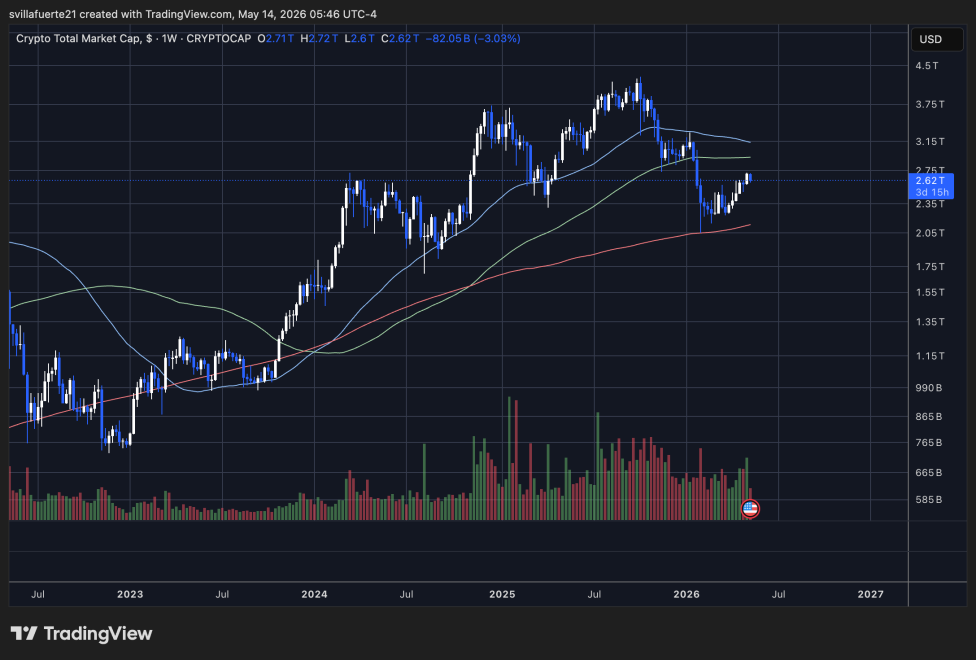
Technically, the market is trying to reclaim a zone around $2.65–$2.75 trillion that previously acted as support before the breakdown earlier this year. Recovering that level would strengthen the case for a broader continuation toward the $3 trillion region. However, repeated rejections in this area suggest buyers have not yet achieved decisive control.
The moving average structure also remains mixed. The market has climbed back above the long-term 200-week moving average, preserving the broader bullish structure, but the shorter-term trend indicators continue acting as overhead resistance. That setup often characterizes transition periods rather than confirmed trend reversals.
Volume has also moderated compared to the intense activity seen during the prior decline. Against today’s CLARITY Act uncertainty, the market appears to be stabilizing, but traders still lack confirmation that capital is returning aggressively enough to support a sustained expansion phase.
Featured image from ChatGPT, chart from TradingView.com

Editorial Process for bitcoinist is centered on delivering thoroughly researched, accurate, and unbiased content. We uphold strict sourcing standards, and each page undergoes diligent review by our team of top technology experts and seasoned editors. This process ensures the integrity, relevance, and value of our content for our readers.
0x Co-Founder Will Warren Steps Down as Co-CEO

Will Warren is transitioning out of his co-CEO role at 0x, the DEX protocol powering billions in monthly trading volume across Coinbase, Robinhood, Phantom, and Kraken.
Will Warren has stepped down from his position as co-CEO at 0x, the decentralized exchange protocol that processes billions of dollars in monthly trading volume.
Warren remains a major shareholder and will continue serving on the board, while Amir Bandeali assumes sole leadership of the protocol. Warren cited organizational structure and the co-CEO model as constraints that slowed decision-making in a “hyper competitive” market.
0x powers onchain swaps for major crypto platforms including Coinbase, Robinhood, Phantom, and Kraken. The protocol was launched in 2016 as one of the first DEX protocols on Ethereum.
Warren emphasized that the organization has “rebuilt and reimagined” itself multiple times over the past decade and must now operate with greater speed to navigate a rapidly evolving landscape where AI is enhancing individual capability.
Warren’s statement highlighted 0x’s market position, noting the protocol’s products, institutional partnerships, technology, track record, and financial reserves position it to lead in the tokenization mega-trend. He expressed confidence in Bandeali’s leadership and stated his continued support for the team.
The transition reflects broader organizational pressures within DeFi protocols to streamline decision-making structures amid intensifying competition in the onchain trading infrastructure sector.
Sources: Will Warren (0x Co-Founder)
This article was produced with the help of AI flows.
EquiLend Names Simon Heath Chief Strategy Officer

WHY THIS MATTERS
The appointment of Simon Heath as Chief Strategy Officer, announced on May 12, 2026, marks a major “practitioner-to-platform” move for EquiLend. As the former Global Head of Agency Securities Finance at J.P. Morgan, Heath brings over 25 years of institutional experience and a formidable book of industry relationships to EquiLend’s Executive Leadership Team. This matters because EquiLend is currently reinforcing its status as “critical market infrastructure” during a period of intense regulatory and structural change in the securities finance sector, including the shift toward T+1 settlement and increased demand for collateral optimization.
Based in London and reporting directly to CEO Rich Grossi, Heath’s mandate is to bridge the gap between EquiLend’s technology and the evolving needs of its global client base. His deep understanding of market structure will be vital as EquiLend moves to expand its regional footprint—particularly across APAC and EMEA—and accelerates the rollout of its next-generation data and analytics tools. For EquiLend, hiring one of the industry’s most senior practitioners is a strategic bet that “knowing the trade” is the best way to build the “tech for the trade.”
EquiLend, the global financial technology, data and analytics firm specializing in the securities finance industry, today announced the appointment of Simon Heath as Chief Strategy Officer. Heath joins EquiLend’s Executive Leadership Team and will be based in London, reporting to CEO Rich Grossi.
In his new role, Heath will drive EquiLend’s strategic growth agenda, partnering across the organization to accelerate regional expansion, support continued product innovation, and reinforce EquiLend’s position as critical market infrastructure for the global securities finance industry.
Heath joins EquiLend from J.P. Morgan, where he most recently served as Managing Director and Global Head of Agency Securities Finance. Across more than 25 years in the industry, he has built deep expertise in securities finance, client strategy, and market structure.
“Simon’s appointment reflects our continued investment in strengthening EquiLend’s market leadership and expanding our influence at the center of the global securities finance market,” said Rich Grossi, CEO of EquiLend. “His practitioner background, market perspective, and deep industry relationships will be instrumental in identifying new opportunities for growth – across our product suite and across the regions we serve. Simon’s leadership is uniquely aligned with our mission, our culture, and the role EquiLend plays as critical market infrastructure for the industry.”
“EquiLend sits at the center of the global securities finance market, and there are few firms with a comparable vantage point on where the industry is heading,” said Heath. “I’ve spent my career on the practitioner side of this business, and I look forward to bringing that perspective to the team as we work to expand EquiLend’s footprint and capabilities for clients globally.”
FF NEWS TAKE
EquiLend is effectively “hiring the client.” By bringing in a Managing Director from a bulge-bracket firm like J.P. Morgan, EquiLend is ensuring that its roadmap is perfectly aligned with the operational realities of the world’s largest lenders and borrowers. Simon Heath is not just a strategist; he is a veteran of the “front line” who has navigated the complexities of global agency lending through multiple market cycles.
However, Heath joins at a transformative time for the firm. Following its acquisition by Welsh, Carson, Anderson & Stowe (WCAS) in early 2024 and the recent launch of EquiLend 1Source—the industry’s distributed ledger initiative to eliminate reconciliation breaks—the pressure is on to scale. Heath’s primary challenge will be to maintain EquiLend’s “neutrality” as market infrastructure while aggressively pursuing the innovative products that the industry’s digital-first future demands. If Heath can translate his “buy-side” perspective into “infrastructure-side” execution, EquiLend will likely pull even further ahead as the definitive global hub for securities finance.
Bitcoin hits $82,000, Coinbase leads crypto stock gains as Clarity Act advances
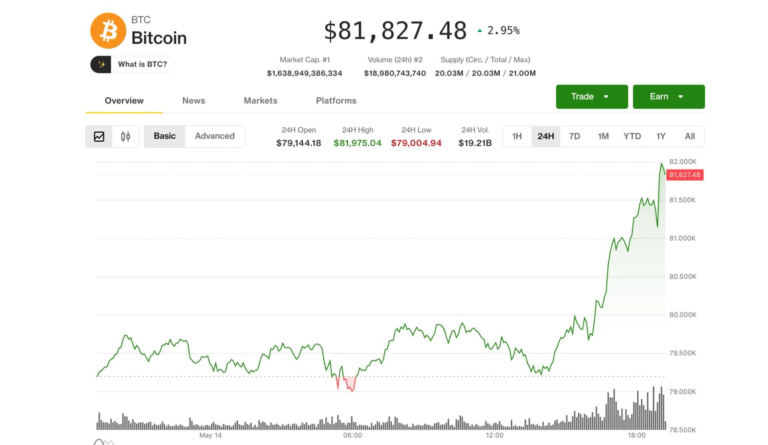
The upbeat public debut of AI chipmaker Cerebras is also helping to lift both crypto and traditional markets.
CFTC Issues No-Action Letter on Prediction Market Data Reporting

The US Commodity Futures Trading Commission’s (CFTC) market and clearing divisions issued no-action relief for fully collateralized event contracts, easing certain swap data reporting and recordkeeping obligations for prediction market operators and clearing organizations.
The divisions said Wednesday that they will not recommend enforcement against designated contract markets (DCMs), derivatives clearing organizations (DCOs), or their participants for failing to comply with specified swap-related recordkeeping requirements or for failing to report covered transactions to swap data repositories.
Event contracts on prediction markets technically qualify as “swaps” as they are based on binary events. However, the letter argued that similar contracts are listed for trade by DCMs and have more similar characteristics to futures and options on futures, hence enabling firms to report certain events contracts directly to the CFTC.
The letter listed 19 platforms, including Polymaket, Kalshi and Gemini Titan. It added that companies seeking to list similar contracts may request a no-action letter from the CFTC.
The CFTC said the no-action letter comes in response to numerous requests from DCMs and DCOs that list and clear event contracts and said it anticipates more similar requests.
The move could reduce compliance complexity for CFTC-regulated prediction market venues, including Kalshi and Polymarket US as the agency continues to defend its jurisdiction against state gambling regulators.
The no-action letter comes as prediction markets sit at the center of a widening federal-state fight over whether sports and other event contracts should be regulated as derivatives by the CFTC or as gambling products by state authorities. The agency filed an amicus brief in the Sixth Circuit Court of Appeals on Tuesday, arguing that Ohio’s actions intrude on federally regulated markets after it ordered Kalshi to halt sports event contracts in the state last year.
Kalshi sued Ohio lawmakers in October 2025, requesting that the federal court stop the Ohio Casino Control Commission and state attorney general from taking action, but the motion was denied in court in March, leading Kalshi to appeal the decision.
CFTC no-action letter on prediction markets. Source: CFTC.gov
CFTC pushes for exclusive jurisdiction over prediction markets
The CFTC has multiple ongoing disputes with state lawmakers over prediction market jurisdiction. It sued five states in a bid to cement its authority over prediction markets, including lawmakers in Wisconsin, New York, Arizona, Connecticut and Illinois.
Earlier in May, the CFTC said it received over 1,500 responses on a rule it proposed in March that would allow it to amend or issue new regulations for event contracts on prediction markets.
The responses were mixed, with some state regulators calling for a stricter crackdown on prediction markets, while others, such as venture capital firm a16z, sided with the CFTC, arguing that state crackdowns on these platforms conflict with federal law and damage market access for ordinary users.
Related: Kalshi, Polymarket face trading halt in Nevada after court rulings
On March 12, the CFTC issued a staff advisory classifying event contracts on prediction markets as a “financial asset class,” Cointelegraph reported.
Earlier in February, CFTC Chair Michael Selig publicly reiterated claims that the CFTC had “exclusive jurisdiction” over prediction markets.
Magazine: Inside a 30,000 phone bot farm stealing crypto airdrops from real users
CLARITY Act Clears Senate Banking Committee With Bipartisan Backing—Next Stop: Full Senate

Trusted Editorial content, reviewed by leading industry experts and seasoned editors. Ad Disclosure
After months of negotiations involving the crypto industry, the banking sector, and lawmakers who had been publicly calling for changes, the long-awaited CLARITY Act has cleared a major step toward becoming law.
The measure advanced with support across party lines in the Senate Banking Committee, winning the last pre–full Senate vote hurdle ahead of the next phase in the legislative process.
15–9 Vote Clears CLARITY Act
The committee vote largely followed party patterns, passing 15–9. Senator Ruben Gallego of Arizona and Senator Angela Alsobrooks of Maryland reportedly joined all Republicans on the panel in supporting the bill.
Chair Tim Scott said the goal is to move the measure forward to provide clearer guidance and standards for the sector. He argued that for a long time the digital economy has been stuck in a regulatory gray zone, leaving developers, entrepreneurs, and investors to deal with confusion and enforcement actions rather than predictable “rules of the road.”
Chair Scott Rejects Democratic Amendments
The hearing also included discussion of amendments offered by Democratic senators aimed at addressing concerns tied to issues such as stablecoin yields and anti–money laundering (AML) measures.
According to CNBC, those amendments were either voted down or rejected by Scott on the grounds that they were not written correctly and could not be offered during the process.
If the CLARITY Act clears the full Senate, it will still face a second major hurdle: approval by the House. The House has already acted before, but it passed a different version of the bill last fall.
That means the legislation could require further reconciliation between the Senate’s final text and the House’s earlier version before it can be sent forward.
Featured image created with OpenArt, chart from TradingView.com
Editorial Process for bitcoinist is centered on delivering thoroughly researched, accurate, and unbiased content. We uphold strict sourcing standards, and each page undergoes diligent review by our team of top technology experts and seasoned editors. This process ensures the integrity, relevance, and value of our content for our readers.
Cerebras shares skyrocket 100% after $5.5B IPO amid AI stock frenzy
The AI infrastructure company began trading Thursday as investors continue pouring capital into artificial intelligence stocks.
Rivian Spinoff Raises $400M for Industrial Robots

Mind Robotics, an industrial robotics startup spun off from EV maker Rivian, has closed its latest funding round with $400 million in funding.
The financing brings total investment in the company to more than $1 billion, following a seed financing of $115 million in late 2025 and a Series A of $500 million in March.
Founded in November 2025, the Palo Alto-based company was set up “to automate industrial and manufacturing tasks at scale,” according to a release.
To that end, Mind said it is building a full-stack platform of foundation models, purpose-built robotics, and deployment infrastructure, using experience from Rivian’s EV factory to give robots more dexterous and adaptive capabilities.
Rivian is both a strategic partner and shareholder in the company.
“We are excited about the technology and product roadmap we are developing at Mind, with a focus on scaled deployments,” RJ Scaringe, Founder of Mind, said in the release.
Mind Robotics’ position in the industrial robotics sector comes at a pivotal moment, as advances in AI drive faster, more advanced applications as companies turn to automation to address labor shortages and productivity requirements.
In its March announcement of the $500 million funding round, Mind said its systems will be designed to perform reasoning-intensive tasks such as assembly, material handling, inspection, and precision manipulation.
“Existing industrial robotics can perform repeatable, dimensionally stable tasks, but a large share of factory value-add work requires human-like dexterity, adaptation, and physical reasoning that classical robotics cannot address,” the release said.
Existing investors included in the round were Andreessen Horowitz, Accel, Eclipse and Bain Capital, among others.
The round was led by Kleiner Perkins, with participation from Meritech Capital, Redpoint Ventures, SV Angel, Incharge Capital, A-Star Capital and Garuda Ventures.