

Wallets holding at least one million ADA now control 25.09 billion tokens, the highest share since July 2020, even as Cardano’s TVL has bled to $137 million from a December 2024 peak of $686 million, per Santiment and DefiLlama data.
Senate Banking Committee Advances Clarity Act In 15-9 Vote
The Senate Banking Committee advanced the Digital Asset Market Clarity Act on a 15–9 vote Thursday, with Sens. Ruben Gallego (D‑Ariz.) and Angela Alsobrooks (D‑Md.) joining all 13 Republicans to move the sweeping crypto market structure bill to the full Senate.
The Clarity Act is the Senate’s bid to build a federal framework for digital asset trading, stablecoins and intermediaries, splitting oversight between the SEC and CFTC and setting registration, disclosure and compliance rules for exchanges, brokers and custodians. It now advances alongside a related bill from the Senate Agriculture Committee, with the two texts expected to merge before a floor vote.
Chair Tim Scott (R‑S.C.) cast the markup as a turning point after years in which crypto firms operated in what he called a “regulatory gray zone” under “outdated rules.”
He said the bill aims to protect consumers, keep innovation in the United States and “close the doors that criminals, terrorists and hostile regimes have tried to exploit,” after months of cross‑party talks that expanded the draft by more than 200 pages.
Sen. Cynthia Lummis (R‑Wyo.), who leads the committee’s digital assets panel, called the Clarity Act “the hardest piece of legislation” she has worked on across decades in state and federal office. She described it as a “case of first impression” that tries to fit new asset types and software into a regulatory code built for earlier markets.
Warren’s camp: “industry‑written” and “not ready”
Ranking Member Elizabeth Warren (D‑Mass.) led the opposition, arguing the committee should focus on groceries, health costs and credit card rates, not “a bill written by the crypto industry for the crypto industry.”
Warren warned that the draft “blows a hole” in securities law that has protected investors since 1929, preempts state anti‑fraud rules and allows banks to load up on volatile crypto exposure in ways she linked to pre‑2008 practices.
She said the bill “declares open season on defrauding American consumers who use crypto,” and accused Republicans of advancing a framework that helps “the President of the United States’ crypto grift.
Sen. Raphael Warnock (D‑Ga.) tied his no vote to ethics concerns, calling President Donald Trump’s digital asset business ties “pure corruption” and faulting Republicans for refusing enforceable conflict‑of‑interest rules for all elected officials, including the president and vice president.
Illicit finance, mixers and stablecoins
National security concerns drove a series of Democratic amendments that Republicans rejected in 11–13 votes. Warren proposed stronger sanction tools against crypto mixers and DeFi services, citing Treasury’s 2022 designation of Tornado Cash and warning that the bill does not isolate mixers in statute.
Sen. John Kennedy (R‑La.) pressed her on why new anti‑money‑laundering sections do not already cover those services, then joined Republicans to defeat the proposal.
Sen. Jack Reed (D‑R.I.) described how Iranian actors use stablecoins to buy drone components, import sensitive goods and collect tolls from tankers in the Strait of Hormuz. He said the Treasury still must “go hat in hand” to issuers such as Tether for voluntary cooperation, and sought explicit power for regulators to block foreign illicit stablecoin flows; his amendment failed on the same party‑line split.
Sen. Chris Van Hollen (D‑Md.) pointed to estimates that more than 150 billion dollars in digital assets flowed through wallets tied to illicit activity last year and highlighted a large North Korean exchange hack where DeFi services helped launder funds.
His proposal to make it unlawful to release a DeFi protocol with the stated purpose of enabling money laundering, sanctions evasion or terror finance also fell in an 11–13 vote, after Republicans argued that existing criminal statutes already reach that conduct.
Republicans, led by Lummis and Sen. Bernie Moreno (R‑Ohio), answered that Titles II and III of the bill already tie digital asset intermediaries into the Bank Secrecy Act, expand Treasury’s “special measures” authority and bring kiosks, brokers and exchanges into clearer federal oversight than the House version.
President Trump, World Liberty and failed ethics amendments
Ethics provisions tied to Trump’s business ties to World Liberty Financial and other crypto ventures produced some of the sharpest exchanges. Van Hollen offered an amendment to bar the president, vice president and members of Congress from business ties to crypto firms and to require more disclosure, saying it was needed because “the president and members of his family” had been involved in “corrupt crypto ventures and various crypto scams.”
Moreno said the measure belonged in the Judiciary Committee because it carried criminal penalties and defended Trump as “a good man,” accusing Van Hollen of declaring criminal conduct without a court record. The amendment failed 11–13.
Warren tried to force banking regulators to release confidential supervisory records related to Jeffrey Epstein, arguing Epstein had backed early crypto investments and that exam files could reveal what banks and supervisors knew as he moved funds through major institutions. Lummis answered that confidential supervisory material is outside a market structure bill’s scope, and that amendment also failed, even after Kennedy said he would have supported it without “co‑conspirator” language.
DeFi safe harbor deal exposes Democratic split
One of the most consequential votes came on Lummis Amendment 122, a technical package negotiated with Sen. Mark Warner (D‑Va.) that refines when a DeFi protocol counts as controlled by a small group and interacts with the bill’s core safe harbors.
Warren argued the amendment embeds “a narrow test” for which entities count as crypto intermediaries and imports a Section 604 “loophole” that shields decentralized services from basic anti‑money‑laundering rules, saying that “it doesn’t matter if you have rules if nobody has to follow them.”
After a short technical fix to strike two lines, the committee adopted the amendment 18–6, with Warner, Cortez Masto and Alsobrooks joining Republicans. That vote marked a clear split: Warren, Reed and Van Hollen opposed the compromise, while a “crypto Democrat” bloc accepted the DeFi framework as a basis to refine before floor action.
Process fight over which amendments get heard
The markup also turned into a test of Scott’s control over the amendment list. Before the hearing, he ruled more than a dozen proposals out of order on drafting and filing grounds, including a National Sheriffs Association‑backed fix from Sen. Catherine Cortez Masto (D‑Nev.) on decentralized platform enforcement and a community‑bank‑supported stablecoin‑yield tweak from Reed and Sen. Tina Smith (D‑Minn.).
Later, seeking a bipartisan outcome, Scott reinstated several amendments, including Lummis 122, after Democrats such as Warner and Gallego said committee votes on those compromises would make support easier. Warren objected that he was reviving a subset of Republican‑side language while leaving law enforcement and community‑bank proposals sidelined.
Van Hollen noted that some of his own properly drafted amendments never reached a vote, even as previously disqualified Lummis text passed 18–6.
Scott replied that he and Warren had agreed to cap amendments from each side, and that within that cap he was using discretion to serve Democrats who wanted a bipartisan result.
Gallego and Alsobrooks give Clarity Act its bipartisan spine
Through the day, Republicans accepted targeted changes that industry and moderates backed, including Sen. Mike Rounds’ AI sandbox and Sen. Dave McCormick’s portfolio‑margin language, both adopted with Democratic support. They rejected every Democratic attempt to extend sanctions tools, bar bailouts, tighten DeFi liability or write ethics rules into the bill.
By the final vote, the Democratic side had split into clear camps. Warren, Warnock, Van Hollen, Smith and Reed built a record that presents Clarity as an industry‑driven framework that weakens enforcement and leaves presidential conflicts untouched. Warner helped shape key language but kept leverage for later stages.
Gallego and Alsobrooks supplied the decisive Democratic votes that turned a partisan project into a 15–9 bipartisan committee win, while both signaled that support on the floor will depend on further movement on ethics and enforcement as the bill heads toward merger with the Agriculture Committee’s version and a 60‑vote test before the full Senate.
XRP, DOGE surge 5%, bitcoin above $81,000 as CLARITY Act clears Senate banking panel

Crypto majors bid higher Friday after the Digital Asset Market Clarity Act cleared the Senate Banking Committee in a 15-9 bipartisan vote, with XRP and dogecoin leading the cohort even as broader risk assets sold off on Trump’s comments that the US does not need to reopen the Strait of Hormuz.
Accenture Federal Services and OpenAI partner to accelerate secure AI adoption across the Federal Government

Accenture Federal Services and OpenAI today announced a strategic collaboration to help U.S. federal agencies rapidly adopt, migrate, and scale advanced AI. As a key OpenAI Partner, Accenture Federal will help clients move from experimentation to production-ready, mission-grade deployment in weeks, not years.
Building on Accenture’s collaboration with OpenAI to accelerate enterprise reinvention through agentic AI, this federal-focused initiative brings OpenAI’s industry leading models and research together with Accenture Federal’s deep mission expertise, cleared engineering talent, and security first delivery capabilities—giving agencies a trusted path to operationalize AI across federal environments.
The collaboration further expands federal access to OpenAI technologies through federal-ready implementation patterns, governance frameworks, and delivery assets designed for the realities of government data, compliance, and operations—enabling agencies to modernize legacy systems, migrate AI workloads faster, and embed intelligence across core mission workflows.
“As AI continues to grow and dominate as a core infrastructure for government, agencies can no longer afford slow, siloed adoption,” said Ron Ash, CEO of Accenture Federal Services. “OpenAI gives federal leaders the ability to accelerate AI to mission scale from pilots to production at speed. When paired with Accenture Federal’s ability to operate in the most secure, complex environments, this collaboration helps agencies modernize faster, serve citizens better, and strengthen the systems the nation relies on — all with humans firmly in the lead.”
Accelerating AI from Proof-of-Concept to Mission Scale
Accenture Federal Services will serve as an OpenAI Implementation Partner for the U.S. federal market, helping agencies design, deploy, and govern AI platforms that can scale across missions, systems, and agencies.
The collaboration focuses on accelerating AI migration and adoption across the full lifecycle, including:
- Accenture Federal + OpenAI Agentic Lab at The Forge®
Located at Accenture Federal’s hands-on reinvention center, The Forge®, the Simulated Government Agency Agentic Lab enables agencies to design, test, and validate agentic workflows and human in the loop solutions in hours, not months—demonstrating the value and ROI of AI deployment. - OpenAI Trained Federal Solution Architects
Accenture Federal has established a dedicated group of OpenAI-trained AI Solution architects and forward deployed engineers to help agencies move rapidly from proof of concept to production, delivering proven reference architectures, integration blueprints, controlling aligned designs that enable faster AI migration and adoption across legacy and modern environments. - FedRAMP-Ready Adoption Pathways for OpenAI Codex across impact levels
Accenture Federal will support FedRAMP aligned implementation pathways across all FedRAMP and IL6+ certification levels for OpenAI Codex capabilities by leveraging authorized cloud foundations and security first integration patterns — helping agencies deploy advanced AI capabilities within high impact, regulated environments without slowing innovation. These initiatives are advancedby OpenAI’s FedRAMP 20x Moderate authorization for ChatGPT Enterprise and the OpenAI API Platform. - Accenture Federal Professionals Empowered with Access to the latest OpenAI Models
Accenture Federal will enable all 15,000 professionals with secure, governed access to OpenAI’s latest models — paired with training, role-based access controls, and continuous oversight — ensuring agencies benefit from battletested expertise at enterprise scale. - Codex Powered Development in a secure enterprise environment
Accenture Federal Services and OpenAI will enable over 3000 AFS practitioners with the latest Codex models, inside of Accenture Federal’s enterprise environments to power lifecycle development. - ChatGPT Enterprise Powered Delivery
Accenture Federal will provide Enterprise ChatGPT to 1500 practitioners to enable enhanced productivity for government client delivery and the Accenture Federal’s enterprise.
Setting a New Standard for Federal AI Delivery
“Together, Accenture Federal Services and OpenAI are redefining how advanced AI is delivered across government—pairing the capabilities of frontier AI with the trust, security, and accountability federal missions demand,” said Joe Larson, OpenAI’s VP for Government. “This collaboration gives agencies a faster, safer path to turn AI into real operational impact.”
By combining OpenAI’s rapidly advancing agentic capabilities with Accenture Federal’s proven ability to deliver at mission scale, the collaboration helps agencies migrate AI platforms faster, integrate intelligence across operations, and move beyond pilots to production ready systems — without compromising security or governance.
From modernizing citizen services and strengthening cyber defenses to improving supply chain resilience and operational readiness, Accenture Federal Services and OpenAI are focused on one outcome: helping federal leaders turn AI into measurable results for the missions they serve — and for the nation they protect.
Bukele’s Futuristic BINAES Library Blends Books, Bitcoin, And Family Play In Revitalized Capital

Located in the heart of the country’s capital, El Salvador’s BINAES library stands tall as a monument to the love of knowledge, literature, and technology—accessible to the public 24 hours a day, for free. Positioned directly in front of and carefully aligned with the Catedral Metropolitana de San Salvador, BINAES is also surrounded by the Palacio Nacional de El Salvador (to its left/side) and the Jardín Centroamérica, all symbols and reminders of a dream. The dream of a society that elevates beauty, the love of knowledge and faith, and shares them with the world.
Having traveled to many countries and cities in my lifetime, I have to say that the safety, tranquility and cleanliness of this area of San Salvador was remarkable. An unignorable contrast to the city squares of many western capitals, often unsafe, filled with garbage, and host to the homeless and drug addicted. Instead, both outside the library, in the gardens and walkable roads of the city square, as well as inside the library, palace and gardens, children and their families can be seen at peace, running around, enjoying this national treasure.

Donated to El Salvador by the Chinese government, BINAES is 7 stories tall with a wide range of amenities, including a cafeteria on the first floor and an Italian restaurant on the 7th. Plenty of room to host events of various sizes, public and private. BINAES stands out with an elegant futurist design, congruent with its facilities and a vision for the future of El Salvador, which also prominently features Bitcoin technology and educational materials.
With a strong focus on supporting families and the next generation, the second floor is a young children’s playground filled with educational tools, books and physical entertainment options for children to unleash their energy. The third floor has a large section dedicated to LEGOs, a powerful educational tool known to stimulate a love of building in children, with multiple tables where parents sit with their kids and play. It also hosts children’s video games, such as collaborative and family-friendly games like Mario Party and the legendary Minecraft.
The fourth floor is aimed at children 8-12 as well as fans of fantasy and fiction, with dedicated Star Wars, Lord of the Rings, and Harry Potter areas, as well as hundreds of manga books featuring some of the greatest stories of the Japanese genre. Many of these areas include collection grade legos and merchandise from the films, as well as, of course, full libraries of books for each fictional universe.
The fifth floor is home to literature, history and books for adults, considered the core of the library, with thousands of books on all major genres of knowledge. Among them, a vast section on social sciences, which includes economics, hosting some samples of libertarian Austrian economists like Mises, Milton Friedman, Rothbard, and Ayn Rand, though not too deep a variety.
This specific topic, which is very important to the history, economic theory of Bitcoin and its cultural roots, is one that the library got some criticism for years ago when it was first completed. Back then, a popular tweet claimed the library had no works on libertarian economic theory, something which today has changed, but could improve further. Their collection, for example, had no fictional work by Rand, only a couple of her philosophy books; this is something that can actually be changed easily enough, though, as the library does accept book donations. Donors can contribute by first emailing BINAES staff at consultalealbibliotecario@cultura.gob.sv.
The sixth floor is the high-tech area. Coming out of the elevators, the first thing you see is a Bitcoin-shaped bookshelf with a solid collection of Bitcoin literature, covering its economics, software architecture and history of money, among many other topics. This specific installation is a project by Alejandra Guajardo, also known as Miss Bitcoin, the Salvadorian model who represented the nation in the Miss Universe pageant of 2022. Her Bitcoin Book Shelf initiative looks to deploy installations of this sort in libraries all over the world, with an expansion to Mexico in the works. Bitcoiners who want to lead the installation of Bitcoin bookshelves in their local libraries can contact her to make it happen.

In the center of the same floor is a beautiful Bitcoin lounge area, with another similarly shaped bookshelf and various Bitcoin plushies called Little Hodlers led by artist and Bitcoin evangelist Lina Seiche. A massive screen shows Mempool.space, a slick and very popular Bitcoin block explorer, showing live network data and statistics.
This floor is also home to 3D printers, tools for robotics work, interactive digital screen-style whiteboards, a full gaming area with top-of-the-line gaming consoles, a virtual reality area, computers available to the public for research, and a digital collection of over 9 million books accessible to the public. As well as various dedicated office-like environments for students and teams to take advantage of and get some work done.
Last but not least is the seventh floor, home to the art gallery, which at the time of my visit was hosting a variety of art pieces, showing the history of El Salvador through the architecture of iconic locations in the area. In the center of this art hall, between the gallery and the Basílico Italian Bistro, are photographs of Bukele and first lady Gabriela Bukele, perfectly aligned with the Metropolitan Cathedral across the square, a beautiful architectural detail that reinforces a harmonic union between the classic arts and faith.
Overall, despite the high-tech Chinese design of the library, which somewhat contrasts against the classical Roman architecture of the area, the BINAES library is likely to stand as a visionary legacy of the self-described Philosopher King and his administration.
Analyst Says XRP Path To $100 Is Not Straightforward, These Things Will Happen First

Trusted Editorial content, reviewed by leading industry experts and seasoned editors. Ad Disclosure
XRP’s $100 price target is one of the most recurrent projections in the crypto market, but EGRAG CRYPTO’s macro analysis is not built around instant gratification.
The analyst is instead looking at the stages that may come before any move into triple digits, arguing that the altcoin still has to pass through a difficult sequence of corrections and lower target zones before the larger price target. Technical analysis of the 2-month candlestick chart places XRP inside a long-term compression structure, with the current price still 530% below the first major target zone of $9.
The Macro Chart Most Traders Are Misreading
Many enthusiasts are projecting a straightforward XRP repricing that sees the cryptocurrency trading above double and triple digits. However, according to popular analyst EGRAG CRYPTO, most traders still don’t understand a few things about XRP macro charts.
EGRAG CRYPTO’s chart is built around XRP’s 2-month timeframe, which gives a much broader view of the asset’s price structure than the daily or weekly chart. The setup shows the token pressing inside a large ascending triangle-like formation, with price action still sitting far below the upper projected targets.
The analyst’s main argument is that traders may be giving too much importance to the 7-week moving average and the 11 EMA cross, even though these indicators are lagging in nature.
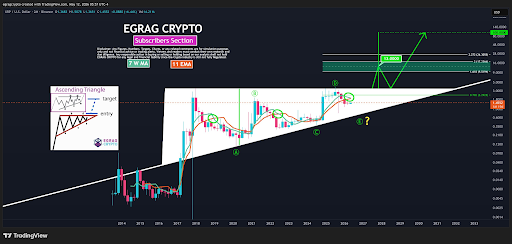
According to the analyst, price leads and indicators follow. That means moving average crosses should not be treated as a standalone confirmation that XRP is already entering a parabolic phase. The weekly chart shared by the analyst shows the altcoin currently trading around the lower end of the larger macro structure, close to the area where the 7W MA and 11 EMA are moving close together.
The chart’s most important visual feature is the broad white triangular pattern that has contained XRP’s macro movement since 2017. The analyst projected a possible “E” phase, implying that the price may still undergo more uncomfortable crashes before the next breakout rally.
A $100 Move Across Multiple Cycles
The $100 price target circulating in the XRP community is not a myth EGRAG CRYPTO dismisses outright, but the analyst’s timeline and roadmap are different from popular expectations. The first clarification is that $100 is not the full measured move from the current triangle pattern, and it is not a target for the present cycle.
The more immediate focus is on a green box in the chart above, which encompasses Fibonacci target zones sitting between $9 and $17. The first price target is around the 1.618 Fib extension at $9.51, followed by the 2.0 Fib extension around $17.23, and then the 2.272 extension around $26.30. These, according to the analysis, are more realistic XRP price targets to keep an eye on first.
XRP may need to first reclaim the macrostructure, clear the green-box zone, and then move into the extended Fib region above $26 before the structure can even begin to price in a future path to $100. Furthermore, these parabolic expansions are expected to come alongside painful retracements and emotional shakeouts, not through a straightforward path.
Featured image from Freepik, chart from Tradingview.com

Editorial Process for bitcoinist is centered on delivering thoroughly researched, accurate, and unbiased content. We uphold strict sourcing standards, and each page undergoes diligent review by our team of top technology experts and seasoned editors. This process ensures the integrity, relevance, and value of our content for our readers.
Farage Faces UK Standards Probe over $7M Gift from Crypto Billionaire

Reform UK leader Nigel Farage is reportedly facing a parliamentary standards inquiry over whether he failed to declare a 5 million pound ($6.7 million) gift from crypto billionaire Christopher Harborne.
The UK Parliamentary Standards Commissioner has opened an inquiry into whether Farage breached House of Commons rules by not registering the payment, the BBC reported Wednesday.
Farage said he was under “no obligation” to declare the gift from the Reform party backer, which he received before he was elected to the Commons in 2024. Critics argue he should have registered the payment after becoming a member of parliament.
The Conservatives wrote to the parliamentary standards watchdog asking it to investigate the matter, according to the BBC. The Conservatives also raised the issue with the Electoral Commission, which is reportedly deciding whether to launch a formal investigation into the donation.
The inquiry adds to scrutiny of Farage’s financial ties to crypto-linked backers and businesses, as UK lawmakers and regulators pay closer attention to the role of digital asset money in politics.
The development comes a month after the UK Liberal Democrats called on the Financial Conduct Authority to investigate whether Farage breached market rules by appearing in a promotional video for Stack BTC while holding a financial stake in the company.
Farage previously disclosed a $286,000 equity investment in the company after acquiring a 6.31% stake through his media vehicle Thorn In The Side in March.
Related: Revolut among 4 companies chosen to test stablecoins in UK sandbox
UK lawmakers mull halt to political crypto donations
Cryptocurrency donations to political parties have come under growing scrutiny in the UK.
Farage’s Reform UK was the first party to start accepting crypto donations in 2025. Reform recently disclosed a $4 million donation from Harborne in the fourth quarter of 2025, after receiving a record $12 million gift in the previous quarter.
Political cryptocurrency donations are currently legal in the UK, subject to permissible rules under the Electoral Commission guidance. However, some parliamentary committees have called for a halt.
On March 18, the Joint Committee on the National Security Strategy urged the UK government to impose an immediate moratorium on crypto donations to political parties until the Electoral Commission produces statutory guidance ahead of the next general election, which is due to take place by August 2029.
The committee also called for the creation of a Political Finance Enforcement Unit and for reducing the minimum declaration threshold of political donations from $14,900 to $668. It cited growing foreign-state threats and efforts to influence the UK’s positions on critical issues, including its relations with the US, the European Union and Ukraine.
Three weeks earlier, Matt Western, chair of the committee, urged the government to put a temporary halt on crypto donations to political parties, citing foreign interference risks, Cointelegraph reported on Feb. 26.
Magazine: Clarity Act risks repeat of Europe’s mistakes, crypto lawyer warns
BlackRock, Janus Henderson tokenized funds get instant redemptions with new $1 billion facility

A new credit facility by Grove aims to allow instant redemptions into stablecoins from BlackRock’s BUIDL and Janus Henderson’s money market funds, reducing settlement time from days to instantaneous.
Kraken Migrates to Chainlink CCIP for Wrapped Bitcoin and Future Wrapped Assets

Kraken is deprecating its existing cross-chain infrastructure and moving exclusively to Chainlink CCIP to secure Kraken Wrapped Bitcoin (kBTC) and all future wrapped assets.
Kraken announced it is deprecating its existing cross-chain provider and migrating to Chainlink CCIP as its exclusive cross-chain infrastructure for Kraken Wrapped Bitcoin (kBTC) and all future Kraken Wrapped Assets. The migration leverages Chainlink’s enterprise-grade infrastructure, which includes ISO 27001 and SOC 2 Type 2 certifications, secure-by-default architecture, 16 independent nodes, and native rate limits.
No action is required from kBTC customers during the migration. Kraken said additional details on the migration process will follow through official Kraken channels.
The partnership aims to accelerate global crypto adoption by unlocking utility and distribution for Kraken Wrapped Assets across decentralized finance. Chainlink CCIP (Cross-Chain Interoperability Protocol) provides cross-chain messaging and token transfers with security oversight designed to meet institutional standards.
Sources: Kraken
This article was produced with the help of AI flows.
The Velocity of Risk and the Explosion of APAC Payment Methods

At the Money20/20 Asia event in Bangkok, the primary challenge identified in the financial landscape was the incredible velocity of transactions coupled with a massive explosion in the diversity of payment solutions. Matt Delauro, President at SEON, noted that while the proliferation of new payment methods in the APAC region has provided more options for consumers, it has significantly complicated the environment for merchants and payment providers. This complexity has inadvertently created gaps that make it easier for fraudsters and financial criminals to operate across different platforms. SEON is helping clients respond to this shift by providing tools that can keep pace with this transaction velocity while securing a fragmented payment landscape.
By addressing these vulnerabilities, SEON allows institutions to regain control over their risk management without slowing down the customer experience. As new payment rails continue to emerge across the region, the ability to identify suspicious patterns in real-time becomes critical. SEON’s approach focuses on simplifying the oversight of these diverse methods, ensuring that the convenience of modern payments does not come at the cost of institutional security or regulatory compliance.
For banks and fintechs adopting these solutions over the next 12 months, the results center on significant cost savings and proactive threat detection. Clients can expect to see a substantial reduction in their overall KYC (Know Your Customer) costs as automated systems streamline the verification process. Furthermore, the technology enables the early discovery of bad actors, identifying them as soon as they make initial contact with the institution. This early-cycle detection prevents criminals from progressing deeper into the financial system, allowing banks and fintechs to operate with greater confidence and efficiency in a high-velocity market.
Key Highlights from Matt Delauro:
-
Transaction Velocity: Delauro highlights the rapid speed of transactions in APAC as a defining characteristic of the current financial year.
-
Payment Diversity: The explosion of new payment methods is creating both opportunities for consumers and significant complexities for merchants.
-
The Fraud Gap: How the diversity of payment solutions has made it easier for financial criminals to exploit system vulnerabilities.
-
KYC Cost Reduction: Banks and fintechs can expect a major decrease in the costs associated with identity verification and compliance.
-
Early Actor Discovery: A look at how SEON identifies bad actors at the point of first contact, preventing fraud before it scales.