Home Blog Page 292

Addepar Introduces ADX, Enabling Data Activation and AI at Scale

0

Addepar, a global data and AI platform for investment professionals, today announced the launch of Addepar Data Exchange (ADX), a managed data environment within the Addepar platform that enables firms to unify, govern and activate their data to power investment workflows, analytics and AI at scale.   

ADX enables firms to securely ingest and synchronize investment data across complex, multi-system environments, bringing information from across the ecosystem into a consistent, permissioned layer. This capability allows firms to operate from a shared source of truth while integrating seamlessly with existing applications and infrastructure. 

ADX builds on Addepar’s multi-year investment in re-architecting its data infrastructure to support scale, performance and AI-driven workflows across more than $9 trillion in assets on its platform. Using Databricks, this foundation powers Addepar internally and is now being extended to clients through ADX, accelerating time to value without the need to build and maintain complex data infrastructure independently. 

With ADX, firms can move beyond fragmented workflows and activate data holistically across the organization. Previously siloed information is structured as a connected, dynamic asset that supports more advanced applications—such as proposal generation, reconciliation, asset allocation modeling and market data integrations. Most importantly, it provides the high-quality foundation required for AI to operate effectively across the business. 

“Our clients’ success depends on their ability to transform data into a clear strategic advantage across their business,” said Bob Pisani, CTO of Addepar. “ADX is a cornerstone of that vision, extending the foundation we’ve built at Addepar so AI can be deeply embedded across the organization and drive operational leverage.”

As part of the Addepar platform, ADX expands what’s possible with Addison, Addepar’s native AI experience. With access to a broader, unified dataset, Addison can provide more context-rich, traceable outputs grounded in a complete view of the business. It also enables firms to extend Addison with their own analytical models and logic, supporting tailored, agentic workflows.  

With ADX, Addepar delivers a purpose-built, vertically integrated data and AI environment designed for the complexity of financial workflows, extending how data is unified, governed and activated across the enterprise. As firms look to operationalize AI, the ability to bring data together in a consistent, connected foundation will increasingly define how they operate and compete.

Coinbase (COIN) bounces 10%, Solana, LINK, SUI outperform as bitcoin (BTC) holds $80K

0

With bitcoin holding above $80,000 and stocks pushing to fresh record highs, risk appetite spilled deeper into crypto markets Friday, lifting altcoins and blockchain infrastructure plays.

Solana (SOL), Chainlink , and rose around 5%, while Near Protocol (NEAR) and Uniswap (UNI) gained roughly 7%. Internet Computer Protocol’s ICP jumped nearly 12%, leading majors higher.

The move came alongside another strong session for equities. The tech-heavy Nasdaq climbed 2.2% to fresh record highs, while the S&P 500 added 0.85%, also closing at an all-time high.

Friday’s U.S. labor market data added to the constructive backdrop. The economy added 115,000 jobs in April, comfortably above expectations for 62,000, while the unemployment rate held steady at 4.3%.

Crypto-linked equities also rebounded, led by Coinbase (COIN). Shares of the crypto exchange recovered 10% from session lows after Thursday’s earnings report showed a $398 million quarterly loss with softer trading activity. The firm’s trading platform also suffered early Friday a several hours long outage due to an AWS failure that was fully resolved later.

Despite the weak quarter, several Wall Street analysts focused on longer-term tailwinds tied to stablecoins and crypto regulation.

That narrative gained momentum after SEC Chair Paul Atkins said Friday that the agency is weighing new rulemaking around onchain trading systems, crypto custody infrastructure and blockchain-based settlement rails as finance increasingly converges with AI and distributed ledger technology.

Atkins also reiterated support for congressional efforts to advance crypto market structure legislation, comments investors viewed as supportive for tokenization and blockchain-based financial infrastructure.

The theme drove gains in related equities. Bullish (BLSH), CoinDesk’s parent company, that this week announced a deeper push into tokenization, rose 6%. Digital asset infrastructure firm BitGo (BTGO) surged 10%, while Cantor Equity Partners II (CEPT), which plans to merge with BlackRock-backed tokenization firm Securitize, gained 4.3%.

What Does Bitcoin “Power Projection” Mean To The U.S. Military?

0

On April 21st and 22nd 2026, during a Senate Armed Services Committee, Admiral Samuel Paparo of U.S. Indo-Pacific Command made comments on Bitcoin’s utility in cybersecurity for the country’s military, calling it a “valuable computer science tool as power projection,” and disclosing that INCOPACOM is running a Bitcoin node in their experiments with the protocol.  

The comments by the INCOPACOM Commander came just days after the Islamic Republic of Iran demanded payment in Bitcoin for safe passage across the Strait of Hormuz. The mention of “power projection” echoed the work of a famous and controversial Bitcoiner, Jason Lowery, author of Softwar: A Novel Theory on Power Projection, MIT Fellow and Special Assistant to the Commander of INDOPACOM. 

In his work — which involved an MIT thesis and book expanding on his work — Lowery discussed the cybersecurity value of Bitcoin and its unique ability to deliver “power projection” in cyberspace, a landscape of national security and military operations that otherwise lacks traditional deterrence options. 

The book gained significant popularity and earned Lowery both fans and critics across the Bitcoin industry, but was later taken down from distribution by Lowery at the request of his superiors. An event that suggested to some that the book might have something important enough that the U.S. military wants to keep it quiet. 

But what is this unique value that Bitcoin brings to military matters, and what does “Power Projection” in this context actually mean? 

According to Department of Defense’s 2002 Dictionary of Military and Associated Terms, power projection is; “The ability of a nation to apply all or some of its elements of national power – political, economic, informational, or military – to rapidly and effectively deploy and sustain forces in and from multiple dispersed locations to respond to crises, to contribute to deterrence, and to enhance regional stability.” In other words, the ability of a nation to influence the behavior of other nations or political entities of interest, at a range beyond its national borders. Examples can range from diplomatic to economic influence, as well as military capabilities such as long-range missiles, drones or a powerful navy. 

The word deterrence is also doing a lot of work here. The DoD defines it as: “The prevention from action by fear of the consequences. Deterrence is a state of mind brought about by the existence of a credible threat of unacceptable counteraction.”

Lowery brings Bitcoin into the world of deterrence in the physical world by presenting a particularly interesting insight. That just as microchips are essentially wires moving electric power in “encoded logic” inside a computer’s motherboard, so can the globe’s electric grid be seen as a kind of “macrochip”, with giant wires moving large amounts of electricity from power sources across nations and throughout the world. These macrochips now also have logic gates in the form of Bitcoin mines — Lowery argues — they consume large quantities of energy, converting it into the scarce digital asset, which can be programmed via Bitcoin script. 

The Bitcoin macrochip could, in theory, bind cybersecurity matters to the physical world, since energy output is one of the most important and expensive resources a nation can muster. While governments can print paper money at will, summoning massive amounts of electricity to influence something like Bitcoin’s proof of work competition is orders of magnitude more difficult and is the basis of Bitcoin’s resilience.

Bitcoin’s Multisignature Deterrence

The most obvious and powerful demonstration of Bitcoin’s “embedded logic” security is the invention of multisignature Bitcoin wallets, which safeguard much of the Bitcoin wealth today. 

Multisignature wallets require multiple predefined private keys to sign valid transactions before Bitcoin can be transferred, making it possible to geographically decentralize the storage of Bitcoin private keys across space and jurisdictions. 

Multisig challenges hackers not just to hack one key pair, but multiple, across multiple locations under time constraints, since users have the advantage of legitimate access to those keys and can potentially move the bitcoin quickly in response to a threat. Hackers must gain access to enough keys while also fooling alarms and safeguards, avoiding getting caught. Multisig imposes high costs on attackers and, as such, might very well fit the definition of ‘deterrence’. It may even fit the definition of ‘power projection’ as Bitcoin funds can be kept secure and available to be sent when needed anywhere in the world, thanks to Bitcoin’s other networking-based censorship resistance qualities. 

This differs from traditional finance and its centralized databases since Banks can freeze and confiscate assets from their rightful owners when pressured politically, as seen in cases like that of Cyprus and their 40% bail in, or the United States’ confiscation of Russia’s foreign treasury reserves held in European custody.

But INDOPACOM did not explicitly talk about Bitcoin, the asset, in their comments; they seemed to think Bitcoin’s proof of work protocol could secure data and networks external to the Bitcoin asset. But the Bitcoin script, the logic internal to the Bitcoin blockchain, only governs BTC, its internal asset. 

For external networks to benefit from Bitcoin’s powerful proof of work macrochip, they would have to be anchored to Bitcoin somehow, and that’s where much of Lowery’s thesis starts to stall out. He does, however, develop this idea further by proposing the “Electro-Cyber Dome”.

Cyber Security Threats and the Electro-Cyber Dome

In Software 2.5, Lowery argues that “software system security vulnerabilities are derived from insufficient constraints on control signals” sent to networked machines. An example of this might be fake login attempts that cost a website more computer resources to authenticate than they cost attackers to send. Lowery adds that such vulnerabilities “can be exploited in such a way that it puts software into insecure or hazardous states.” Examples of such network security exploits include, but are not limited to:

  • Email spam and comment spam — superfluous emails and comments that flood inboxes or forums.
  • Sybil attacks — creation of large numbers of fake identities to manipulate systems.
  • Bots and troll farms — automated or coordinated accounts used to amplify malicious activity.
  • Weaponized misinformation/disinformation campaigns — flooding networks with false or manipulated information.
  • Distributed Denial-of-Service (DDoS) attacks — flooding networks with superfluous control signals (service requests) to overwhelm bandwidth.
  • Forged or replayed control signals — impersonating legitimate commands, orders, or data that put software into insecure/hazardous states.
  • Systemic exploitation of administrative permissions/insider abuse — exploitation of trust-based hierarchies where high-privilege accounts can be compromised or misused.

Lowery suggests that other networks could defend themselves against all of these threats to some significant degree using proof of work (POW) protocols like Bitcoin’s.

In the Bitcoin white paper, Satoshi Nakamoto defined Bitcoin’s POW quite elegantly: “The proof-of-work involves scanning for a value that when hashed, such as with SHA-256, the hash begins with a number of zero bits. The average work required is exponential in the number of zero bits required and can be verified by executing a single hash.”

Nakamoto specifically references Adam Back’s “Hash Cash, A Denial of Service Counter-Measure”, which was designed to make email spam costly by requiring computers sending an email to produce a POW stamp of a difficulty defined by the recipient of the email. Recipient servers would need to keep a list of stamps already used, in order to prevent reuse of the same work by attackers, aka to prevent “double-spending” attacks. These stamps, however, were not transferable, a quality which some cypherpunks wanted in their pursuit of digital money. Hal Finney was one such engineer who furthered the field by inventing RPOW, or reusable proof of work.

RPOW essentially tokenized POW stamps via a centralized server that kept track and facilitated transfers. One of Nakamoto’s key innovations was decentralizing this server and its list of spent stamps, in the form of the blockchain, while also defining a global difficulty algorithm that all Bitcoin miners must satisfy, rather than relative difficulty targets chosen by each website at will. 

Lowery, in his concept of the Electro-Cyber Dome, is essentially talking about Hash Cash. He specifically says that servers can choose the difficulty target they see fit, and never proposes that the Dome would or should use Bitcoin’s SHA-256 protocol, though it is implied in his idea of the macrochip. What he does do is use Bitcoin as the principal example of such a cybersecurity network actually working at scale; “We know for sure that electro-cyber domes can function successfully as a security protocol because this is what Bitcoin uses to secure itself and its own bits of information against systemic exploitation.”

Lowery goes further than defense, pointing out that as such systems gain adoption, a concept of aggression becomes possible by large miners, he writes; “it should be noted that this wouldn’t be a strictly “defensive” power projection capability…People with access to proof-of-power can theoretically “smash” through these electro-cyber dome defenses if desired. Thus, proof-of-power protocols are not strictly “defense only” protocols as some have argued. A top threat to people using physical cost function protocols like Bitcoin is other people using the same protocol (hence why Nakamoto mentions the word “attack” 25 times in an 8-page whitepaper, each time referring to people running the same protocol).”

Criticisms of Lowery’s Softwar Thesis 

Lowery’s Softwar thesis can be fairly described as controversial within the Bitcoin community. It’s optimistic take that large portions of military conflict could instead be settled via hash rate wars in some future has been described by Shinobi at Bicoin Magazine as “delusional”. 

Broadly speaking, critics reject the idea that data or networks external to Bitcoin can be secured in any way with Bitcoin’s technology stack, be it its POW, its blockchain or its native asset. Jameson Lopp did a multi-part review of Lowery’s thesis and book, praising many aspects of the thesis but ultimately dismissing its conclusions, saying that: “Softwar falls short on acting as a blueprint for how we should build the future.”

The most obvious question to me is whether using SHA-256 proof of work to gatekeep access to networks outside of Bitcoin makes sense in the first place, or if it could even be considered using Bitcoin. If the Electro-Cyber Dome is not demanding a high enough POW difficulty to mine any Bitcoin, if it does not use Bitcoin’s target difficulty, its asset or its blockchain, then is it using Bitcoin? 

Furthermore, given that China has the bulk of the ASIC manufacturing industry for Bitcoin mining, would INDOPACOM — the U.S. military branch in charge of keeping the Indo Pacific in check — really want to secure its cyber networks with algorithms that China mass produces chips to brute force? That seems like an awkward decision to make at best, and is more likely to lead them to consider alternative POW algorithms. But at that point, they certainly would not be using Bitcoin and would lose the macrochip argument. It would instead be using classic Hash Cash, and maybe that’s the lesson in this story. Lowery’s affinity with Bitcoin might be more of a marketing strategy and a shout-out to an industry that inspired him, rather than the actual tool that INDOPACOM might end up using.  

The Happy Middle Ground

In the gap between theory, implementation, and criticisms of Software style ideas, there exist some projects that serve as young but curious examples of how Bitcoin can secure more than money. 

SimpleProof, an Open Time Stamps-based Bitcoin notary of sorts, has been using the blockchain to record hashes of data, demonstrating that a certain version existed at a certain time. This very narrow use of Bitcoin as a time-stamping server helped defend one side of the Guatemala elections a few years ago from accusations of fraud by the opposition, resulting in real political consequences for the country. 

Michael Saylor, on the other hand, led the creation of what some have called the Orange Checkmark protocol on top of Bitcoin. This tech stack, which can be found on Github, is a privacy preserving Bitcoin native decentralized digital identity system. It gained some interest from the Bitcoin community when it was announced a couple of years ago, but it does not appear to have gained any adoption. 

Finally and ironically enough, Jameson Lopp, perhaps Lowery’s most verbose critic with three dedicated articles on the topic, actually implemented a proof-of-work-based spam protection mechanism on his website for a submission form, which, according to Lopp, works well. So if even he can see the use of these old ideas, even if just based on Hash Cash, then perhaps we will one day see Bitcoin-like technologies used to secure the networks and data of the world. 

MegaETH Kicks Off MEGA Buybacks

0

Future repurchases will follow a preset schedule and be routed through on-chain markets.

The MegaETH Foundation completed its first MEGA buyback on May 7, deploying all net rewards accrued from the network’s USDm stablecoin issuer through the end of April.

The circulating supply of USDm, the MegaETH-native stablecoin built in partnership with Ethena, currently stands at $480 million, the foundation said. The sharp climb from roughly $63 million in USDm in circulation at the time of MEGA’s token generation event on April 30 reflects a wave of post-TGE capital inflows into Layer 2’s DeFi ecosystem.

The foundation said future MEGA buybacks would be programmatic, with no discretionary calls on timing or sizing. However, the size of the initial buyback and the average price paid were not disclosed, sparking some backlash from the community.

Repurchases will also shift to onchain markets once operational infrastructure is in place, with the foundation signalling its intent to route flows through MegaETH’s own DeFi protocols rather than centralized venues.

The buyback mechanism is central to the economic design that MegaETH unveiled ahead of its TGE, which ties MEGA’s value capture to USDm adoption rather than transaction fees. Yield generated by USDm reserve assets flows to the foundation, which uses the proceeds to acquire MEGA on the open market.

The foundation also noted that buyback amounts will fluctuate because USDm supply tracks user demand, and the reward share is sensitive to prevailing returns on the underlying reserve assets.

MegaETH’s mainnet went live on Feb. 9 with Aave deployed from day one, and the network has seen a steep rise in deposits since the MEGA launch, led by USDm-related strategies on Aave’s MegaETH market.

This article was written with the assistance of AI workflows. All our stories are curated, edited and fact-checked by a human.

The CLARITY Act Won’t Make or Break Digital Assets, Infrastructure Will

0

This is a contributor content by Tal ElyashivFounder of SPiCE VC.

When the White House said digital assets would ‘take off like a rocket ship’ once the CLARITY Act passes, markets reacted the way markets do: Bitcoin rallied, commentary flooded in, and the word ‘historic’ appeared in approximately every third headline. I’ve been investing in blockchain infrastructure since 2017. My read is more measured.

Legislation matters. But the question serious investors should be asking isn’t whether the CLARITY Act passes, it’s whether the underlying market structure is ready to absorb what clarity is supposed to enable.

The CLARITY Act, if enacted as currently drafted, would establish jurisdictional boundaries between the Securities and Exchange Commission and the Commodity Futures Trading Commission for digital assets, provide clearer criteria for when a token is a commodity versus a security, and create a defined path for digital asset exchanges to register and operate. Those are meaningful changes. They resolve years of enforcement-by-ambiguity that has kept institutional capital on the sidelines and pushed legitimate projects offshore.

But legislation is not infrastructure. And infrastructure is what moves markets.

Consider what happened after the spot Bitcoin exchange-traded fund approvals in January 2024. The SEC’s decision was described as a watershed moment. BlackRock, Fidelity and Invesco launched ETF products within days. By March, the iShares Bitcoin Trust had crossed $10 billion in assets under management faster than any ETF in history. Price followed institutional flows, not the reverse. The regulatory event mattered, but what converted that event into sustained price appreciation was the distribution infrastructure, the custody rails and the compliance frameworks that institutional buyers required before they could allocate.

The CLARITY Act creates a similar setup. If it passes, tokenized securities, compliant digital asset exchanges and on-chain settlement infrastructure become significantly more viable at institutional scale. The real-world asset tokenization market was estimated at roughly $185 billion as of mid-2024 according to data aggregated by rwa.xyz, a figure that includes tokenized Treasuries, private credit and real estate. McKinsey projected that number could reach $2 trillion by 2030 under favorable regulatory conditions. Clarity is a prerequisite for that trajectory, not a guarantee of it.

What’s still missing, and what the CLARITY Act does not address, is the market structure layer. Tokenized assets need liquid secondary markets, standardized settlement protocols and interoperable custody infrastructure before institutional allocators can treat them like a functioning asset class. Right now, many tokenized securities trade in thin, fragmented markets with settlement rails that don’t connect to the prime brokerage and fund administration systems that large investors depend on. Regulatory clarity tells you what you’re allowed to build. It doesn’t build it.

This is the dynamic I’d call buy the rumor, sell the news, not because the legislation is empty, but because the gap between what the law enables and what the market can operationalize is larger than current enthusiasm accounts for. We saw a version of this in 2022 when the European Union’s Markets in Crypto-Assets regulation began moving toward finalization. Sentiment around compliant digital asset issuance in Europe improved significantly. But the actual volume of regulated tokenized security issuance in EU markets remained modest through 2023, because the exchanges, custodians and legal frameworks required to transact those instruments were still being built.

None of this means the CLARITY Act is priced in and the trade is over. It means the trade is more nuanced than a single legislative catalyst.

The firms that will benefit most from regulatory clarity aren’t necessarily the ones with the highest trading volume today. They are the ones building the settlement rails, the compliance infrastructure, the custody architecture and the secondary market liquidity mechanisms that make a regulated digital asset market function at scale. Those are the structural enablers. They are less visible than token prices, and they are harder to model in a retail portfolio, but they are where durable value accretes in technological revolutions.

Stablecoin infrastructure is one example. On-chain settlement infrastructure is another. Institutional-grade custody that integrates with existing fund accounting systems is a third. These aren’t exciting in the way that a White House endorsement is exciting. They are, however, what converts a legal framework into a functioning market.

The CLARITY Act, if it passes, will matter. The question worth sitting with is what the market will look like 18 months after it passes, and whether the infrastructure required to make clarity actionable is in place by then. Based on where the buildout stands today, that work is well underway but not finished.

Clear rules are necessary. They are not sufficient. The investors who understand that distinction will be better positioned than the ones who bought the rocket ship.

The article “The CLARITY Act Won’t Make or Break Digital Assets Infrastructure Will” was first published on AlexaBlockchain. Read the complete article here: https://alexablockchain.com/clarity-act-wont-make-or-break-digital-assets-infrastructure-will/

Read Also: MoneyGram, Pairpoint and eToro Back Midnight’s Privacy Blockchain Before Mainnet

Disclaimer: This is a contributor article, a free service allowing blockchain and crypto industry leaders to share their experiences or opinions with AlexaBlockchain’s audience. The content above has not been created or reviewed by the AlexaBlockchain team, and AlexaBlockchain expressly disclaims all warranties, whether express or implied, regarding the accuracy, quality, or reliability of the content. AlexaBlockchain does not guarantee, endorse, or accept responsibility for the content in any manner. This article is not intended to serve as investment advice. Readers are advised to independently verify the accuracy and relevance of any information provided before making any decisions based on the content. To submit an article, please contact us via email.

Image Credits: Shutterstock, Canva, Wiki Commons

Bitcoin Strength Carries On As Altcoins Remain Under Clear Pressure

0

Key points:

  • Bitcoin needs to hold above $78,000 to avoid a trend reversal and return to $80,000 as resistance.
  • Altcoin buyers have left the scene, keeping in step with Bitcoin’s slight correction.

Bitcoin (BTC) pulled back near $79,000 on Friday, but buying at lower levels pushed the price toward $80,000. The next big question on traders’ minds is whether BTC will resume its uptrend or higher levels will again attract aggressive selling from bears. 

CryptoQuant analyst IT Tech said in a Thursday QuickTake note that BTC needs to rally and maintain above $88,880 for a bottom to be confirmed. Until then, the $85,000 to $88,000 range is likely to see selling by buyers who want to “get out flat.”

However, Bollinger Bands creator John Bollinger has a different view. In an X post on Thursday, Bollinger said that their trend model had turned positive for BTC a day earlier and they had taken a position accordingly.

Crypto market data daily view. Source: TradingView

Among all the positives, a minor negative for the bulls is that BTC exchange-traded funds recorded $277.5 million in outflows on Thursday. That was the first net outflow in May, according to SoSoValue data. That suggests select investors have turned cautious and are booking profits near overhead resistance levels.

Could BTC and the major altcoins bounce off their support levels? Let’s analyze the charts of the top 10 cryptocurrencies to find out.

Bitcoin price prediction

BTC pulled back from $82,850 on Wednesday, signaling that the bears are fiercely defending the $84,000 overhead resistance. 

BTC/USDT daily chart. Source: Cointelegraph/TradingView

The 20-day exponential moving average ($77,929) is the critical support to watch out for on the downside. If the BTC price rebounds off the 20-day EMA with strength, it signals that the bulls are buying on every minor dip. That improves the prospects of a break above the $84,000 level. If that happens, the BTC/USDT pair may skyrocket to $92,000, then to $97,924.

Sellers are likely to have other plans. They will strive to defend the $84,000 level and yank the price below $74,937. If they manage to do that, the pair may tumble to the 50-day simple moving average ($73,448) and then to the support line.

Ether price prediction

Ether (ETH) closed below the 20-day EMA ($2,304) on Wednesday, indicating that the bulls are booking profits.

ETH/USDT daily chart. Source: Cointelegraph/TradingView

The next stop on the downside is the 50-day SMA ($2,225), followed by the support line. A solid rebound off the support line suggests the ETH/USDT pair may remain within the channel for a few more days.

The first sign of strength will be a break and close above $2,465. The pair may then rise to the resistance line, where the bears are expected to step in. However, if the bulls prevail, the ETH price may soar to $3,050.

BNB price prediction

BNB (BNB) has pulled back toward the moving averages, suggesting bears are selling on minor rallies. 

BNB/USDT daily chart. Source: Cointelegraph/TradingView

If the BNB price bounces off the moving averages with force, it increases the likelihood of a rally to the $687 level. Sellers will attempt to keep the price within the $ 570 to $ 687 range by defending the overhead resistance.

On the other hand, a break and close above the $687 signals that the bulls are back in the driver’s seat. The BNB/USDT pair may rise to $730 and then to $790. Sellers are expected to pose a strong challenge at the $790 level.

XRP price prediction

XRP (XRP) continues to trade near the moving averages, indicating a state of equilibrium between the buyers and sellers.

XRP/USDT daily chart. Source: Cointelegraph/TradingView

The flattish moving averages and the RSI just below the midpoint do not give either bulls or bears a clear advantage. If the price turns down and breaks below the $1.27 level, the XRP/USDT pair may remain inside the descending channel pattern for a few more days.

On the upside, the bulls are expected to encounter stiff resistance at the downtrend line and then at the $1.61 level. Buyers will have to overcome the $1.61 barrier to signal a potential trend change. The XRP price may then rally to $2.

Solana price prediction

Solana (SOL) is facing selling pressure at the $90.73 level, but a positive for the bulls is that they have not ceded much ground to the bears.

SOL/USDT daily chart. Source: Cointelegraph/TradingView

The bulls will again attempt to push the SOL price above $90.73. If they succeed, the SOL/USDT pair may surge to $98. Sellers are expected to vigorously defend the $98 level, as a close above it may catapult the pair to $117.

Contrary to this assumption, if the price turns down and breaks below the moving averages, it suggests that the pair may remain inside the tight range for a while longer. A break below the $82.65 level opens the doors for a fall to $76.

Dogecoin price prediction

Dogecoin (DOGE) declined sharply from the $0.12 resistance level on Wednesday, indicating profit-taking by short-term traders.

DOGE/USDT daily chart. Source: Cointelegraph/TradingView

The 20-day EMA ($0.10) is the critical support level to watch in the near term. If the DOGE price turns up sharply from the 20-day EMA, the bulls will again attempt to pierce the $0.12 resistance. If they manage to do that, the DOGE/USDT pair may rally to $0.14, then to $0.16.

Conversely, a break and close below the 20-day EMA suggest that the pair may remain within the $0.09 to $0.12 range for a few more days.

Hyperliquid price prediction

Hyperliquid (HYPE) turned down from the $43.76 to $45.77 zone on Wednesday, indicating aggressive selling by the bears.

HYPE/USDT daily chart. Source: Cointelegraph/TradingView

The HYPE price pulled back to the 20-day EMA ($41.69), an important level to watch. If the price turns up sharply from the 20-day EMA, the bulls will again endeavor to clear the overhead hurdle. If they manage to do that, the HYPE/USDT pair may surge to $50.

This bullish view will be invalidated in the near term if the price continues lower and breaks below the 50-day SMA ($40.29). The pair may then descend to $34.45.

Related: Four signs that show Ethereum’s rally is exhausted at $2.4K

Cardano price prediction

Cardano (ADA) continues to oscillate within the broad range of $0.22 to $0.31, indicating a balance between supply and demand.

ADA/USDT daily chart. Source: Cointelegraph/TradingView

The 20-day EMA ($0.25) has begun to turn up gradually, and the RSI is in positive territory, indicating a slight edge for the bulls. If the price turns up above the moving averages, the bulls will attempt to drive the ADA/USDT pair to $0.30 and, later, to the stiff overhead resistance at $0.31.

Contrarily, a break below the moving averages suggests that the bulls are losing their grip. The bears will then strive to pull the ADA price to the $0.22 support.

Zcash price prediction

Zcash (ZEC) broke above the $560 resistance on Wednesday, but the bears stalled the rally at $607.

ZEC/USDT daily chart. Source: Cointelegraph/TradingView

The shallow pullback is a positive sign, as it indicates the bulls are not rushing to close their positions. That improves the prospects of the continuation of the uptrend. If the ZEC/USDT pair breaks above $607, the next target is likely $750.

On the downside, support lies at the 38.2% Fibonacci retracement level at $496, then at the 50% retracement level at $462. Sellers will be back in the driver’s seat on a close below the 61.8% retracement level of $428.

Bitcoin Cash price prediction

Bitcoin Cash (BCH) turned down sharply from $486 on Wednesday, suggesting bears are aggressively defending the level.

BCH/USDT daily chart. Source: Cointelegraph/TradingView

The flattish 20-day EMA ($450) and the RSI near the midpoint suggest that the BCH/USDT pair may remain inside the $419 to $486 range for some more time.

The next trending move is expected to begin on a close above $486 or below $419. If buyers secure a close above $486, the BCH price may start an up move to $520. Alternatively, a close below the $419 support signals the resumption of the next leg of the downtrend toward $375.

Nvidia Taps Robotics Ecosystem to Scale Physical AI

0

Earlier this year, Nvidia declared it was partnering with the “global robotics ecosystem” to bring physical AI to factory floors.

Defined as software that gives machines greater awareness of and interaction capabilities with their surroundings, physical AI has long been tapped as the next wave of innovation in the industry, with anticipated applications across manufacturing, healthcare and construction.

AI hardware-software giant Nvidia is looking to forge ahead in this burgeoning industry, with current partners (such as ABB, Agibot, Agility and Figure) using Nvidia tech to power everything from robot brains to industrial humanoids

AI Business spoke with Docca about how the company is driving physical AI uptake across industries, and what is still needed before the tech can see full-scale rollout.

Regarding physical AI deployment, what is still needed to shift the needle from innovation and experimentation to real-world usability?

Related:Scout AI Raises $100M to Build ‘AI Brain’ for Autonomous Warfare

Akhil Docca: What is needed now is the assurance that physical AI can work reliably in the environments where it will actually operate. That means better real-world and synthetic data, physically accurate simulation, validated digital twins, safety testing and edge runtime infrastructure that can stress-test systems before they are put near people, equipment or production workflows.

The goal is to move from a demo that works once to a repeatable loop that seamlessly transitions from simulation to reality. That is why physically accurate simulation and synthetic data are so important. With technologies like Nvidia Omniverse libraries and the Nvidia Isaac open robotics development platform, teams are integrating these libraries, models and frameworks for building digital twins, generating training data and validating systems before deployment. 

Where does the partner ecosystem sit within these efforts? What gap is it looking to address?

Docca: Every deployment looks different. A factory, warehouse, hospital or vehicle fleet will have its own sensors, workflows, safety requirements and physical constraints, so the gap is between general robotics capability and systems that can actually work in a specific site.

That is where the ecosystem becomes essential. Robot makers, sensor and actuator providers, industrial software companies, cloud providers, systems integrators and domain experts help adapt Nvidia’s open models, frameworks, and compute to different embodiments and operating environments. This is what lets physical AI scale beyond isolated pilots to general-purpose robots that are ready for production environments.

Related:Humanoid Bots to Start Airport Pilot in Japan

What are the biggest challenges in implementing physical AI?

Docca: Testing every edge case in the real world is too slow, expensive and dangerous, making simulation and synthetic data essential for training, testing, validating and deployment at scale. Physical AI systems require large volumes of real and synthetic data to handle unstructured environments and real-world ambiguity. Models must generalize across different settings, and systems must meet strict safety requirements when operating around people and other systems.  

Developers can simulate these environments using physically accurate digital twins and synthetic data to test rare or dangerous scenarios before deployment, then connect that training and validation loop to accelerated edge systems in the field.

How are the demands of the robotics industry changing? And how are these changes informing Nvidia’s own pipeline?

Docca: The industry is moving from fixed automation toward adaptable autonomy: robots and fleets that can perceive, reason, act and adapt to new tasks without expensive reprogramming. Customers are asking for systems that are software-defined, easier to program, safer to validate and flexible enough to work across many physical environments.

Related:Accenture Showcases Humanoid Robot Warehouse Pilot

That shift puts models such as Nvidia Isaac GR00T N, an open, reasoning vision-language-action model, at the center of robotics development. Rather than building a narrow model for every task, developers need powerful generalist models that understand language, perception and action, and can then be post-trained for a specific robot, site or workflow. 

A recurring problem is closing the sim-to-real gap. How can organizations overcome this obstacle? 

Docca: The biggest challenge is fidelity: accurate simulationof physics, sensors, lighting, materials, contact, motion and human behavior close enough to the real world that learned behavior transfers. Coverage is just as important. Simulation has to expose models to edge cases, not only idealized conditions.

Closing the gap also requires continuous calibration between real and synthetic data. Synthetic data can fill gaps and accelerate training, but it has to be grounded in real-world physics and validated against real performance. The most durable approach is a loop where simulation, deployment data and evaluation keep correcting each other.

Editor’s note: This interview was edited for clarity and conciseness

Perp DEXs still don’t work for institutions, consensus panelists explain why

0

Institutional investors have increasingly gained exposure to bitcoin and other major tokens through ETFs and centralized exchanges.

However, they have largely stayed away from decentralized exchanges (DEXes) offering perpetual (perp) futures tied to crypto and tradfi assets, panelists said at Consensus Miami, citing security risks and a mismatch between DeFi’s permissionless design and institutional identity and compliance requirements.

The session titled “Perp DEX Explosion: Bullish Volumes & Bear Market Resilience” featured Wizard of SoHo, a veteran trader and family office manager; Michaël van de Poppe, founder and CIO of MN Fund & MN Capital; and Michael Anderson of Canary Labs. Jason Atkins, chief commercial officer at liquidity provider Auros, moderated the discussion.

The discussion focused on perpetual-focused decentralized exchanges and what it would take for them to attract institutional capital and scale up.

Wizard of SoHo said that institutions are unlikely to move onto perp DEXs easily due to recurring security/exploit risks highlighted by the recent multi-million-dollar hack of Drift, and that the next major competitive battleground for all perp DEXs will be whether any of them can safely onboard institutional capital.

“How do you convince the big institutional players to go on the perp devs? I think that’s going to be the biggest challenge, especially given the exploit on Drift. And, you know, we’ve had a lot of exploits lately,” he said.

Canary Labs’ Anderson struck a cautious tone on decentralized finance, saying he is reluctant to use it despite having explored parts of the ecosystem.

“I’m scared to use DeFi right now,” he said. “It does feel like a bit of a minefield, and you’re just waiting for the next headline each day.”

Anderson added that while activity has picked up in some areas, particularly from Asia amid tighter KYC enforcement on centralized exchanges, the overall environment still feels risky.

“Right now, it feels slightly dangerous on the product side,” he said.

Anderson argued that the risk perception makes it difficult to see large institutional players adopting decentralized exchanges at scale, especially compared with centralized platforms.

“I think it’s gonna be very difficult for some of the larger firms to use it on the institutional level, versus some of the centralized exchanges,” he said.

Anderson also pointed to product innovation gaps as another constraint, noting that centralized exchanges are increasingly integrating trading tools, such as bots, into futures markets. In contrast, decentralized exchanges have yet to match that pace of development.

KYC, or know-your-customer verification, is another key point of divergence. DeFi is built around open, permissionless participation, where users can interact without formal identity checks or traditional onboarding requirements.

Institutions, by contrast, operate under strict regulatory obligations and must meet full KYC and compliance standards, which makes that permissionless model difficult to adopt at scale.

“Crypto wants to be more non-KYC,” he said, “but to bring on institutional [players] you need to have some form of KYC at the larger size.”

The discussion also broadened into adjacent themes shaping market structure, including the rise of AI-driven trading tools and Hyperliquid’s dominance.

Michaël van de Poppe said AI agents are effectively an evolution of algorithmic trading, rather than a fundamentally new concept.

“To be honest, I think that AI agents are just the next level algorithmic trading anyways, so it’s just a little different execution,” he said. Responding to a moderator’s point about reduced human control in automated systems, he acknowledged the shift in oversight but argued the direction is inevitable.

“Yeah, there are some risks, but I think that at the end of the day, we are not going to be trading ourselves anymore. Nothing will be manual,” he said. “AI agents will be doing it for us, and they are probably better.”

van de Poppe added that the technology is still early and highly dependent on how it is deployed.

“If you start using those AI protocols or LLMs and you’re not putting in the right context or framework, it’s going to build a bad trader for you,” he said. “So if you are not a good trader, then it’s not going to build anything for you.”

Here’s How Much Ripple’s CTO XRP Holdings Would Be Worth If He Never Sold

0

Trusted Editorial content, reviewed by leading industry experts and seasoned editors. Ad Disclosure

Debates surrounding the XRP holdings of former Ripple Chief Technology Officer (CTO), David Schwartz, continue to emerge across the crypto market. New updates from an XRP researcher show just how many tokens Schwartz held and how much this would have been worth each year from 2012 to 2026 if he had never sold off his holdings.

How Much Ripple’s Ex-CTO’s XRP Holding Could Have Been Worth

A prominent crypto blockchain researcher, known as BankXRP, has released a new report on the value of the XRP stash once held by Schwartz. The findings detail how the value of the holdings could have grown over time before the former Ripple CTO sold his bags.  

The report reveals that Schwartz once held 26 million XRP tokens, which saw massive swings as the price changed each year. In 2012, XRP’s value sat at $0.005, making his holdings worth $130,000 before the cryptocurrency hit $2.30 in 2017 during the bull market. At that time, the former Ripple executive’s stash could have been valued at approximately $59.8 million. 

Following this, BankXRP said that Schwartz’s portfolio value would have plummeted when the XRP price fell to $0.19 in 2019, and would have risen again as the cryptocurrency’s value climbed back toward $1.00 in recent cycles. By 2024, after the massive rally, XRP’s average price sat at $2.08. This means the estimated value of Schwartz’s holdings would have been over $54 million.

For 2025 and 2026, the latest figures show that XRP traded at average prices of $1.84 and $1.40, respectively. These market rates would have kept the value of the former CTO’s total holdings between $36.4 million and $47.8 million during the last two years.

Notably, BankXRP said that Schwartz chose to sell a large portion of his tokens when the price was roughly $0.10 per token. This sell-off was not done in a single transaction. The former Ripple CTO had liquidated a large portion of his holdings in several waves between 2012 and 2020 as part of his de-risking strategy. 

That specific sale earned him about $2.6 million at the time, but the market continued to fluctuate wildly afterward. On May 6, 2026, Schwartz noted on X that he “once had 26 million XRP” but now holds considerably less. 

Schwartz Speaks On His Investment Strategy

Schwartz shared new details regarding his personal digital asset holdings and overall financial strategy on X this week. The former Ripple CTO revealed that he has moved a significant portion of his wealth away from direct crypto exposure, including XRP.

Schwartz explained that he prefers to limit his financial risk even though many of his past investments have been highly successful. He also clarified that he does not have much of his original XRP stash left because he dislikes risk and prefers a more conservative investment approach.

While he views cryptocurrency as a rare opportunity to build wealth, Schwartz said he is comfortable missing out on potential massive gains. This is because he chose to prioritize stability over the highest possible returns in a volatile market.

The former Ripple CTO also mentioned that he could have been a billionaire if he had been willing to take more risks with his portfolio. He believes that his current level of success matches the level of risk he has been prepared to accept over the years. Currently, his main tie to the blockchain industry comes from ownership of the Ripple stock. He said that the position gives him sufficient exposure to the crypto space while allowing his other finances to remain secure.

XRP
XRP trading at $1.39 on the 1D chart | Source: XRPUSDT on Tradingview.com

Featured image from Shutterstock, chart from Tradingview.com

Editorial Process for bitcoinist is centered on delivering thoroughly researched, accurate, and unbiased content. We uphold strict sourcing standards, and each page undergoes diligent review by our team of top technology experts and seasoned editors. This process ensures the integrity, relevance, and value of our content for our readers.

Why the ‘Trump rally’ is hitting a wall of profit-taking

0

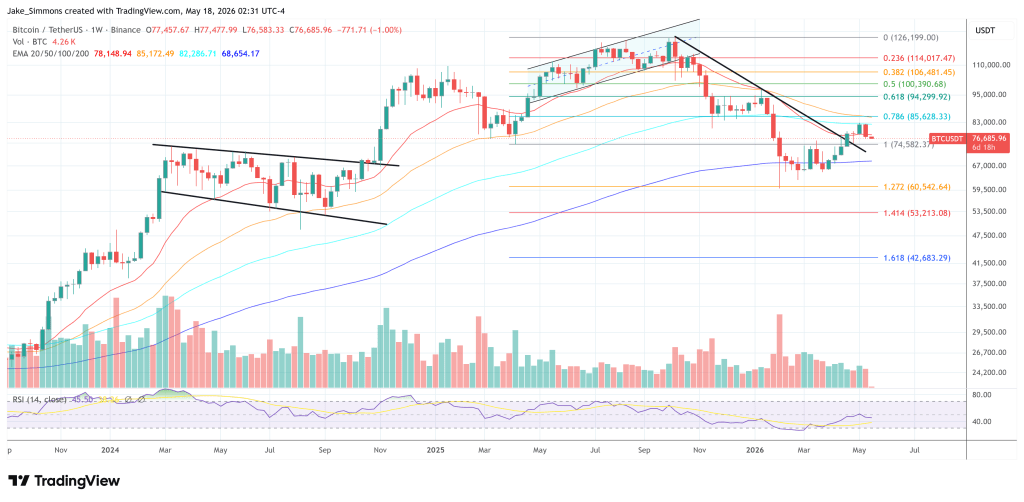
Bitcoin slipped back below $80,000 on Wednesday after a brief breakout attempt, as onchain data suggested the rally was already running into profit-taking pressure.

CryptoQuant said bitcoin’s 37% rebound from April lows still looks more like a bear-market rally than a confirmed trend reversal, with realized profits hitting their highest level since December and short-term holders increasingly exiting at a gain.

Bitcoin’s rally has pushed traders back into profit, with holders cashing out at the fastest pace since December, as recent buyers increasingly sell into strength, they wrote.

But the rebound still looks more like a relief rally than a true bull-market breakout, since profits remain well below levels seen in past sustained uptrends while unrealized gains are already high enough to tempt more selling, according to CryptoQuant. Traders are also sitting on an 18% unrealized profit margin, the highest since June 2025, a level where profit-taking has historically accelerated.

Singapore-based market maker Enflux offered a different read, focusing less on holder behavior and more on the macro catalyst that drove bitcoin’s initial move higher.

Enflux said bitcoin’s push through the $80,000 level was part of a broader risk-on reaction after President Donald Trump paused a U.S. naval operation tied to tensions around the Strait of Hormuz, a move that sent oil prices lower and lifted equities.

But while Enflux said the rally “makes sense mechanically,” it warned markets may be overestimating the durability of the catalyst, noting that previous Trump diplomatic pauses since March either reversed within days or were misread by traders.

Glassnode, however, offered a more constructive view, arguing bitcoin’s recent move reflects an early structural recovery rather than just a short-lived macro bounce.

The analytics firm said bitcoin had reclaimed two closely watched on-chain levels in a note this week: the True Market Mean at $78,200 and the short-term holder cost basis near $79,100, levels that often serve as dividing lines between weaker and stronger market regimes.

Glassnode identified roughly $85,200 as the next major resistance zone, while pointing to improving U.S. spot ETF inflows and persistent negative perpetual funding, a sign some traders remain positioned for downside even as prices recover.

Still, Glassnode stopped short of declaring a clean breakout.

Long-term holders are beginning to realize profits, while elevated realized losses across the broader market suggest bitcoin still needs stronger spot demand to sustain a more durable move higher.

Prediction markets reflected similar caution. On Polymarket, traders assigned relatively low odds to bitcoin extending cleanly toward $85,000 or beyond this week, suggesting the market remains hesitant to treat the recent rebound as a confirmed breakout.