The White House is on the verge of a formal announcement on the U.S. Strategic Bitcoin Reserve — and the official leading the charge says the hard part is done.
Patrick Witt, Executive Director of the President’s Council of Advisors for Digital Assets, told an interviewer this week that the administration has cleared a major legal hurdle in standing up the reserve.
“We’ll have an announcement,” Witt said. “I wish I could say more… It’s a breakthrough as far as getting everything in place, legally sound, properly safeguarding the assets.”
The signal follows a similar declaration Witt made at the Bitcoin 2026 conference in Las Vegas, where he told the crowd an update was coming within weeks.
President Trump signed the executive order establishing the Strategic Bitcoin Reserve on March 6, 2025. Since then, Witt says his deputy Harry John has driven the interagency process: identifying what legal authorities exist, commissioning the necessary legal memos, and building a custody and reporting infrastructure across federal agencies that were designed for gold, not private keys.
The reserve holds an estimated 328,372 BTC — roughly 1.6% of total global supply — accumulated through law enforcement seizures, including the Silk Road takedown, the 2022 Bitfinex hack recovery, and years of criminal forfeitures.
The executive order bars the Treasury from selling a single coin.
A government bitcoin hack lit a fire for the U.S. government
Witt pointed to a breach at the U.S. Marshals Service as proof that the reserve’s security mandate is urgent. A government contractor named John Daghita allegedly stole more than $46 million in cryptocurrency from USMS custody accounts in late 2025, and the FBI arrested him in March 2026. A separate $24 million theft was traced to October 2024.
“It’s a case in point for why it was so necessary that the president established the SBR,” Witt said.
An executive order dies the moment a new president takes office. That vulnerability is the core argument for two bills now moving through Congress. Rep. Nick Begich recently rebranded the BITCOIN Act as the American Reserves Modernization Act (ARMA), which would authorize the U.S. Treasury to purchase up to 200,000 BTC per year for five years — with holdings locked for a minimum of 20 years. Senator Cynthia Lummis has put Congress on a deadline, pushing for a vote before the summer recess as midterm campaigning begins to consume floor time.
If the BITCOIN Act passes, the Treasury’s first open-market Bitcoin purchase is projected for Q4 2026 — making the U.S. the first sovereign nation to actively accumulate Bitcoin as a strategic reserve asset.
Wall Street and payment giants are quietly taking over Solana, moving billions onto the network for tokenized funds and global payments even as the broader crypto market cools down, according to a new report by Messari.
The European fintech giant is launching a physical debit card that lets users spend the popular meme coin anywhere Visa and Mastercard are accepted with zero extra exchange fees.
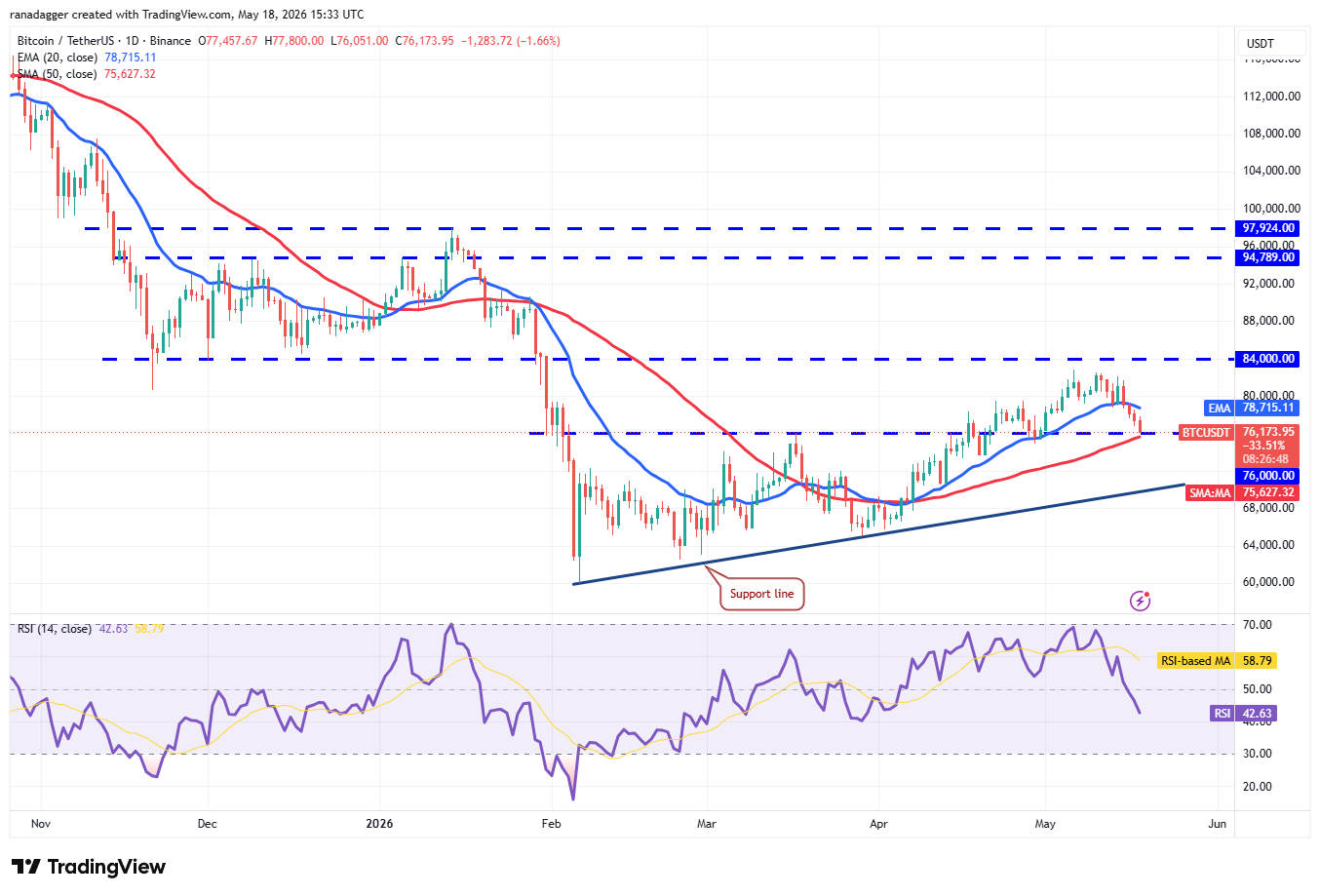
Bitcoin has pulled back to the $76,000 level, a crucial near-term support level to watch.
Several major altcoins have broken below their near-term support levels, indicating that the bulls have given up.
Bitcoin (BTC) came under pressure on Monday after US President Donald Trump warned Iran that the “clock is ticking” and they better get moving fast. Analyst CryptoRover said in a post on X that a potential US military operation against Iran “is extremely dangerous for $BTC.”
Institutional investors also seem to be turning cautious in the short term. According to SoSoValue data, spot BTC exchange-traded funds recorded $1 billion in weekly net outflows. That was the first net outflow after six successive weeks of inflows totaling $3.4 billion.
Crypto market data daily view. Source: TradingView
While several traders are cautious on BTC’s prospects in the near term, Michael Saylor’s Strategy, the world’s largest public Bitcoin holder, continued to buy BTC. Strategy purchased 24,869 Bitcoin for $2.01 billion between May 11 and 17, boosting its holdings to 843,738 BTC, per Monday’s 8-K filing with the US Securities and Exchange Commission.
Could BTC and the major altcoins bounce off their crucial support levels? Let’s analyze the charts of the top 10 cryptocurrencies to find out.
S&P 500 Index price prediction
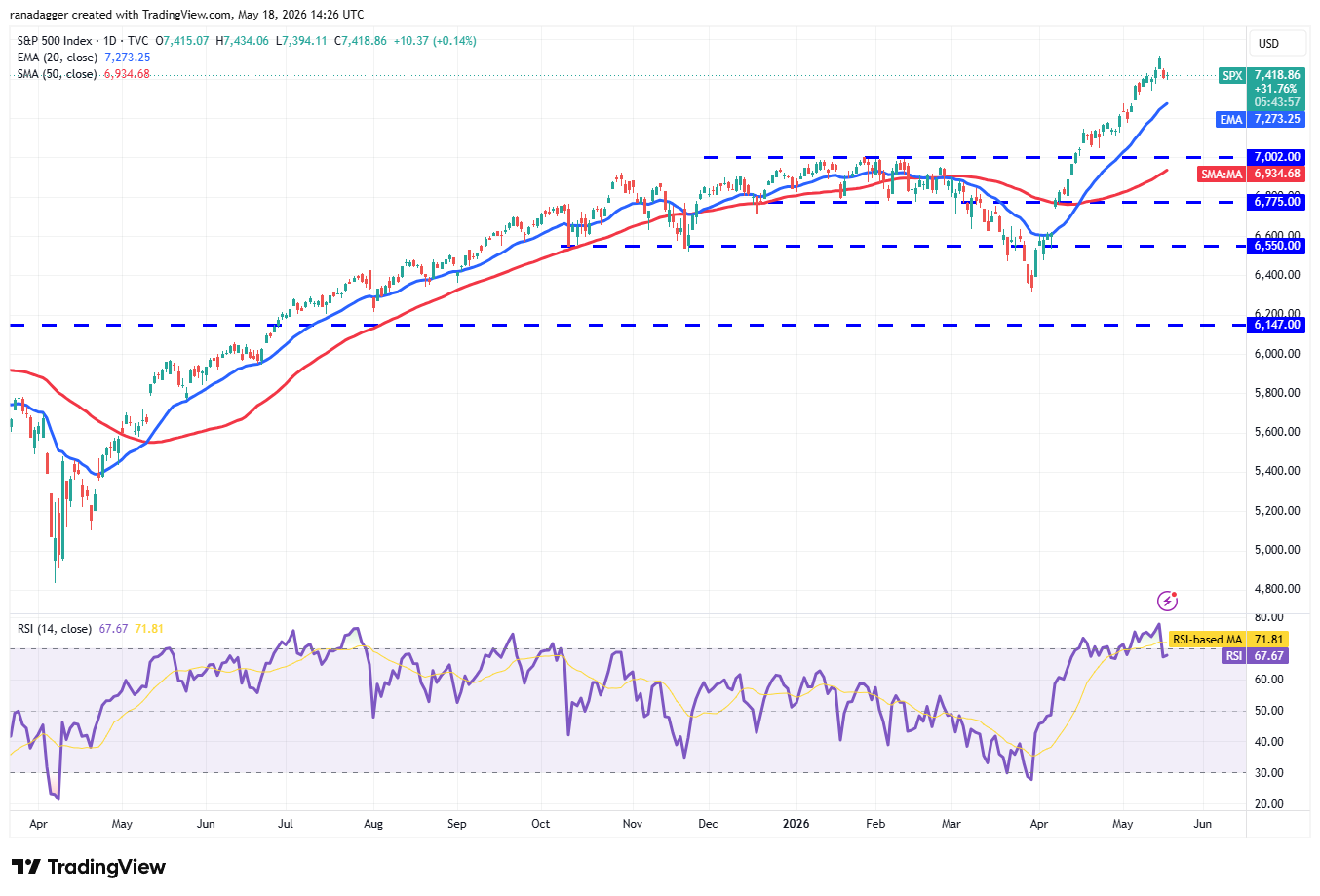
The S&P 500 Index (SPX) rallied to a new all-time high of 7,517 on Thursday, where short-term traders booked profits.
The index may pull back to the 20-day exponential moving average (7,273), a crucial support level to watch. If the price rebounds off the 20-day EMA with strength, it suggests a positive sentiment. That increases the likelihood of an uptrend resuming toward the 8,000 level.
Sellers will have to tug the price below the 20-day EMA to weaken the bullish momentum. If they do that, the index may witness a deeper pullback to the 7,002 level.
US Dollar Index price prediction
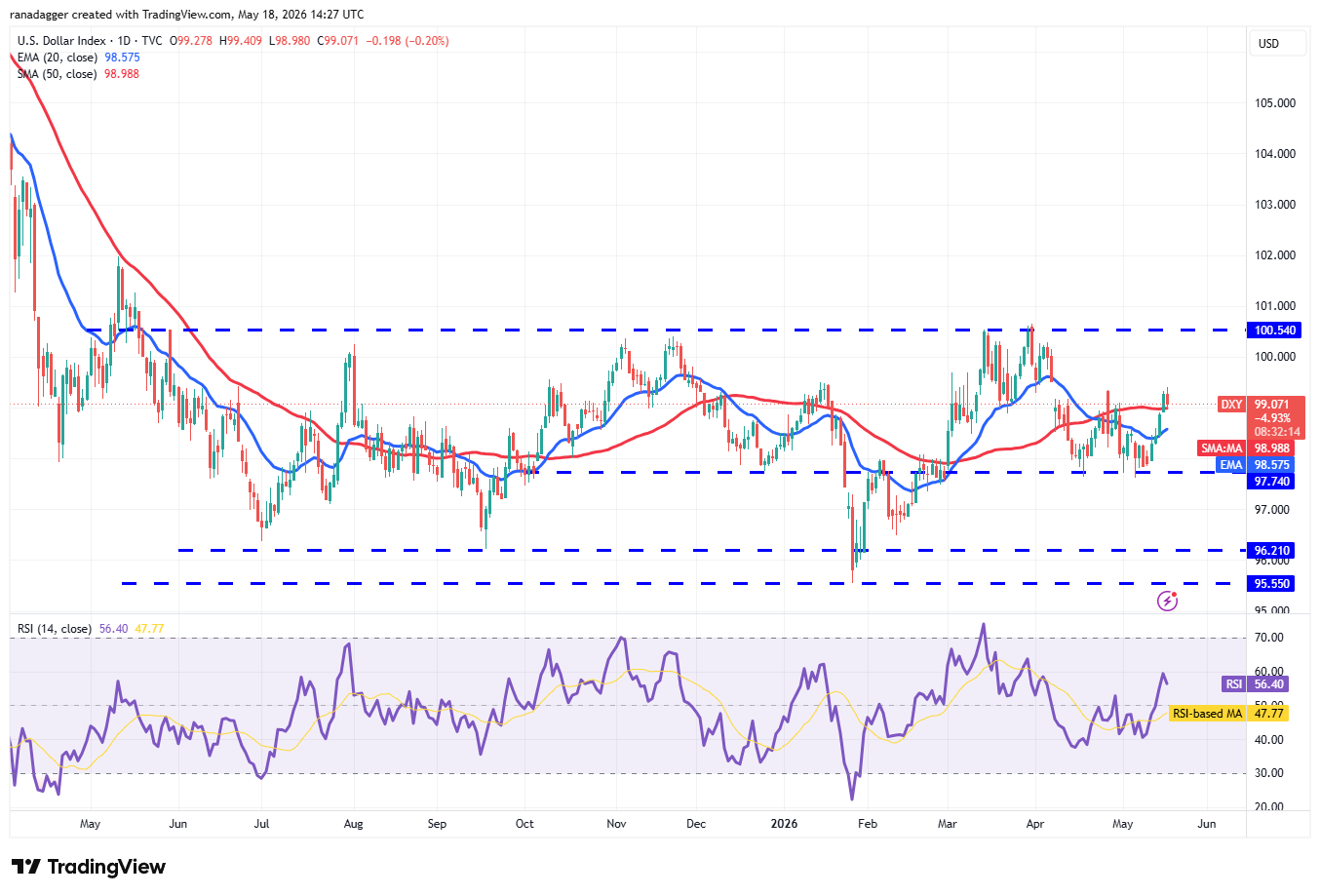
The US Dollar Index (DXY) turned up from the 97.74 support and broke above the moving averages.
There is minor resistance at 99.34, but if the bulls sustain the price above it, the index may reach the stiff overhead resistance at 100.54. Sellers are expected to fiercely defend the 100.54 level, as a break and close above it would signal the start of a new uptrend. The index may then surge to 101.97.
Conversely, if the price turns down from the current level or from the 100.54 resistance and breaks below the 50-day simple moving average (98.98), it suggests that bears remain active at higher levels. That may keep the index range-bound between 97.74 and 100.54 for a few more days.
Bitcoin price prediction
BTC continued its slide and has reached the 50-day SMA ($75,627), suggesting bears are attempting to take charge.
Buyers will have to sustain the BTC price above the 50-day SMA to retain the advantage. The first sign of strength will be a close above the 20-day EMA ($78,715). That opens the door to a rally toward the $84,000 resistance.
Instead, if the price closes below the 50-day SMA, it increases the risk of a drop to the support line of the ascending channel pattern. Buyers are expected to vigorously protect the support line, as a break below it may sink the BTC/USDT pair to $65,000.
Ether price prediction
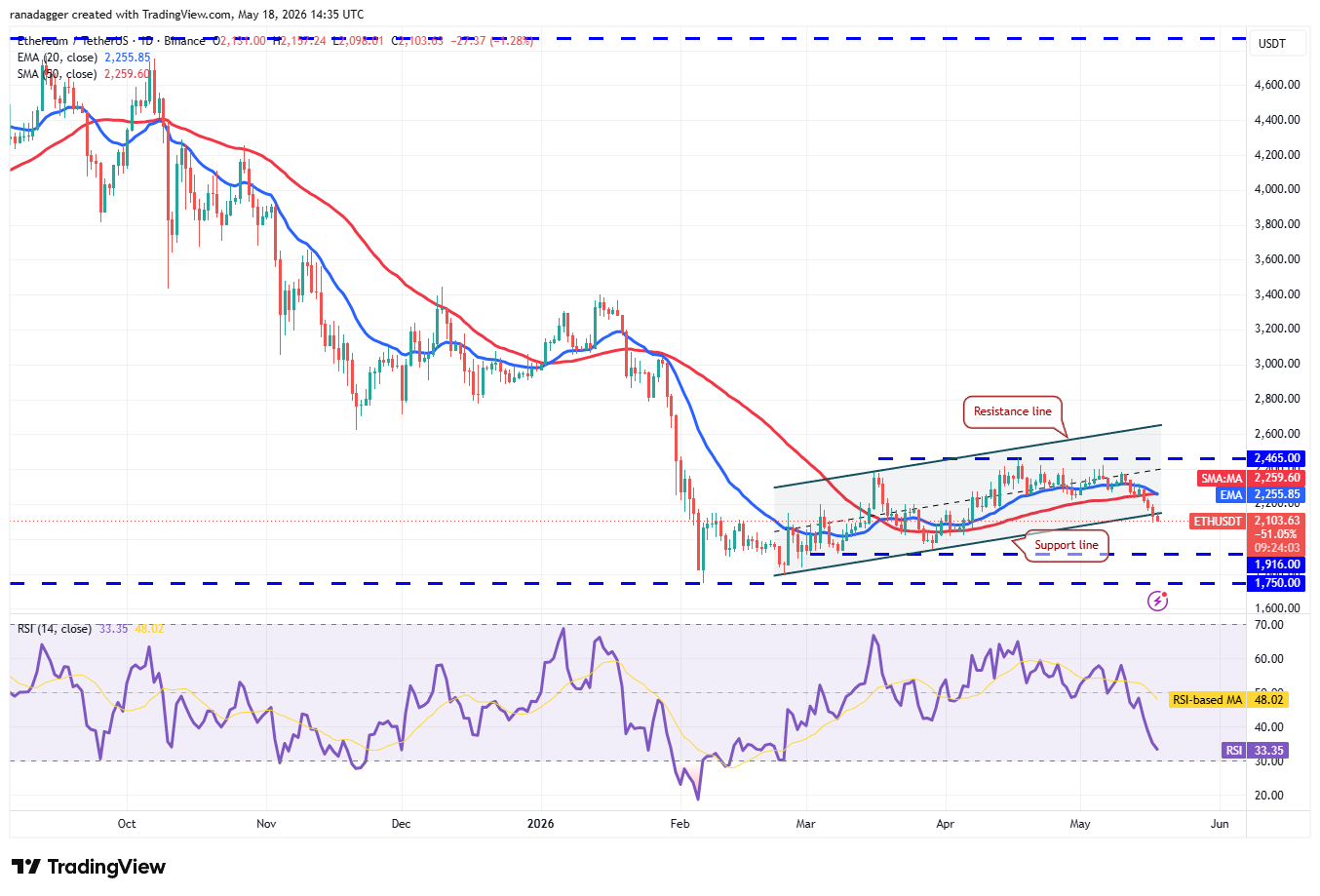
Ether (ETH) continued its downward march and closed below the support line of the ascending channel pattern on Sunday.
The 20-day EMA ($2,255) has begun to turn lower, and the RSI is near oversold territory, indicating that bears are in control. Any recovery attempt is expected to face selling at the 20-day EMA. If the ETH price turns down sharply from the 20-day EMA, the likelihood of a drop to $1,916 increases.
Buyers have an uphill task ahead of them. They will have to drive and maintain the ETH/USDT pair above the moving averages to signal a comeback.
XRP price prediction
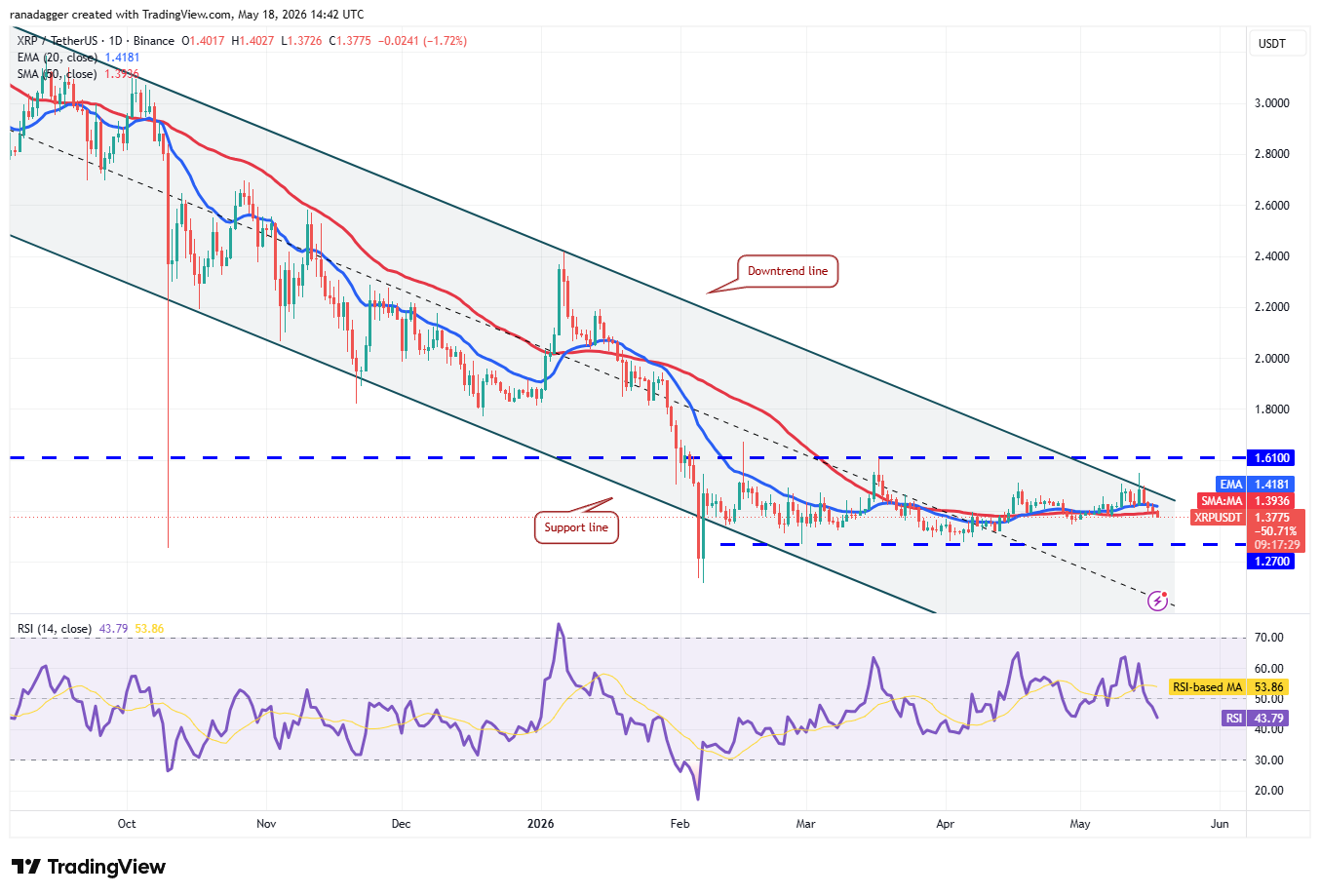
XRP (XRP) has dipped below the 50-day SMA ($1,39), indicating that the bears are attempting to gain the upper hand.
If the price closes below the 50-day SMA, the next likely stop is the solid support at $1.27. Buyers are expected to defend the $1.27 level with all their might, as a close below it may sink the XRP/USDT pair to $1.11 and later to the psychological level at $1.
Buyers are expected to face selling at the downtrend line and then at the $1.61 level. A break and close above the $1.61 resistance signal a short-term trend change. The XRP price may then march to $2 and subsequently to $2.40.
BNB price prediction
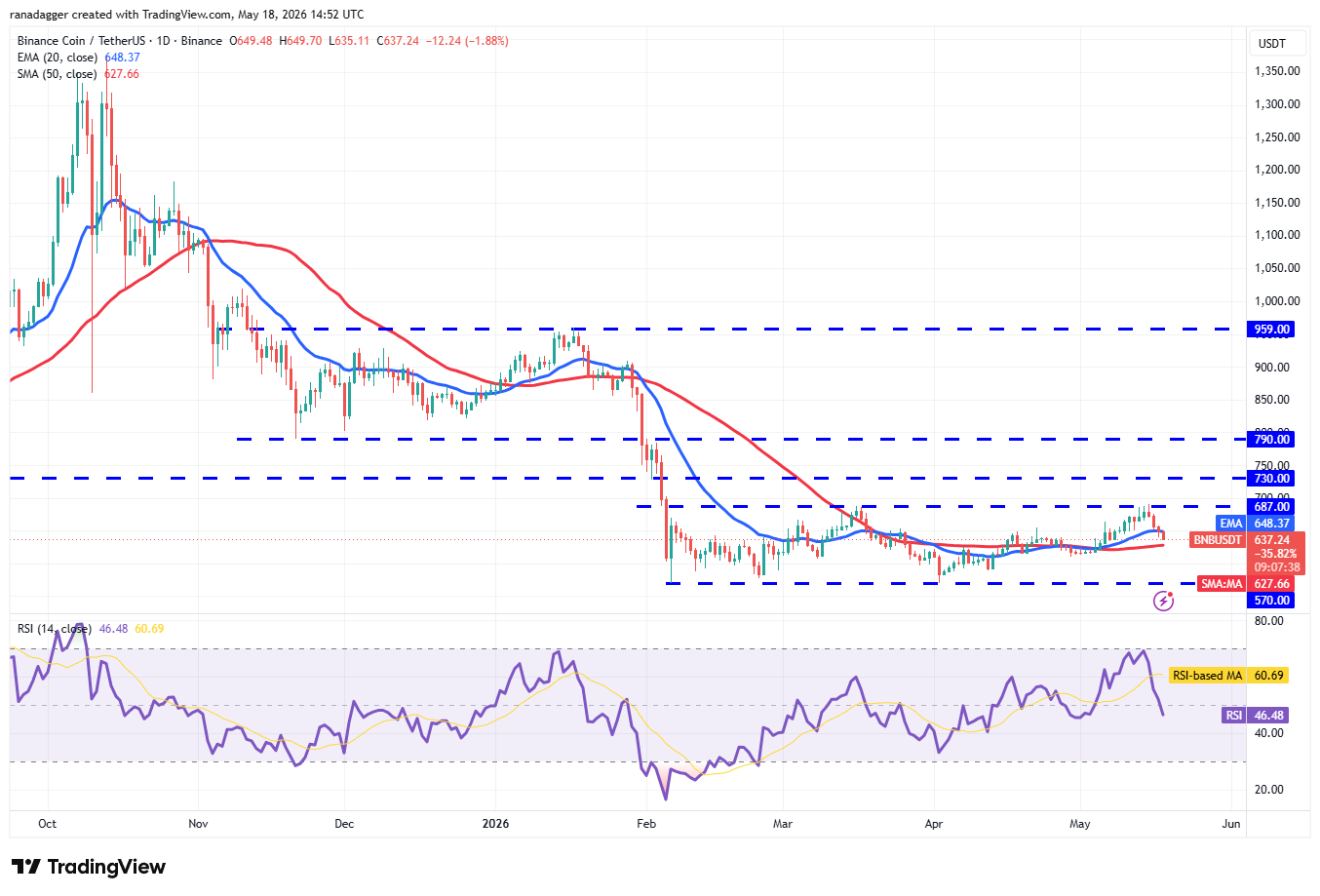
BNB (BNB) pulled back from the $687 overhead resistance and broke below the 20-day EMA ($648).
There is minor support at the 50-day SMA ($637), but if the level cracks, the BNB/USDT pair may plummet to the solid support at $570. This is a crucial level to watch out for, as a close below $570 indicates the start of the next leg of the downtrend. The pair may then collapse toward $500.
On the contrary, if the BNB price turns up from the 50-day SMA, it suggests demand at lower levels. Buyers will have to thrust the price above the $687 resistance to indicate strength. The pair may then rally to $730 and then to $790.
Solana price prediction
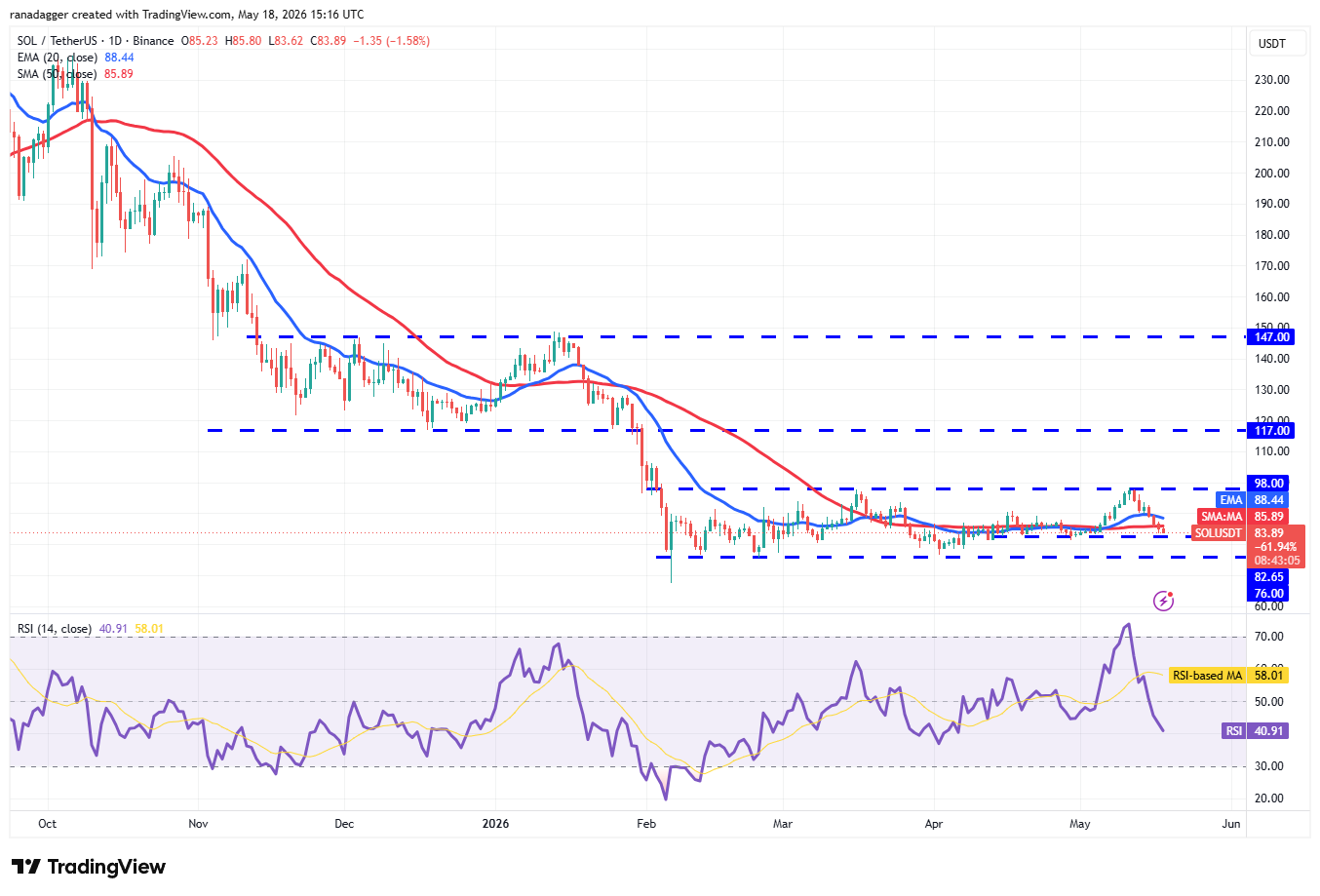
Solana (SOL) closed below the 50-day SMA ($85) on Sunday, indicating that the bears are on a comeback.
There is support at $82, but the recovery is expected to face selling at the 20-day EMA ($88). If the SOL price turns sharply down from the 20-day EMA, the likelihood of a break below the $82 support increases. That opens the doors for a drop to the $76 level.
The first sign of strength will be a close above the 20-day EMA. That shows solid buying at lower levels. The bulls will be back in the driver’s seat after the SOL/USDT pair closes above the $98 resistance.
Related: Hyperliquid eyes 55% price rise after Silicon Valley investor’s ‘massive HYPE buy’
Dogecoin price prediction
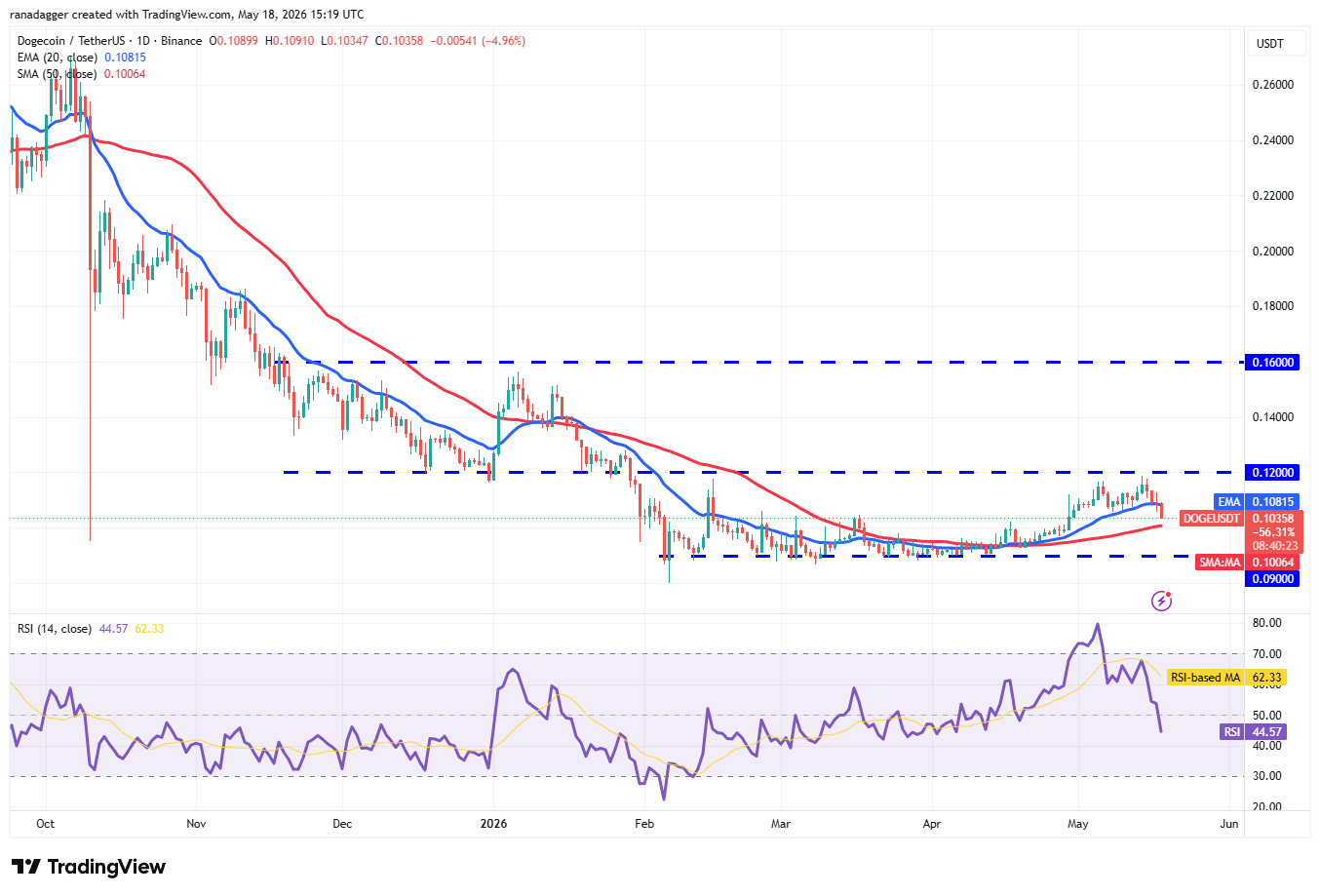
Dogecoin (DOGE) has dipped below its 20-day EMA ($0.11), suggesting that bulls have given up in the short term.
The flattish 20-day EMA and the RSI just below the midpoint suggest a range-bound action between $0.09 and $0.12 for some more time.
Buyers will have to push and sustain the DOGE price above the $0.12 resistance to signal the start of a new up move. The DOGE/USDT pair may then climb to $0.14 and later to $0.16.
On the downside, a break and close below the $0.09 support indicates the resumption of the downtrend. The pair may then slump to $0.08.
Hyperliquid price prediction
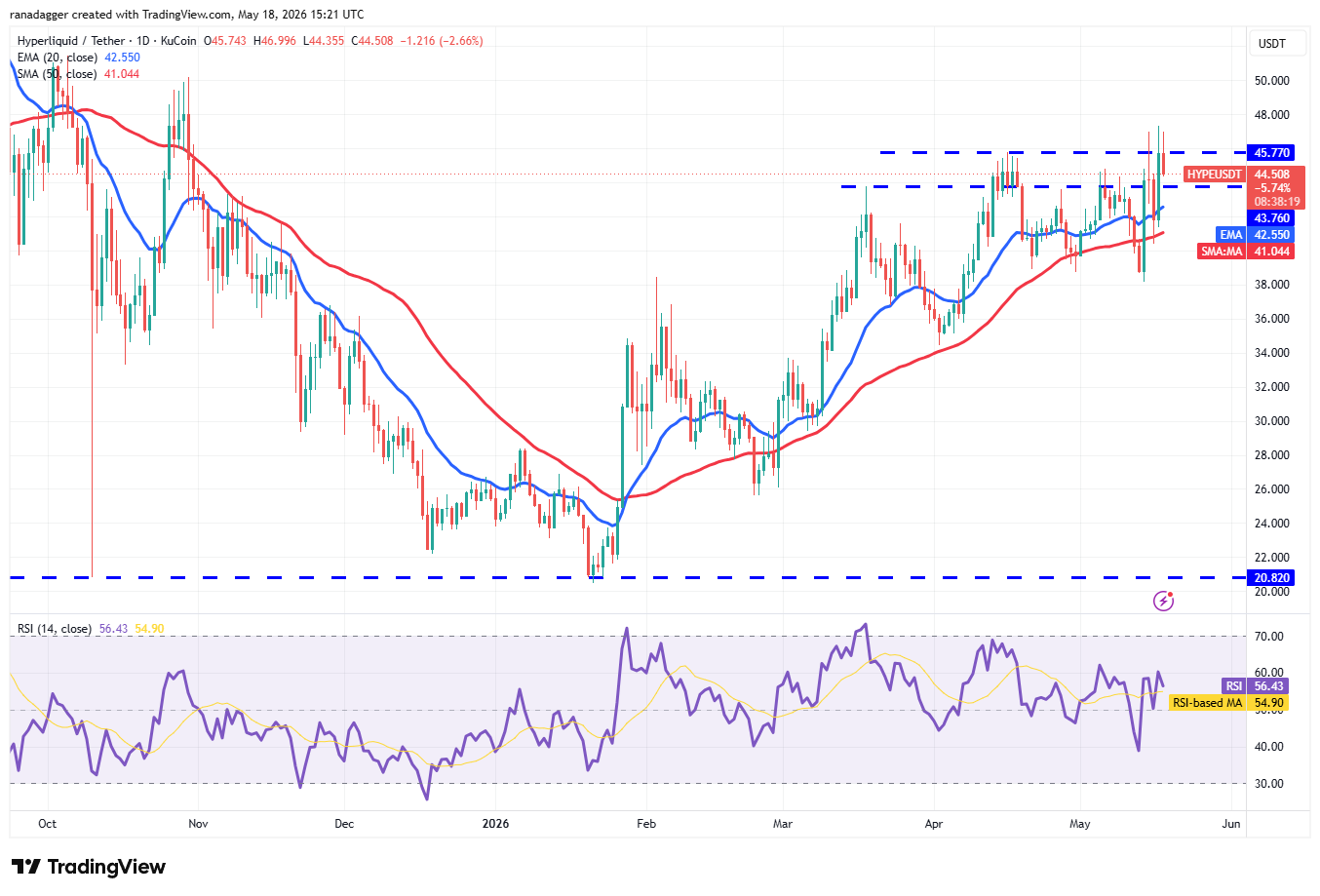
Hyperliquid (HYPE) has been volatile for the past few days, indicating a tough battle between the bulls and the bears.
The bulls pushed the HYPE price above the $45.77 resistance, but the long wick on the candlestick shows selling at higher levels. Buyers will have to secure a close above the $45.77 level to clear the path for a rally to the $50 to $51.43 zone.
The 20-day EMA ($42.55) is the critical support to watch out for on the downside. A break below it suggests that the HYPE/USDT pair may consolidate inside the $38.17 to $47.32 range for a while.
Cardano price prediction
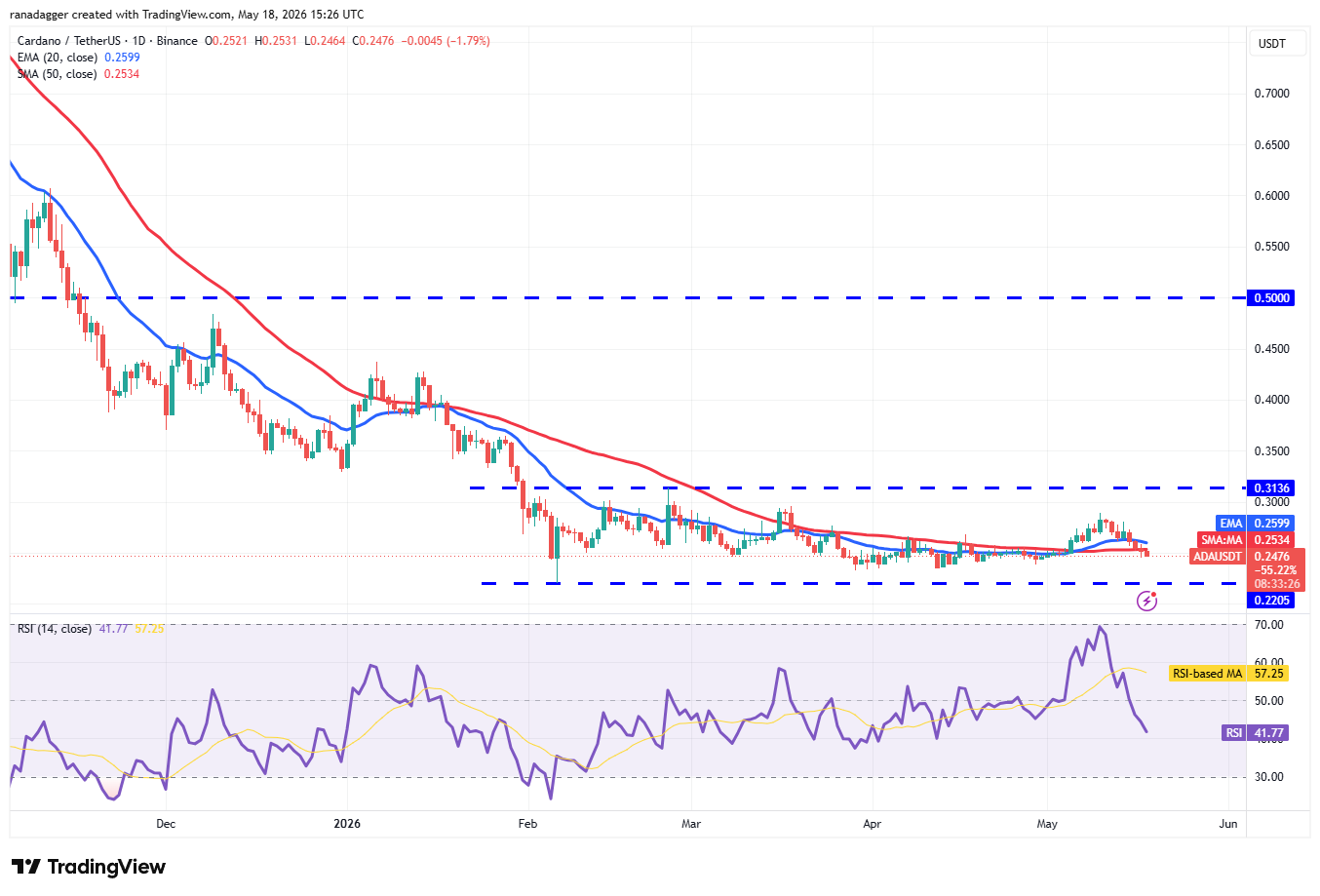
Cardano (ADA) has dipped below the 50-day SMA ($0.25), indicating that the bears continue to exert pressure.
The flattish moving averages and the RSI just below the midpoint suggest the ADA/USDT pair may oscillate inside the $0.22 to $0.31 range for a few more days.
The next trending move may begin on a close above the $0.31 resistance or below the $0.22 support. If the ADA price turns up and breaks above $0.31, the pair may pick up momentum and soar toward $0.40. Alternatively, a close below $0.22 signals the resumption of the downtrend toward the target objective of $0.13.
Bitcoin Depot, one of the largest Bitcoin ATM operators in the US, filed for Chapter 11 bankruptcy protection as the company moved to wind down operations and sell its assets.
In a Monday announcement, Atlanta-based Bitcoin Depot said it started voluntary Chapter 11 proceedings in the US Bankruptcy Court for the Southern District of Texas, citing mounting regulatory pressure and financial strain.
CEO Alex Holmes said the company strengthened anti-fraud protections in recent years, including stricter identity checks and lower transaction limits, but argued that growing compliance demands and enforcement actions made the business model “unsustainable.”
The filing marks one of the biggest collapses in the crypto ATM sector to date and highlights the increasing pressure facing companies that provide cash-to-crypto services in the US.
Thousands of Bitcoin ATMs taken offline
Bitcoin Depot said its network of Bitcoin ATMs has already been taken offline as part of the court-supervised restructuring process. The company operated more than 9,000 kiosk locations globally as of August 2025 and held one of the largest market shares in North America.
The company said the bankruptcy process is intended to support an “orderly wind-down” while allowing management to pursue a sale of its assets.
Bitcoin Depot’s first-day bankruptcy hearing is scheduled for Tuesday at 7:00 pm UTC, according to court information published on Kroll’s restructuring portal. The company appointed law firm Vinson & Elkins as legal adviser, while Portage Point Partners will oversee restructuring efforts.
Bitcoin Depot’s Canadian entities are also included in the restructuring process, with separate proceedings expected to begin in Canada. The company added that its remaining non-US entities will shut down under local laws.
Regulatory pressure weighs on the crypto ATM industry
Crypto ATMs have become a popular on- and off-ramp, allowing users to buy Bitcoin with cash or withdraw cash by selling it.
However, regulators in several US states and Canada have been scrutinizing the sector, citing complaints tied to scams and fraud.
Operators in the sector have also faced lawsuits, while multiple jurisdictions have proposed blanket bans on crypto ATMs.
Bleak outlook for crypto ATM operators
Bitcoin Depot’s collapse may signal broader trouble ahead for the crypto ATM sector in the US as regulators tighten oversight of cash-to-crypto services.
“Bitcoin Depot’s bankruptcy is likely a preview of what the broader crypto ATM industry will face in the US over the next several years,” Roshan Dharia, CEO of Echo Base and a restructuring adviser, told Cointelegraph.
Dharia said the traditional crypto ATM business model relied on high transaction fees and relatively limited regulatory scrutiny to offset steep operating costs tied to compliance, cash handling, fraud remediation and revenue-sharing agreements with retail partners.
Related: Canada proposes crypto ATM ban over scams and money laundering
“That equation is breaking down as states increasingly impose consumer protection standards that compress fees, expand operator liability for scam-related activity, and raise expectations around transaction monitoring and reimbursement,” he said, adding:
“The result is that many crypto ATM operators may no longer be able to generate sufficient margin to support a nationwide network at scale.”
Bitcoin Depot shares plunged more than 70% in premarket trading following the bankruptcy announcement, according to TradingView data. Since debuting on the Nasdaq under the ticker “BTM” in July 2023, the company’s stock has fallen roughly 95% to about $2.93.
Magazine: How crypto laws changed in 2025 — and how they’ll change in 2026
The Bank of England on Monday proposed extending operating hours for its core settlement infrastructure toward near-24/7 availability, part of a broader push with the Financial Conduct Authority (FCA) to prepare UK wholesale markets for tokenized finance.
The proposal seeks to add weekend and extended daily operating hours to the central bank’s settlement mechanism, Real-Time Gross Settlement (RTGS), and the Clearing House Automated Payment System (CHAPS).
The Bank of England said the expanded operating hours would support cross-border payments and new payment and settlement models as tokenization develops.
The consultation will support cross-border payments and new payment and settlement models based on tokenization developments, according to the joint letter published on Monday.
The BoE is seeking public feedback on the consultation paper until July 3 and plans to publish a feedback statement in the summer.
It comes weeks after the FCA said that tokenization and distributed ledger technologies could make fund management more efficient and support the innovation of the UK asset management sector.
Call for input on the future of tokenization in UK wholesale markets. Source: FCA
“Fantastic to see the UK setting out a clear vision for tokenization in wholesale markets,” Katie Harries, head of policy for Europe at Coinbase, told Cointelegraph.
“The opportunity is huge — not only for companies seeking new pools of capital, but for the ‘unbrokered’: the many individuals globally who are not able to participate in capital markets today,” she added.
PRA plans consultation on tokenization framework in 2028
The Prudential Regulation Authority (PRA) also issued updated guidance for bank CEOs proposing that tokenized financial instruments receive the same regulatory treatment as their traditional equivalents when legal rights and risks are comparable, replacing prior guidance issued in 2022.
The PRA said the letter would serve as interim guidance until it publishes a broader prudential framework following the Basel Committee on Banking Supervision’s (BCBS) targeted review of banks’ crypto asset exposure standards.
Related: Farage faces UK standards probe over $7M gift from crypto billionaire
The BCBS launched the review in November 2025 to examine the prudential treatment of tokenization, stablecoins and permissionless blockchains, with updates expected later this year.
The PRA said it expects to consult on a proposed long-term framework in 2028 at the earliest.
Under the UK’s approach, crypto regulation would largely fall under the FCA, the country’s primary financial markets regulator.
The FCA separately opened a public consultation on its crypto regulatory regime on April 30, focusing on stablecoin issuance, trading, custody and staking. The regulator is expected to fully implement the framework by October 2027.
Magazine: How crypto laws changed in 2025 — and how they’ll change in 2026
Michael Saylor’s Strategy, the world’s largest public Bitcoin holder, made another massive BTC acquisition last week as the crypto asset hovered around $80,000.
Strategy acquired 24,869 Bitcoin (BTC) for $2.01 billion between May 11 and 17, according Monday’s 8-K filing with the US Securities and Exchange Commission.
Source: SEC
The purchases were made at an average price of $80,985 per BTC, raising Strategy’s cost basis to $75,700.
The company now holds 843,738 BTC, acquired for about $63.87 billion. At the time of publication, the holdings were valued at roughly $65.3 billion, according to CoinGecko.
STRC sales account for 97% of the entire purchase
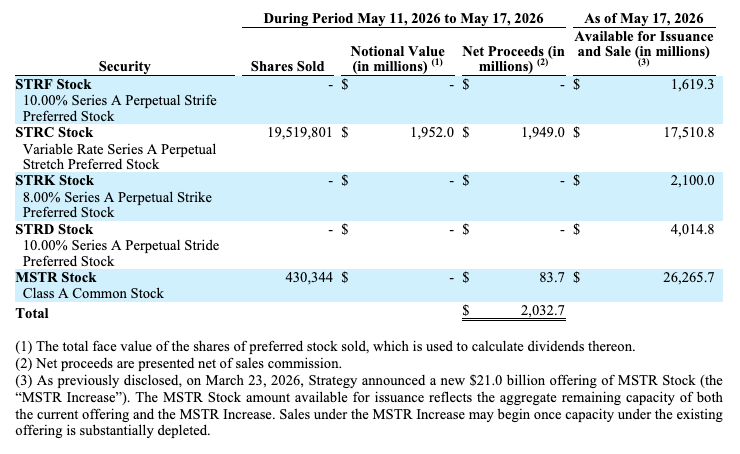
Strategy funded nearly all of its latest Bitcoin purchase through sales of its STRC perpetual preferred stock, which accounted for about 97% of total proceeds.
According to the SEC filing, Strategy raised roughly $1.95 billion from the sale of about 19.5 million STRC shares.
In comparison, Strategy’s Class A common stock (MSTR) contributed a smaller share of funding, generating about $83.7 million in net proceeds from the sale of 430,344 shares.
Source: SEC
The outcome was broadly in line with expectations from STRC Live, which reported heavy STRC activity during the week, including a record trading day of 15.1 million shares, with estimated purchases of around 15,466 BTC.
The structure mirrors previous large bitcoin buys this year, including a 34,164 BTC purchase, Strategy’s third-largest on record, which was also largely financed through preferred securities rather than common equity.
Related: Strategy resumes Bitcoin acquisitions with $43M BTC buy
Strategy co-founder Saylor previously signaled that the company would add to its Bitcoin holdings by posting a chart showing Strategy’s purchase history with 109 Bitcoin acquisition events since 2020.
Its 843,738 BTC now far outpaces BlackRock, the world’s largest asset manager, which holds around 817,000 BTC on behalf of its clients.
The purchases came a week after Saylor raised the possibility of selling Bitcoin during Strategy’s recent earnings call, framing it as a way to better protect the asset’s long-term value.
He said that sticking too rigidly to a “never sell” Bitcoin approach could, over time, work against the very asset the company is built to accumulate and hold.
Magazine: Bitcoin ETFs bleed $1B, Aave’s $71M ETH unfreeze bid delayed: Hodler’s Digest, May 10 – 16
The move brings onchain yield and lending to the payments-focused chain in a bid to offer full-stack onchain finance platform to companies building on it.
The bitcoin mining firm continues on its investment path into AI data centers after raising $115 million to expand its global footprint in the industry.
Capital B, the Paris-listed Bitcoin Treasury Company formerly known as The Blockchain Group, has completed the purchase of 192 bitcoin for €13.0 million, bringing its total holdings to 3,135 BTC — one of the largest bitcoin reserves held by a European public company.
The acquisition, announced May 18, 2026, was funded through three capital raises that together generated €17.15 million. The raises included a €0.85 million placement under an “at-the-market” (ATM) agreement with TOBAM, a €1.1 million warrant issuance subscribed by cypherpunk and Blockstream CEO Adam Back, and a €15.2 million private placement of shares with attached subscription warrants (ABSA) at €0.66 per unit, placed with a group of global institutional investors.
The 192 BTC were purchased at an average cost of €67,866 per bitcoin, according to a note shared with Bitcoin Magazine. The company’s total bitcoin stack now carries an aggregate acquisition value of €283.6 million, reflecting an average cost basis of €90,451 per coin. The acquisition was executed through Swissquote Bank Europe SA, a Luxembourg-registered virtual asset service provider, with custody handled via the Swiss firm Taurus.
Capital B’s bitcoin yield
Capital B tracks a proprietary performance metric called “BTC Yield” — a measure of bitcoin accumulation per fully diluted share — to assess the efficiency of its treasury strategy. Year-to-date, the company has recorded a BTC Yield of 1.82%, a BTC Gain of 51.3 BTC, and a BTC Euro Gain of €3.5 million. Since the start of the second quarter, those figures stand at 1.09%, 31.4 BTC, and €2.1 million.
The private placement carried a warrant structure with three tranches, each with a five-year maturity. Warrant 2026-03 carries an exercise price of €0.86, Warrant 2026-04 at €1.12, and Warrant 2026-05 at €1.46 — each set at 130% of the prior tranche’s exercise price. If all warrants were exercised, the transaction would generate an additional €99.1 million in capital for the company. Maxim Group LLC served as lead placement agent, with Marex S.A. as co-manager.
The capital table following the transaction shows Adam Back holding 13.37% of ordinary shares and 10.00% on a diluted basis, while Blockstream Capital Partners holds 14.36% on an ordinary basis but 35.90% on a diluted basis — reflecting its large warrant position. TOBAM holds 4.52% of ordinary shares. On a total basis, the company has 300,265,812 shares outstanding, with a potential diluted count of 420,859,061.
Capital B trades on Euronext Growth Paris under the ticker ALCPB, with U.S. OTC trading under CPTLF. The company’s bitcoin treasury strategy centers on a single stated objective: growing the number of bitcoin held per fully diluted share over time.
Earlier today, Strategy said they purchased 24,869 BTC for about $2.01 billion last week, bringing its total holdings to 843,738 BTC at an average cost of roughly $75,700 per coin and reinforcing its position as the largest corporate bitcoin holder.
The buy marks a sharp acceleration in accumulation, funded in part through preferred equity and ATM offerings, as the company continues to prioritize bitcoin per-share growth while signaling it remains a net accumulator despite limited flexibility to sell if needed.