Home Blog Page 255

Senate Banking Committee Opens Historic Crypto Bill Markup As Warren, Republicans Clash Over CLARITY Act Amendments

0

The Senate Banking Committee opened a historic markup Thursday morning on H.R. 3633, the Digital Asset Market Clarity Act of 2025, moving the most sweeping attempt at federal cryptocurrency regulation in American history toward a committee vote. 

The session — defined by sharp partisan exchanges, procedural disputes, and targeted Republican courtship of crossover Democrats — unfolded against a hard deadline: if the bill does not clear the committee before the Memorial Day recess, the entire legislative calendar resets.

Chairman Tim Scott (R-SC) opened by casting the bill as a correction to years of regulatory failure. 

“For years, the digital frontier was trapped in a regulatory gray zone,” he said. “Developers, entrepreneurs and investors were left with uncertainty. They faced confusion and enforcement actions when instead the government should have been crafting clear rules of the road.” 

Scott framed the legislation around three pillars: consumer protection, retaining American innovation, and national security.

He acknowledged the bill had grown substantially through negotiation — “since June of last year, we have added 33,000 words and 219 pages to get this legislation as bipartisan as humanly possible” — and conceded that Republicans had not gotten everything they wanted.

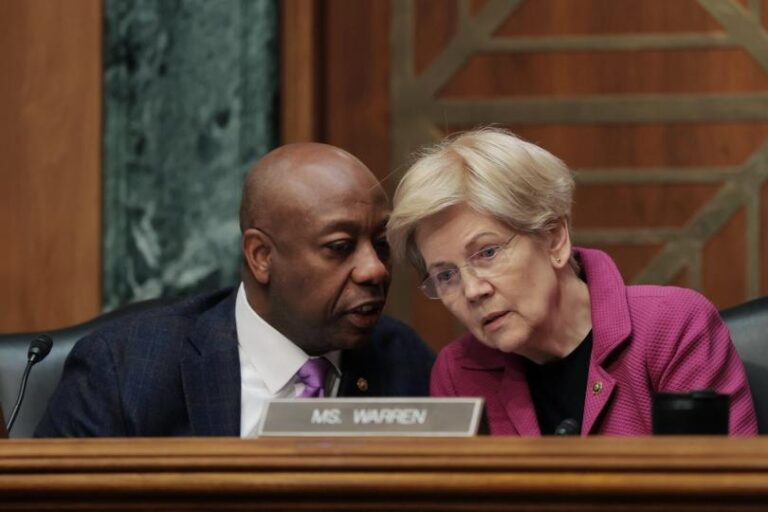
Ranking Member Elizabeth Warren (D-MA) offered a frontal assault. She opened not with digital assets, but with grocery prices, overdraft fees, and credit card interest rates — consumer concerns she argued the committee should be addressing instead. 

“We’re spending our time working on a bill written by the crypto industry, for the crypto industry,” Warren said. 

“Nothing made it into this bill that wasn’t approved by the crypto industry.” She cited a CoinDesk survey showing crypto ranked at the bottom of voter priorities, with just 1% of respondents identifying it as their top concern.

Warren then leveled five charges against the bill: that it would tear a hole in securities laws protecting investors since 1929; declare open season on consumer fraud by preempting state-level protections; repeat the mistakes of 2008 by allowing banks to load up on risky crypto assets; deepen national security vulnerabilities; and do nothing about what she called the Trump administration’s crypto corruption. 

“Since taking office last year, the president and his family have raked in at least $1.4 billion in gains from crypto deals alone,” she said.

A procedural fight before the first vote

Before amendments were called, a dispute over which ones would be heard consumed the opening minutes. Warren said more than a dozen Democratic amendments had been ruled out of order before the session began — including one requested by the National Sheriffs Association to close a money-laundering loophole for cartels, and another from community banks seeking to prevent deposit flight.

“You and you alone have decided which amendments are in and which amendments are out,” she told Scott directly, calling on him to reverse the rulings from the floor.

Scott pushed back, attributing the situation to Warren’s own staff, who he said had objected to a Republican amendment on a technical drafting ground, triggering a wholesale review of all filed amendments. He acknowledged throwing out at least one Republican amendment in the process.

“I tried to make sure both sides had an opportunity,” Scott said. Senator Cynthia Lummis (R-WY) sought a formal clarification on the ruling — drawing a procedural exchange with Scott that underscored the fragile footing of a markup in which more than 130 amendments had been filed.

Senator Jack Reed (D-RI) offered a terse counter: “The definition of working together at a markup is allowing amendments to be called up and voted upon.”

Lummis: ‘The hardest piece of legislation I’ve ever worked on’

Lummis, the bill’s most tenacious Senate champion, delivered a defense that was equal parts policy brief and personal testimony.

“I served 14 years in the Wyoming Legislature, eight years as State Treasurer, and now 14 years in the Congress,” she said. “This is by far the hardest piece of legislation I’ve ever worked on.” 

She said former Sen. Kirsten Gillibrand had said the same thing.

Lummis catalogued the bill’s anti-illicit-finance provisions at length: risk-based examination standards, expanded Treasury special measure authority, mandatory annual reports on foreign jurisdictions’ AML compliance, recurring Treasury reports on offshore stablecoins, insider resale restrictions, and a federal regulatory floor for crypto kiosks — the last drawing an endorsement from AARP, which cited FBI data showing more than 13,460 crypto kiosk fraud complaints and $389 million in losses in 2025 alone.

She turned Warren’s national security argument back on her. “The risks of which she spoke exist now — right now — because there is no regulatory framework,” Lummis said. “There is no way now that this industry can protect the good actors, discover, vet and punish the bad actors.” 

She closed with a humanitarian pitch: that the bill would let ordinary people transmit money faster and cheaper, provide a level financial playing field regardless of geography, and protect domestic abuse survivors and political refugees who could memorize their savings in Bitcoin. 

“This is an innovation that provides individual freedom, individual savings,” she said.

Both Scott and Lummis used their floor time to name individual Democrats — Warner, Cortez Masto, Gallego, Warnock, Alsobrooks — who had contributed to the bill’s nine-month negotiation process. 

The acknowledgments were deliberate: with 13 Republicans and 11 Democrats on the committee, and a 60-vote threshold needed on the Senate floor, bipartisan support was not optional.

The amendment fights so far

Sen. Mike Rounds’ (R-SD) proposal to create an AI regulatory sandbox for financial firms passed 15-9, with Democratic Sens. Mark Warner and Andy Kim joining Republicans in support — an early sign some Democrats remain open to compromise.

Sen. Elizabeth Warren failed repeatedly to reshape the legislation. Her amendments targeting tokenized asset disclosures, DeFi sanctions tied to terror financing, and bank crypto activity all fell 11-13, largely along party lines. 

During debate over DeFi sanctions, Warren invoked the Treasury’s 2022 sanctions on Tornado Cash and warned Iran could use crypto to collect tanker fees through the Strait of Hormuz. Sen. John Kennedy (R-LA), viewed as a possible crossover vote, ultimately opposed the measure.

A separate amendment from Sen. Dave McCormick (R-PA) directing the SEC and CFTC to revisit portfolio margin rules passed 18-6 with broad bipartisan support.

The markup is ongoing and can be followed here

Ethena’s ENA Token Launches on Solana via Sunrise DeFi: Solana

0

Ethena’s ENA stablecoin is now live on the Solana blockchain through integration with Sunrise DeFi.

Ethena’s ENA token is now live on Solana, according to an announcement from Solana. The integration with Sunrise DeFi enables ENA, Ethena’s synthetic stablecoin protocol, to operate on the Solana blockchain, expanding its multichain presence beyond Ethereum.

Ethena is a stablecoin protocol that generates yield through delta-neutral trading strategies. ENA, the protocol’s governance token, was previously available on Ethereum. The Solana integration marks a significant expansion of ENA’s accessibility, allowing Solana users and developers direct access to Ethena’s stablecoin and tokenomics.

Sunrise DeFi serves as the integration partner, handling the technical implementation to bring ENA to Solana’s ecosystem. The move aligns with a broader trend of major DeFi protocols expanding across multiple blockchains to capture ecosystem-specific liquidity and user bases.

Sources: Solana

This article was produced with the help of AI flows.

Get Ready for Fintech Meetup in Europe

0

At Fintech Meetup 2026, Doug Mackenzie, Head of Content at FinTech Meetup Europe explains why the conference is unique and how it generates positive results, setting the scene for the energetic atmosphere of their Las Vegas gatheringHe explains that while fintech world doesn’t need another conference, however FinTech Meetup is designed as an actual meeting platform focused entirely on facilitating productive one-to-one discussions.

Mackenzie highlights the core benefit of the conference: none of the meetings are cold and attendees are able to immediately see who they will be speaking with, and start building a sales pipeline before attendees arrive on siteThis commitment to efficiency yields powerful results, with the Fintech Meetup model consistently achieving approximately 50,000 completed meetings and boasting an impressive 96% completion rate.

The exciting news that Mackenzie shares is that this successful, efficient Fintech Meetup model is expanding to Europe; and Mackenzie believes that this format will be essential for success.

Fintech Meetup Europe will take place in Lisbon from October 6th – 8th and will be offering organisations a streamlined way to engage with the right contacts, making it a gathering for European businesses looking to accelerate their growth and market penetration across the continent.

Bitcoin Can Still Hit $85,000 as Stocks Head to New All-Time Highs

0

Bitcoin (BTC) touched $80,000 around Thursday’s Wall Street open as US stocks hit fresh all-time highs and oil retested $100.

Key points:

  • Bitcoin rebounded to $80,000 while US stock markets hit new records, ignoring high inflation.
  • Risk appetite is “skyrocketing,” analysis says, despite worries over central-bank policy tightening.
  • Bitcoin can still head to $85,000 next, traders agree.

Bitcoin recoups losses as US stocks ignore inflation

Data from TradingView showed BTC/USD recovering much of the previous day’s losses, which followed some of the highest US inflation data in four years. 

BTC/USD one-hour chart. Source: Cointelegraph/TradingView

US stocks quickly shook off the numbers, despite the implications for future financial policy tightening. 

The S&P 500 posted its highest daily close on record, and continued to surge on Thursday. The Dow Jones Industrial Average revisited 50,000 points for the first time since early February.

S&P 500 versus Dow Jones one-day chart. Source: Cointelegraph/TradingView

Commenting, trading resource The Kobeissi Letter reported “skyrocketing” risk appetite among investors.

“Assets under management (AUM) in US leveraged ETFs are up to a record $177 billion. Since the March bottom, total leveraged ETF AUM has surged +$45 billion,” it wrote in its latest analysis on X.

Leveraged ETF AUM data. Source: The Kobeissi Letter/X

Kobeissi used the same term to describe global money-supply growth — a crypto and risk-asset tailwind at odds with concerns that central banks were adopting a “hawkish stance.” 

“Meanwhile, US M2 money supply jumped +$1 trillion YoY, or +4.6%, to a record $22.7 trillion,” it continued. 

“Money supply growth is accelerating.”

Global money supply data. Source: The Kobeissi Letter/X

As the US-Iran war rumbled on, oil prices seemed unable to crack new highs, with WTI crude retesting the $100 per barrel mark from above.

CFDs on WTI crude oil one-day chart. Source: Cointelegraph/TradingView

“Most important” BTC price support still in play

Looking at BTC price action, trader Daan Crypto Trades saw the market at a “pivotal level.”

Related: Bitcoin price history suggests 77% odds of new all-time high within a year

“Hanging on to that ~$79.4K level which marked the previous highs in April,” he told X followers.

An accompanying chart showed the 200-period simple (SMA) and exponential (EMA) moving averages trending higher toward the spot price.

BTC/USDT perpetual contract four-hour chart. Source: Daan Crypto Trades/X

On the same topic, fellow trader CrypNuevo saw the potential for BTC/USD to head to new multi-month highs at the 50-week EMA should that support hold.

“Bitcoin is at the most important level,” he agreed on Wednesday. 

“If it holds the range highs here, then it’ll push towards the 1W50EMA at $84k-$85k. But a failure to hold this level could trigger a rotation back to the mid-range, potentially exposing range lows if momentum doesn’t shift.”

BTC/USDT one-day chart. Source: CrypNuevo/X

Saylor’s Strategy May Slow BTC Buys after $28B STRC Issuance Cap: Delphi

0

Strategy’s preferred stock funding engine could hit a key constraint within the next year, potentially slowing the company’s Bitcoin purchases unless it expands issuance capacity or leans more heavily on common-stock sales, according to Delphi Digital.

Delphi said Strategy’s Variable Rate Series A Perpetual Stretch Preferred Stock, known as STRC, has become one of the company’s main Bitcoin-buying tools but has an authorized issuance cap of about $28.3 billion.

If the cap is reached without an extension, Strategy’s Bitcoin accumulation could “slow or stop while the dividend obligation remains,” the report said.

The report highlights how one of Strategy’s main capital-raising mechanisms is approaching an inflection point that may dictate the BTC accumulation rate of the largest corporate Bitcoin holder.

The report comes after Strategy announced another 535 Bitcoin acquisition for $43 million on Monday, marking its first investment since April 27, when the company bought 3,273 BTC for $255 million. The filing showed that only about $100,000 worth of capital was funded from the issuance of STRC stock, while the majority of the acquisition, or $42.9 million, was funded through the sales of Class A common stock (MSTR).

STRC was first introduced by Strategy in July 2025 when the company raised $2.5 billion in the stock’s initial public offering (IPO). STRC is a Nasdaq-listed preferred security that pays variable monthly dividends, which currently stand at 11.5%. STRC is perpetual, meaning the company is not obligated to buy back the stock at a specified date.

Source: Delphi Digital

Strategy can raise funds through different models following STRC issuance cap 

Researchers at Delphi Digital pointed out that Strategy has other capital-raising mechanisms, which largely depend on its market net asset value (mNAV), which measures the ratio between a company’s enterprise value and the total value of its cryptocurrency holdings.

“Strategy will use STRC as its main accumulation vehicle as long as MSTR mNAV stays low,” Delphi’s head of research, Ceteris, told Cointelegraph. “If MSTR mNAV expands again it would be prudent to start more ATM MSTR sales to acquire BTC.”

Strategy’s mNAV stood at 1.25x on Thursday, down from 2.11x a year ago, Strategy’s dashboard shows. This means that the company is trading at a premium to its Bitcoin holdings.

Strategy MSTR mNAV, other key metrics. Source: Strategy.com

An mNAV reading below 1 limits a company’s capital raising ability, while a reading above 1 enables the issuance of more stock to fuel Bitcoin acquisitions.

Related: Capital B raises $17.8M to expand its Bitcoin treasury 

Strategy approaches major cash obligation in September 2027

Strategy is approaching its next major cash obligation in September 2027, which is set to be fully covered by its $2.25 billion of cash reserves, according to Delph Digital researcher Aatharv D, who authored the report.

“The financials do not read panicky,” he told Cointelegraph, adding:

“If management believes the cycle bottom is in, the posture is to lean into BTC accumulation, not pull back.”

Strategy is currently using its At-The-Market (ATM) equity offering program to service the preferred dividend payments. However, provided that Strategy’s mNAV expands, common issuance may become accretive again, enabling Strategy to “redirect” the ATM proceeds towards Bitcoin accumulation, giving STRC stock some “breathing room,” explained the researcher.

Strategy’s ATM program enables the company to sell common stock (MSTR) or preferred stock such as STRC directly into the open market at prevailing prices, enabling capital raising without large offerings. Strategy debuted its latest $44 billion ATM program on March 24.

Magazine: Strategy reveals why they would sell BTC, Trump Media posts loss: Hodler’s Digest, May 3 – 9

Kraken to replace LayerZero with Chainlink for kBTC, future wrapped assets

0

Kraken said it will replace LayerZero, a protocol for moving crypto assets across blockchains, with Chainlink’s equivalent after the $292 million bridge exploit that hit liquid restaking protocol Kelp last month exposed risks in legacy cross-chain infrastructure.

Chainlink’s Cross-Chain Interoperability Protocol (CCIP) will become the exclusive cross-chain service for Kraken’s wrapped crypto assets including kBTC, its wrapped bitcoin, the crypto exchange said in a statement.

The move follows similar migrations by platforms including Kelp, Solv and Re. Kelp lost 116,500 rsETH (restaked ether) from a LayerZero-powered bridge in 2026’s largest exploit in April. LayerZero later said it “made a mistake” by allowing its own verifier network to secure high-value assets in the configuration used. In total, an estimated $3 billion in total value locked has since migrated.

Kraken’s migration covers various blockchains including Ink, Ethereum, Unichain and Optimism, with others to follow. Kraken introduced kBTC in 2024 as a 1:1 bitcoin-backed token available first on Ethereum and OP Mainnet. The token now has a $260 million market capitalization, CoinGecko data shows.

CCIP will handle the movement of Kraken’s wrapped assets under the Cross-Chain Token standard. Kraken will continue to issue and custody the assets, the firms said.

Rival crypto exchange Coinbase (COIN) also selected Chainlink CCIP last year as the sole bridge for about $7 billion in wrapped tokens.

Kraken’s parent company, Payward, applied this month for a federal trust charter in a bid to become a federal crypto bank.

Read more: Kraken parent Payward seeks fresh funding at $20 billion valuation ahead of planned IPO

Broadridge Announces Integrated Infrastructure for Tokenized Securities

0

WHY THIS MATTERS

The expansion of Broadridge’s tokenization capabilities, announced on May 12, 2026, represents the “institutionalization” of blockchain technology at the highest levels of global finance. Broadridge is a titan of market infrastructure, processing over $15 trillion in daily assets. By extending its tokenization engine—which already powers $365 billion in daily DLR (Distributed Ledger Repo) volume—to equities, funds, and alts, Broadridge is solving the “innovation silo” problem. Institutional firms no longer need to build experimental blockchain islands; they can now trade and settle tokenized assets using the same resilient workflows and regulatory controls they use for traditional securities.

This matters because it provides a unified Post-Trade and Corporate Actions framework. Historically, the “lifecycle management” of digital assets (voting, dividends, and reporting) has been fragmented. Broadridge’s single-platform approach ensures that whether an asset is a fractionalized token on an EVM-compatible chain or a standard share in a custodial account, the governance and entitlement processes remain identical. For the global capital markets, this is the “missing link” that allows firms to unlock the liquidity and speed of DLT without sacrificing operational integrity.

Broadridge Financial Solutions, Inc. (NYSE: BR), a global fintech leader, today announced a comprehensive expansion of its tokenization capabilities, providing institutional firms the infrastructure to operate across tokenized and traditional securities on a single, integrated platform.  

Broadridge supports institutional trading at scale by reducing operational complexity from execution to settlement for more than $15 trillion in assets per day. Today’s announcement marks the extension of Broadridge’s market-leading multi-asset capabilities to support the trading of tokenized assets across its order, execution, and post-trade infrastructure. 

“Broadridge is already a leader in tokenization with our Distributed Ledger Repo solution platform, which tokenizes more than $365 billion every day,” said Frank Troise, President of Broadridge’s Global Capital Markets business. “Now, we’re delivering a suite of capabilities that support the trading of tokenized securities across our infrastructure with the established systems, controls, and workflows institutional investors rely on every day. Bringing together digital innovation with proven trading, connectivity, and post-trade infrastructure will enable our clients to unlock liquidity and reduce friction across their operations while maintaining the scale, operational resilience, and regulatory compliance required in global capital markets.” 

As demand for tokenized securities grows, the core requirements of institutional trading remain the same – standardized protocols for issuance, transfer, settlement, and asset servicing as well as interoperability across firms and venues. Broadridge is powering that evolution by enhancing its key capabilities to support a tokenized market structure that delivers the reliability, consistency, and operational integrity expected in today’s capital markets. 

A Single Tokenization Engine Across Asset Classes

To make this happen, Broadridge has extended the core tokenization engine behind its Distributed Ledger Repo solution, built for regulated institutional settlement and proven in Fixed Income, to also support equities, funds, alts, and money market instruments within a single, consistent framework. Institutions can now operate with one set of tokenization rails, one governance standard, and one operational model across their entire tokenized asset portfolio. 

Post-Trade Precision for a Tokenized Multi-Asset World

Broadridge’s post-trade infrastructure now supports tokenized and traditional assets within the same processing ecosystem and control framework. Institutions can process tokenized securities, fractionalized assets, and crypto-related holdings alongside conventional instruments using consistent workflows, controls, reconciliation, and reporting standards. By building on existing post-trade infrastructure, Broadridge is enabling clients to integrate tokenized assets with greater speed, lower cost, and less operational complexity.  

Direct Connectivity to Major Blockchain Networks

Broadridge connects directly to major public and permissioned Layer 1 blockchain networks (e.g. Canton, ETH, EVM compatible), giving institutions a single integration point across the distributed infrastructure landscape. This allows operations teams to manage business workflow, oversight, and risk through familiar controls, while Broadridge manages the underlying connectivity complexity required to support a multi-network market environment.

Institutional-Grade Order Routing and Connectivity  

Broadridge’s CQG and NYFIX capabilities help firms incorporate crypto and tokenized asset trading into existing workflows by combining front-end trading access, intelligent order routing, and connectivity across a broad execution ecosystem. Through our existing capabilities, Broadridge provides connectivity to leading crypto exchanges and prediction markets that support multi-asset trading, while NYFIX extends institutional-grade order routing and connectivity through standardized messaging. With millions of trades routed each day, Broadridge brings the scale, resilience, and market reach institutions need to incorporate tokenized assets into existing trading operations with confidence.

End-to-End Corporate Actions and Governance — Across Every Model

Broadridge delivers the full corporate actions and governance lifecycle across tokenized and traditional securities on a single platform, under a single governance standard. Dividend processing, mandatory and voluntary corporate actions, proxy voting, and on-chain governance for tokenized equities all flow through Broadridge’s existing infrastructure. Whether assets sit in traditional custodial accounts, digital wallets, or on-chain, investors receive consistent entitlements, consistent disclosure, and consistent voting access. 

FF NEWS TAKE

Broadridge is effectively building the “Universal Translator” for the next era of finance. While crypto-native firms focus on the “chain,” Broadridge is focusing on the “workflow.” By integrating directly with major networks like Canton and Ethereum while maintaining connectivity through NYFIX, they are shielding institutional desks from the underlying complexity of the blockchain landscape. This “single set of rails” strategy is a masterstroke; it allows a Tier-1 bank to treat a tokenized money market fund exactly like a traditional one, significantly lowering the “cost of entry” for blockchain adoption.

Furthermore, the inclusion of on-chain governance and proxy voting on a unified platform is a significant competitive moat. In 2026, as tokenized equities gain traction, the ability to manage mandatory and voluntary corporate actions across every asset model is what will separate “experimenters” from “operators.” Broadridge isn’t just following the tokenization trend—it is defining the plumbing that will allow the $100 trillion securities market to migrate on-chain.

Who Supports CLARITY on the US Senate Banking Committee?

The CLARITY Act, the crypto lobby’s long-awaited regulatory framework, is finally headed to a markup session in the United States Senate Banking Committee.

It’s been a long road. The bill passed the House of Representatives on July 17, 2025, and has since been in deliberation in the Senate. Most recently, the crypto and banking lobbies were at loggerheads over whether stablecoins could offer interest, further delaying progress.

The two industry interest groups appear to have reached an agreement. However, this does not mean that the bill is finished. Indeed, far from it, as members could introduce contentious amendments, vote against reporting the bill to the Senate floor, or not produce a quorum. 

With the vote set for May 14, here’s a quick look at who supports the bill on the Senate Banking Committee. 

Supporters

Tim Scott (R-SC)

Source: US Senate

As Chairman of the Senate Banking Committee, Senator Scott has led the group’s work on CLARITY, stating his desire to make the US “the crypto capital of the world.”

He was also a cosponsor of the GENIUS Act regulating stablecoins, and voted for SAB 121, a resolution that made pro-crypto amendments to US banking standards. 

Scott received an A grade from Coinbase’s crypto policy tracking site Stand With Crypto. 

Mike Crapo (R-ID)

Source: US Senate

Senator Crapo supported the GENIUS Act, as well as SAB 121 and SJ Resolution 3. The latter was a Senate Resolution that disapproved of the Internal Revenue Service (IRS) requiring DeFi services to collect user data.

While supporting the crypto industry with his votes, in his statements, Crapo has noted the need to create regulations with some investor protections. In a February 2018 statement, he said, “Technology is forward-looking, and we look to our regulators to continue carrying out their mandates, including investor protection, as the markets evolve.”

Crapo received an A from Stand With Crypto.

Mike Rounds (R-SD)

Source: US Senate

In addition to many of his Republican colleagues, Senator Rounds voted for GENIUS, SAB 121, and SJ Resolution 3. 

Amid the pro-crypto furor that followed US President Donald Trump entering office, Rounds harshly criticized former President Joe Biden’s administration on its approach to crypto.

As the banking and crypto lobbies debated CLARITY, Rounds called for open negotiations, saying the public must have a chance to see what’s going on. Rounds himself has violated federal transparency laws by failing to disclose stock trades.

Rounds received an A from Stand With Crypto.

Thom Tillis (R-NC)

Source: US Senate

Tillis voted yes on GENIUS, SAB 121 and SJ Resolution 3. He also supported the Equal Opportunity for all Investors Act which, if it had passed, would have expanded who could have been considered a qualified investor under US securities law. 

He supported the Trump administration’s decision to allow 401(k) retirement plans to invest in cryptocurrencies

Tillis said that the current form of CLARITY, which prohibits stablecoin rewards from resembling interest on bank deposits, but allows other forms of rewards, “helps put us on a bipartisan path to pass the CLARITY Act.”

Tillis received an A from Stand With Crypto.

John Neely Kennedy (R-LA)

Source: US Senate

Kennedy has supported pro-crypto regulations in the Senate like GENIUS, SAB 121 and SJ Resolution 3. 

In an October 2025 statement on the floor of the US Senate, Kennedy said that the market structure bill would be “one of the most important pieces of legislation that this body will consider.”

Kennedy received an A from Stand With Crypto.

Bill Hagerty (R-TN)

Source: Bill Hagerty

Senator Hagerty is very pro-crypto, introducing the GENIUS Act to the Senate as a co-sponser. He also co-sponsored SJ Resolution 3, voted for SAB 121, and co-sponsored the Capital Gains Inflation Relief Act of 2023. The latter proposed indexing tax of certain assets, like Bitcoin, to inflation to reduce capital gains taxes on long-term investments. It didn’t pass.

Hagerty has said on many occasions that CLARITY is needed to make American markets more competitive. “In the race to lead in digital assets, America’s markets are our competitive edge,” he said in April.

Hagerty received an A from Stand With Crypto.

Cynthia Lummis (R-WY)

Source: Cynthia Lummis

Senator Lummis has long been an advocate for the crypto industry in the United States. She co-sponsored GENIUS and sponsored the Blockchain Regulatory Certainty Act of 2026.

The latter would acknowledge that blockchain developers and infrastructure providers don’t have control over users’ digital assets, and therefore cannot be classified as money transmitters under federal law. It has been referred to the banking committee.

She has also sponsored a bill to create a “Mined in America” certification for Bitcoin miners. This would ostensibly encourage miners to locate in the US rather than set up compute infrastructure overseas. 

Ahead of the markup sessions, she said, “After nearly a year of bipartisan work, this markup brings us one step closer to cementing America’s place as the global leader in financial innovation.”

Lummis received an A from Stand With Crypto.

Katie Britt (R-AL)

Source: US Senate

Senator Britt has supported several pro-crypto bills, voting for SAB 121, GENIUS and SJ Resolution 3. 

Like many of her colleagues, Britt has made crypto regulation an issue of national competition. She wrote on X in 2021, “Supporting #Bitcoin means supporting personal freedom, American competitiveness and national security.”

Britt received an A from Stand With Crypto.

Pete Ricketts (R-NE)

Source: US Senate

Senator Ricketts has supported the GENIUS Act, SJ Resolution 3 as well as SAB 121. In regulating the cryptocurrency market, he said the goal was “making sure the digital asset market is both innovative and predictable.”

Ricketts received an A from Stand With Crypto.

Jim Banks (R-IN)

Source: US Senate

Senator Banks is a reliable pro-crypto vote on the Senate Banking Committee. He supported the GENIUS Act and cosponsored SJ Resolution 3. 

He previously co-sponsored and voted for the CBDC Anti-Surveillance State Act and FIT21 in the House before moving to the Senate. The latter clarified jurisdiction over crypto, shifting it primarily from the SEC to the Commodity Futures Trading Commission (CFTC).

In a June 2024 X post, Banks said that Trump “is the best choice for Bitcoin,” signaling a broader alignment between his crypto views and the MAGA political coalition.

Banks received an A from Stand With Crypto.

Kevin Cramer (R-ND)

Source: US Senate

Senator Cramer voted for GENIUS, SJ Resolution 3 and the earlier SAB 121 resolution, building a consistently pro-crypto voting record. 

He has vocally supported the CLARITY Act, and keeping America as a leader in the industry. He argued in a March 2026 Fox Business appearance that the US “cannot allow digital assets and digital industry to go overseas.”

Cramer received an A from Stand With Crypto.

Bernie Moreno (R-OH)

Source: US Senate

Senator Moreno is an outspoken crypto advocate, himself shifting into blockchain collectibles from a career in the automotive industry. He co-sponsored SJ Resolution 3 and voted for GENIUS.

On the campaign trail, he repeatedly attacked his predecessor, Democrat Sherrod Brown, as an “extremist” on crypto regulation, and once declared that “our Founding Fathers would have been bitcoiners.”

Since joining the Senate, Moreno has served on the Digital Assets Subcommittee and has been named by industry analysts as a likely early supporter of the CLARITY Act.

Moreno received an A from Stand With Crypto.

David H. McCormick (R-PA)

Source: David McCormick

Senator McCormick, the former CEO of Bridgewater Associates, has voted for GENIUS and SJ Resolution 3, and has personally invested over $1 million in a spot Bitcoin ETF since taking office. 

In a 2024 op-ed, McCormick wrote that blockchain and crypto “offer America the chance to lead another generation of critical innovation” and warned that without regulatory clarity, the industry would develop and thrive elsewhere. He now sits on the Senate Banking Committee’s Digital Assets Subcommittee.

McCormick received an A from Stand With Crypto.

Angela Alsobrooks (D-MD)

Source: US Senate

Senator Alsobrooks voted for GENIUS at every stage and has supported SJ Resolution 3. 

On CLARITY, she co-negotiated a compromise with Tillis on the question of stablecoin rewards, agreeing to the language that bars passive interest-like payments on stablecoins while preserving other forms of rewards. 

Her spokesperson has also signaled that bipartisan ethics provisions are a prerequisite for her final support. Industry analysts classify her as “constructive/pro-framework.” 

Alsobrooks received an A from Stand With Crypto.

Ruben Gallego (D-AZ)

Source: Ruben Gallego

Senator Gallego is the Ranking Member of the Senate Banking Committee’s Digital Assets Subcommittee. He voted for GENIUS at both cloture stages and on final passage, and voted for SJ Resolution 3 and the earlier FIT21 and SAB 121 measures in the House.

Galaxy Digital classifies him as “constructive/pro-framework” on CLARITY. However, Gallego has also joined colleagues in pressing the DOJ and Treasury to investigate Binance over alleged Iran-linked fund flows.

Gallego received an A from Stand With Crypto.

Opponents

Elizabeth Warren (D-MA)

Source: US Senate

Senator Warren is the Senate’s most prominent and prolific crypto skeptic, and has used her role as Ranking Member of the Banking Committee to lead Democratic opposition to major crypto legislation.

She voted against both cloture attempts on GENIUS and against its final passage, and sponsored the Digital Asset Anti-Money Laundering Act of 2023, which Stand With Crypto classified as “very anti-crypto.”

At a July 2025 committee hearing, Warren laid out priorities for any crypto market structure legislation, including closing anti-money laundering loopholes and barring public officials from profiting off crypto tokens.

On the CLARITY Act, she has called the legislation a “corruption superhighway” and urged colleagues not to pass any crypto bill without addressing presidential conflicts of interest.

Warren received an F from Stand With Crypto.

Jack Reed (D-RI)

Source: US Senate

Senator Reed has been a consistent skeptic of pro-crypto legislation, voting against both cloture votes and the final GENIUS Act passage in June 2025. 

In a Senate floor statement, Reed called the bill “fundamentally flawed,” arguing it exposed taxpayers to crypto company bailouts and created venues for “criminals, terrorists, and rogue governments.” 

He has also led bipartisan anti-money laundering efforts targeting DeFi, cosponsoring the CANSEE Act with Republican senators including Mike Rounds. 

Reed received an F from Stand With Crypto.

Chris Van Hollen (D-MD)

Source: US Senate

Senator Van Hollen voted against GENIUS and is expected to oppose the CLARITY Act as well. He also voted against SAB 121, SJ Resolution 3. He co-sponsored a bill, the Digital Asset Anti-Money Laundering Act of 2023, that would make some crypto companies subject to the Bank Secrecy Act compliance regime.

He has co-signed multiple anti-crypto letters with Warren, including a 2023 letter to the DOJ requesting an investigation into Binance.

Van Hollen also co-sponsored the End Crypto Corruption Act, which would ban elected officials and their families from issuing or endorsing crypto assets. 

Van Hollen received an F from Stand With Crypto.

Tina Smith (D-MN)

Source: US Senate

Senator Smith voted against GENIUS and is expected to oppose CLARITY. She has been a vocal critic of the legislation’s potential to enable presidential corruption, and in June 2025 posted that Republicans were “jamming through the GENIUS Act which will turbocharge Donald Trump’s crypto corruption.”

Smith has also raised concerns about allowing crypto and private equity into 401(k) retirement accounts, joining Warren in opposing a Trump executive order to that effect. 

Smith received an F from Stand With Crypto.

On the fence

Catherine Cortez Masto (D-NV)

Source: US Senate

Senator Cortez Masto has carved out a complicated position on crypto, supporting consumer protection and anti-money laundering measures while ultimately voting for the GENIUS Act. 

As a former Nevada attorney general, she has focused on closing loopholes exploited by drug cartels and terrorist organizations. She cosponsored Warren’s Digital Asset Anti-Money Laundering Act and pushed to ensure the GENIUS Act included stronger foreign issuer oversight. 

After its passage, Cortez Masto said the law was “an important first step toward clarity and security” but added that “there is still more work to do to protect consumers and our national security.” Industry analysts at Galaxy Digital classify her as a “conditional dealmaker” on the CLARITY Act.

Cortez Masto has received an A from Stand With Crypto.

Mark Warner (D-VA)

Source: US Senate

Senator Warner has a more nuanced and at times industry-friendly approach than some of his Democratic colleagues. He voted for GENIUS at both cloture stages and on final passage, and voted for SJ Resolution 3, though he voted against the earlier SAB 121 resolution. 

Warner has pushed for tax compliance and sanctions enforcement in the crypto space, co-introducing the Digital Asset Sanctions Compliance Enhancement Act in 2022 in the wake of Russia’s invasion of Ukraine. He also pushed back against overly broad regulations that would snare legitimate participants. 

He serves on the Digital Assets Subcommittee and is seen by analysts as a “conditional dealmaker” on the CLARITY Act.

Warner has received an A from Stand With Crypto.

Raphael Warnock (D-GA)

Source: US Senate

Senator Warnock has a more neutral voting record on crypto legislation, initially voting against cloture on GENIUS, then eventually voting to support it.

“We’re already using these products. And so from a public policy point of view, one of the questions for me, is, what will leave the consumers in a better place? So we clearly need some kind of regulatory structure,” Warnock told NBC News.

He also has been a strong proponent for ethics and conflicts of interest clauses in crypto regulations, co-sponsoring the End Crypto Corruption Act targeting.

Industry analysts classify him as a “conditional dealmaker” on CLARITY. 

Warnock has received a C from Stand With Crypto.

Andy Kim (D-NJ)

Source: US Senate

Like Warnock, Kim initially voted against cloture for GENIUS before eventually voting to pass it. He supported SJ Resolution 3 and also voted for FIT21.

Senator Kim, who is the newest Democrat on the Banking Committee, is categorized by Galaxy Digital as a conditional dealmaker on CLARITY, as he is willing to support a framework but attentive to anti-money laundering and consumer protection controls.

He cosponsored the End Crypto Corruption Act and joined colleagues in pressing the DOJ and Treasury to investigate Binance over alleged Iran-linked funds.

Kim has received a C from Stand With Crypto.

Lisa Blunt Rochester (D-DE)

Source: US Senate

As a House member, Blunt Rochester voted for SAB 121 and supported several pro-crypto measures. But she voted against final passage of the GENIUS Act as a senator, making her the outlier among the Democrats who had supported its earlier procedural stages.

Industry analysts at Galaxy Digital labeled her “mixed,” and she is seen as a potential swing vote on CLARITY depending on the strength of ethics and illicit finance provisions added to the bill. She cosponsored the End Crypto Corruption Act. 

Blunt Rochester has received a D from Stand With Crypto.

Senate Banking Committee holds key hearing on market structure bill

0

The Senate Banking Committee is holding its markup hearing for the Digital Asset Market Clarity Act — more commonly known as just the Clarity Act — on Thursday, kicking off a key process for the long-awaited market structure bill.

Over the course of Thursday’s hearing, the 24 Senators on the committee will debate and vote on dozens of proposed amendments to the text released past midnight Tuesday morning. Ultimately, the lawmakers will vote on whether or not to advance the bill to the full Senate.

The bill still has a lengthy journey to becoming a law; if the Banking Committee does advance the bill, it will have to be merged with the Senate Agriculture Committee version of the legislation, debated and voted on the Senate floor, reconciled with the House of Representatives’ version of the bill and voted on in that chamber of Congress before it can go to the president’s desk.

Lawmakers are moving ahead with Thursday’s vote after finding a compromise on stablecoin yield they found acceptable. Senators Thom Tillis (R-N.C.) and Angela Alsobrooks (D-Md.) negotiated the agreement, circulating text at the beginning of the month. Outstanding issues include whether the bill will ultimately include an ethics provision barring senior government officials from having business ties to the crypto industry. According to a survey commissioned by CoinDesk, 73% of Americans believe senior government officials should not have business ties to the industry, referring to senior officials at large. The impetus for including such a provision in the bill is President Donald Trump and his family’s ties to World Liberty Financial and other cryptocurrency businesses.

And while lawmakers have come to a compromise on stablecoin yield, the banking industry as a whole maintains that the stablecoin yield provisions are still too tilted toward the crypto industry. State bank organizations have filed letters to lawmakers, and bankers themselves have sent some 8,000 letters to Senators, a source familiar said.

CoinDesk will be covering the hearing live as the lawmakers work through the hearing.

Nvidia Taps British AI Startup to Build ‘Next Frontier’ of AI

0

Nvidia has entered into a partnership with Ineffable Intelligence to build next-generation AI systems built on reinforcement learning.

The London-based AI lab was founded at the end of last year by Google DeepMind architect David Silver and emerged from stealth a few weeks ago. It closed its seed funding round in April with $1.1 billion — the largest seed round ever in Europe.

Nvidia participated in the financing, alongside Google, Sequoia Capital and the U.K. government’s Sovereign AI Fund.

Under the partnership, the companies said they are entering an engineering-level collaboration to build “AI systems that learn by trial and error.”

Unlike AI systems trained on human data, Ineffable’s design focuses on reinforcement learning, which means its AI models learn from repeated experiences. 

“The next frontier of AI is superlearners — systems that learn continuously from experience,” Nvidia CEO Jensen Huang said in a May 13 statement.

Related:Anthropic Targets Small Businesses With Latest Claude Release

The partners said they will co-develop a pipeline to inform reinforcement learning systems at scale, with engineers from both companies collaborating on the project. Nvidia will provide its Grace Blackwell chips for the effort, along with its Vera Rubin platform. 

The goal, the vendors said, is to stay ahead of the new generation of software and hardware needed to shift AI from human-led to experience-led data.
“Researchers have largely solved the easier problem of AI: how to build systems that know all the things humans already know,” Silver said in a statement. “But now we need to solve the harder problem of AI: how to build systems that discover new knowledge for themselves. That requires a very different approach — systems that learn from experience.”

The deal is the latest in a sweeping investment blitz from Nvidia, which has committed billions to the AI ecosystem this year alone. This has included chip vendors such as Marvell and photonics companies Lumen and Coherent.

Nvidia has also been increasingly pushing into European AI, backing firms including French AI lab Mistral and UK data center startup Nscale.