Home Blog Page 242

Bitcoin Exchange Supply Stays At 8-Year Lows: Bullish Sign?

0

Trusted Editorial content, reviewed by leading industry experts and seasoned editors. Ad Disclosure

On-chain data shows the Bitcoin exchange reserves have been at 8-year lows for the past month despite the recovery that the asset has witnessed.

Bitcoin Supply On Exchanges Has Been Flat Recently

As highlighted by on-chain analytics firm Santiment in an X post, Bitcoin and Ethereum have differed in their trend of the Supply On Exchanges. This indicator measures, as its name suggests, the total amount of a given asset that’s currently stored in the wallets associated with centralized exchanges.

When the value of the metric rises, it means investors are depositing a net number of tokens to these platforms. As one of the main reasons why holders transfer to exchanges is for selling-related purposes, this kind of trend can have a bearish impact on the cryptocurrency’s price.

On the other hand, the indicator witnessing a decline suggests the exchange outflows are overwhelming the inflows. Such a trend implies the investors may be participating in accumulation, which can naturally be a bullish signal.

Now, here is the chart shared by Santiment that shows the trend in the Supply On Exchanges for Bitcoin and Ethereum over the past year:

Bitcoin Vs Ethereum Supply On Exchanges

Looks like the value of the metric has gone up for ETH in recent days | Source: Santiment on X

As displayed in the above graph, the Bitcoin Supply On Exchanges observed some decline during March and has since followed a mostly flat trajectory. Currently, around 5.6% of the BTC supply is sitting inside exchange-connected wallets. “It has stayed consistent around this level for the past month, and it is the lowest ratio of BTC supply on exchanges since 2018,” noted the analytics firm.

While Bitcoin has witnessed its exchange supply remain flat at 8-year lows recently, the trend has been a bit different for Ethereum. From the chart, it’s apparent that ETH observed a much more dramatic decline in the Supply On Exchanges compared to BTC for most of the past year, but recently, the trajectory has flipped for the network.

Over the past 10 days, Ethereum has seen the indicator go from 4.2% to 4.6%, which is a notable increase. “Nevertheless, this is also still near the lowest levels we’ve seen since $ETH’s public trading inception back in 2015,” explained Santiment.

Interestingly, the flat exchange netflow for Bitcoin has arrived while BTC has observed a recovery surge. This means that despite the profit-taking opportunity, holders haven’t made deposits to sell.

Something to note when it comes to the Supply On Exchanges is that while exchanges held a central role in the digital asset sector earlier, the paradigm has shifted recently as a result of the emergence of off-chain investment routes like the spot exchange-traded funds (ETFs). As such, the exchange reserves alone no longer capture the full picture of the market.

BTC Price

At the time of writing, Bitcoin is floating around $79,400, down 0.9% in the last seven days.

Bitcoin Price Chart

The trend in the price of the coin over the last five days | Source: BTCUSDT on TradingView

Featured image from Dall-E, chart from TradingView.com

Editorial Process for bitcoinist is centered on delivering thoroughly researched, accurate, and unbiased content. We uphold strict sourcing standards, and each page undergoes diligent review by our team of top technology experts and seasoned editors. This process ensures the integrity, relevance, and value of our content for our readers.

Arkham Intelligence Reports 90%+ Token Concentration in $LAB Project Trading at $4B Market Cap

0

Blockchain intelligence firm Arkham flags extreme insider ownership concentration in $LAB, which has surged 3000% in three months.

$LAB, a cryptocurrency project with a $4 billion market capitalization, faces scrutiny from blockchain intelligence firm Arkham over concentrated token ownership. According to Arkham’s analysis, a single entity likely controls 90% or more of the token supply, with insider holdings potentially reaching 95% according to on-chain analyst ZachXBT. The token has rallied 3000% over the past three months.

Arkham’s investigation, published on X, identified the extreme concentration through on-chain analysis. The findings raise questions about token distribution and potential market manipulation risks in a project of this market size. The concentrated ownership structure suggests limited decentralization and liquidity for retail participants.

The 3000% three-month gain in a token with such heavily concentrated supply dynamics represents a significant market move in the crypto space.

Sources: Arkham Intelligence

This article was produced with the help of AI flows.

Sharplink CEO Points out 3 Catalysts for Ethereum’s Price to Surge Higher

0

Ethereum needs three catalysts to fall into place for its price to regain momentum and surge higher, according to SharpLink Gaming CEO Joseph Chalom.

“One is the CLARITY Act to pass in the US,” Chalom pointed out in an interview with Robert Baggs on Cointelegraph’s Chain Reaction show published to YouTube on Thursday. It came on the same day that all 13 Republican members and two Democrats voted to advance the Digital Asset Market Clarity Act (CLARITY) at the US Senate Banking Committee meeting.

Chalom said that while many view the legislation, which aims to give the US crypto industry greater clarity, as “a US phenomenon,” it is also being seen as a major signal for other jurisdictions around the world.

Other countries are noticing the US shift away from a hostile stance toward crypto

“I’ve been traveling a lot in Asia, and if you go to Korea, Hong Kong, Tokyo and Singapore, they are watching really closely because they realize the US went from having a hostile stance towards crypto and digital assets to um it could become the leader again in finance and you’ll see a red dollarization of a lot of financial activity and these other capitals are very worried,” Chalom said.

Joe Chalom spoke to Cointelegraph’s Robert Baggs on Chain Reaction. Source: Cointelegraph

Chalom said the second catalyst is a return in market risk appetite, which he said will largely depend on geopolitical tensions easing and the cooling of the “AI thesis.” “I think we’ll need some of that to go away in order to see crypto rise again,” Chalom said.

Sharplink Gaming is the second-largest publicly listed Ethereum treasury company, holding approximately 861,251 ETH, valued at $1.89 billion at the time of publication, according to Ethereum Treasuries data.

Ether (ETH) reached an all-time high of $4,823 in August 2025 as part of a broader market uptrend, but has since fallen 55% to $2,190 at the time of publication, according to CoinMarketCap. 

Tokenization is where Ethereum will “dominate”

Chalom said the final Ethereum catalyst he’s watching is the continued expansion of real-world asset tokenization.

“Tokenization of financial assets is where Ethereum is going to dominate,” Chalom said.

“I think there’s about 32 billion of tokenized RWA. And tokenization started in 2017. So it’s been remarkably slow. Now you’re seeing announcements of whole fund complexes being tokenized,” he said.

Several major asset managers have recently made announcements related to tokenization.

Related: How the stablecoin market tripled from $100B to $300B in one year

On Wednesday, JPMorgan filed to launch a tokenized money market fund on Ethereum, allowing stablecoin issuers to hold reserves backing their stablecoins in a regulated, cash-like vehicle while earning interest.

In March, Franklin Templeton announced it is teaming with Ondo Finance to bring tokenized versions of its exchange-traded funds onchain, allowing investors to access them through crypto wallets.

Chalom said, “You could see a world where there’s not $30 billion in tokenized assets in a year from now. It could be $500 billion or a trillion.”

Magazine: eToro founder timed Bitcoin top perfectly due to belief in 4 year cycles

Spot Bitcoin ETFs Lose $1B in a Week, Ending Six-Week Inflow Streak

0

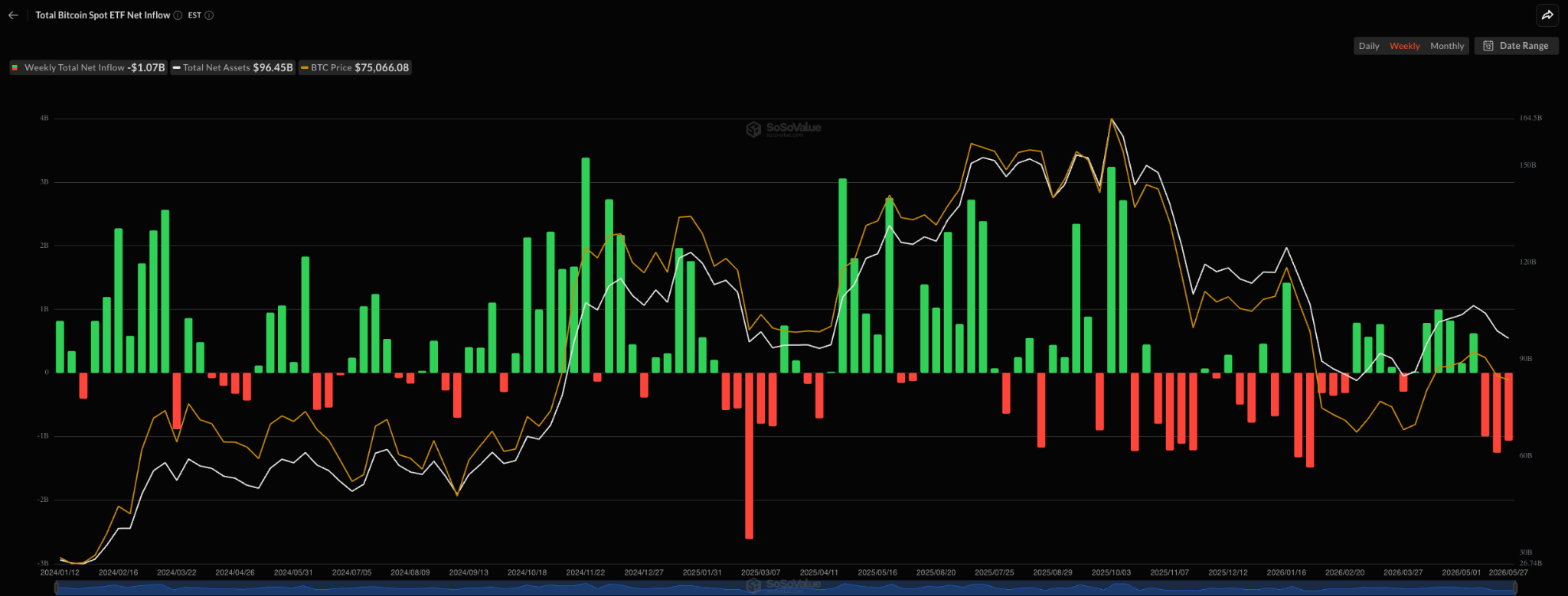
Spot Bitcoin exchange-traded funds (ETFs) recorded $1 billion in weekly net outflows, ending a six-week inflow streak that had drawn a combined $3.4 billion.

The week started on a cautiously optimistic note, with Monday posting modest inflows of $27.29 million, according to data from SoSoValue. The tide turned sharply on Tuesday, when investors pulled $233.25 million from the funds. Selling pressure intensified on Wednesday, the worst single day of the week, with outflows reaching $635.23 million.

A brief reprieve came on Thursday, as inflows of $131.31 million offered a momentary reversal. However, Friday erased that recovery as well, when a further $290.42 million exited the products, sealing the week in the red at exactly $1 billion in net outflows.

Spot Bitcoin ETFs see weekly outflows. Source: SoSoValue

The weekly loss marks a reversal from the previous six weeks, during which spot Bitcoin ETFs attracted consistent net inflows, with the week of April 17 standing out as the strongest, pulling in $996.38 million. This week’s selling leaves total net assets sitting at $104.29 billion, with cumulative net inflows across all products at $58.34 billion.

Related: Bitcoin ETFs Post Largest Outflows Since January as BTC Slips

Capital rotates toward AI, crypto

In a recent note, analysts at Bitunix said capital is “aggressively” rotating toward both the “AI growth narrative” and the institutionalization of crypto assets. NVIDIA, Google and Apple pushed toward fresh all-time highs last week, while AI chipmaker Cerebras surged more than 70% intraday on its IPO debut.

On the crypto front, the CLARITY Act, widely seen as one of the most consequential crypto market structure bills in the US, cleared the Senate Banking Committee. Coinbase shares rallied sharply subsequently as markets priced in the development, and Bitcoin climbed back toward the $82,000 mark.

However, Bitcoin’s price structure points to a market on edge, Bitunix said. They noted that heavy short liquidity sits clustered between $82,400 and $82,600, with $80,000 serving as the key support level to watch. “Current price action suggests the market has clearly entered a high-leverage volatility structure, as capital waits for further direction from the three dominant macro themes: AI expansion, U.S.-China relations, and crypto regulation,” they wrote.

Related: JPMorgan Boosts Bitcoin ETF Holdings in Q1 2026 Filing

Spot Ether ETFs see consistent outflows

Meanwhile, spot Ether ETFs recorded outflows across all five trading days last week. Tuesday was the worst session, with $130.62 million exiting the products, followed by $65.65 million on Friday, $36.30 million on Wednesday, $16.89 million on Monday, and a relatively muted $5.65 million on Thursday.

Combined, the five-day streak wiped $254.46 million from the funds, pulling total net assets down to $12.93 billion by week’s end.

Magazine: Guide to the top and emerging global crypto hubs — Mid-2026

Crypto longs lose $500 million as bitcoin slides to $78,000, SOL and XRP down 5%

0

A long-skewed liquidation cascade flushed leverage across the major tokens overnight, with the move tracking a global bond selloff and the worst session for U.S. stocks since March.

Andorra’s Fintech and Wider Digital Landscape in 2026

0

16Located between Spain and France, what is the tiny nation of Andorra’s fintech, digital and wider economic development in 2026?  

Andorra, with a population just shy of 90,000 people, does not enter the fintech conversation in the way larger markets do. There is no surge of venture capital, no crowded field of startups competing for scale. Instead, what is unfolding in 2026 is something quieter, more deliberate. It is a recalibration of a traditional financial centre adapting to a digital age.

It is the only country in the world that speaks Catalan as its official language. For decades, Andorra’s economic identity has been anchored in banking, tourism and retail. That foundation remains intact. With gross domestic product (GDP) estimated at roughly $4 billion and GDP per capita above $45,000, the country sits comfortably among high-income European economies via from the World Bank. Yet scale has never been its defining feature. What matters more is positioning. Andorra has historically acted as a niche financial jurisdiction. It is compact, discreet, and outward-looking. Today, the question is whether that model can evolve in a world where digital capability is no longer optional.

The digitalisation and growth of fintech in Andorra

The answer, increasingly, lies in adaptation rather than reinvention.

At the centre of this shift are Andorra’s banks. Institutions such as Andbank and Crèdit Andorrà are not being displaced by fintech. Instead, they are absorbing it. Digital onboarding, mobile banking platforms, and online wealth management tools are now standard features, not differentiators. The transformation is subtle but significant: rather than building a parallel fintech ecosystem, Andorra is embedding digital finance directly into its existing financial architecture.

Yet to describe Andorra as lacking fintech activity would be misleading. The ecosystem is small, but it is beginning to take shape in identifiable ways. According to startup tracking data, the country hosts a handful of fintech and fintech-adjacent firms. At present, it is around a dozen. These include names such as NEAR Mobile, EasyInvoice and Paymeter, which operate across payments, digital services and financial tooling. These are not large-scale disruptors, but they signal a gradual emergence of local innovation layered on top of the banking system.

aerial view of the city of Andorra la Vella, capital of Andorra. IMAGE SOURCE GETTY

More telling, however, is how fintech manifests through institutional initiatives. One of the clearest examples is MyAndbank, the fully digital banking platform developed by Andbank. Positioned as a fintech solution within a traditional banking group, it offers mobile-first services, free international transfers and integrated digital experiences, effectively functioning as a neobank within a legacy institution. Its expansion into crypto-asset services further reflects how Andorra is approaching fintech: cautiously, but with intent. This is allowing customers to buy and hold Bitcoin and Ethereum within a regulated environment.

This hybrid model extends across the sector. Creand Crèdit Andorrà has developed digital investment platforms and supported startup acceleration programmes, while MoraBanc has partnered with fintech providers such as Inbenta and QuickBlox to enhance digital interfaces, AI-driven services and customer interaction tools. Even externally, fintech firms are beginning to see Andorra as a viable base: Spanish crypto-infrastructure company Onyze secured regulatory approval to operate in the country, using it as a platform for broader European expansion.

What emerges is not a startup-led ecosystem, but a network of embedded innovation. This is showing where fintech is integrated into banking, infrastructure and cross-border services.

Regulation plays a central role in enabling this. The L’Autoritat Financera Andorrana (English: Andorran Financial Authority) has worked to align the country’s framework with European standards while preserving a degree of flexibility. This has been particularly evident in digital assets, where Andorra has introduced legislation allowing regulated crypto services. This in effect is creating space for both domestic and international players to operate.

At the same time, the government has begun to extend the conversation beyond finance. Digital transformation strategies, which are focused on connectivity, e-government and the attraction of technology-oriented businesses, are gradually taking shape. These initiatives are less about immediate disruption and more about long-term positioning. For a country of Andorra’s size, that is a rational approach.

Geography reinforces this logic. Positioned between Spain and France, but outside the European Union, Andorra operates in a delicate balance. It seeks regulatory alignment without losing flexibility. This has shaped its fintech trajectory: not trying to outcompete larger hubs, but carving out a niche within the broader European financial system.

What becomes clear in 2026 is that Andorra is not attempting to build fintech scale. It is attempting to build fintech relevance. Its ecosystem is small, institution-led, and internationally connected. However, it reflects a country adapting its traditional strengths to a digital environment.

For Andorra, it is not about volume, but about precision. They embed innovation where it matters most and what is suitable for their population size.

  • Richie Santosdiaz

    Richie is a global economic development advisor and Managing Partner of Santos-Diaz LLC, specializing in international trade and foreign direct investment across the UK, Middle East, and North America. With over 15 years of experience and a Masters from SOAS University of London, he has advised high-level governments and multinational corporates while contributing to major outlets like Forbes and the World Economic Forum. Currently based in Dubai, he leverages his background in emerging markets and RegTech to bridge the gap between global policy and private sector growth.

    View all posts


    Executive Economic Development Advisor (Emerging Markets) | Contributor

Can The Bullish ‘HYPE’ Sustain?

0

HYPE, the native token of decentralized exchange Hyperliquid, jumped more than 23% in the past 24 hours, climbing toward $47 on Friday to hit its highest level since October 2025.

HYPE/USDT daily chart. Source: TradingView

What is driving the sudden HYPE rally, and does the token have enough momentum to extend its bull run in the coming days?

Key takeaways:

  • This week’s multiple US spot HYPE ETF launches have strengthened the token’s institutional-demand narrative.
  • Coinbase becoming Hyperliquid’s USDC treasury deployer boosts HYPE prices.

HYPE ETF launches fuel institutional demand hopes

The biggest immediate catalyst behind HYPE’s rally appears to be the arrival of US-listed Hyperliquid exchange-traded products.

On Friday, Bitwise launched its spot Hyperliquid ETF, trading under the ticker BHYP on the NYSE.

HYPE/USDT daily chart. Source: TradingView

The fund gives investors regulated exposure to HYPE and intends to stake a portion of its holdings through Bitwise’s in-house staking division. Its sponsor fee is set at 0.34%, with a full waiver for the first month on the first $500 million in assets.

The launch follows 21Shares’ Hyperliquid ETF, THYP, which debuted on Nasdaq on Tuesday.

A day later, onchain data resource Lookonchain claimed that wallets linked to venture capital firm a16z had purchased nearly $67.5 million worth of HYPE tokens.

Source: X

The purchases reportedly took place in the month leading up to the ETF launches, adding to signs of growing institutional interest in Hyperliquid.

Sustained upside through May will likely depend on whether the HYPE ETFs attract meaningful inflows rather than simply generating launch-week speculation.

As of Friday, they were managing $3.17 million worth of assets, according to SoSoValue data.

US spot HYPE ETFs net flows. Source: SoSoValue

Coinbase, Circle deal adds structural tailwind for HYPE rally

HYPE’s rally also gained momentum after Coinbase announced on Thursday that it had become the official treasury deployer of USDC on Hyperliquid.

The deal strengthens USDC’s role as the main collateral and quote asset across Hyperliquid’s onchain markets.

The stablecoin already accounts for roughly $5 billion in supply on Hyperliquid, making it the dominant stablecoin in the ecosystem, according to DefiLlama.

Stablecoin market cap on Hyperliquid. Source: DefiLlama

Under the upgraded AQAv2 framework, Coinbase is expected to share the vast majority of reserve-yield revenue from USDC deployed on Hyperliquid with the protocol.

Circle will also serve as the technical deployer for USDC on Hyperliquid and has committed to stake 500,000 HYPE tokens.

“It’s an admission that Hyperliquid is too dominant in perps to displace, so better to align and capture distribution,” analyst Aylo said in a Thursday post, adding:

“We should see an increase of ~$140M+ in annualised revenue which will be used to buyback HYPE.”

CLARITY Act progress adds regulatory tailwind

HYPE’s rally also came as US crypto regulation showed signs of progress.

On May 14, the Senate Banking Committee advanced the CLARITY Act in a 15–9 vote, marking a key step for a bill that aims to define when digital assets fall under securities or commodities rules.

The update improved sentiment across crypto markets, sparking intraday rallies in Bitcoin, Ethereum, XRP and other top coins.

Still, the CLARITY Act is not law yet. The bill now heads to the Senate, where it will likely need broader bipartisan support to overcome procedural hurdles.

If it passes the Senate, lawmakers would still need to reconcile it with the House version before sending a final bill to President Donald Trump for approval.

HYPE rising wedge warns of 30% price correction

HYPE’s ongoing upside momentum remains inside what appears to be a rising wedge pattern, confirmed by the price trending inside two converging, upward-sloping trend lines.

In technical analysis, such a wedge typically plays out when the price breaks below its lower trend line and falls to the level at a length equal to the structure’s maximum height.

HYPE/USDT daily chart. Source: TradingView

Applying this rule to the HYPE chart brings its downside target to the $26.5–$31.20 range, depending on the potential breakdown point, as shown above. That means a potential 30%-45% correction by June or July.

Conversely, a decisive breakout above the rising wedge’s upper boundary may invalidate the bearish setup altogether, pushing HYPE’s price toward the $59–$60 range, aligning with the 1.0 Fibonacci retracement level shown below.

HYPE/USDT daily chart. Source: TradingView

HYPE’s daily relative strength index (RSI) also supports the short-term bullish case. The indicator remains below the overbought threshold of 70, suggesting the price still has room to extend its rally.

Crypto Industry Watches As Poland Advances Long-Delayed Regulatory Bill

0

Trusted Editorial content, reviewed by leading industry experts and seasoned editors. Ad Disclosure

Poland’s prime minister has tied the country’s repeated failure to pass crypto rules to a high-profile fraud case — a charge that added urgency to a parliamentary vote that had already failed twice before.

A Scandal Shapes The Debate

Prime Minister Donald Tusk pointed to Zondacrypto, a Polish crypto exchange now under a prosecutor’s fraud probe, as evidence of what happens when investor protections are not in place.

Thousands of the exchange’s users reportedly could not access their funds, and Tusk alleged the platform had ties to Russian capital and influence dating to its early years.

He argued that Poland’s inability to finalize a regulatory framework had slowed any official response to the crisis.

The exchange scandal cast a long shadow over this week’s sitting of the Sejm, Poland’s lower house of parliament, where lawmakers debated four separate crypto bills simultaneously.

Source: SEJM

On Friday, they approved the government-backed bill — numbered 2529 and supported by the Ministry of Finance — by a vote of 241 to 200. It was the third time the government had pushed this kind of legislation through parliament after President Karol Nawrocki vetoed two earlier versions.

The approved bill hands broad authority to Poland’s Financial Supervision Authority, known as the KNF, to monitor crypto market participants, impose administrative penalties, and block accounts and transactions when deemed necessary.

Critics Point To Unchanged Provisions

Not everyone in the crypto community welcomed the outcome. Market participants and commentators noted that the account and transaction blocking provisions — the same ones that prompted Nawrocki’s previous vetoes — remained largely intact in the final text. Proposed changes such as stronger judicial oversight of enforcement actions were not included.

BTCUSD trading at $79,182 on the 24-hour chart: TradingView

With those concerns unresolved, many observers expect the president to veto the bill again. That prospect worries industry players, since a third rejection would deepen regulatory uncertainty at a particularly inconvenient time.

Poland is required to bring its rules in line with the European Union’s Markets in Crypto-Assets Regulation, known as MiCA, with implementation deadlines approaching in July.

Four Bills, One Outcome

The vote came after lawmakers reviewed competing proposals from four separate sources: the government, the president, the Confederation party, and a parliamentary group. A committee merged the texts before the final vote, and the government version ultimately prevailed.

Featured image from Hotels.com, chart from TradingView

Editorial Process for bitcoinist is centered on delivering thoroughly researched, accurate, and unbiased content. We uphold strict sourcing standards, and each page undergoes diligent review by our team of top technology experts and seasoned editors. This process ensures the integrity, relevance, and value of our content for our readers.

CLARITY Act Faces Partisan Fight Over Ethics on Senate floor

The US Senate Banking Committee passed the crypto framework CLARITY Act yesterday.

Now, the bill, for which the crypto industry has heavily lobbied since it was introduced in 2025, will head to the Senate floor for a broader debate. 

As Cointelegraph reported, over 100 amendments were proposed while lawmakers hashed out the exact language of the bill. These covered a wide range of issues, including ethics, AI sandboxes and stablecoin yields.

But many of these fell apart. While two Democrats joined with their Republican colleagues, the vote was mainly along party lines. 

The chances for the bill to pass look good, with nearly all Republicans and some Democrats supporting, but increasing partisan gridlock ahead of the elections could still delay passage. 

CLARITY gets out of committee on party lines

After yesterday’s session, Senator and committee chairman Tim Scott announced “a successful bipartisan markup” in advance of the bill proceeding to the Senate floor.

Scott speaks at the markup session. Source: US Senate

“After nearly a year of good-faith bipartisan negotiations, Senate Banking Committee Republicans and Democrats came together today,” he said.

While the tone of Scott’s announcement leaned on supposed bipartisanship, the actual vote was mostly split along party lines. All 13 Republican members of the committee voted to advance the bill. All but two Democrats voted against, save for Senators Ruben Gallego and Angela Alsobrooks.

Contrary to Scott’s message of bipartisanship, Senator Jack Reed stated that Republicans arbitrarily dismissed Democrats’ concerns about the bill, which ranged from how crypto could enable crime to the president’s use of crypto projects for personal enrichment. 

Indeed, the minority released a brief after the vote, outlining its concerns. They stated that the current version, as passed by the majority, fails to adopt global anti-money laundering standards, exempts DeFi protocols from financial standards and doesn’t close loopholes for crypto mixer services. 

Related: Who supports CLARITY on the US Senate Banking Committee?

While there are clearly some pro-crypto Democrats in Congress, whether the bill can progress depends on them crossing the aisle to vote against their own party. 

Currently, the Republicans hold a 53-seat majority in the 100-seat Senate. To pass CLARITY, they’ll need 60 votes, so at least seven Democrats willing to vote with them. 

Republicans (red) hold a 53-seat majority in the Senate.

At the Wyoming Blockchain Summit last year, Scott said that there were 12 Democrats open to the market structure bill, giving Republicans and the crypto lobby what they need to cross the line.

But that may not ring as true now as it did then. The Congressional Progressive Caucus announced opposition to any bill which could “allow the President and his family to enrich themselves, engage in corruption, and sell access to the White House through cryptocurrency.” Notably, CLARITY’s current draft does not contain any such provisions. 

Progressive groups have called on lawmakers to address these concerns. A group of organizations including Americans for Financial Reform, Demand Progress Action, Indivisible and Public Citizen wrote a letter on May 8.

“A bill without strong ethics provisions elevates the dangers of cheating consumers and investors, distorting and destabilizing financial markets, hindering competition, eroding longstanding investor protection laws, and making a mockery of regulatory enforcement,” they said.

Ryan Cooper, a senior editor at progressive politics publication The American Prospect, even suggested that Democrats who voted with the crypto industry ought to be primaried. “Allowing yourself to be bought by the crypto lobby is unforgivable,” he wrote

Ethics could represent a politically volatile and important sticking point as the bill is debated on the Senate floor. 

Industry still optimistic 

Despite the largely partisan vote and the lingering ethics concerns, the crypto industry was largely optimsitc about the May 14 markup session. 

Javier Martinez, CEO and former chief legal officer at crypto trading platform sFOX, said the vote represented a “major step toward resolving crypto’s regulatory identity crisis in the United States.”

Congress is “moving toward replacing regulatory ambiguity with a more defined legal framework. And markets respond to clarity,” he told Cointelegraph.

Ji Hun Kim of the Crypto Council for Innovation said the vote will make the US more competitive in the digital asset space. CLARITY will “ensure that our country leads when it comes to digital assets policy and innovation,” he said. 

Blockchain investors and Blockstreet chief operating officer Kyle Chasse said, “This is the biggest regulatory moment in crypto since spot ETFs.”

Notably, the bill was held up for months as the banking and crypto lobbies argued over whether stablecoins could bear yields. Banks claimed this could lead to a critical flight of deposits, endangering financial stability, while crypto accused banks of stifling competition.

The version that passed markup last night sided with the banks, but would still allow crypto platforms to offer other activity-based rewards.

Even then, pseudonymous crypto trader 10 Delta said, “The yield ‘ban’ is cosmetic & simply something for banks to tout as a victory.” 

“It bans stablecoins from paying you interest for just holding them: the way a savings account does. But it explicitly allows stablecoins to pay you rewards for using them: buying things, lending, providing liquidity, participating in any program.”

Ultimately, the focus is still on the market. Alexander Lorenzo, founder and chief investment officer of CoinPicks Capital, said, “The last crypto bill to clear this exact process was the GENIUS Act in July 2025. Bitcoin hit an all-time high of $123,000 within weeks.”

“CLARITY is bigger. It covers the entire crypto market, not just stablecoins.”

Magazine: eToro founder timed Bitcoin top perfectly due to belief in 4 year cycles

ZachXBT Claims LAB Insiders Control 95% After $6B Crypto Pump

0

Trusted Editorial content, reviewed by leading industry experts and seasoned editors. Ad Disclosure

Crypto On-chain investigator ZachXBT has escalated his accusations against LAB, alleging that insiders likely control more than 95% of the token’s supply after a rally that pushed its fully diluted valuation to roughly $6 billion. The claims center on opaque private loans, OTC deals, changing vesting terms, market-maker coordination and what he described as a retail-facing market structure where key supply information is visible to insiders but not ordinary traders.

The latest thread is not ZachXBT’s first warning on LAB. On May 7, he publicly accused LAB founder Vova Sadkov of crypto market manipulation through centralized exchanges and said he had offered a $10,000 bounty for contracts, chat logs and insider documents tied to LAB market-making activity on Bitget spot, Bybit perpetuals, Binance perpetuals and OKX perpetuals.

ZachXBT Points To Unknown Float And Insider Supply

LAB was founded by Sadkov and Mark as a crypto trading platform and held its token generation event in October 2025, according to ZachXBT’s account. He also tied the founders to Eesee, or ESE, a prior project he said left some investors feeling abandoned after the team moved on.

A central issue in the report is the lack of a clear token distribution. ZachXBT said CoinGecko, RootData and CoinMarketCap report different float figures, while LAB’s own documentation provides “zero details” on the supply breakdown. He listed Lemniscap, OKX, Animoca, GSR, Gate, KuCoin, Mirana and Amber among LAB’s backers, adding that several of those entities are also connected to venues where the token trades.

“Based on my analysis of onchain activity, insiders likely control >95% of supply currently,” ZachXBT wrote.
The accusation follows a sharp move in LAB earlier this month. Prior coverage of ZachXBT’s May 7 warning noted that LAB had surged more than 537% in one week, reaching above $4.65 after previously trading below $1, with up to 99% of supply potentially controlled by insiders or market makers, according to that report.

ZachXBT also alleged that LAB’s team unilaterally changed public sale terms on Legion from a three-month cliff to a nine-month cliff. He said other creators had publicly reported waiting months for marketing campaign payments without clear follow-up from the team.

The thread then turns to private financing arrangements. ZachXBT cited one draft loan contract from the first quarter of 2026 offering 7.5% per month for six months, with The Lab Management Ltd., a BVI shell, listed as borrower and Sadkov signing as director. In the event of default, repayment would be made in LAB at “market price,” according to his description.

He also alleged that the borrower wallet from the loan contract was the same wallet used for public LAB buybacks and tied it on-chain to a separate Wildcat borrower address. Funds related to LAB, he claimed, flowed to Sadkov’s alleged personal crypto exchange accounts, including accounts that had previously received deposits tied to Eesee.

ZachXBT said additional private OTC and loan deals had circulated since January 2026, including loans at 5% per month, OTC allocations at a 60% discount with a five-month cliff, guaranteed discount tranches and a more recent KOL Capital pitch at an 80% discount. Under that pitch, he said, KOLs were required to post multiple times in support before unlock or risk being blacklisted.

“These create hidden supply unlocks retail cannot see,” ZachXBT wrote. “As price has gone up, the OTC discounts have widened.”

Crypto Exchange Flows Put Bitget In Focus

The most concrete market-structure allegation concerns large crypto exchange flows. ZachXBT said insiders deposited 226 million LAB, which he described as a large percentage of float, to Bitget deposit addresses in March and April.  ZachXBT had identified LAB-linked wallets transferring 226 million tokens to Bitget, raising insider-trading concerns.

According to ZachXBT, those deposits remained dormant until roughly 100 million LAB was withdrawn in recent days. He said that from May 11 to May 12, nearly 100 million LAB, worth about $482 million, was withdrawn from Bitget to ten addresses. He also argued that an unknown market maker operating through Chinese crypto exchanges appeared to be using a playbook similar to RIVER, RAVE, SIREN, MYX and SKYAI.

“It seems everyone has private info except retail. Team knows the unlocks, MM knows the positioning, OTC buyers know their cliffs. Retail only sees LAB price.”

ZachXBT called on Bitget, Binance and Gate to freeze alleged insider profits and redistribute them to users, or to delist earlier without waiting for public pressure. He also warned traders against interpreting the thread as a short signal: “This is NOT a recommendation to short. With this much supply control, shorts potentially give insiders more fuel to manipulate the price higher.”

At press time, the total crypto market cap stood at $2.6 trillion.

Total crypto market cap
Total crypto market cap must hold the 20-week EMA, 1-week chart | Source: TOTAL on TradingView.com

Featured image created with DALL.E, chart from TradingView.com

Editorial Process for bitcoinist is centered on delivering thoroughly researched, accurate, and unbiased content. We uphold strict sourcing standards, and each page undergoes diligent review by our team of top technology experts and seasoned editors. This process ensures the integrity, relevance, and value of our content for our readers.