Home Blog Page 239

DeFi Yields Are Too Damn Low! Here's Why

0

DeFi is approaching a breaking point.

After a wave of hacks and growing concerns around smart contract risk, liquidity risk, and hidden dependencies, the biggest question in crypto is no longer just how much yield you can earn, but whether that yield is actually worth the risk.

A Russian stablecoin built to dodge sanctions says it can survive even if they're lifted

0

A7A5, the Russia-linked stablecoin built to move money around banking restrictions, says faster trade settlement, yield and regional crypto infrastructure could keep it relevant even if geopolitical tensions ease.

Intesa Sanpaolo’s Crypto Portfolio Hits $235M as Italy’s Biggest Bank Goes Deeper Into Digital Assets

0

Intesa Sanpaolo, Italy’s largest bank, more than doubled its crypto exposure in the first quarter of 2026, with holdings climbing from approximately $100 million at the end of 2025 to around $235 million as of March 31.

The growth was driven by expanded Bitcoin positions, with the bank adding to positions in both the ARK 21Shares BTC ETF and BlackRock’s iShares Bitcoin Trust ETF. It also entered Ethereum for the first time through BlackRock’s iShares Staked Ethereum Trust, and picked up a fresh stake in Ripple’s XRP via the Grayscale XRP Trust ETF, worth approximately $26 million, according to a report by local crypto outlet Criptovaluta.it.

Intesa also opened a new position in iShares Bitcoin Trust call options, its first derivatives play in the space. The bank previously confirmed to Criptovaluta.it that its crypto positions are held for proprietary trading purposes, though it has not disclosed whether any of the assets are also used to hedge products offered to professional clients, the report said.

Source: Criptovaluta.it

On the other hand, the bank reduced its Solana holdings, which had featured prominently in the prior quarter. Its position in the Bitwise Solana Staking ETF slashed from 266,320 shares to just 2,817, a near-total exit.

Related: Banking Circle Joins Europe’s Stablecoin Settlement Race

Intesa adds BitGo, dumps Bitmine

On the equities side, the bank made several adjustments to its crypto stock holdings. It added 165,600 shares of BitGo for the first time, while dumping the Bitmine position. The bank also closed out its put options on Strategy and trimmed its stake in Cantor Equity Partners II, the vehicle through which tokenization firm Securitize is set to list. Coinbase shares also increased from 1,500 to 10,357.

The moves come as Intesa deepens its ties to the digital asset sector. Last month, Ripple announced it would offer its custody services to the Italian banking group.

Intesa shares closed at 5.74 euros on Friday, down 1.56% on the day and off 3.14% year-to-date, according to Yahoo! Finance.

Related: Europe Bitcoin Treasury Model Won’t Mirror Strategy: PBW 2026

European banks expand crypto offerings

More European banks are moving into crypto, with Spain’s BBVA, France’s BPCE and Belgium’s KBC among those already live with retail trading services. BBVA became the first major Spanish bank to offer 24/7 Bitcoin and Ether trading through its mobile app, while BPCE launched in-app crypto trading via regulated subsidiary Hexarq, targeting 12 million customers by 2026.

At the infrastructure level, a consortium of 12 major European banks, including BNP Paribas, ING, UniCredit and Deutsche Bank, formed Qivalis to issue a MiCA-compliant euro-backed stablecoin, targeting a launch in the second half of 2026.

Magazine: Guide to the top and emerging global crypto hubs — Mid-2026

Grove Launches Basin With up to $1 Billion in Daily Liquidity for Tokenized Real-World Assets

0

Grove has launched Basin, a DeFi protocol providing instant onchain stablecoin liquidity for tokenized real-world assets with up to $1 billion in daily liquidity capacity.

Grove has launched Basin, a DeFi protocol designed to provide instant onchain stablecoin liquidity for tokenized real-world assets. The platform supports up to $1 billion in daily liquidity, enabling rapid settlement of stablecoin transactions tied to tokenized RWAs on the blockchain.

Basin addresses a key infrastructure gap in the emerging tokenized real-world assets market by allowing users to access stablecoin liquidity without delay. The protocol facilitates the conversion and settlement of digital representations of traditional assets—including real estate, commodities, and other RWAs—into stablecoins for immediate use within DeFi ecosystems.

The $1 billion daily liquidity capacity positions Basin as a significant liquidity provider for the growing RWA tokenization sector, which has expanded as institutions seek to bridge traditional finance and blockchain networks. By enabling instant settlement in stablecoins, the protocol reduces friction in converting tokenized assets back to dollar-denominated value.

Basin’s launch reflects broader infrastructure development in DeFi to support real-world asset tokenization, a trend gaining momentum as regulatory frameworks for on-chain RWAs continue to develop globally.

Sources: BusinessWire

This article was produced with the help of AI flows.

Michael Saylor Floated Bitcoin Sales Idea to Avoid ‘Impairing The Asset’

0

Strategy executive chairman Michael Saylor said he raised the possibility of selling Bitcoin during Strategy’s recent earnings call to protect the asset’s long-term interests.

“We own about $65 billion worth of Bitcoin. If the market thought we would never sell it, the credit rating agencies would say, Well then, I guess it’s not an asset,” Saylor told Scott Melker on The Wolf Of All Streets podcast published to YouTube on May 10.

“There is $20 to $100 billion of liquidity in the Bitcoin market that is not correlated to our equity or to our credit. If we were to say we’re never going to take advantage of that liquidity and we’re never going to use that asset, then we’re impairing the asset, which 98% of the company is built on,” Saylor explained, adding:

“It’s pretty important to us to send the signal that if we need to, we can.”

It comes after growing speculation within the Bitcoin community after Saylor said during Strategy’s first-quarter earnings call that his company could sell Bitcoin to “inoculate” the market against sudden panic or to reinforce confidence in the company, in contrast to its long-standing “never sell” Bitcoin strategy.

Michael Saylor spoke to Scott Melker on The Wolf Of All Streets podcast. Source: The Wolf Of All Streets

Bitcoiners began to speculate on social media. Prominent Bitcoiner and BnkToTheFuture CEO Simon Dixon said on May 7 that Strategy “might need to sell some Bitcoin when the financial industrial complex manipulates our Bitcoin collateralized debt obligations and perpetual dividends wrappers.”

Strategy has been consistently buying Bitcoin since August 2020, when it began holding Bitcoin as a primary treasury asset. The company now holds 818,869 BTC at an average purchase price of $75,540 per coin, according to its website.

Related: Sharplink CEO points out 3 catalysts for Ethereum’s price to surge higher

On Monday, Cointelegraph reported that Strategy acquired 535 Bitcoin for $43 million between May 4 and May 10 at an average price of $80,340 per BTC.

While Saylor is known for regularly posting “Never sell your Bitcoin” on X, on May 6, he wrote, “Buy more bitcoin than you sell.”

Magazine: eToro founder timed Bitcoin top perfectly due to belief in 4 year cycles

Cointelegraph is committed to independent, transparent journalism. This news article is produced in accordance with Cointelegraph’s Editorial Policy and aims to provide accurate and timely information. Readers are encouraged to verify information independently.

Coinbase Lands Hyperliquid Stablecoin Role Eight Months After Governance Vote Picked Native Markets

0

Native Markets is selling its brand assets to Coinbase as USDC becomes the protocol’s canonical quote asset.

Coinbase will become the official treasury deployer of USDC on Hyperliquid, the companies announced Thursday, ending the short run of USDH, the native stablecoin that validators selected over more established competitors less than a year ago.

Native Markets, the startup that won Hyperliquid’s September governance vote to issue USDH, has agreed to sell its brand assets to Coinbase, the company announced.

USDH markets will sunset gradually. USDC, already the dominant stablecoin on the platform with roughly $5 billion in supply, will become the quote asset across Hyperliquid’s HIP-1 through HIP-4 markets under an upgraded framework called AQAv2, Hyperliquid confirmed.

Circle will serve as technical deployer and has committed to stake 500,000 HYPE tokens. Coinbase announced it has also increased its staked HYPE position as part of the arrangement.

Reversing the Governance Vote

The reversal is notable for what came before it. In September, Hyperliquid validators ran an on-chain governance vote to select an issuer for a native stablecoin. The premise was that Hyperliquid held billions in USDC, and the yield on those reserves — estimated at $150 million to $220 million annually — flowed to Circle, not the protocol. A native stablecoin would redirect that yield back into the ecosystem through HYPE buybacks and the Assistance Fund.

The vote ran September 11–14. Native Markets won with roughly two-thirds of staked HYPE, beating Paxos, Ethena, Frax, BitGo, and Agora, The Defiant reported. The outcome was striking because Native Markets offered less generous financial terms than its rivals: a 50/50 split of reserve yield between the Assistance Fund and ecosystem growth initiatives.

Paxos had offered 95% of yield for HYPE buybacks; Ethena offered 95% plus a minimum of $75 million in ecosystem incentives; Frax and Agora pledged 100%. Native Markets won anyway as validators favored a team that was Hyperliquid-native over institutions offering better economics but less ecosystem integration. The Hyper Foundation abstained from the vote.

The governance process drew immediate criticism, The Defiant reported at the time. Haseeb Qureshi of Dragonfly — an investor in both Agora and Ethena — alleged a backroom deal, noting that Native Markets submitted the first proposal within 90 minutes of the RFP going live. One validator, Hypurrscan, held approximately 15% of total voting power. The process was also compressed: proposals were due September 10, validator signaling began September 11, and the vote closed September 14.

Stalling USDH Supply

USDH launched in late September 2025 with $2.2 million in day-one trading volume. Eight months later, its supply had stalled around $100 million while USDC on the platform had grown to approximately $5 billion.

Under AQAv2, Coinbase will share “the vast majority” of reserve yield revenue from its Hyperliquid USDC supply with the protocol — the same yield-sharing model USDH pioneered.

Circle, which began accumulating HYPE and deploying native USDC on HyperEVM within days of the September vote, The Defiant reported, will handle minting, redemption, and cross-chain infrastructure.

Hyperliquid said that, in a future network upgrade, canonical outcome markets will use USDC as the quote asset. The Hyper Foundation said it will issue grants to HIP-1, HIP-3 deployers, and builders who integrated USDH to support migration.

Incumbents at the Table

Native Markets framed the outcome as a proof-of-concept.

“We’re proud to have brought incumbents to the table with USDH, shifting economics not just for Hyperliquid, but for all stablecoin ecosystems,” the company said.

Native Markets also said it remains independent and did not disclose the terms of the brand asset sale.

Not everyone read it that way.

“The bullish read is ‘incumbents came to the table,'” one user wrote on X. “The honest read is the incumbent just bought the table.”

USDH remains fully backed during the transition. Feeless conversions to USDC and fiat are available through Native Markets’ dashboard.

Dune Analytics Cuts 25% of Staff, Doubled Down on AI and Institutional Crypto Data

0

The crypto data platform laid off a quarter of its workforce this week while refocusing on AI-powered dashboards and institutional adoption of onchain assets.

Dune Analytics announced a significant restructuring Thursday, laying off 25% of its staff while doubling down on artificial intelligence and institutional adoption of blockchain data.

The crypto data provider, which has served major cryptocurrency companies since 2018, is shifting its product focus to two core areas: AI-powered data tools and financial institutions moving assets onchain.

The platform emphasized it remains well capitalized and committed to its mission of making crypto data accessible.

“We’re all-in on two shifts: AI and institutions coming onchain,” the company stated in its announcement. Dune said it has built the only end-to-end stack for crypto data infrastructure, encompassing ingestion, quality assurance, storage, cleaning, normalization, and querying.

A key product in this strategy is Dune MCP, which allows teams and agents to build dashboards and workflows without requiring SQL knowledge or managing data infrastructure costs. The platform noted it already serves “virtually every leading crypto company” and is now expanding to serve major financial institutions as traditional assets like currencies, stocks, bonds, and commodities migrate onchain.

Dune characterized the affected employees as “exceptional people” and encouraged hiring managers to reach out for crypto talent. The company has weathered multiple market cycles since its 2018 founding, outlasting other crypto data providers that have shuttered during downturns. The restructuring underscores a broader industry shift toward institutional-grade infrastructure and AI-integrated tools for blockchain data analysis.

Sources: Dune Analytics (Official)

This article was produced with the help of AI flows.

US CLARITY Act Will Be a ‘Boon For Domestic Innovation’: A16z

The US CLARITY Act, which aims to provide the US crypto industry with more regulatory clarity, could have a positive ripple effect beyond the crypto sector itself, according to venture capital firm a16z crypto.

“If the US provides builders with regulatory clarity, it will be a boon for domestic innovation,” a16z crypto said in an X post on Friday.

A16z pointed to the passage of the GENIUS Act in July 2025, which created a regulatory framework for stablecoins, as a possible indication of what may happen following the CLARITY Act.

“Its passage led to unprecedented growth and adoption, which is not only good for the U.S. economy, but is also good for long-term dominance of the US dollar,” a16z crypto said. The US dollar index, which tracks the dollar’s strength against a basket of major currencies, is 99.27 at the time of publication, up 1.28% over the past 30 days, according to TradingView. A16z said:

“When our legal frameworks are designed to both foster innovation and protect consumers, America leads and the world benefits.”

Source: Cynthia Lummis

Since the US CLARITY Act was introduced in July 2025, the crypto industry has been widely speculating about its potential impact on global markets.

Sharplink Gaming CEO Joseph Chalom recently said that while many view the legislation as “a US phenomenon,” it is also being seen as a major signal for other jurisdictions around the world.

Source: Kalshi Crypto

US asset management firm Grayscale said in a report published on Friday that the odds of the legislation passing are high in the firm’s view, but “the bill will require bipartisan support to clear the full Senate and become law.”

“There are still a few hurdles to clear before CLARITY can become law,” Grayscale said.

Related: US CLARITY Act brings ‘major spike of euphoria’ to Bitcoin: Santiment

The comments came after a Thursday session of the US Senate Banking Committee, in which all 13 Republican members and two Democrats voted to advance the bill, with nine Democrats also voting no on the bill.

Grayscale pointed out that Republicans currently hold 53 seats, meaning at least seven Democrats would need to support the bill. “We believe that’s possible: the GENIUS Act cleared the Senate with 66 votes including 18 Democrats,” Grayscale said.

Magazine: ETH stalls at $2.4K five times, SOL to rally to $120: Market Moves

Thorchain Exploit Triggers Security Fears Across DeFi

0

Trusted Editorial content, reviewed by leading industry experts and seasoned editors. Ad Disclosure

Blockchain tracking firm Arkham Intelligence has labeled a set of suspicious wallets as “THORChain Exploiter” addresses, with one Bitcoin-linked wallet holding close to 36.85 BTC — worth roughly $3 million — and a separate Ethereum wallet carrying around 216 ETH. The funds are sitting there, visible on-chain, linked to two addresses that security researchers have already flagged publicly.

Who Found It First

The person who spotted the attack before anyone else did was on-chain investigator ZachXBT. He reported suspicious movement tied to THORChain’s router infrastructure, describing how attackers shifted roughly $7.2 million in assets — including USDT, USDC, and wrapped Bitcoin — across several blockchains before converting them into ETH.

His initial estimate of losses above $7.4 million was later revised upward. The total stolen, according to ZachXBT, may now exceed $10 million.

THORChain is a cross-chain trading protocol that lets users swap crypto assets across different blockchains without relying on a centralized exchange. That design also means its infrastructure touches multiple networks at once — and in this case, that became a vulnerability. The attack hit Bitcoin, Ethereum, BNB Chain, and Base simultaneously.

Security firm PeckShield independently confirmed the breach. Based on their estimates, attackers walked away with around 36.75 BTC worth close to $3 million, along with roughly $7 million more pulled from the Ethereum, BNB Chain, and Base ecosystems.

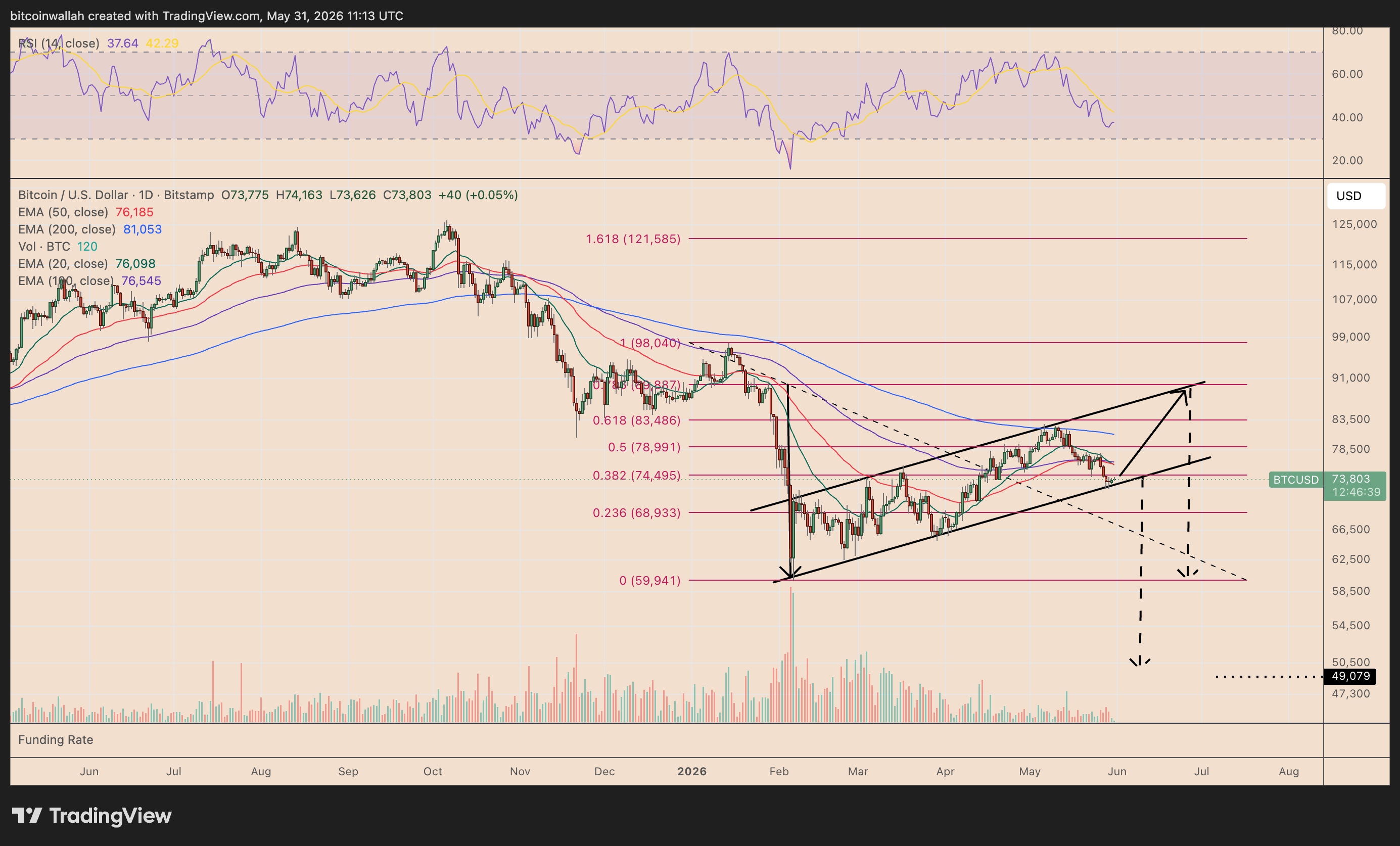
BTCUSD now trading at $77,926. Chart: TradingView

Markets React, Team Goes Quiet

RUNE, THORChain’s native token, dropped close to 14% in the hours following news of the breach, sliding toward the $0.50 mark as traders moved to cut their exposure. The price drop was fast. The official response was not.

As of reporting, THORChain had not issued a public statement explaining the scope of the exploit or what steps were being taken to address it.

That silence has added to the anxiety in the market. The protocol survived earlier security incidents by tapping into treasury reserves and recovery mechanisms, but without clarity from the team, it is difficult to know whether a similar path is possible this time.

A Pattern That Keeps Repeating

Cross-chain infrastructure has repeatedly been the site of major losses in decentralized finance. Bridges and routing systems that connect different blockchains require complex code — and complex code creates more opportunities for something to go wrong. The THORChain attack fits that pattern.

The stolen assets remain in the flagged wallets for now. Whether they stay there is another question.

Featured image from Unsplash, chart from TradingView

Editorial Process for bitcoinist is centered on delivering thoroughly researched, accurate, and unbiased content. We uphold strict sourcing standards, and each page undergoes diligent review by our team of top technology experts and seasoned editors. This process ensures the integrity, relevance, and value of our content for our readers.

PrimeXBT: How Crypto Funding Changes Access to Global Markets

0

Trusted Editorial content, reviewed by leading industry experts and seasoned editors. Ad Disclosure

Most traders who hold Bitcoin or Ethereum are sitting on capital they cannot easily deploy.

To trade global markets with it, the traditional route goes like this: convert to fiat, pay a conversion spread, wait for the transfer, fund a separate brokerage account, and then execute. Conversion fees and delays vary by provider, but they all eat into your timing and your margin. By the time you are in position, the opportunity you spotted may have already played out. For active traders, that friction does not just cost money. It costs access.

This is where crypto-funded trading changes the equation. PrimeXBT, a multi-asset broker and crypto service provider, was among the first to let traders use crypto as margin for FX, gold, indices and other markets, without converting, without transferring, and without leaving the crypto ecosystem.

Your crypto is already capital. Start using it that way.

The mental model most crypto holders carry is that Bitcoin and Ethereum are assets to be managed separately from everything else. Trading stocks means a brokerage account. Trading FX means another account. Crypto sits in its own silo.

PrimeXBT was built on a different premise from the start. Since 2018, the platform has treated crypto as the base layer of trading activity. It is the collateral that funds your entire trading operation across asset classes. You do not move it out to access global markets. You use it where it already is.

With its new native platform, PXTrader 2.0, you can open your account in BTC, ETH, USDT, USDC or USD and trade across 350+ instruments, including forex pairs, commodities like gold and oil, global indices including the Nasdaq and S&P 500, individual shares, and crypto futures, all from that single account. When the Nasdaq moves on a Fed decision, you can be in position within seconds. When oil spikes on a geopolitical headline, your crypto margin is already there.

What PXTrader 2.0 gives you in practice

The platform is built around the reality that active traders rarely stay in one market for long. That thinking is reflected across the entire trading experience.

Leverage goes up to 1:1000 depending on the market, with cross or isolated margin giving you precise control over exposure. You decide how much of your balance backs each trade, not the platform. Hedge mode and netting mode give you further flexibility over how positions interact, depending on your strategy.

Spreads are tighter on PXTrader 2.0 than on the previous PXTrader platform. On CFDs, spreads start from 0.2 pips, with VIP tiers offering discounts of up to 25% as trading activity increases. On crypto futures, fees start from 0.01% maker and 0.045% taker, while with VIP tiers you can reduce taker fees to as low as 0.015%. For traders who are active across multiple markets daily, tighter pricing compounds into a real cost advantage over time.

The charting tools are powered by TradingView, with 100+ indicators, no indicator limit, and multi-chart layouts that let you track several markets simultaneously. Execution happens in the same interface. One-click trading, a clean order form with limit, stop and market orders, and a customised buy/sell on-chart tile for fast entries in volatile conditions. You are not switching between analysis and execution. You are doing both in one place.

MetaTrader 5 is also integrated for traders who prefer that environment, all within the same PrimeXBT ecosystem.

The practical side

There is no minimum deposit for trading accounts and no withdrawal fees. If you need to convert between crypto and fiat, you can do it inside the platform without touching any external exchange.

PrimeXBT was crypto-native before that phrase existed. The idea that digital assets and global markets belong in the same environment was not a product pivot or a response to a trend. It was the original premise, built in 2018 and still running the same logic today. That same foundation now powers PXTrader 2.0.

Being positioned to act fast

This year repeatedly showed why cross-market access and capital flexibility matter. When tensions around the Strait of Hormuz escalated, oil, currencies, gold and crypto all reacted within the same session. The traders who captured those moves were not the ones scrambling to transfer funds between platforms. They were already in position, because their capital was already there. 

This is where PrimeXBT continues to make a difference, offering a trading environment where crypto and global markets operate within a single ecosystem.

Start trading with PrimeXBT.

About PrimeXBT

PrimeXBT is a global multi-asset broker and crypto asset service provider trusted by traders in more than 150 countries. The platform bridges traditional and digital markets within one integrated environment, redefining versatility and innovation in online trading. Clients can access Forex, CFDs on indices, commodities, shares, crypto, and Crypto Futures, as well as buy, store and exchange cryptocurrencies. This unified experience extends across both the native PXTrader 2.0 platform and MetaTrader 5, supported by advanced risk-management tools and a wide range of funding options in crypto, fiat and local payment methods. Since 2018, PrimeXBT has focused on empowering traders through broad multi-asset access, fair and transparent conditions, professional-grade technology and dedicated human support. By combining expertise, trust and a client-first approach, PrimeXBT sets a benchmark of excellence in the financial industry and provides traders with the tools they need to trade, grow and succeed with confidence.

Disclaimer: The content provided here is for informational purposes only and is not intended as personal investment advice and does not constitute a solicitation or invitation to engage in any financial transactions, investments, or related activities. Past performance is not a reliable indicator of future results. The financial products offered by the Company are complex and come with a high risk of losing money rapidly due to leverage. These products may not be suitable for all investors. Before engaging, you should consider whether you understand how these leveraged products work and whether you can afford the high risk of losing your money. The Company does not accept clients from the Restricted Jurisdictions as indicated on its website / T&Cs. Some products and services, including MT5, may not be available in your jurisdiction. The applicable legal entity and its respective products and services depend on the client’s country of residence and the entity with which the client has established a contractual relationship during registration.


Editorial Process for bitcoinist is centered on delivering thoroughly researched, accurate, and unbiased content. We uphold strict sourcing standards, and each page undergoes diligent review by our team of top technology experts and seasoned editors. This process ensures the integrity, relevance, and value of our content for our readers.