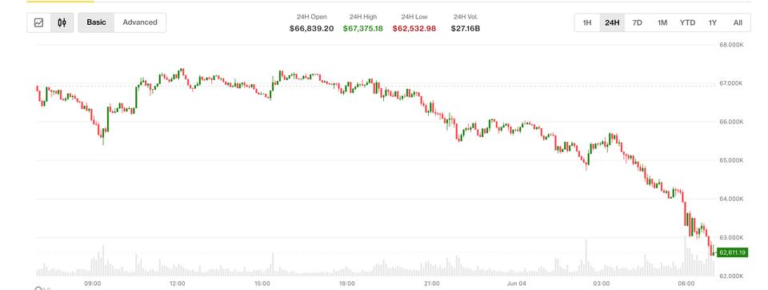
Bitcoin BTC$66,924.57 extended losses early Thursday, falling to $63,000 for the first time since February 24. The cryptocurrency has lost over 14% this week alone and 21% over the past four weeks, according to CoinDesk data.
The selloff has triggered demand for protective options plays, pushing the fear gauge, the 30-day implied volatility index BVIV, to 53.17, its highest level since April 2.
Investors yanked another $50 million from U.S.-listed spot ETFs Wednesday, marking the 13th consecutive trading day of outflows from these vehicles, which are viewed as a proxy for institutional demand.
“A broad sell-off in crypto, which started with Strategy’s transfer triggering ETF outflows and is now fueled by speculative news about Mt. Gox liquidations, signals a potential continued sell-off. BTC at $50k is a level some are starting to talk about as a bottom this year,” Paul Howard, senior director at liquidity provider Wincent, said in an email.
“Whilst there is a long way to go, the absence of catalysts and the movement of liquidity into other tech sectors such as AI indicate we have further volatility ahead,” he added.
Some traders are closely watching levels around $60,000 as potential support. The February crash saw prices nearly test that level on some exchanges before the sell-off ran out of steam
“The first major zone I’m watching is the low $60k region, because that is where a lot of important pieces start coming together. We have the local low around $59.9k. We have the 200-week moving average now sitting in that same general area,” analysts at data tracking platform Material Indicators said in an email.
“That does not guarantee support. It simply tells us this is where the market should have to make a decision,” they added.
The US Commodity Futures Trading Commission has rescinded a long-standing policy that prevented it from accepting a lawsuit settlement if the defendant denied the agency’s allegations.
The CFTC said on Wednesday that it scrapped the policy, first adopted in 1998, because it “may have created an incorrect impression that the Commission is trying to shield itself from criticism.”
The language was similar to that provided by the US Securities and Exchange Commission when it rescinded a similar policy in May.
“For nearly three decades, the Commission has refused to settle cases unless the defendant promised not to publicly deny the Commission’s allegations,” CFTC Chairman Mike Selig said. “I am pleased that we are rescinding the no-deny policy consistent with regulators throughout the government.”
Crypto companies that have faced enforcement action by the CFTC or SEC have criticized the rule, claiming it restricted their right to free speech.
Source: CFTC
The CFTC said the policy change now gives it more flexibility when settling enforcement actions.
However, it will not enforce existing no-deny provisions and could still require some defendants to admit certain facts or liabilities when settling enforcement actions.
Under the Trump administration, the CFTC and SEC have rolled back enforcement actions taken against crypto companies that were launched under the Biden administration.
On Thursday, the CFTC sought to vacate its $5 million settlement with crypto exchange Gemini, a case that Selig claimed was “politically targeted.”
Tim Massad, who headed the CFTC under the Obama administration, told Cointelegraph on Friday that the agency’s choice to reverse the settlement was “extraordinarily unusual.”
Magazine: The legal battle over who can claim DeFi’s stolen millions
Cointelegraph is committed to independent, transparent journalism. This news article is produced in accordance with Cointelegraph’s Editorial Policy and aims to provide accurate and timely information. Readers are encouraged to verify information independently.
Hyperliquid’s HIP-3 framework — which lets anyone deploy a perpetual futures market on the protocol’s settlement layer — cleared $62 billion in May volume, pushing the venue to a record 6.63% share of global perps and 14.4% against Binance.
The Hyperliquid, the largest decentralized perpetuals exchange by volume, is share of global perpetual futures volume jumped in June.
Hyperliquid’s share of monthly perps against global exchanges, including centralized exchanges, jumped to an all-time high of 7.5% in June from 6.6% in May, on track to be the largest monthly increase in data that goes back to June 2025, according to The Block data.
The share against Binance specifically reached a record 14.4% in May, per The Block’s data on the two venues.
Builder-deployed markets under the protocol’s HIP-3 framework cleared more than $62 billion in monthly volume last month, per the ASXN Hyperscreener dashboard. That HIP-3 volume sits on top of $176.97 billion in 30-day perp volume across the wider Hyperliquid exchange, per DefiLlama.
Open interest at the venue stands at $9.82 billion — 54% of the $18.08 billion tracked across all perpetual DEXs.
HIP-3, activated on mainnet on October 13, 2025, lets any team that stakes 500,000 HYPE deploy its own perpetual DEX on HyperCore, Hyperliquid’s order-matching layer. That stake is worth roughly $36.7 million at the token’s current price. The first three markets per deployer are free; further listings go through a Dutch auction, and deployers keep 50% of trading fees.
What the Builders Are Listing
The framework has been used to launch markets centralized exchanges either won’t or can’t build. Synthetic perpetuals on private companies. Tokenized US equities. Commodities trading around the clock.
trade.xyz, operated by Hyperliquid’s tokenization unit, deployed the first HIP-3 DEX. Its product slate includes an index tracking the 100 largest public companies and individual perps on Tesla, Apple, Nvidia, and Amazon. Tokenized equities and commodities now account for 23 of the top 30 trading pairs on the platform.
Ventuals, a separate HIP-3 deployer, runs synthetic perpetuals on private-company valuations including OpenAI, SpaceX, and Cursor. The Defiant reported on trade.xyz’s launch of a SpaceX pre-IPO perpetual in May, which valued the rocket maker at $1.78 trillion. ICE chief Jeff Sprecher then called Hyperliquid “bigger than Nasdaq” on the strength of that pre-IPO market.
The Distribution Layer
HIP-3 markets do not appear on Hyperliquid’s main front-end. Builders must list them through external interfaces, which has pulled wallets and aggregators into the deployment chain.
Phantom, the Solana-native wallet, has listed trade.xyz’s XYZ100 index perp through its Hyperliquid integration. BasedApp did the same. Some aggregators, including Axiom, have opted not to list HIP-3 markets, per Blockworks — leaving distribution uneven by design.
That third-party-frontend structure is one reason HIP-3 markets get categorized as “community-deployed.” The protocol provides the matching engine and margining. Everything else — oracle definition, interface, liquidity — sits with the deployer.
The Macro Backdrop
The market-share gains have come during a broader contraction in crypto derivatives. Centralized-exchange perp volume fell to roughly $2.9 trillion across the top 10 venues in May, the lowest monthly figure since late 2023. That is well below the $6 trillion to $7 trillion peaks of 2025. Binance still holds roughly a third of the global market.
Hyperliquid’s perp volume on pure-crypto contracts is also down year-on-year. The protocol is taking share, not riding a rising tide. The non-crypto markets opened up by HIP-3 are the offset.
HYPE traded at $73.31 on Wednesday, up 4% on the day and 23% on the week, per CoinGecko. The token sits roughly 3% below its all-time high set Monday. Market cap is $16.31 billion; fully diluted valuation is $70.03 billion. The protocol’s annualized revenue, per DefiLlama, is $618 million, with 97% routed to a buyback program for HYPE.
Concentrated Growth
HIP-3’s growth is real but narrow. trade.xyz alone accounts for more than 90% of HIP-3 open interest, according to CoinGecko’s compilation of Dune dashboards. One deployer’s risk management currently underwrites the framework’s headline numbers.
The 500,000-HYPE staking requirement also limits who can deploy. At Wednesday’s price, the entry ticket is around $36.7 million in capital that must remain bonded and is subject to validator slashing. The Hyperliquid team has said the requirement is expected to decrease as the system matures.
What’s Next
HIP-4, the protocol’s next improvement proposal, is live on testnet. It brings outcome-based contracts — prediction markets with 0-or-1 settlement — into the HyperCore execution layer. A mainnet date has not been announced. If HIP-4 ships with the same builder-deployed model as HIP-3, Hyperliquid would be the only crypto venue offering spot, perpetuals, and prediction markets natively in a single account.
Panic has crept back into the crypto market, as bitcoin continues its decline to $62,000, spurring demand for options bets that protect against potential price losses below $50,000.
In the past 24 hours, the $50,000 strike put expiring on June 26 is the most traded bet on Deribit, the world’s largest crypto options exchange by volume. A put option offers insurance against price losses in the underlying asset.
This shows that even as bitcoin hovers well above the strike, suggesting traders are either positioning for a significant correction or securing cheap insurance against tail-risk events in the coming weeks.
The rest of the leaderboard reinforced a distinctly bearish tilt. Two other puts at strikes of $65,000 and $55,000 also saw notable volume. The only call to crack the top five was the $80,000.
The overwhelming presence of put volume across multiple lower strikes indicates that a notable portion of options flow is betting on, or hedging against, bitcoin failing to sustain its current levels.
The US Securities and Exchange Commission (SEC) has elevated digital assets to a strategic priority, calling for regulatory clarity around blockchain technology, tokenization and crypto market infrastructure through 2030.
The shift was outlined in the agency’s draft Strategic Plan for fiscal years 2026–2030, published Tuesday. Alongside broader goals focused on capital formation, investor protection and agency modernization, the SEC dedicated an entire objective to digital assets and distributed ledger technology.
The agency said it aims to “provide a firm regulatory foundation for digital assets and distributed ledger technologies through a rational, coherent, and principled approach,” adding:
“Blockchain and crypto asset technologies have the potential to revolutionize America’s financial infrastructure.”
An excerpt from SEC Chair Paul Atkins’ message in the agency’s draft Strategic Plan. Source: SEC
The strategic plan acknowledges that the growth of digital assets has outpaced existing regulations and calls for greater legal certainty for market participants. It also highlights tokenized offerings and onchain financial infrastructure as areas where the SEC intends to support compliant capital formation.
The document further references custody, trading and staking services, saying they should be able to operate under appropriate oversight without duplicative or conflicting regulatory requirements.
Related: SEC approves Paxos as ‘blockchain-native’ clearing agency
SEC reiterates the need for a clearer division of oversight with CFTC
Another key priority outlined in the draft plan is clarifying the division of responsibilities between the SEC and the Commodity Futures Trading Commission (CFTC), a longstanding issue in US digital asset regulation.
As part of its push for a more coherent regulatory framework, the SEC said establishing clear rules for digital assets “also involves clarifying jurisdictional questions between the SEC and Commodity Futures Trading Commission.”
The agencies have already taken steps toward closer coordination. In March, the SEC and CFTC signed a memorandum of understanding to strengthen cooperation and information sharing as emerging technologies continue to reshape financial markets.
Source: Mike Selig
Jurisdictional boundaries between the SEC and CFTC are also a central issue in congressional deliberations over the Digital Asset Market Clarity Act, a market structure bill that seeks to establish a regulatory framework for digital assets.
As Cointelegraph previously reported, the legislation is expected to expand the CFTC’s authority over large segments of the digital asset market. The bill advanced out of the Senate Banking Committee last month and is expected to proceed to the Senate floor for a full vote.
Bitcoin briefly plunged below $62,000 Thursday morning Hong Kong time, triggering more than $1.5 billion in leveraged crypto liquidations over the past 24 hours as a wave of forced selling accelerated the market’s steepest decline in months.
More than 208,000 traders were liquidated across crypto markets, according to CoinGlass data, with bitcoin accounting for over $800 million of the losses and ether another $386 million.
The liquidation wave coincided with continued weakness in institutional demand. Investors have pulled approximately $1 billion from U.S. spot bitcoin ETFs this week, according to SoSoValue data, extending the funds’ record streak of net outflows.
Presto Research argued Thursday in a note that bitcoin’s weakness may reflect broader competition for investor capital rather than any single crypto-specific catalyst.
The firm said bitcoin’s major drawdowns this year have coincided with rallies in gold and artificial intelligence stocks as investors scaled back expectations for Federal Reserve rate cuts.
If that relationship holds, Presto argues, bitcoin’s recovery may depend less on crypto market developments and more on easing inflation concerns and a renewed shift toward liquidity-sensitive assets.
Read more: Bitcoin isn’t crashing because of Saylor, it’s losing the momentum trade
US Treasury Secretary Scott Bessent told Senate lawmakers that his department is pushing to establish a strategic Bitcoin reserve and digital asset stockpile more than a year after it was called for in an executive order from President Donald Trump.
Speaking at a Senate Finance Committee hearing on Trump’s fiscal year 2027 budget for Treasury on Wednesday, Bessent said that the department was “proceeding with all deliberate speed” on the president’s 2025 order to establish Bitcoin and digital asset reserves. Although the reserve has been filled with crypto seized by the government, Treasury officials had no additional acquisition plans as of March.
“We are moving forward very quickly on that, and part of that is our digital assets initiative, the strategic Bitcoin reserve is something, this is new technology, this is new ground, we are proceeding with all deliberate speed, and we are making sure that as we are doing this in this complicated process, that we use best practices and things will be durable for the future,” Bessent said in response to questions raised by Senator Tim Scott.
Scott Bessent testifying at Wednesday hearing. Source: US Senate Finance Committee
The US currently holds 328,372 BTC in its reserves, worth about $215 billion at the time of publication. While lawmakers have sought to codify Trump’s order into law by Congress, individual jurisdictions like Texas have already passed legislation creating state-controlled crypto reserves.
Related: US Treasury issues sanctions on Iran, targets 4 crypto exchanges
Bessent did not comment on whether the $1 billion in digital assets seized from Iran since the US-Israel war against the country began in February was included in the crypto reserves. Iran has reportedly been collecting tolls in Bitcoin from ships seeking safe passage through the Strait of Hormuz waterway.
Treasury chief expects CLARITY Act could pass this summer
Bessent also addressed questions from finance committee chair Mike Crapo on the Digital Asset Market Clarity (CLARITY) Act, under consideration in the Senate almost a year after being passed by the House of Representatives. Lawmakers on the Senate Banking and Agriculture committees have passed their versions of the bill to address securities and commodities laws and regulations, respectively, but the full chamber will need to consolidate the bills before any vote.
“We saw Congress pass stablecoin legislation, CLARITY Act, which I would encourage everyone to get behind — it’s very necessary to bring US best practices onshore — and we work tirelessly in terms of custodying these assets and keeping them,” said the Treasury Secretary.
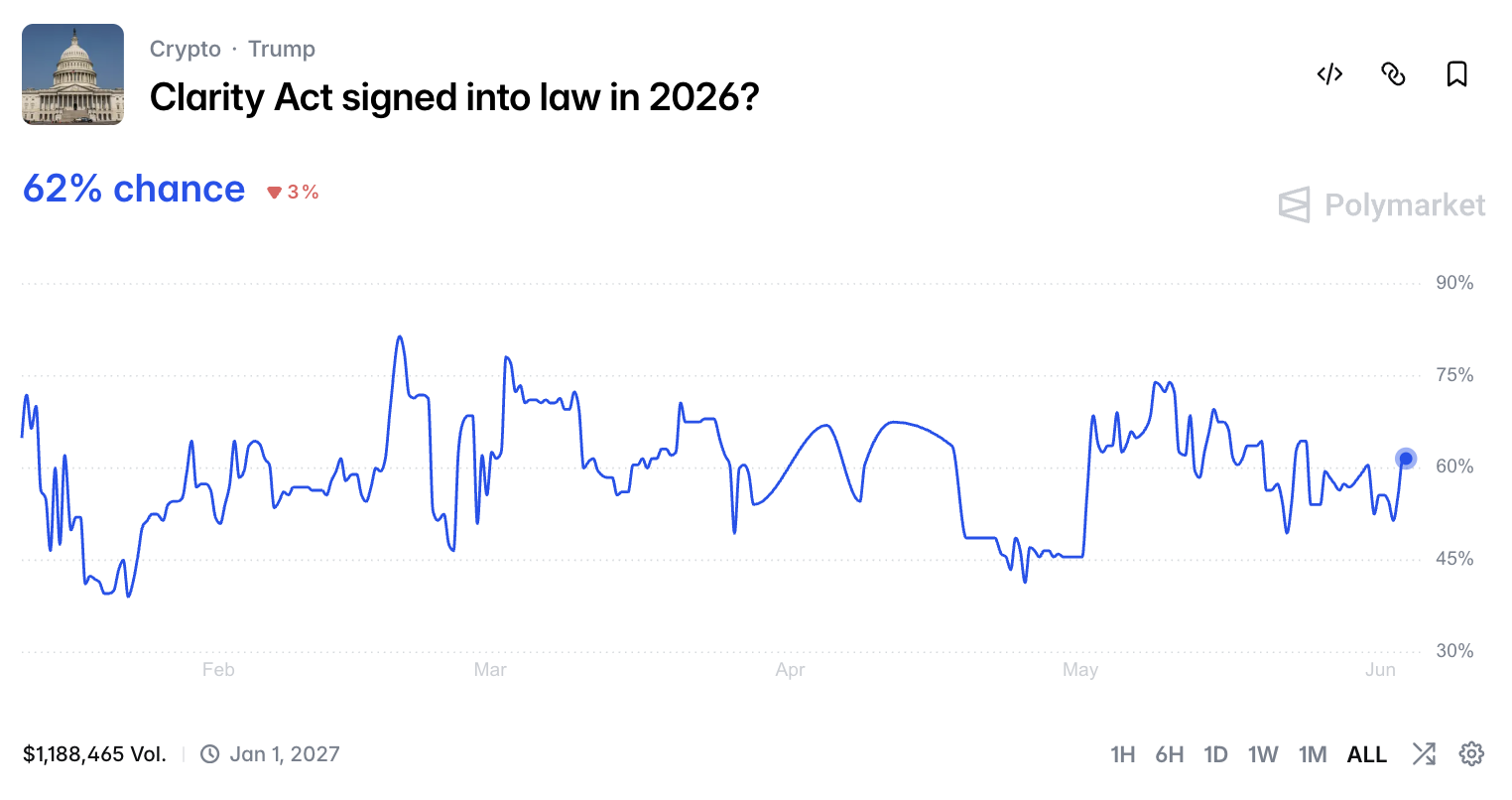
Event contract on CLARITY Act timeline. Source: Polymarket
Bessent said the administration was aiming for the bill to pass the Senate sometime this summer. White House crypto adviser Patrick Witt said in May that Trump was aiming for a July 4 signing ceremony, but some senators expect passage before August.
Magazine: NEAR price may ‘grow 20X,’ Bitcoin ETFs post 10-day outflow streak: Hodler’s Digest, May 24 – 30
Franklin Templeton CEO Jenny Johnson has a straightforward explanation for why major financial institutions have been slow to embrace public blockchains: the technology destroys their fee-based revenue streams.
Speaking at the Proof of Talk summit in Paris, Johnson — who oversees $1.74 trillion in assets at Franklin Templeton — told a panel audience that the resistance from traditional financial players is not about technology skepticism.
It is about protecting the business model. Banks and intermediaries that collect transaction fees at every step of the settlement process stand to lose that income the moment a smart contract can handle the same function at a fraction of the cost.
Johnson pointed to Franklin Templeton’s tokenized money market fund, Benji, as a concrete demonstration of the cost differential. Running 50,000 transactions through the firm’s legacy system cost $1.30 per transaction. The same volume processed on the Stellar blockchain came in at $1.13 per transaction — a meaningful reduction at institutional scale.
The announcement came as Franklin Templeton disclosed a new partnership with MoonPay, designed to let institutional investors move between stablecoins and the firm’s tokenized fund through an on-chain workflow.Franklin Templeton’s push into digital assets is one of the most aggressive moves by a legacy asset manager in the industry’s history. The California-based firm, which manages roughly $1.74 trillion in assets, began building its dedicated digital assets team in 2018 — years before tokenization became a mainstream focus among institutional players.
Franklin Templeton’s bitcoin and crypto push
Benji launched in 2021 as the world’s first U.S.-registered mutual fund to use a public blockchain as its official system of record for processing transactions and recording share ownership. The fund invests predominantly in U.S. Treasury securities and uses blockchain strictly for operational efficiency rather than crypto exposure.
On the bitcoin front, Franklin Templeton launched the Franklin Bitcoin ETF (ticker: EZBC), a passive product that holds only bitcoin and cash, designed for investors seeking direct price exposure without managing custody.
The firm also offers a dynamic bitcoin/ethereum separately managed account product for investors wanting active allocation between the two largest digital assets.
In April 2026, Franklin Templeton announced plans to acquire 250 Digital, a spinoff from crypto venture firm CoinFund, forming a new division called Franklin Crypto to pursue active cryptocurrency investment strategies at institutional scale.
The deal itself broke new ground — BENJI tokens were used as part of the acquisition payment, making it one of the first M&A transactions structured on-chain. The firm’s digital assets division manages approximately $1.8 billion in assets.
Israeli taxpayer disclosures of profits from cryptocurrencies have reportedly fallen short of expectations at the Israel Tax Authority after enactment of a policy allowing immunity from criminal proceedings for filers correcting their reports.
According to a Wednesday report from Globes, Israeli authorities had expected to gain up to $1 billion in taxes from “voluntary disclosures” allowed under an August 2025 policy, but have so far only received reports of a fraction of those capital earnings.
The local news outlet reported that the tax authority had received reports of $50 million combined from crypto capital, with the potential of billions of dollars in underreported holdings.
“In the cryptocurrency field, the difficulty of the absence of an anonymous track is even more acute,” said Iftach Simhony, a CPA and head of the tax department at the Prof. Bein Law Office, Globes reported. “When the risk assessment of some taxpayers is not high, and the procedure itself does not offer certainty or anonymity in the first stage, the incentive to undergo voluntary disclosure is weakened.”
The voluntary disclosure procedure announced by the tax authority gives crypto holders immunity from criminal charges, provided the value of their holdings did not exceed the equivalent of $522,000 as of December 2024, they filed correct reports and paid their taxes in full before Aug. 31, 2026. Globes reported only 58 filers had attempted to correct their taxes using the procedure.
Related: Israel crypto industry pushes regulatory changes amid strong public support
According to the Bank of Israel’s financial stability report for January to June 2024, Israelis held about $1 billion worth of crypto assets.
US lawmakers seek to create de minimis exemption for crypto taxes
A group of members of the US Congress introduced legislation in May called the PARITY Act that would direct the US Internal Revenue Service (IRS), to review creating a de minimis exemption for digital assets. Under the proposed law, taxpayers could not be forced to reported small crypto transactions to the IRS.
Magazine: HYPE chases $100 target, ETH could dump below $1800: Market Moves
Cointelegraph is committed to independent, transparent journalism. This news article is produced in accordance with Cointelegraph’s Editorial Policy and aims to provide accurate and timely information. Readers are encouraged to verify information independently.
The British neobank, with 70 million customers and a $75 billion valuation, will pair FDIC-insured accounts with stablecoin access on a single platform — a tier-one fintech entering US banking with stablecoins designed in, not bolted on.
Revolut plans to open a US bank in 2027 that will pair FDIC-insured accounts with stablecoin services in the same app. US chief executive Cetin Duransoy disclosed the plan in a Reuters interview on Wednesday. The British neobank counts 70 million customers globally and was valued at $75 billion in a November 2025 secondary share sale.
The entity will be called Revolut Bank US, N.A. and headquartered in Stamford, Connecticut, with a second office in New York, per Duransoy. Product scope spans FDIC-insured checking and high-yield investment accounts, multi-currency deposits, stock and crypto trading, and stablecoin access on a single platform. Revolut filed for a national bank charter with the Office of the Comptroller of the Currency and the Federal Deposit Insurance Corporation on March 5, and has committed $500 million in US investment to back the application.
The structural point is that a tier-one fintech is entering US banking with stablecoins designed in as a core product rather than bolted on later. SoFi Technologies, the only US national bank that currently offers a proprietary stablecoin, was granted its charter in January 2022. It did not launch SoFiUSD inside its banking app for retail customers until May 27 of this year. Revolut would arrive in 2027 with that integration as the launch product.
The Charter Path
Revolut’s filing seeks a federal charter that would let it operate uniformly across all 50 states under a single regulator. The application replaces an earlier track in which Revolut had considered acquiring an existing US lender. It also follows roughly six months after then-US head Sid Jajodia told Banking Dive that a charter would give Revolut “a seat at the table with the regulator.” Jajodia is now Revolut’s global chief banking officer; Duransoy succeeded him in January.
“Filing for a national bank charter is a major milestone toward our vision of building the world’s first truly global banking platform,” Revolut co-founder and chief executive Nik Storonsky said at the time of the filing. The charter would give Revolut direct access to Federal Reserve payment rails such as Fedwire and ACH. It would also let the bank offer FDIC-insured deposits without partner banks, and originate personal loans and credit cards directly.
OCC charter approvals typically run 12 to 18 months. The application lands in a surge of new-bank activity: the OCC received 18 de novo applications in 2025 and several more in 2026. Crypto-native firms including Ripple, Paxos and Circle have also filed. Crypto.com received a conditional national trust bank charter earlier this year; Erebor Bank is already operating with a full charter.
What “Stablecoin Services” Means
Duransoy did not name which stablecoins Revolut intends to offer, whether the bank would issue its own coin, or what custody arrangement would apply. The product description so far refers to “access” to stablecoins alongside FDIC-insured deposits, not a Revolut-issued dollar token. Revolut already supports zero-fee USDC and USDT swaps for European users. It also crossed $1.2 billion in onchain stablecoin volume on Polygon in 2025. Third-party-stablecoin distribution is the more likely starting point than a proprietary issue.
The bank-issued model still has a clear US precedent. SoFi’s SoFiUSD launched on Ethereum and Solana on May 27, redeemable 1:1 for dollars and accessible inside the consumer app for SoFi’s 14.7 million members. Cash App, which does not hold a US bank charter, supports USDC across Ethereum, Solana, Polygon and Arbitrum. Chime remains a non-bank fintech that partners with chartered institutions and has no stablecoin product.
Whichever model Revolut chooses, it would operate inside a framework that did not exist when SoFi got its charter. The Guiding and Establishing National Innovation for U.S. Stablecoins Act, enacted on July 18, 2025, gives US banks a federal path to issue payment stablecoins under their existing regulators. The OCC’s implementing rulemaking was published in the Federal Register on March 2. It proposes specific requirements for national-bank stablecoin issuance and custody. Comments closed on May 1.
The Distribution Argument
The number that matters for the stablecoin market is reach. The combined circulating supply of the five largest dollar stablecoins is roughly $281 billion, with Tether at $187.5 billion and Circle’s USDC at $76 billion. Revolut has about 1 million existing US customers and 70 million globally. Storonsky has set a target of 100 million customers by mid-2027.
A charter-holding Revolut that defaults users into stablecoin rails for cross-border transfers would be a distribution channel several orders of magnitude larger than any crypto-native firm currently operating. The initial customer wedge is explicitly cross-border. “We’ll begin by focusing on business and retail customers that need multiple currencies, such as dollars, rupees or Latin American currencies,” Duransoy told Reuters. The bank will not operate physical branches; customers will rely on ATM networks. The app currently supports more than 30 currencies.
What’s Not Locked In
The OCC and FDIC have not signaled a decision date. Charter approvals can come with conditions that materially shape a launch product — capital floors, activity limits, or restrictions on certain digital-asset offerings — and none have been disclosed. Revolut’s 2027 target is a company goal, not a regulatory commitment.
Revolut’s last completed financing was a November 2025 secondary share sale at the $75 billion valuation, up from $45 billion fifteen months earlier. The company has ruled out a public listing before 2028, with Storonsky saying a US IPO is the preferred venue when one comes.