Hyperliquid’s HYPE token, one of crypto’s best-performing assets this year, tumbled following its record run as longtime bull Arthur Hayes revealed he had sold his entire position just days after predicting much higher prices.
“I just dumped my entire HYPE and NEAR position,” Hayes, co-founder of BitMEX and chief investment officer at family office Maelstrom, wrote on X.
The selloff pulled HYPE back to $67 from record highs near $75, though the token remains up more than 70% since mid-May.
Hayes said the decision reflected growing caution about broader markets rather than a change in his view of Hyperliquid. He pointed to rising energy prices tied to the Iran conflict, several high-profile AI IPOs expected in the coming months and his belief that financial markets could peak between now and September.
“Time to take profit,” he wrote.
The abrupt exit caused backlash in crypto circles because Hayes had been among Hyperliquid’s most vocal supporters. Just days earlier, he reiterated a $150 price target for HYPE and, in a March essay, laid out a roadmap for how the token could reach that level.
Arthur Cheong, founder of crypto investment firm DeFiance Capital, described the move as “the epitome of a guy that over-trades his position” in an X post.
Others questioned why investors continue to treat Hayes’ market calls as actionable signals.
Crypto trader TraderSZ, who has more than 683,000 followers on X, noted that Hayes had recently argued HYPE could be among the year’s best-performing assets before announcing the sale.
One of crypto’s biggest winners
Hyperliquid and its token, HYPE, have been standout performers over the past few weeks as the broader crypto market remained under pressure.
As bitcoin fell back to near its 2026 lows at $60,000, HYPE notched fresh all-time highs and remains up 166% year-to-date even with Thursday’s decline.
The project operates a blockchain-based onchain perpetual futures exchange, allowing users to trade cryptocurrencies and other assets through a transparent order book rather than relying on a centralized venue.
The platform has rapidly gained market share, clearing around $40 billion in weekly perp volume and $1 billion in spot assets, and has emerged as one of the closely monitored venues for weekend commodity prices and pre-IPO stocks.
Hyperliquid weekly trading volumes (DefiLlama)
HYPE rally got overheated
But the 100% gain in a month put the move overextended from the project’s fundamentals, noted Markus Thielen, founder of 10x Research.
In a report earlier this week, Thieled said Hyperliquid remained “one of the most impressive businesses in crypto,” citing its roughly 77% gross margins, fully onchain trading infrastructure and token buyback program funded by protocol revenue.
At recent highs near $75, HYPE traded at roughly 25 times projected fee revenue, near the richest levels seen over the past year, according to Thielen. Meanwhile, protocol revenue remains well below its peak, and a large token unlock scheduled for June could introduce additional selling pressure.
“We have been vocal HYPE bulls,” Thielen wrote. “But at current prices, the risk-reward has shifted.”
The long-term bull case is still compelling, he said. If trading activity recovers toward previous highs and new products attract more users, HYPE could eventually justify significantly higher prices.
Bitcoin (BTC) has tagged a key bear-market trend line with its drop to four-month lows, with a “decent chance” of a rebound next.
Key points:
Bitcoin revisits its 200-week simple moving average after trading above it since October 2023.
The trend line functioned as resistance throughout the 2022 bear-market bottom and rebound.
Bitcoin’s daily RSI approaches its most oversold since 2020.
Bitcoin bear-market trend line returns after nearly three years
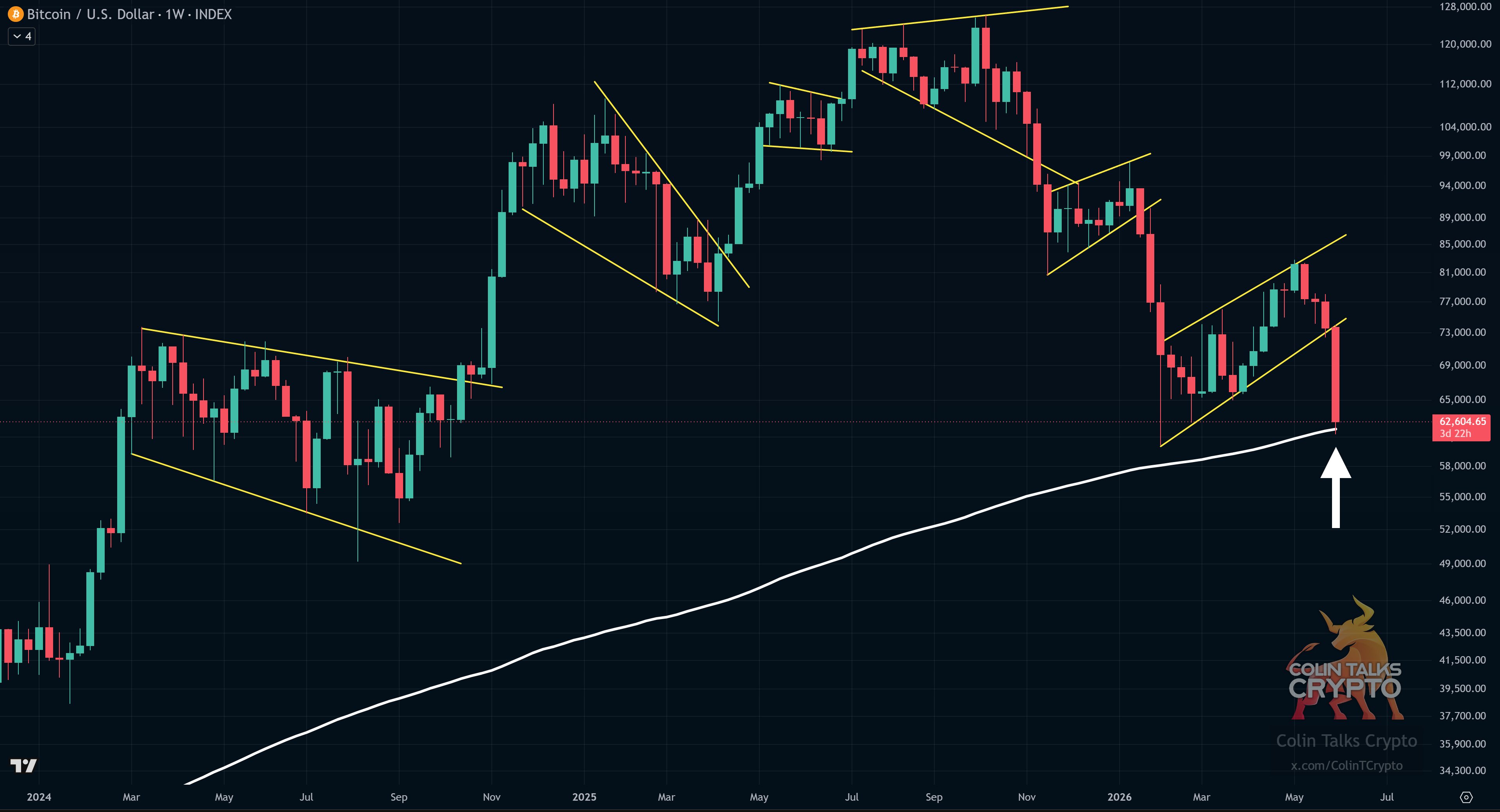
Data from TradingView shows that for the first time since 2023, BTC/USD is back at its 200-week simple moving average (SMA).
The 200-week SMA is a key yardstick during Bitcoin bear markets. The trend line, which has only ever increased with time, currently sits at $61,626.
BTC/USD one-week chart with 200SMA. Source: Cointelegraph/TradingView
The last time price interacted with it was in October 2023, but during the 2022 bear market, it functioned as resistance until bulls fully regained control.
Commenting, CollinTalksCrypto, creator of the social media channel of the same name, described the return of the 200-week SMA as a “key milestone.”
“Does it bounce here or keep dropping?” he queried in a post on X.
“My guess is BTC has a decent chance of bouncing soon as it’s been dropping pretty steeply. But honestly it’s anyone’s guess in the short term.”
BTC/USD one-week chart with 200SMA. Source: ColinTalksCrypto/X
ColinTalksCrypto included a chart showing various bull and bear flags over the past several years. As Cointelegraph reported, BTC/USD has now copied its bear-flag breakdown from the start of 2026.
He added that the “best bear market entries happen *below* the 200-week MA.”
BTC price sparks more record “oversold” talk
Some optimistic market takes focused on the “oversold” nature of Bitcoin at its latest local lows.
Related: Bitcoin copying 2022 ‘almost perfectly’ as trader sees key support failing
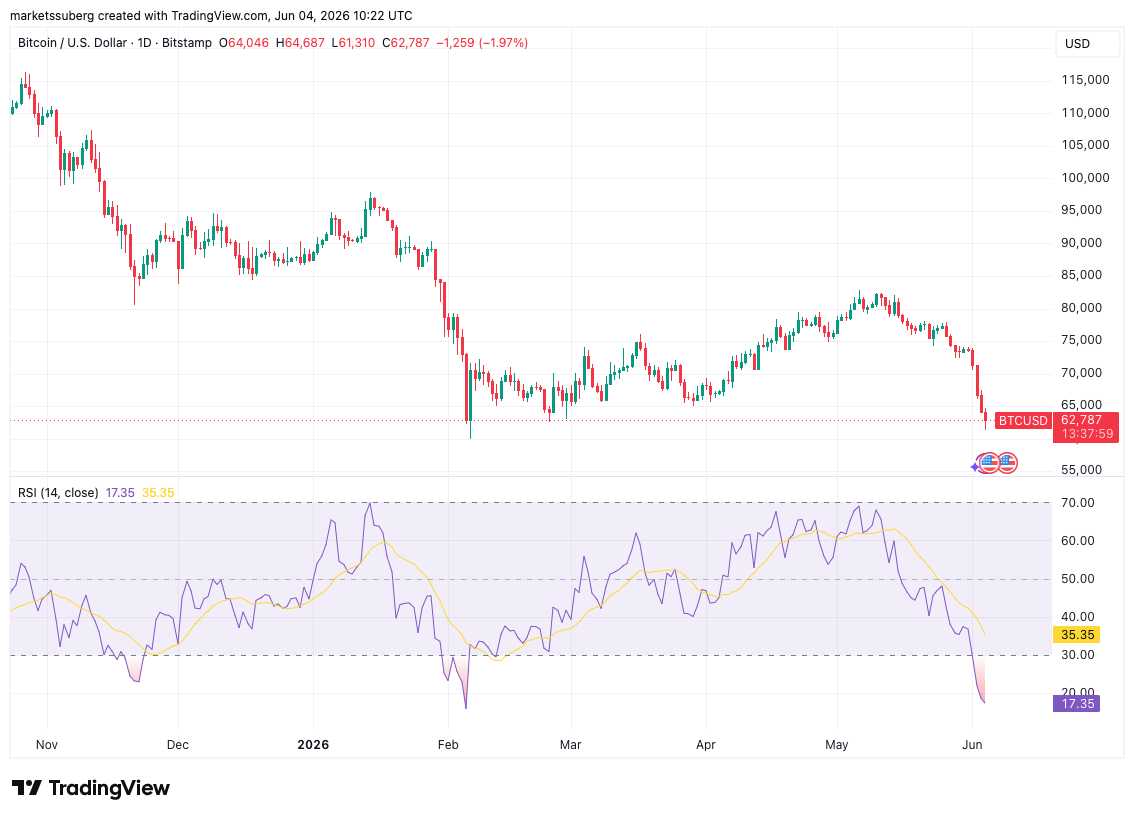
On daily time frames, the relative strength index (RSI) dropped to 17.35, marking its lowest levels since 2020 along with the February drop.
BTC/USD one-day chart with RSI data. Source: Cointelegraph/TradingView
Responding, the X analytics account named after famous economist Frank A. Fetter stressed that BTC/USD was “pretty much the most oversold ever.”
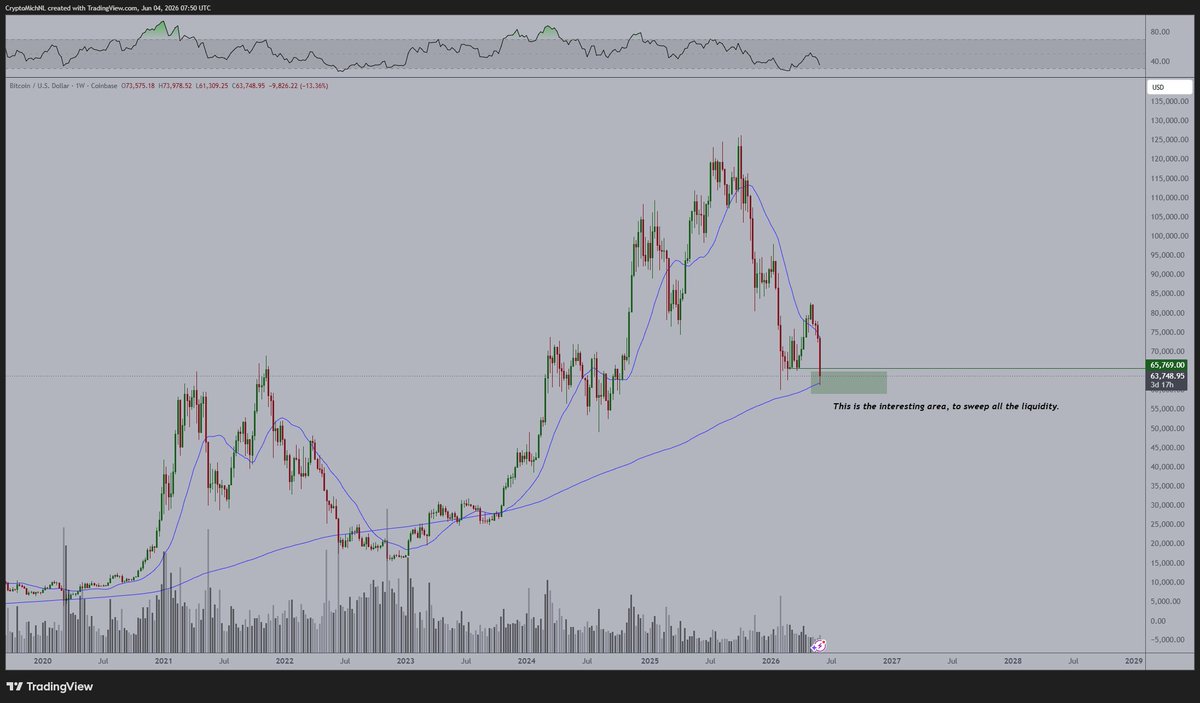
“It’s the area to accumulate your positions, if you have a strong thesis on Bitcoin from here,” crypto trader and analyst Michaël van de Poppe added on the back of both RSI data and the revisit of the 200-week SMA.
Van de Poppe put ongoing questions over Strategy’s corporate debt at the center of short-term price trajectory.
“Aside from that perspective, it’s all about STRC and the depeg; if that flips back upwards, it’s very likely time for Bitcoin to bounce back too,” he added.
“If there’s a constant, continuous downward trend here, we’ll most likely see sub-$60,000 in the markets.”
BTC/USD one-week chart. Source: Michaël van de Poppe/X
The world’s largest crypto exchange is folding its in-house NFT service into Binance Wallet by July 3, ending the centralized-marketplace bet a year after Coinbase NFT shut down and four months after X2Y2’s sunset — a near-complete unwinding of the CEX-backed NFT marketplace category.
Binance, the world’s largest crypto exchange by trading volume, will shut its centralized NFT marketplace on July 3 and migrate the service into its self-custody Binance Wallet, the company said in an announcement published Wednesday, closing the last major centralized-exchange NFT venue still operating four years after the category’s peak.
The move ends a service Binance launched in June 2021 at the top of the NFT cycle and continues a near-complete unwinding of the CEX-backed marketplace category that has now claimed Coinbase NFT, Kraken NFT, Gemini’s Nifty Gateway and X2Y2 inside a single 24-month window. NFTs across all chains generated roughly $5.5 billion in trading volume in 2025, down from more than $50 billion at the 2022 peak, according to CryptoSlam, with Q4 2025 volume of $1.25 billion marking a 28% drop from the previous quarter.
For Binance the wind-down is a corporate-strategy move. The exchange is concurrently expanding into tokenized U.S. equities through its bStocks product and an Alpaca minority stake, redirecting product capacity away from a consumer-NFT bet that never recovered from the 2022 crash.
Binance framed the change as a product upgrade rather than a closure.
“To provide a more seamless and integrated NFT experience, we are upgrading the Binance NFT service to be made available on Binance Wallet, where users can manage their NFTs with easier access to Web3 and decentralized features,” the company said in the announcement, signed off as “Binance Team.”
The CEX-NFT Retreat Pattern
Coinbase NFT, launched in May 2022 with reported waitlists in the millions, halted all marketplace functionality on July 10, 2024 and was fully sunset on August 1, 2024, with visits to the site redirected to the Base app.
Kraken NFT, which launched in June 2023, entered withdrawal-only mode on November 27, 2024 and shut down completely on February 27, 2025, with the exchange citing a need to “shift resources into new products and services,” per its closure FAQ.
X2Y2, the standalone marketplace that briefly traded as the second-largest NFT venue behind OpenSea, shut down on April 30, 2025 after posting $5.6 billion in cumulative volume. Pseudonymous founder TP wrote that “marketplaces live or die by network effects” and pivoted the team to a permissionless AI-powered DeFi product.
Binance had itself been progressively shrinking the NFT surface ahead of this week’s full migration — removing Polygon support in September 2023 and Bitcoin Ordinals in April 2024.
OpenSea and Magic Eden remain among the few NFT-native venues still operating at scale, and both have pivoted. OpenSea rebuilt its platform as OS2, a multichain trading aggregator now spanning 22 blockchains, and launched its native SEA token earlier this year. Magic Eden acquired the trading app Slingshot in April 2025 to push beyond NFTs into broader token markets.
The Withdrawal Mechanics
Users holding transferable NFTs on the Binance exchange have until 23:59 UTC on July 3 to move them to Binance Wallet or another compatible self-custody wallet. After that, the company said, the NFTs “will no longer be accessible” through the exchange interface.
To smooth the migration, Binance is reimbursing on-chain withdrawal fees. Up to 100,000 users will receive 1 USDC for each eligible non-CR7 NFT withdrawn to Binance Wallet via BNB Smart Chain or Ethereum between June 3 and June 17, with payouts credited by July 3. A separate track covers the CR7 collection — the NFT series tied to footballer Cristiano Ronaldo — with withdrawal fees refunded by July 19 for any CR7 transfers completed on BNB Smart Chain before the deadline.
Non-transferable NFTs, including completion certificates issued through Binance Academy courses, cannot be withdrawn and will go dark after July 3. Binance said it will issue PDF certificates as a substitute to affected Academy holders.
In today’s newsletter, Beth Haddock reviews the three due diligence questions advisors should be asking in 2026: how client cash is managed, how regulatory assumptions should be disclosed and how to manage liability when AI executes crypto trades.
Then, in “Ask an Expert,” Aaron Brogan reviews the GENIUS Act implementation timeline, how things will change once it’s here and what to do in the meantime.
– Sarah Morton
Crypto due diligence has changed: three questions advisors should revisit
As digital money, shifting regulatory requirements and AI-enabled infrastructure mature, advisors need to revisit what legal and regulatory diligence covers. The objective is practical: meet fiduciary duties, protect client trust and adapt as the market changes. Three questions deserve more attention: how client cash is managed, how regulatory assumptions are disclosed and how AI-driven crypto infrastructure is validated.
3 legal and regulatory questions advisors should ask
Prepared with Claude (Anthropic) as a drafting tool; content, direction, and review by author
Diligence Question
Which clients would benefit most from evaluating digital cash management alternatives?
Institutional and cross-border payment clients are a natural place to start.
1. Cash Management Innovation
How should client cash management be reviewed? The GENIUS Act and the growth of stablecoins have opened a new chapter for cash management. Stablecoin lending markets, made accessible via platforms like Axal, offer yields with increased transparency. Tokenized money market funds and other short-term assets from issuers including BlackRock, Fidelity and J.P. Morgan now hold billions in assets, with on-chain settlement and daily liquidity.
For advisors, the question is not whether digital alternatives should replace traditional cash sweeps or money market funds. It is also whether the documented analysis reflects that the advisor considered the client’s best interests, including fees, conflicts and suitability. The SEC’s recent cash sweep enforcement actions against Wells Fargo Advisors and Merrill Lynch make the point: cash management is not a neutral decision. Stablecoins and tokenized short-term assets are not generic cash products, but that is the point: their structure may offer meaningful advantages for the right client, particularly where settlement speed, transparency, yield or cross-border movement matter. Advisors should understand the product terms, provider controls and client use case before making a recommendation.
Diligence Question
What would change a recommendation of legislation, agency leadership or enforcement posture shifts?
2. Connecting Political Risk and Client Trust
How should regulatory dependency be explained? Political support for and opposition to crypto growth remains contentious. The GENIUS Act and proposed CLARITY Act represent progress from regulation by enforcement toward more predictable frameworks. But implementation regulations, market conduct, consumer protection and global coordination remain unsettled. Stablecoin yield and ethics debates, including bank opposition and CLARITY legislative hurdles, show the sector still faces scrutiny from incumbents, private litigants and state attorneys general.
The enforcement shift under SEC Chairman Atkins illustrates why client communication matters. A platform under active enforcement one year can be cleared the next, and the reverse is possible under a future administration. Advisors should not overpromise certainty. Advisors should disclose regulatory assumptions and risks behind portfolio recommendations and update those assumptions as legislation and enforcement posture evolve.
Diligence question
Who is accountable when an agentic workflow touches client data or transaction execution?
3. The Convergence of AI and Crypto
Who is accountable when AI touches crypto execution? AI agents are beginning to settle transactions on crypto rails, while the IMF and others have flagged gaps in operational resilience and governance. Research on agentic commerce suggests validation, liability and programmable compliance remain unsettled.
This convergence should push advisors to cover four priorities. Security: do product sponsors have a credible view on quantum readiness? Substance over hype: the SEC’s AI-washing cases remind us that claims about AI capabilities must be verifiable. Validation and controls: how are AI outputs tested, supervised and authenticated before they are used in advice, trading or client communications? Are platforms that prepare transactions for users transparent user interfaces or opaque in their operations? Privacy: amended Reg S-P and the recent Fidelity data breach settlement show why client data governance matters when AI tools touch client and confidential information, including prompts, outputs and data used for training.
These trends will keep evolving. Advisors who deliver trustworthy crypto recommendations will be the ones whose diligence accounts for AI innovation, political risk and the best cash management options for their clients. Where is your practice least prepared?
– Beth Haddock, managing partner and founder, Warburton Advisers
Ask an Expert
When interacting with stablecoins, is it important to evaluate whether they are the GENIUS-compliant type, or the old MTL-only type?
The GENIUS Act was signed into law on July 18, 2025. Despite this, to date, stablecoins remain regulated under the old regime. While GENIUS will introduce cross-agency federal oversight, as well as many requirements including limiting reserve composition, current stablecoins are still issued using state money transmitter licenses (MTLs) without dedicated federal oversight.
The GENIUS Act will change the risk profile of legal stablecoins in the United States, but when will it take effect?
This will all change when GENIUS takes effect. The statute becomes effective on the earlier of January 18, 2027, or 120 days after the primary federal payment stablecoin regulators issue final implementing regulations. It separately directs the federal payment stablecoin regulators, state payment stablecoin regulators and the Secretary of the Treasury to coordinate to promulgate rulemaking by July 18, 2026. Those rulemakings are currently in progress. The rules governing foreign payment stablecoin issuers will become operative on the same effective-date timeline.
– Aaron Brogan, founder and managing attorney, Brogan Law
Keep Reading
Looking for more? Receive the latest crypto news from coindesk.com and market updates from coindesk.com/institutions.
Issuers and acquirers can now clear card transactions in regulated stablecoins on Arbitrum, Base, Canton, Ethereum, Polygon, Solana, Tempo and XRPL, with ARQ, CBW Bank, Cross River, Lead Bank and Nuvei lined up as the first adopters in the US and Latin America.
Mastercard on Tuesday opened its global card-settlement network to regulated stablecoins, allowing issuers and acquirers to clear card transactions onchain across eight blockchains and adding intraday, weekend and holiday settlement cycles for the first time.
The company announced the expansion in a press release from its Purchase, New York headquarters, framing it as a move toward an “always-on” model for rails that today carry roughly a quarter of the world’s card spend.
The supported assets are Circle’s USDC, Paxos-issued PYUSD, USDG and USDP, Ripple’s RLUSD and SoFi’s SoFiUSD. They will be enabled across Arbitrum, Base, Canton, Ethereum, Polygon, Solana, Tempo and XRPL.
ARQ — formerly DolarApp — CBW Bank, Cross River, Lead Bank and Nuvei are expected to be the first to use the optionality, starting in the US and Latin America.
Mastercard reported $10.6 trillion in gross dollar volume in 2025, according to its most recent 10-K.
The announcement collapses a separation that has held since stablecoins emerged: regulated-bank settlement runs on legacy rails operating banker’s hours, and onchain dollar movement runs around the clock on a parallel system.
Mastercard, which acquired the NYDFS BitLicense one week earlier and agreed to buy stablecoin infrastructure firm BVNK for up to $1.8 billion this year, is folding the second system into the first.
“The next phase of stablecoin adoption is about real-world utility, especially in settlement, where timing and liquidity matter most,” said Raj Dhamodharan, executive vice president, Blockchain & Digital Assets at Mastercard, in the announcement. “By introducing intraday and weekend settlement options across our global network, we’re expanding how partners manage liquidity and operate in an always-on digital economy while maintaining the trust, resilience and safeguards they expect from Mastercard.”
The Stablecoin and Chain Mix
The six stablecoins span four regulated issuers and together cover most of the regulated US-dollar stablecoin float. USDC, Mastercard’s earliest on-chain settlement asset in select markets, holds $75.89 billion in market capitalization, per CoinGecko. Paxos-issued PYUSD sits at $2.98 billion and Ripple’s RLUSD at $1.82 billion. USDG, USDP and SoFi’s SoFiUSD round out the launch list.
The eight-chains list signals Mastercard is willing to settle on chains designed for bank-and-corporate users as well as the retail-DeFi public.
Visa’s Live Network
Visa, the other major card network with a multi-year stablecoin program, launched USDC settlement to US issuers in December 2025 over the Solana blockchain, with Cross River and Lead Bank as the initial banks.
Visa first piloted USDC settlement on Solana with Crypto.com in 2023; its stablecoin-settlement run rate had reached roughly $7 billion annualized by late April, the company said on its most recent earnings call.
Mastercard’s announcement Tuesday is materially broader on day one: six stablecoins versus Visa’s one at launch, eight chains versus Visa’s one, and an explicit commitment to weekend and holiday cycles built into the framework. The two initial banks — Cross River and Lead — are the same ones Visa launched with, an indication that the institutional banking layer for stablecoin card settlement is converging on a small set of partners.
What Could Slow the Rollout
The expanded capabilities will roll out globally “subject to regulation,” Mastercard said, and the initial deployment is constrained to “parts of the United States and Latin America.”
That phrasing leaves open the operational question that has gated every prior stablecoin-settlement deployment: how individual prudential regulators treat a bank holding intraday stablecoin balances against US-dollar liabilities. Federal regulators are working against a statutory one-year deadline under the GENIUS Act, the federal stablecoin framework signed in July 2025, to finalize implementing rules. The OCC’s proposed rule was published March 2 and closed for comment in May; the FDIC, Federal Reserve and Treasury have proposed companion rules. None has yet been finalized.
What Comes Next
Mastercard said additional regions, partners and regulated stablecoins will be added through 2026.
The first read on uptake will come from Cross River, Lead and Nuvei reporting how much of their existing Mastercard-acquired volume migrates into the on-chain track over the coming quarters, and from Mastercard’s next earnings call.
When Zero Network announced it was shutting down last month, the reaction across crypto was weary: Another Ethereum layer-2 just bit the dust.
The closure joined a growing list of struggling rollups and came amid renewed debate about whether Ethereum’s sprawling layer-2 ecosystem has become too crowded. At the same time, Ethereum creator Vitalik Buterin has urged developers to rethink the network’s long-term scaling roadmap, while several major projects have shifted away from marketing themselves as general-purpose blockchains and toward more focused applications in payments, stablecoins and tokenized assets.
To many observers, the developments have revived a familiar question: Has Ethereum’s sprawling layer-2 ecosystem become too crowded?
Industry participants, however, argue the opposite.
“The thing to recognize is that anywhere where somebody would be running a smart contract on an existing blockchain, someone could equally run a layer two,” said Ben Fisch, co-founder and CEO of Espresso Systems. “We’re in a consolidation phase for general-purpose layer twos, not layer twos broadly.”
Ethereum layer-2s exploded over the past several years as improvements in rollup technology dramatically reduced the cost and complexity of launching new chains. Rollups work by processing transactions off Ethereum’s main blockchain, bundling hundreds of them together, and then periodically posting compressed transaction data back to Ethereum for settlement and security. The model allows applications to offer faster transactions and lower fees while still relying on Ethereum as the ultimate source of trust.
The result was a flood of networks built using infrastructure stacks such as Optimism’s OP Stack, Arbitrum Orbit and zkSync. But while launching a chain became easier, attracting users proved much harder.
“There were way too many general-purpose layer twos, which frankly don’t make sense as a product, because there’s no reason to have many, many versions of the same thing,” Fisch said.
The numbers support that view. Today, activity across Ethereum’s layer-2 ecosystem remains heavily concentrated among a handful of networks. Base and Arbitrum alone account for more than 80% of layer-2 DeFi total value locked (TVL), according to DefiLlama data.
(DefiLlama)
That concentration has only become more apparent as smaller chains struggle to maintain liquidity. Over the past six months, networks including Linea, World Chain, Starknet and Mantle have all seen declining bridge deposits. Linea’s deposits, for example, fell from $976 million in November 2025 to $367 million in May 2026, a decline of more than 60%.
Token Terminal
“I think only a few L2s with clear financial demand will be able to sustain themselves over time,” said Alice Hou, a former research analyst at Messari, to CoinDesk.
For Hou, the key issue isn’t whether layer-2 technology works, it’s whether a network can generate enough activity to justify its existence.
“Without enough blockspace demand, user activity or developer traction, there is little reason to continue maintaining an L2,” she said.
Ironically, the economics of launching a rollup have never looked better. Ethereum’s Dencun upgrade, introduced in 2024, dramatically reduced the cost of posting rollup data to Ethereum through blobs. According to Messari research, data availability costs now represent only a small fraction of operator expenses for many OP Stack chains.
“From an operator perspective, it is definitely cheaper to run an L2 today,” Hou said. “The economics of launching an L2 have become easier, but the real challenge is still generating enough sustained demand to make the network worth operating.”
That dynamic has created a paradox. The barriers to creating a blockchain continue to fall, but the barriers to attracting users continue to rise. As a result, many teams are discovering that simply offering another Ethereum-compatible chain is no longer enough.
“People have realized that all the different general-purpose blockchains compete with each other,” Fisch said. “If you want to succeed, you need to build out a differentiated application.”
From infrastructure to applications
The shift is already visible across the industry. Several blockchain projects that once emphasized infrastructure are increasingly focusing on payments, stablecoins, tokenized assets and other application-specific markets. Traditional financial institutions may become some of the biggest beneficiaries.
Fisch pointed to asset managers launching tokenized money-market funds, stablecoin issuers and tokenized deposit platforms as examples of businesses that have clear reasons to operate on-chain. For those firms, a dedicated layer-2 can offer lower costs, greater control and more predictable performance than deploying directly as a smart contract.
“The technology decision to run as a layer two is simply an option of running an application onchain,” Fisch said.
Hou said she agreed that distribution matters more than technology.
“Only L2s with a solid existing user base and a clear reason to benefit from blockchain infrastructure should launch their own networks,” she said.
That helps explain why exchanges remain among the strongest candidates. Coinbase’s Base has become the dominant example, leveraging the exchange’s existing customer base while integrating users into Ethereum’s broader DeFi ecosystem.
“The question should not be, ‘Can this company launch an L2?'” Hou said. “It should be: ‘Does this business already have enough distribution, financial activity and ecosystem synergies to make an L2 meaningfully useful?'”
A different vision for the layer-2 landscape
The debate also reflects a deeper disagreement about what layer-2s are actually for. For years, Ethereum advocates framed rollups primarily as a scaling solution for Ethereum itself.
Fisch said he sees them differently.
“I don’t view layer twos as scaling Ethereum,” he said. “I view layer twos as leveraging the existing security properties of layer one.”
In that framework, Ethereum functions less as a destination and more as a settlement layer that applications can use when it makes sense.
“Ethereum is sort of a commodity that layer twos can choose to use,” Fisch said.
That vision aligns with a broader trend unfolding across crypto infrastructure. Rather than competing to become the next dominant blockchain, more projects are increasingly treating blockchains as modular components that can be assembled into larger products.
If that trend continues, the future Ethereum ecosystem may look very different from the one imagined during the rollup boom. Instead of hundreds of competing general-purpose chains fighting for liquidity, the winners could be a smaller number of networks tied to specific businesses, financial products and user communities.
Read more: ‘You are not scaling Ethereum’: Vitalik Buterin issues a blunt reality check to the biggest crypto networks
A wallet tagged by Arkham to the publicly listed Ethereum treasury company FG Nexus moved another 10,000 Ether on Wednesday, extending a series of sales that began after the company built a large position in 2025.
The latest transfer equates to roughly $17.8 million at current prices and comes after earlier disposals that saw the Nasdaq-listed firm unwind more than 21,000 ETH from its treasury for roughly $55 million.
FG Nexus accumulated 50,770 ETH between August and September 2025 at an average price of $3,860 per coin, building a position worth about $196 million at the time.
With Ether trading near $1,765 at the time of writing, according to CoinGecko data, the cryptocurrency is down roughly 54% from FG Nexus’s average purchase price of $3,860, implying a loss of more than $100 million in value on its original investment.
FG Nexus’s share price was down 13.40% pre-market Thursday, trading at $7.11, down from $8.21 at Wednesday’s close, according to Yahoo Finance data.
Wallet linked to FG Nexus moves 10k ETH. Source Arkham
The company disclosed holdings of roughly 40,093 ETH in December 2025 and has yet to publicly comment on its Ether sales since those disclosures, with recent transfers identified by onchain data providers not addressed in subsequent company statements.
Cointelegraph reached out to FG Nexus for comment but had not received a response by publication.
Institutional Ether holders continue accumulating
FG Nexus’ recent selling contrasts with the approach taken by other corporate Ether holders, who have continued to add to their positions despite Ethereum’s price decline.
Related: Ethereum drops to 14-week lows: Can ETH price hold $1.8K support?
Listed miner BitMine, the largest publicly traded holder of Ether with more than 5.4 million ETH, has been adding to its position, including a recent purchase of approximately $52 million worth of Ether.
The company also unveiled plans Wednesday to issue dividend-paying preferred shares, expanding the financing tools available to support its Ethereum treasury strategy.
Some analysts likewise remain upbeat on Ether’s long-term outlook despite its recent underperformance.
Standard Chartered reaffirmed its long-term $40,000 Ether price target last week, saying that Ethereum’s network fundamentals are strengthening, and pointing to growing onchain activity and continued dominance in decentralized finance.
The bank compared Ethereum’s current position to Amazon during its early growth phase, arguing that the asset’s market performance has yet to fully reflect those underlying trends.
Market Moves: Why is Ethereum Foundation selling? BTC futures warning signs
While residents of California, Iowa, Montana, New Jersey, New Mexico and South Dakota are voting today in Democratic and Republican Congressional primaries, the cryptocurrency industry is more focused on the Maryland primaries later this month.
According to filings with the US Federal Election Commission (FEC) as of Tuesday, the Coinbase- and Ripple-backed political action committee (PAC) Fairshake affiliate Protect Progress spent about $3 million combined to support Democratic candidates in House races across California and New Jersey. Another affiliate, Defend American Jobs, spent more than $411,000 to support Republican Senator Mike Rounds’ reelection bid in South Dakota.
In addition to its activities in California, Protect Progress appeared to be prepared for significant spending in Maryland, where primary elections are scheduled for June 23.
FEC filings showed the crypto-backed PAC spent more than $3.1 million on media to support Democratic candidate Adrian Boafo in Maryland’s 5th district, and about $320,000 on Ritchie Torres’ reelection to New York’s 15th district, which will also hold a primary on June 23.
Source: FEC
Today’s California races will be another test of the cryptocurrency industry’s influence over US elections after Fairshake and other PACs backed House and Senate candidates who won their primaries in Texas last week. In addition to Fairshake, which reported a war chest of more than $193 million as of January, crypto-aligned PACs included Fellowship, backed by $11 million from financial company Cantor Fitzgerald and crypto custodian Anchorage Digital and the Blockchain Leadership Fund funded by $175,000 from Chainlink and Anchorage.
Related: Senator Lummis says China will ‘write the rules’ of new financial era if CLARITY fails
Fairshake has been open about its intention to force out House and Senate lawmakers it considers “anti-crypto,” such as Representative Al Green, who voted against the stablecoin legislation GENIUS Act and digital asset market structure bill, CLARITY. The Texas lawmaker lost his primary for the state’s 18th congressional district after Protect Progress spent $5 million supporting his opponent, Democrat Christian Menefee.
CLARITY Act added to the US Senate legislative calendar
After advancement by the US Senate Agriculture Committee in January and the Banking Committee in May, lawmakers have added the Digital Asset Market Clarity (CLARITY) Act to the chamber’s calendar for consideration and a potential vote. Notably, both versions of the bill with amendments passed by the respective committees will likely need to be consolidated before a vote.
Magazine: HYPE chases $100 target, ETH could dump below $1800: Market Moves
Bitcoin’s (BTC) brief plunge toward the $60,000 area triggered more than $600 million in long liquidations, raising doubts over whether the latest rebound marks a real bottom or only a relief bounce after a leverage flush.
BTC price may rebound toward $70,000 next
BTC fell to roughly $61,300 on Thursday before recovering 5.52% to around $64,690, with the rebound coinciding with reports that Israel and Lebanon had agreed to implement a ceasefire.
BTC/USD four-hour chart. Source: TradingView
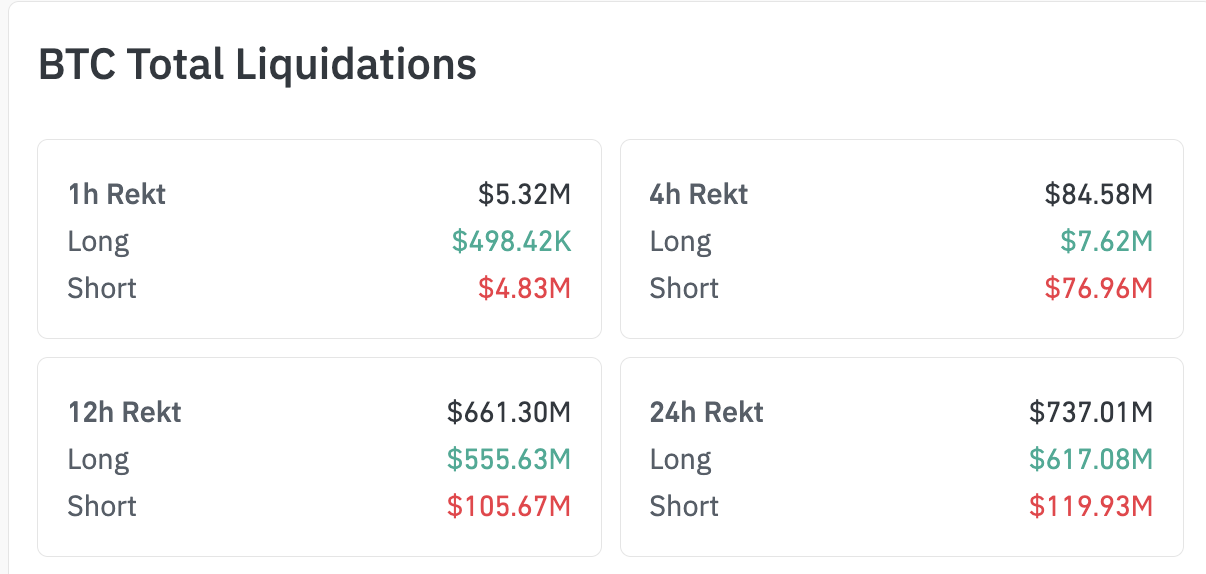
The volatile move liquidated over $737 million in BTC positions on a 24-hour rolling basis, with long traders taking most of the hit, according to data resource CoinGlass.
BTC total liquidations. Source: CoinGlass
Over $617 million in long positions were wiped out, showing how aggressively bullish traders were positioned before the sell-off.
Still, Bitcoin’s sharp 5.52% rebound encouraged some traders to call for a bottom.
Trader RidaaXBT said BTC could stage a relief bounce toward the $69,000–$70,000 range, implying that the liquidation-driven selloff may have exhausted near-term sellers.
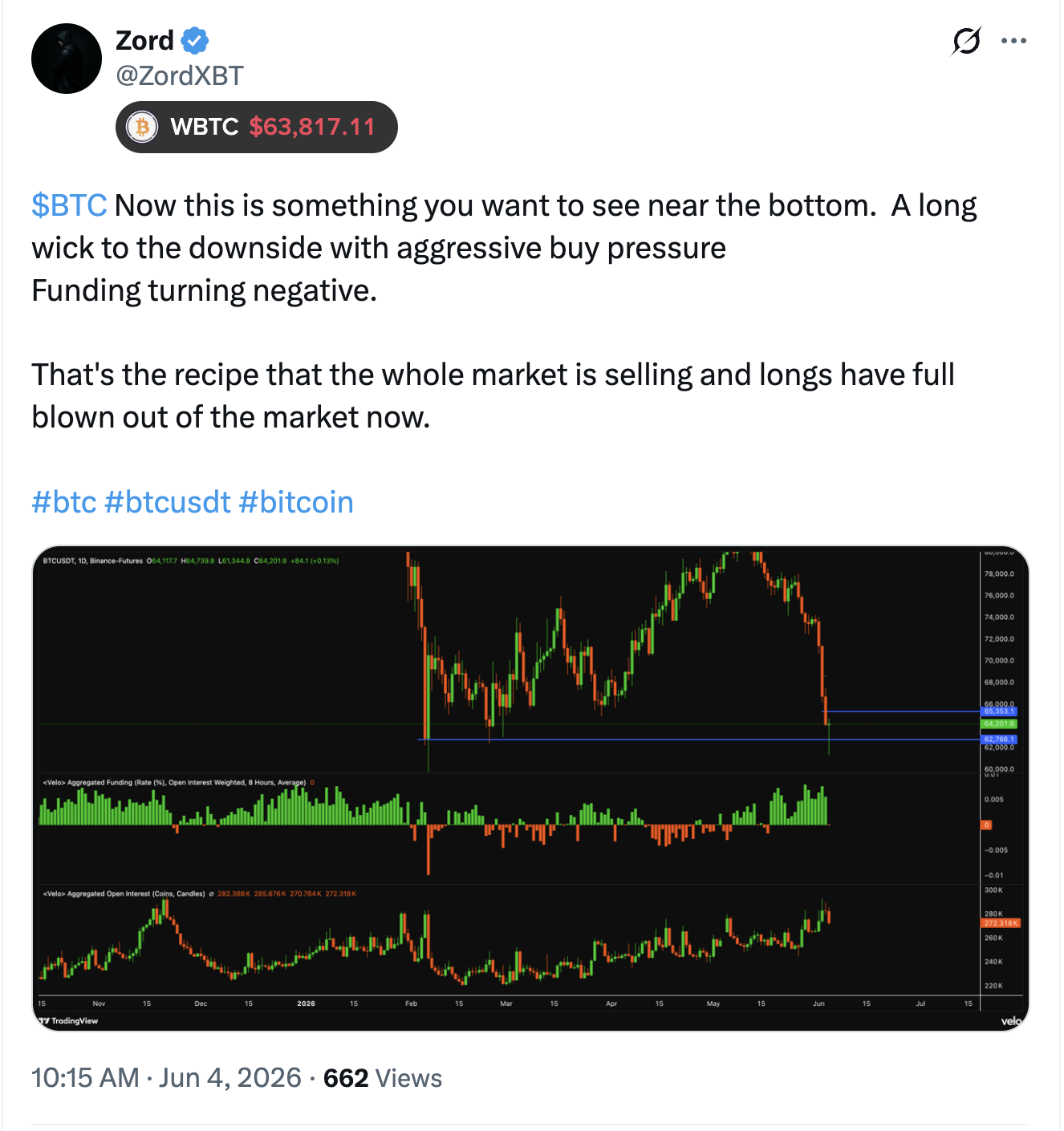
Analyst ZordXBT shared a similar view, pointing to Bitcoin’s long downside wick as a sign that buyers stepped in aggressively near the lows.
Source: X
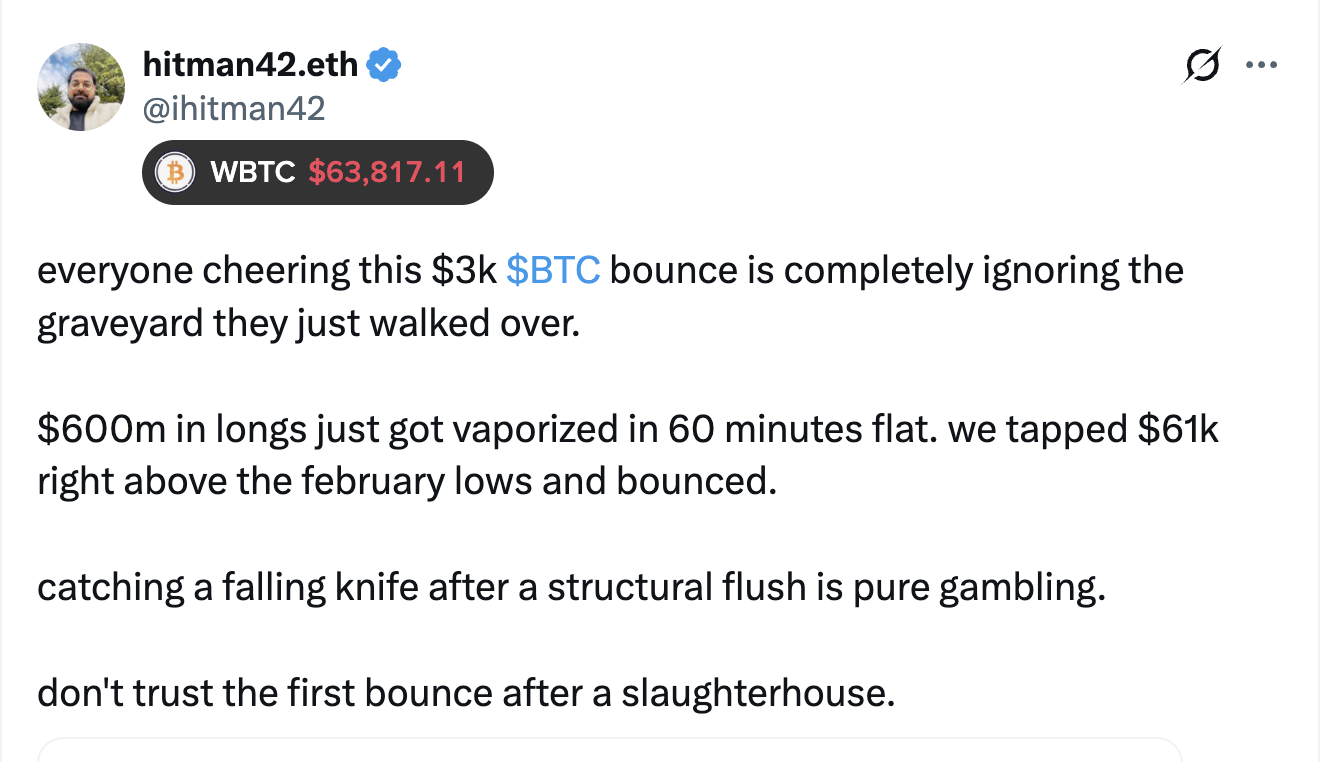
On the other hand, crypto trader Hitman42.eth warned that BTC bulls may be celebrating too early, noting that the Bitcoin bounce may end up trapping bulls.
Source: X
Bitcoin bear flag keeps $50K target in play
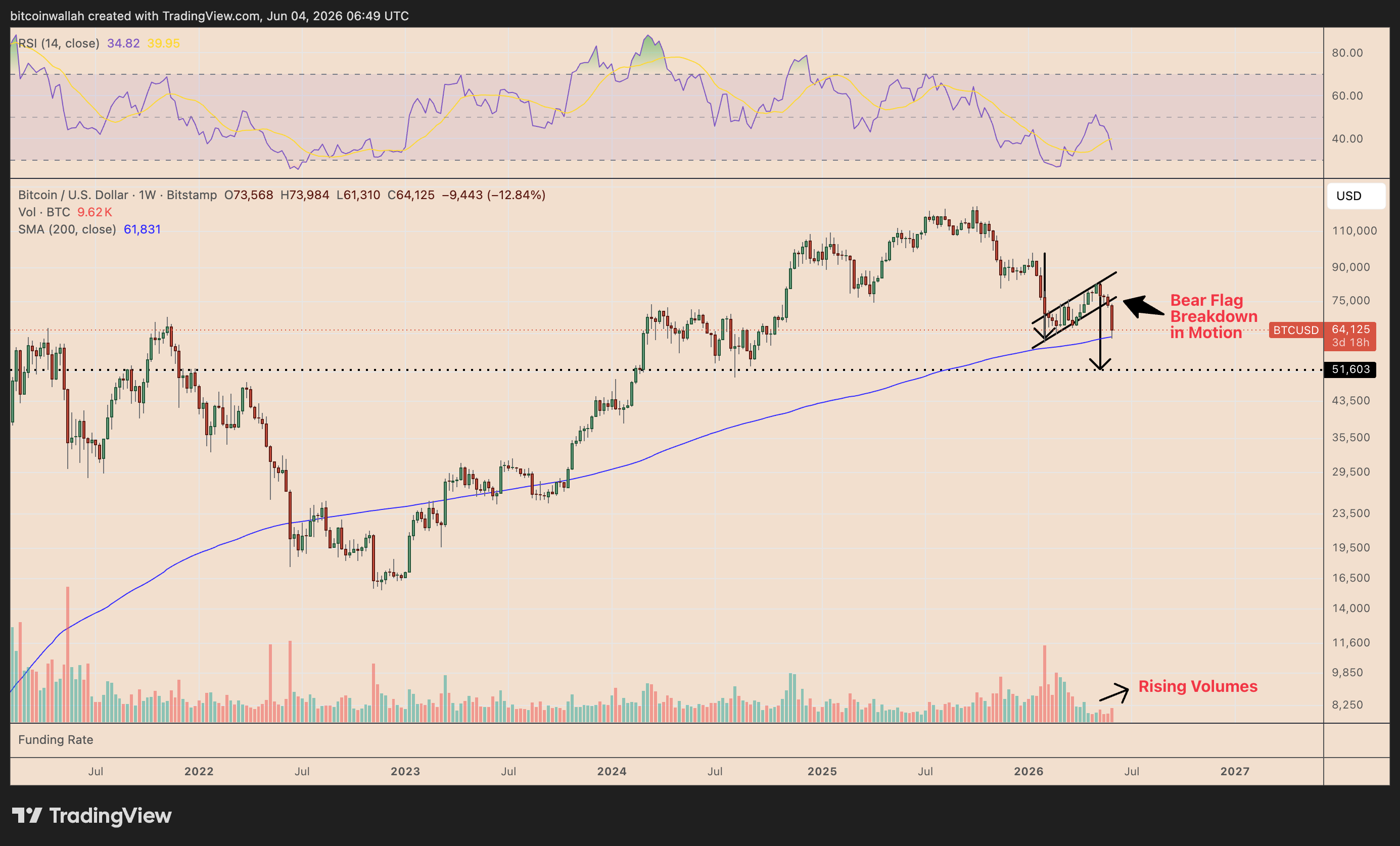
Bitcoin’s weekly chart still shows a bear flag breakdown in progress, keeping the risk of a deeper drop toward the $50,000–$52,000 area alive. The setup follows BTC’s failure to reclaim the flag’s upper trend line, with rising volumes adding weight to the downside move.
BTC/USD weekly chart. Source: TradingView
However, the bearish scenario is not confirmed as long as BTC trades above its 200-week simple moving average (200-week SMA, blue line) at around $61,800. This level has acted as a major cycle-bottom zone in past Bitcoin bear markets, including 2015, 2018 and 2020.
A strong rebound from the 200-week SMA would weaken, or potentially invalidate, the bear flag breakdown, putting BTC price in position to test $70,000 as the next upside target.
Nine Democratic lawmakers in the US House of Representatives have called on the Federal Trade Commission to launch a probe into how prediction markets are advertising to customers compared to how they present themselves to regulators.
In a statement on Wednesday, US Representatives Kevin Mullin and Gabe Vasquez said the FTC should investigate whether online prediction market platforms are misleading customers by advertising as gambling platforms while telling regulators they are financial tools offering investment products.
Prediction markets allow users to trade contracts on the outcome of future events. They have also been facing scrutiny over insider trading, with Congress launching a probe into Polymarket and Kalshi in May and questioning the companies’ responses to insider-trading incidents on their platforms.
The Democratic lawmakers allege that prediction market platforms use language associated with sports gambling, including legal betting and betting on sports without a sportsbook, while attempting to evade state gambling regulations.
A group of nine Democratic lawmakers is calling on the FTC to launch a probe into prediction markets. Source: Kevin Mullin
“These prediction market companies are presenting themselves differently to regulators than they are to the public, and that kind of contradictory messaging can mislead consumers about what rules and protections actually apply,” Mullin said.
“We are urging the FTC to investigate these practices and ensure consumers are protected from this potentially deceptive activity,” he added.
In their letter, the lawmakers are also asking the FTC for detailed information by June 29 on whether it has plans to take investigative or enforcement action against prediction market platforms for possible deceptive practices.
Related: Kalshi bans 3 US politicians for betting on their own election races
At the same time, the lawmakers have asked whether the FTC has received complaints about prediction markets and if the FTC considers public perception and legal filings when determining if a company has engaged in possible deceptive practices.
US Representatives Jared Huffman, Raul Ruiz, Salud Carbajal, Mike Levin, Dina Titus, Paul Tonko, and Valerie Foushee have also signed the letter.
Prediction markets have emerged as a significant real-world use case for blockchain, with some platforms relying on crypto rails and stablecoins for settlement and payments.
In March, transactions hit record highs amid growing interest in political and geopolitical event contracts, improved accessibility and positive regulatory developments for the industry.
Magazine: Big Questions: Do we really only need 2–5 cryptocurrencies?