Federal prosecutors in Philadelphia charged two men Wednesday with running an international bitcoin and crypto money laundering operation that processed nearly $400 million in illicit funds over five years, part of a sweeping multinational law enforcement takedown that dismantled the group’s criminal infrastructure across multiple continents.
Ruslan Igorevich Tkachuk, 37, a Ukrainian national, and Alexander Vladimirovich Ledenev, 25, a Russian national, were arrested in Batumi, Republic of Georgia, where both men reside, according to U.S. Attorney David Metcalf of the Eastern District of Pennsylvania.
Each faces one count of conspiracy to launder monetary instruments and one count of sting money laundering — charges that carry a maximum sentence of 20 years in prison.
Prosecutors allege the two men were senior members of an organization that called itself “AudiA6,” which operated a cryptocurrency mixing service and managed a cybercrime forum known as Dark2Web, where users could negotiate the commission of cybercrimes for pay. Since launching in 2021,
$389 million in bitcoin
AudiA6 accepted approximately 10,333 Bitcoin — valued at roughly $389.7 million at the time of the transactions — into its wallets, earning at least $10 million in commission fees by charging clients up to 5% per transaction.
Of those funds, approximately 393 Bitcoin, valued at around $19.2 million, were traced directly to known darknet markets, ransomware groups, and other illicit sources, with additional funds flowing in indirectly from criminal actors.
Despite AudiA6’s promises to clients that the mixed funds would be untraceable, investigators said blockchain analysis revealed the transactions could be followed directly through exchange records.
The case, built partly on six undercover operations conducted between December 2022 and May 2026, featured FBI and Secret Service agents posing as criminals seeking to launder proceeds from scams and narcotics sales.
In one exchange, an AudiA6 operator responded to an agent asking whether stolen Bitcoin was acceptable by saying simply, “don’t care.” In another, when asked whether drug sale proceeds posed too great a risk, the operator replied, “Everything like that needs to go through a mixer.”
The arrests were part of a coordinated international takedown involving the U.S. Secret Service, IRS Criminal Investigation, Europol, Eurojust, and law enforcement partners from Australia, Canada, France, Georgia, Germany, Iceland, Japan, Poland, Switzerland, and the United Kingdom. Authorities searched three properties, seized digital devices, froze cryptocurrency assets, blocked associated Telegram accounts, and replaced the AudiA6 and Dark2Web websites with law enforcement seizure banners.
The U.S. Attorney’s Office said it will seek extradition of Tkachuk and Ledenev to the Eastern District of Pennsylvania. The case is being prosecuted by Assistant U.S. Attorneys Benjamin D. Traster and Sima Kazmir.
A regulated security backed 1:1 by independently certified bitumen reserves — issued under ERC-3643, settled on Ethereum, and offered to accredited investors through a dedicated SPV. The thesis: a structural supply shock in U.S. asphalt binder, met with a tokenization framework purpose-built for the kind of long-lifecycle, securities-compliant commodity exposure institutional balance sheets actually want.
Most real-world asset projects in crypto tokenize what is already liquid: treasuries, money-market funds, gold. AetherStrike picked the opposite end of the spectrum — an illiquid physical commodity in structural undersupply – one that every state DOT in America must buy, can’t substitute for, and is finding harder to source each quarter. AetherStrike’s first Strike brings an NSAI-certified bitumen deposit in Utah’s Uinta Basin to accredited investors as a Dynamic Resource Reserve Unit (DRRU): one token, one barrel, on-chain.
The pitch isn’t a narrative. It’s an arbitrage between a real-world supply shock and a tokenization framework that finally meets institutional standards.
The Asphalt Problem Is a Refining-Economics Problem
Asphalt binder is the heaviest 2% of a refinery’s slate. No one runs a refinery for it. Capacity decisions get made on light-end crack spreads — gasoline, diesel, jet — and when those margins compress, the refinery doesn’t reconfigure for binder. It closes. Asphalt supply leaves with it as collateral damage.
That collateral damage is now structural. Phillips 66 shut its 139,000-bpd Los Angeles plant in Q4 2025. Valero followed in April 2026, idling Benicia and taking roughly 45% of Northern California’s paving-grade binder offline in a single decision. California has gone from 23 active refineries in 2000 to 11. The same arithmetic is playing out across the West Coast, Midwest, and East Coast — analysts project on the order of 1.9 million bpd of U.S. refining capacity reductions through 2045.
Crucially, the capacity isn’t coming back. U.S. greenfield refining has been functionally dead since 1977 — Marathon’s Garyville was the last meaningful new build — and CARBOB compliance, LCFS economics, and capital cost have only widened the moat against new entrants. The Asphalt Institute Foundation’s own Wood Mackenzie study (January 2025) projects shortfalls of 55,000–205,000 barrels per day under realistic transition scenarios and explicitly calls for “new dedicated binder production capacity via greenfield plants.” The industry is asking — in writing — for what AetherStrike’s first Strike supplies.
Demand isn’t softening to meet the shortfall. EVs, autonomous fleets, and last-mile logistics all run on asphalt roads. The U.S. carries a $684B infrastructure funding gap through 2033, and 94% of paved roads use asphalt binder. Whatever the next highway bill looks like, the binder still has to come from somewhere.
Why Utah Is Not Alberta
When folks hear “oil sands,” they think Alberta — water-intensive processing, tailings ponds, synthetic crude upgraders, and long pipeline routes to market. The Uinta Basin is a different geology and a different supply chain. Utah’s bitumen sits in shallow seams that were used directly for road paving before modern refining existed. There is no water used in the process, no synthetic crude step, no Gulf Coast refinery in the chain. The ore comes out of the ground and goes to the binder market with minimal processing.
That structural simplicity is also why this is a meaningfully lower-carbon source of binder than the refinery-sourced alternative — and why Valkor Oil and Gas, the operator behind the Strike, has spent years building a closed-loop, water-free solvent extraction process engineered specifically for this geology. Valkor holds mineral rights across more than 25,000 acres in the basin, has its proof-of-concept facility (AR Pioneer) under construction, and operates as a fee-for-service producer for the offering vehicle — keeping the underlying asset independent of any single operator.
The first Strike, Asphalt Bluff South (ABS), is a SITLA-leased section roughly 6.5 miles southwest of Vernal, Utah. NSAI has independently certified its contingent resource base under the 2018 PRMS, sized for approximately two decades of production at a ~2,500-bbl/day target. The capital raise itself is the mechanism that converts a certified contingent resource into a producing reserve.
What a DRRU Actually Is: A DRRU is a regulated ERC-3643 security token representing one independently certified barrel of recoverable reserve, held in a bankruptcy-remote Wyoming SPV (DRRUSPV1 LLC). It is not equity, not a futures wrapper, not a governance token, and not a stablecoin. It carries a contractual right to revenue from the underlying extraction, anchored by an on-chain reserve count and a buyback floor priced off actual commodity sales — not modeled values.
Three mechanics matter most.
Three-wallet token integrity. Active tokens are split between an SPV Retained wallet (unsold and operational), a Circulating wallet (investor-held, entitled to dividends), and an Escrow wallet (frozen, used only for under-recovery adjustments). At all times, Active Tokens = Certified Recoverable Reserves. The identity is on-chain and publicly verifiable.
F-factor reconciliation. Each year, F = actual cumulative recovery ÷ projected cumulative recovery. If F < 1.0, tokens move from SPV Retained into Escrow — the SPV, not investors, absorbs reserve shortfalls. If F > 1.0, new tokens mint into SPV Retained, but cannot extend investors’ return timeline. Circulating tokens are never affected by reconciliation. This is materially different from how most tokenized commodity structures handle reserve risk.
NAV floor anchored to real sales. The SPV maintains a 50% NAV buyback auction floor anchored to the attained market price of actual commodity sales — not an oracle feed or a synthetic index. Most tokenized RWAs price off modeled NAVs. DRRU’s floor is anchored to dollars that actually changed hands for the underlying barrel.
“One token, one reserve unit — verifiable by anyone. Don’t trust. Verify.”
Tier 3 Entry: A Compressed Discount, Not a Promotion
Strike #1 prices its DRRU at $13.92 against an independently calculated NAV of $48.08 per barrel — a 71% discount. That gap isn’t promotional. It is the explicit price of the contingencies still standing between today’s certified resource and tomorrow’s producing reserve: financing, construction, and operational ramp. As each milestone clears, reserve classification upgrades and the discount to NAV compresses. Tier 3 entry is positioned for the full de-risking trajectory.
Four distinct value drivers compound through the asset’s life: tier progression (discount compression as milestones close), commodity-price exposure (1:1 via the NAV oracle), reserve over-recovery (new tokens minted only if extraction exceeds projections), and built-in liquidity pathways (secondary market, SPV buyback auctions, and holding through maturity). They aren’t dependent on each other to work — they are independent return streams attached to the same underlying barrel.
Why Ethereum L1 and ERC-3643
The chain decision was constrained, not stylistic. ERC-3643 (T-REX protocol) is the only mature standard purpose-built for regulated security tokens — identity verification, transfer restrictions, accreditation checks, and Rule 144 holding-period compliance enforced at the contract level. Audited by Kaspersky and Hacken, in production managing real securities, and progressing through ISO standardization.
The custody, compliance, and legal infrastructure for institutional RWA — Fireblocks, Coinbase Prime, Tokeny, Securitize — was independently selected by BlackRock’s BUIDL, Franklin Templeton’s BENJI, and effectively every serious institutional RWA issuance. That isn’t coincidence. Ethereum has run without a consensus failure since 2015.
There is also a second-stage design here that most security-token issuances never solve. After the Rule 144 twelve-month holding period, the plan is for the DRRU to transition from ERC-3643 to a standard ERC-20 — subject to regulatory confirmation — without losing its core mechanics. The three-wallet system, F-factor reconciliation, NAV oracle, and dividend distribution all carry through. What unlocks is composability: DEX liquidity, collateralized borrowing via Morpho or similar venues, and perpetuals exposure. A reserve of community tokens seeds initial DEX liquidity from day one. RWA-to-DeFi composability without sacrificing securities compliance is the part of the design space most issuers have left unsolved.
Why This Matters Now
Commodity reserve investment has historically been the province of institutional balance sheets and well-connected insiders — high minimums, complex deal structures, no liquidity, and a due-diligence burden that ruled out most allocators. The DRRU framework changes the calculus: fractional ownership, transparent reserve backing, on-chain settlement, and a compliance layer engineered to hold up under SEC scrutiny.
Strike #1 is also the proof-of-concept for a broader platform. The DRRU architecture is commodity-agnostic — the same three-wallet system, tier classification, and lifecycle mechanics apply equally to hydrocarbons, precious metals, industrial minerals, forestry, or water rights. AetherStrike is targeting multiple launches per year by 2027. The platform’s credibility starts with this one.
At a Glance
Asset
Asphalt Bluff South, Uinta Basin, Utah
Operator
Valkor Oil and Gas (fee-for-service)
Offering Vehicle
DRRUSPV1 LLC (Wyoming)
Reserve Classification
NSAI-certified PRMS Contingent (Tier 3), March 2026
Token Standard
ERC-3643 on Ethereum mainnet
Token Price (Tier 3)
$13.92 per DRRU
NAV per Token
$48.08 per barrel
Tier Discount
71% to NAV
Production Target
~2,500 bbl/day, ~20 years
Primary Products
Low-carbon asphalt binder + diesel range organics
Custody (during deployment)
Coinbase Prime / Fireblocks (USDC)
Eligibility
Reg D 506(c) (U.S. accredited) / Reg S (international)
What Comes Next
AetherStrike is not opening the offering today. It is opening the channel. The SPV will conduct the formal raise through definitive offering documents, including a Private Placement Memorandum. Investor capital, when it begins, will be held in USDC at an institutional custodian and drawn down as engineering, procurement, and construction milestones close.
Register Your Interest
AetherStrike is informing qualified investors — not pitching them. Registration does not constitute participation in any offering.
Learn more at AetherStrike.com →
DISCLOSURE: This is sponsored content. This communication is for informational purposes only and does not constitute an offer to sell or a solicitation of an offer to purchase any security. Any offering of securities will be conducted only by DRRUSPV1 LLC in accordance with applicable federal and state securities laws, and only to investors who meet applicable eligibility requirements. DRRU tokens are offered under Regulation D (Rule 506(c)) to verified U.S. accredited investors and under Regulation S to eligible international investors. Contingent resource estimates have been prepared by Netherland, Sewell & Associates, Inc. (NSAI) in accordance with the 2018 PRMS definitions and guidelines as of March 2026. Contingent resources are not reserves; they are subject to contingencies including securing project financing, construction of production facilities, and commitment to develop the resources. Financial projections including NAV per token, token pricing, and production timelines are based on AACE Class 4 estimates and are subject to change. Investment in commodity development carries significant risk, including potential loss of capital. Dividends are variable and not guaranteed. AetherStrike earns a 5% Mint Fee on initial token sales and a 5% Value Realization Fee on over-recovery and new discovery tokens; these fees are disclosed in the applicable Private Placement Memorandum. Prospective investors should review the complete risk disclosures in the applicable Strike’s Private Placement Memorandum before making any investment decision. AetherStrike LLC is a Wyoming limited liability company.
The structure is based on depositary receipts, a longstanding financial product that allows investors to gain exposure to shares through a bank-issued security. Citi has adapted that model for private companies and recorded the securities on blockchain infrastructure operated by Swiss market operator SIX.
The result is a digital version of a traditional financial instrument. Investors own the depositary receipt rather than the underlying shares directly, while Citi acts as both issuer and custodian.
The bank argued the approach could make private-market investing simpler and more transparent than some existing structures, which often rely on special-purpose vehicles and multiple intermediaries.
The launch is part of a larger effort by major financial institutions to tokenize traditional assets.
Tokenization refers to representing real-world assets such as stocks, bonds or bank deposits as digital tokens that can move across blockchain networks.
Supporters say tokenized assets could eventually reduce settlement times, lower costs and allow markets to operate around the clock.
Citi has been among the banks pushing that transition. Earlier this month, Citi joined several of the largest U.S. banks in announcing plans to develop a shared tokenized deposit network through The Clearing House by mid-2027. The system would convert traditional bank deposits into blockchain-based tokens while keeping funds inside the regulated banking system.
XRP (XRP) charts are painting multiple bearish patterns this month with a downside target under $1.
Key takeaways:
XRP is forming head-and-shoulders and bear flag setups on its shorter-time frame chart.
An on-chain metric is further signaling weak demand or capitulation sentiment among traders.
Head-and-shoulders setup hints at 10% XRP decline
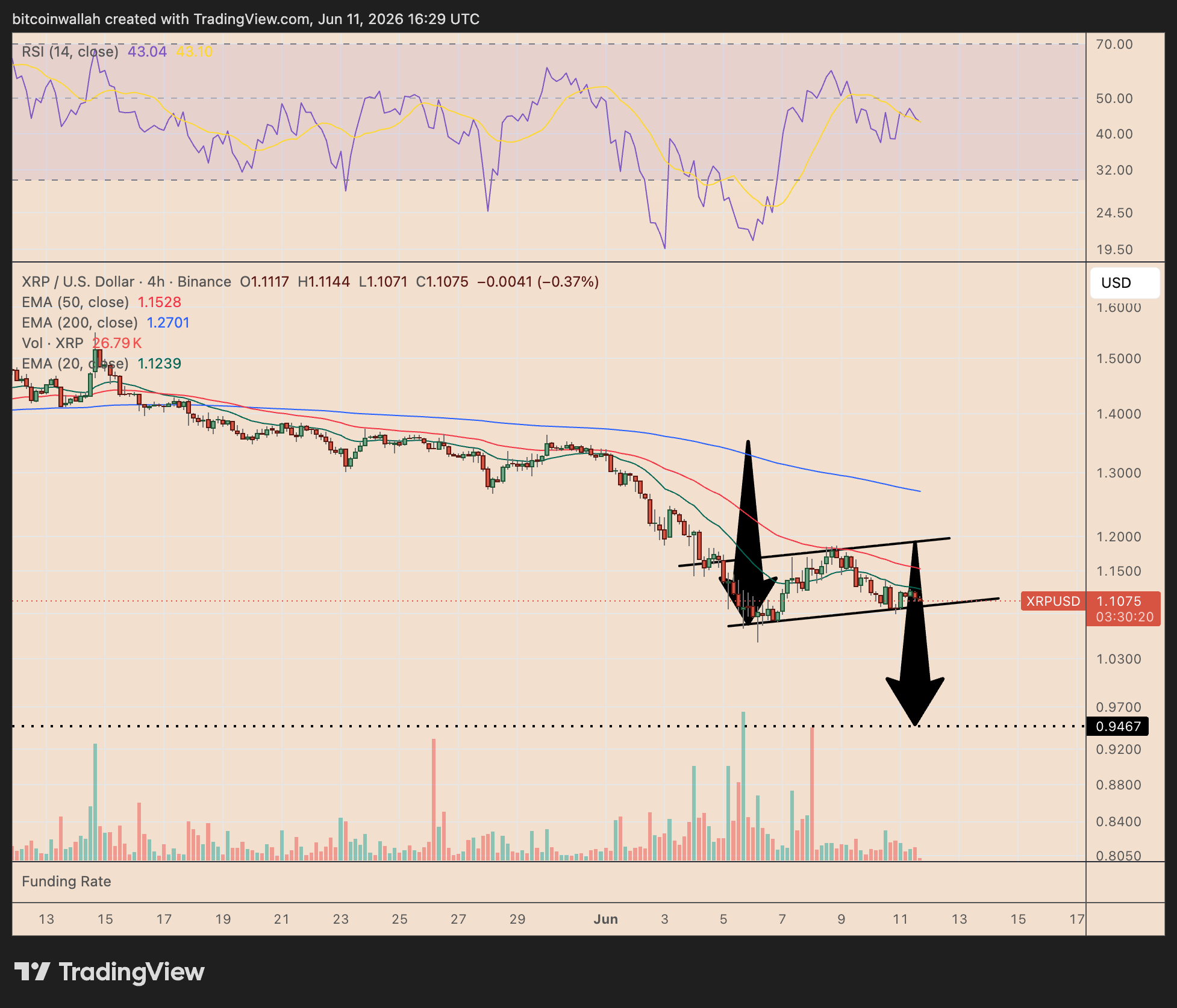
Since June 5, the XRP price has formed what appears to be a head-and-shoulders (H&S) pattern.
The setup develops when the price forms three peaks atop a common neckline support, where the middle peak, called the “head,” is higher than the other two, the “shoulders.”
An H&S pattern typically resolves when the price breaks decisively below the neckline support, with its downside target measured by subtracting the breakdown level from the structure’s maximum height.
As of Thursday, XRP was forming the pattern’s right shoulder, eyeing an initial dip toward the neckline near $1.09.
Applying the technical rule, the target for June is around $0.99, down roughly 10%, if the price breaks below the neckline.
Conversely, a clear break above the right shoulder’s peak at around $1.12, a level also aligning with the 20-period exponential moving average (20-period EMA, green) on the four-hour chart, may invalidate the H&S pattern.
In that case, XRP may rally toward the 50-period EMA (red) near $1.15, up 4.5% from the current price levels.
Another bearish setup hints at a lower XRP price target
XRP’s four-hour chart also shows a bear flag, adding weight to the sub-$1 bearish outlook.
A bear flag forms when the price consolidates inside a rising channel after a sharp sell-off. It typically signals a pause before the prior downtrend resumes.
XRP/USD four-hour chart. Source: TradingView
As of Thursday, XRP was testing the flag’s lower trendline near $1.10. A decisive four-hour close below this level could confirm the breakdown.
Applying the technical rule, XRP’s bear flag target sits near $0.94, down roughly 15% from current prices.
The relative strength index (RSI) near 43 supports the bearish view, showing weak momentum below the neutral 50 level.
However, a rebound above $1.12 would weaken the setup. A stronger move above the 50-period EMA near $1.15 could delay the selloff and send XRP toward the flag’s upper trend line near $1.18–$1.20.
On-chain data points to dip toward $0.96
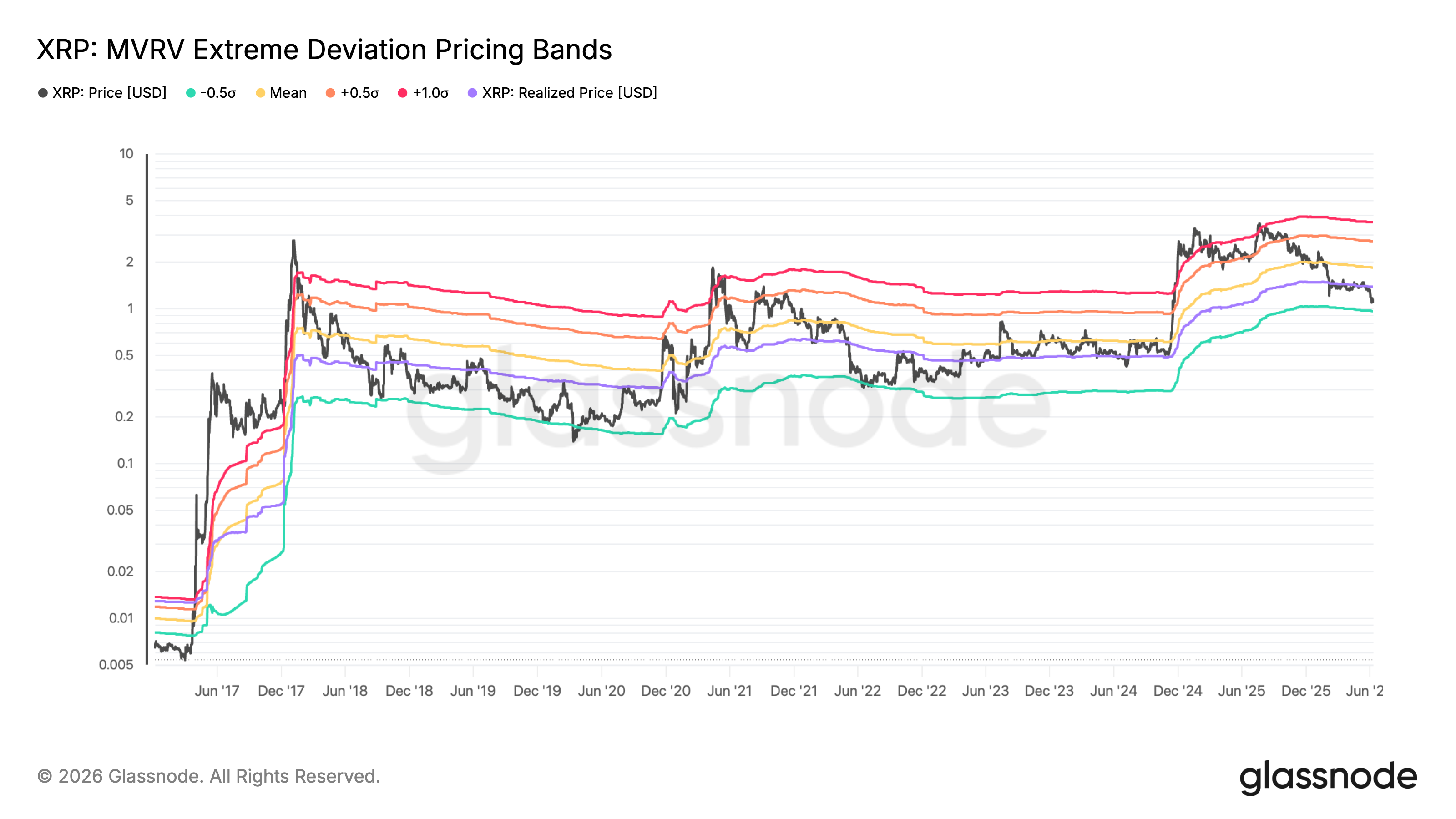
XRP’s MVRV pricing bands suggest the price still has room to fall toward the lower green zone.
For new traders, MVRV compares XRP’s market price with the average price at which coins last moved on-chain. In simple terms, it shows whether holders are sitting on large paper profits or losses.
When price trades near the upper bands, the market is usually overheated. When it falls toward the lower bands, it often signals stress, weak demand, or capitulation.
Related: XRP transaction demand falls 91.5% as traders focus on $0.65 support
That lower green band has acted like a bear-market magnet for XRP in previous cycles. It declined toward or below the same zone during major downturns in 2018, 2020 and 2022 before finding stronger support later.
The next major downside target sits near the green lower band near $0.96, about 13% below current prices if history repeats.
The Solana Foundation formalized Solana’s institutional market-structure tier with Frontier Traders, requiring $500M in trailing 30-day DEX volume for VIP access, with the debut campaign running on SpaceX tokenized equity.
The Solana Foundation launched Frontier Traders Thursday afternoon, a formal institutional program for elite trading firms, with the first qualifying campaign opening on SpaceX tokenized equity Friday.
The entry bar sits at $500 million in trailing 30-day onchain DEX volume combined with $16 million in gross time-weighted open interest. Three VIP tiers scale from there: VIP 1 for $500M–$2B in volume, VIP 2 for $2B–$5B, and VIP 3 for $5B and above. Maker minimums are reviewed directly with firms that can provide competitive liquidity. Members receive trading rebates across all Solana venues, priority RPC access, early access to asset launches through Asset Express, and invites to quarterly closed-door briefings. Jupiter Exchange is the program’s featured venue partner; VIP enrollment closes June 18.
Firms below the volume threshold can qualify through time-limited campaigns. The first campaign opens on SpaceX tokenized equity, starting Friday. The choice of SpaceX as the debut asset places Solana directly in the pre-IPO derivatives race: Trade.xyz launched a synthetic SpaceX perpetual on Hyperliquid in May; Bybit and Kraken followed in June with 1:1 equity-backed SpaceX exposure via Backed Assets’ xStocks, bringing the active venue count to four before Thursday’s announcement.
The Frontier Traders website cites all-in fees of 0.4 basis points on SOL/USDC versus 2.6 basis points for Binance VIP 9, a 6.5x gap the Foundation frames as the case for routing institutional volume to Solana. The site also cites BisonFi Prop AMM generating more than $6 billion in trailing 30-day onchain volume, nearly three times Binance’s figure for the same period.
The program arrives as the Solana ecosystem applies pressure on Hyperliquid’s institutional perp share from multiple angles. Solana co-founder Anatoly Yakovenko backed a new perp DEX last month specifically aimed at pulling volume back to Solana. Frontier Traders layers direct financial rewards on top: firms in the program collect rebates from the Foundation for trading onchain, with structured access to the protocols shaping Solana’s market structure.
Surging oil prices and rising producer inflation have pushed traders to price in a stricter US Fed monetary policy.
Massive spot Bitcoin ETF outflows in June show the cryptocurrency is currently failing to act as a stock market hedge.
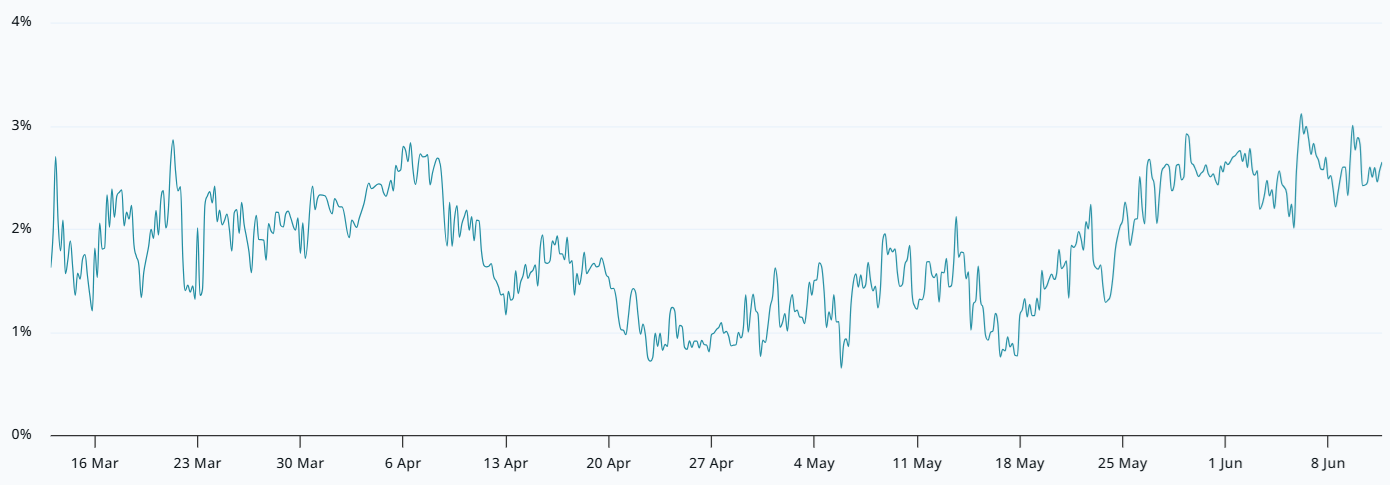
The Nasdaq 100 Index dropped 7.5% in the seven days leading up to June 10, wiping out $2.7 trillion in market value. The fallout represents more than twice the entire Bitcoin (BTC) market capitalization and has put traders on alert, especially as inflation data feels the heat from high oil prices. Traders now fear that Bitcoin support near $60,000 stands at risk.
Nasdaq 100 futures (left) vs. Bitcoin/USD (right). Source: TradingView
The ongoing war in Iran has driven Brent crude oil prices above $90, prompting investors to fear an economic slowdown and to price in a tighter monetary policy for longer than previously anticipated. Regardless of job market conditions, money available for consumption tends to decline.
The US Labor Department reported Thursday that its producer price index jumped 6.5% from May 2025, the highest level since 2022. Traders now anticipate 40% odds of an interest rate increase by the US Fed by September, up from 5% one month prior, according to the CME FedWatch Tool.
Bitcoin futures contracts traded below the 4% neutral premium relative to regular spot markets on Thursday, indicating low demand for bullish leverage. Meanwhile, the upcoming $75 billion SpaceX (SPCX US) IPO was oversubscribed by more than 2x, signaling investors are not yet ready to abandon hope of further tech sector growth.
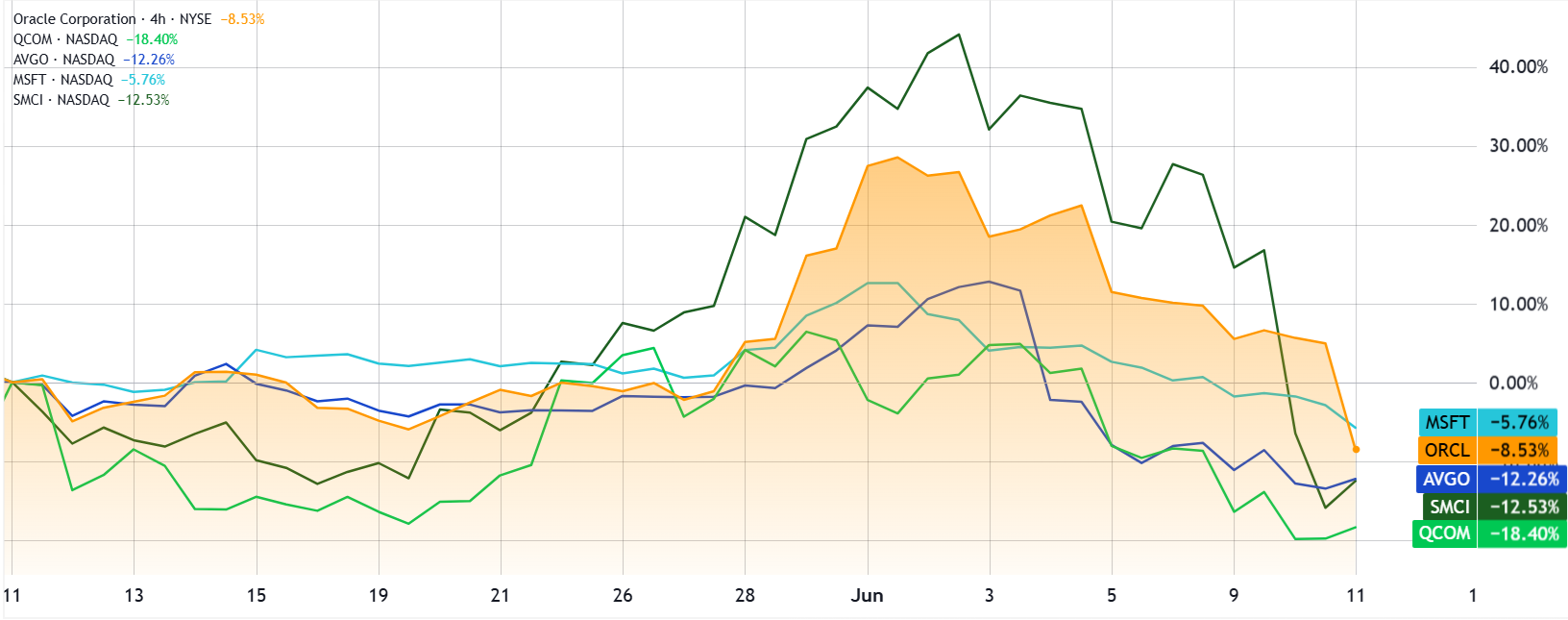
AI infrastructure companies are in desperate need of cash to fuel their build-outs, which partially explains the negative market reaction. Google (GOOG US) announced plans to raise $80 billion, while Oracle (ORCL US) and Super Micro Computer (SMCI US) followed suit with $40 billion and $7 billion, respectively. The Friday debut of SpaceX shares will likely set the tone for upcoming IPOs.
Selected AI sector stock performances. Source: TradingView & Cointelegraph
It seems premature to deem the AI sector a bubble after SpaceX marked the largest IPO in history at a $1.77 trillion valuation. Moreover, the US stock market reacted positively after US President Donald Trump called off planned strikes on Iran, citing renewed negotiations to reopen the Strait of Hormuz.
Bitcoin’s decline coincided with Strategy’s (MSTR US) decision to temporarily halt its Bitcoin accumulation to reduce convertible debt. As a result, Strategy’s cash position declined to seven months of dividend coverage, while its preferred variable Stretch (STRC US) shares distanced themselves from the $100 level that would allow further equity issuance.
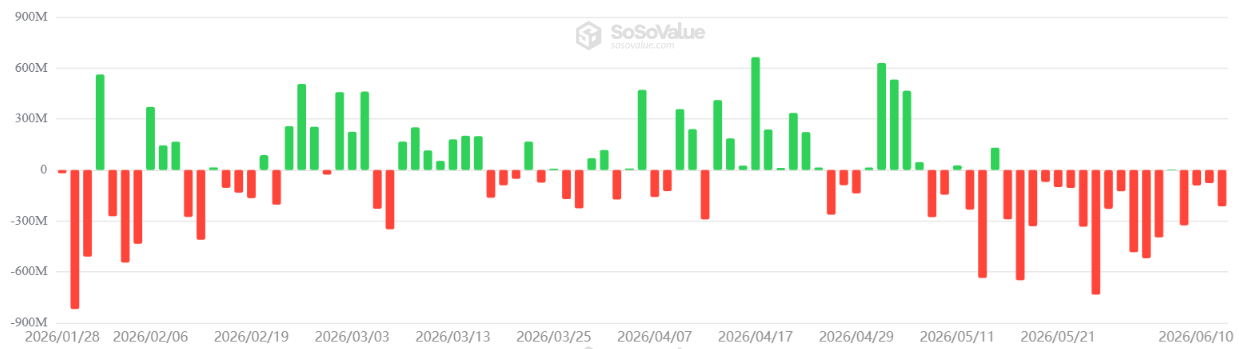
US-listed Bitcoin spot ETFs daily net flows, USD. Source: SoSoValue
The $1.9 billion in outflows from spot Bitcoin exchange-traded funds (ETFs) in June reinforced bearish sentiment, as the indicator serves as a proxy for institutional demand. Presently, Bitcoin can hardly be considered a hedge against an eventual stock market sell-off; the odds of a further correction below $60,000 should not be ruled out.
SpaceX begins trading on Nasdaq at 9:30 AM ET Friday under SPCX. The same morning, Ondo’s SPCXon, Kraken’s xStocks SPCXx, a Backpack Securities-issued SPCX token on Solana, and Hyperliquid’s pre-IPO perpetual all settle into a single live tokenized-equity stack.
SpaceX begins trading on Nasdaq under the ticker SPCX tomorrow. The same day, a stack of crypto-native tokenized-equity products designed to mirror or redeem against SPCX goes live in parallel.
SpaceX priced its IPO at $135 per share on Thursday, offering roughly 555.6 million shares for a $75 billion raise at a $1.75 trillion valuation, the largest IPO on record. Crypto-native exposure has built ahead of the bell on rails spanning institutional TRS desks to retail DeFi wrappers: Ondo Finance’s SPCXon, Kraken’s xStocks SPCXx, a Backpack Securities-issued SPCX token routed to Solana through SunriseDefi, and a Galaxy Digital total return swap referencing an on-chain SpaceX perpetual for institutional counterparties.
Hyperliquid’s pre-IPO SPCX perpetual, deployed by Trade.xyz, holds over $190 million in open interest and converts to a standard stock-linked perpetual once Nasdaq trading begins.
Friday’s open is the first time a marquee IPO has had a simultaneous on-chain equity market issued by a regulated brokerage, alongside a separate regulated tokenized-equity wrapper, alongside a live pre-IPO derivatives book waiting to settle into spot.
Ondo Finance SPCXon
Ondo Finance is listing SPCXon through its Global Markets platform, which is designed to bring public equities on-chain the same day they list on traditional exchanges. The product is backed 1:1 by SpaceX shares held in regulated custody and operates as a total-return tracker, with mint and redeem windows available to non-U.S. users via wallets including MetaMask on Ethereum and Solana.
Ondo’s own SPCX allocation registration page is live for retail interest, and DEXTools reported that tokenized SPCX exposure from Ondo, Backed Finance, and Dinari will arrive on Ethereum, Solana, and Base within hours of the Nasdaq open. Ondo and xStocks already lead the tokenized-equity category on Ethereum, per recent Defiant reporting.
Kraken xStocks Settlement
Kraken’s xStocks framework is offering SPCXx, a 1:1 backed tokenized representation of SpaceX equity, to customers in 110-plus supported regions including the European Economic Area, per Kraken’s blog. Eligible users submitted indications of interest at the IPO price range; successful allocations land in Kraken balances on the listing day and trade 24/7 across Kraken and other xStocks Alliance venues.
“From today, someone in 110 countries can register for SpaceX from their phone, and the moment it lists they trade it: nights, weekends, no waiting for an opening bell,” Payward Co-CEO Arjun Sethi said in Kraken’s announcement. xStocks are issued by Backed Assets (JE) Limited against shares in regulated custody, the same legal structure Defiant has previously detailed. xStocks are not available to U.S., UK, Canadian, or Australian users.
SunriseDefi and Backpack Securities Bring 24/7 Solana Redemption
Backpack Securities is issuing a separate SPCX token on Solana, with SunriseDefi routing the asset onchain and Meteora seeding the liquidity layer. Each token corresponds to one real SpaceX share purchased and custodied by Backpack Securities, a regulated U.S. brokerage, and holders can redeem the token for the underlying equity and move those shares to a traditional brokerage through ACATS and DTCC settlement rails. The mechanics were confirmed via the Solana Foundation’s official account and amplified by Solana co-founder Anatoly Yakovenko.
SunriseDefi is built on Wormhole and has coordinated more than $360 million in spot volume across six prior tokenized launches; for SPCX it brings the asset to Solana DeFi from the first moment of listing.
Galaxy Digital’s Total Return Swap for Institutional Counterparties
Galaxy Digital said it structured a total return swap referencing a perpetual contract linked to SpaceX’s market-implied valuation, an institutional pattern that sits alongside the retail and DeFi-native wrappers going live the same day. A total return swap is a bilateral derivative in which one party pays the total economic return of a reference asset and the other pays a financing leg, so counterparties get the price exposure without holding the underlying.
The transaction is cash-settled and does not provide ownership of, rights to acquire, or delivery of SpaceX securities, with Galaxy noting it conducts security-based derivatives activity solely with eligible institutional counterparties.
“How does a TradFi hedge fund gain synthetic exposure to private-company valuation trends before a public listing? Onchain, via derivatives instruments already traded by institutions,” Galaxy wrote, describing the swap as a structure that lets institutional clients access SpaceX valuation moves through the same on-chain perpetual venues fueling retail tokenized-equity demand.
The Galaxy structure rounds out the institutional layer of the same stress-test Ondo SPCXon, Kraken xStocks, and the Backpack-SunriseDefi Solana token are putting on the retail and DeFi-native side: pricing for a single equity event is now discoverable across regulated tokenized wrappers, on-chain perpetuals, and bilateral institutional swaps, all settling against the same underlying reference.
Hyperliquid Pre-IPO Perp Settles Into Spot
The largest on-chain pre-IPO market for SpaceX sits on Hyperliquid. Trade.xyz deployed the SPCX-USDC perpetual on May 18 at a $150 reference price implying a $1.78 trillion valuation, and the contract now accounts for 94% of HIP-3 open interest on Hyperliquid per Arkham Intelligence. At Thursday morning, SPCX on Hyperliquid was implying a $2.01 trillion valuation at $154 per share, roughly 14% above the IPO price. Active positions transition to a standard stock-linked perp once Nasdaq trading begins, in the same conversion path the Cerebras pre-IPO contract took in May.
What to Watch at the Bell
The xStocks and Backpack tokens both depend on shares purchased through normal IPO channels landing in regulated custody before allocations are minted on-chain; the time between Nasdaq’s first print and the first on-chain mint is the gating telemetry for both products.
Ondo’s SPCXon will publish daily custody attestations once live, per its Global Markets design. The Hyperliquid perp converts mechanically once SpaceX’s spot price is established, and the reference rate that perpetual settles to is also the rate Galaxy’s institutional TRS will mark against.
Whether the cross-product basis between SPCXon, SPCXx, the Solana SPCX token, the Hyperliquid perp, and Galaxy’s swap reference tightens through the first 24 hours is the cleanest test of how well the crypto-native tokenized-equity stack actually mirrors the underlying equity.
The Fidelity Digital Dollar stablecoin deployed Curve Finance Stableswap LP positions and Uniswap LP positions simultaneously in a single Ethereum block Thursday evening, with Curve founder Michael Egorov noting the same-block execution as evidence of DeFi operational expertise.
The Fidelity Digital Dollar reportedly deployed liquidity to both Curve Finance and Uniswap in a single Ethereum block Thursday evening, with an on-chain watcher flagging the move as the Fidelity-branded stablecoin’s first foray onto permissionless DeFi rails.
LytninCrypto, an on-chain data tracker, posted the discovery Thursday, noting that the FIDD liquidity adder wallet set up Curve Finance Stableswap LP positions and Uniswap LP positions simultaneously. Curve founder Michael Egorov responded within six minutes. “Same block to both protocols, wow,” Egorov wrote on X. “@Fidelity do know how to use DeFi!”.
Fidelity Digital Assets has made no public statement specifically about the Curve or Uniswap deployment.
The Issuer and the Token
Fidelity Digital Assets, National Association, a federally chartered subsidiary of Fidelity Investments, issued FIDD in February. The stablecoin is backed 1:1 with cash and short-term US Treasuries, built on the ERC-20 standard on Ethereum, and designed for GENIUS Act compliance. Monthly reserve reports are published by the subsidiary on its website. Fidelity targets both institutional on-chain settlement and retail payments with the token.
The asset manager’s blockchain trajectory has built steadily: Fidelity filed to tokenize an on-chain Treasury fund, runs both a spot Bitcoin ETF and a spot Ethereum ETF, and added staking to its Ethereum ETF application. FIDD extends that posture to active liquidity infrastructure.
What the Same-Block Deployment Tells Us
Deploying liquidity to both Curve and Uniswap inside a single Ethereum block requires coordinating transaction calls in advance, typically through a scripted multi-call contract. Doing so in one block eliminates any window where FIDD would sit on one venue but not the other, a hygiene detail that matters for price consistency at launch. Together the two pools give FIDD coverage across the two deepest permissionless liquidity layers on Ethereum. Curve processed $34.6 billion in trading volume in Q1 2026, per earlier The Defiant reporting.
The Broader TradFi-DeFi Picture
The GENIUS Act, signed into law last year, created a compliance path for federally regulated stablecoin issuers and accelerated institutional launches. Stablecoin supply grew by $18 billion in the month following the Act’s passage, per prior The Defiant reporting.
Adding Curve and Uniswap pools as FIDD’s primary liquidity layer plants a regulated, Fidelity-issued dollar instrument inside the same DeFi composability stack that permissionless protocols use.
io.net is tying its token economy more closely to customer revenue.
The decentralized GPU network said today that it expects to burn at least 12 million IO tokens over the next year under a new tokenomics framework called the Incentive Dynamic Engine, or IDE.
The first burn is scheduled for June 11, the company’s third anniversary.
The move comes as io.net reports its strongest commercial traction to date.
The company said it has closed an $8 million enterprise contract, its largest agreement so far. The deal is expected to contribute about $650,000 in monthly on-chain network earnings.
io.net also said a second enterprise deal is in advanced stages.
The company has been positioning itself as a decentralized alternative to hyperscale cloud providers, offering GPU capacity for artificial intelligence workloads through a distributed network of suppliers.
That positioning has become more relevant as demand for AI compute continues to rise.
Large technology companies are spending heavily on data centers, chips and cloud infrastructure to support AI models. Goldman Sachs has estimated that 2026 capital spending by major AI hyperscalers has climbed above $500 billion in consensus expectations.
The pressure point is clear.
AI companies need more inference capacity, while access to high-performance GPUs remains concentrated among a small number of cloud providers.
io.net says its network is now processing up to 4 billion AI tokens per day. The company also says it has become the leading DePIN-native inference provider on OpenRouter, a platform that routes AI model requests across different providers.
OpenRouter currently lists io.net as a provider for multiple open-weight models.
The token burn is designed to connect that usage to IO supply.
Under the IDE, at least 50% of post-payout network revenue in IO tokens is permanently destroyed. The company says this shifts tokenomics away from inflationary incentives and toward a demand-linked model.
In simple terms, higher customer usage would lead to more token burns.
That is different from many DePIN models, where suppliers are often paid through token emissions before there is enough customer demand to support the network.
The supplier side is also central to the redesign.
io.net said the IDE pegs supplier payouts to a stable US dollar value. The goal is to reduce the risk that GPU providers leave the network when the IO token price falls.
That has been one of the core weaknesses in token-incentivized infrastructure networks.
When token prices decline, supplier rewards can fall in dollar terms. That can reduce available compute capacity and weaken customer trust.
io.net says built-in reserves are meant to absorb volatility in either direction.
The company said the model was stress-tested by CryptoEcon Lab, a third-party tokenomics research firm, under scenarios including a 55% demand collapse and a 50% token price crash. Supplier returns remained stable in those simulations, according to io.net.
“Most token economies in our space are still built around the hope that prices go up. Ours is built around the certainty that people are paying to use the network. That’s a fundamentally different foundation,” said Gaurav Sharma, CEO of io.net.
The burn target is also meaningful against IO’s current circulating supply.
CoinMarketCap data shows roughly 346.46 million IO tokens in circulation. A 12 million-token burn would represent about 3.5% of that amount, though the final impact will depend on future emissions, market supply and actual network revenue.
The broader question is whether io.net can sustain enterprise demand.
Decentralized compute networks have long argued that idle or underused GPUs can be pooled into a cheaper and more open alternative to centralized cloud infrastructure. But the sector has often struggled to prove consistent revenue at enterprise scale.
io.net’s latest numbers suggest that inference, rather than only training, may become a more practical use case for decentralized GPU supply.
Inference workloads are recurring. They also scale with real application usage.
That makes them more suitable for revenue-linked token models than one-off compute campaigns.
Still, execution risks remain.
Enterprise AI customers usually require reliability, predictable pricing, compliance controls and support. Centralized cloud providers continue to dominate that market because they offer integrated infrastructure and established enterprise relationships.
io.net’s pitch is that decentralization can reduce dependence on those providers.
The company says distributed GPU infrastructure can also reduce single points of failure and give developers access to compute without waiting for allocation from major cloud platforms.
With the IDE now live, io.net is also preparing for a more automated compute market.
The company said it is building toward an “agentic” future in which AI agents can autonomously procure, deploy and manage infrastructure through its Agent Cloud platform.
The significance of today’s announcement is narrower but more measurable.
io.net is trying to prove that a crypto infrastructure token can be tied to paying customers, not only speculative emissions.
The next test will be whether enterprise demand keeps growing after the first burn.
IO token price declined 5.39% in the past 24 hours. IO was trading at $0.1675 at the time of writing.
The above article “io.net Ties Token Burn to Real AI Demand After $8M Enterprise Deal” was first published on AlexaBlockchain. Read the complete article here: https://alexablockchain.com/io-net-ties-token-burn-to-real-ai-demand-after-8m-enterprise-deal/
Read Also:
Disclaimer: The information provided on AlexaBlockchain is for informational purposes only and does not constitute financial advice. Read complete disclaimer here.