Home Blog Page 182

Alephium Bridge Loses $815K to Forged Guardian Messages, Not Stolen Keys

0

Alephium’s Wormhole-fork TokenBridge was drained on Ethereum and BNB Chain in roughly seven minutes after an off-chain backend flaw let fraudulent messages slip past its four-guardian network, the team said in a public correction.

Alephium, a proof-of-work Layer 1 that runs a private fork of the Wormhole bridge, lost about $815,000 across Ethereum and BNB Chain on Friday after an attacker pushed forged messages through the bridge backend and out the other side as legitimate-looking transfers, according to the team. Alephium has shut the bridge down and said no new transactions can be initiated.

The attacker drained 200,967 USDT, 17,594 USDC, 5.18 WETH and 0.335 WBTC on Ethereum, plus 36,750 USDT and 24.386 WBNB on BNB Chain, per Alephium’s accounting, and minted 13.76 million wrapped ALPH on Ethereum with no corresponding ALPH locked on the Alephium chain. The full sequence took about seven minutes, according to blockchain security firm Blockaid, which spotted the exploit first and brought in the SEAL 911 emergency-response unit.

The headline number is small by the standards of 2026’s bridge year — PeckShield data put cumulative cross-chain bridge losses at roughly $329 million through mid-May — but the attack mechanism is the part to watch. Initial reports, including from Blockaid, blamed compromised guardian keys. Alephium and Blockaid have since revised that.

What Actually Broke

In a follow-up post, Blockaid said the exploit “does not appear to have involved a compromise of guardian private keys. Instead, it appears to have involved an exploit that allowed forged malicious events/messages to be observed and signed by guardians.” Alephium’s own post-incident statement traced the root cause to “an off-chain vulnerability in the bridge backend that could be triggered in specific edge cases” and ruled out both a smart-contract bug and a key compromise.

The distinction is the story. A stolen-key incident is an operational-security failure — a guardian custodian losing control of a signing device. A forged-event incident is a software-layer flaw between the bridge’s on-chain contracts and the off-chain process that feeds the guardians what to sign. The guardians, in other words, signed valid signatures over invalid data. Six of those signed approvals were enough to drain the bridge.

Four-Guardian Set

Alephium’s fork uses four guardians with a quorum of three. Wormhole’s mainnet, by comparison, runs 19 guardians and a 13-signature quorum. Under the larger Wormhole set, a backend bug that pushes a forged message to a single guardian still has to convince twelve more. Under a four-guardian set, the same bug only has to convince two. The math is unforgiving once the off-chain feed is wrong.

ALPH held inside the bridge itself was not drained and is recoverable, the team said, and Alephium has urged ALPH holders on Ethereum and BNB Chain to pull liquidity from Uniswap and PancakeSwap pools immediately. Any swap activity now lets the attacker convert the 13.76 million unbacked wrapped ALPH still in the exploiter wallet into real value.

A Pattern Beat Across 2026

Cross-chain bridges have been the busiest target in DeFi this year. The Verus-Ethereum bridge lost $11.5 million on May 18 to a backing-validation flaw — the same class of bug, fraudulent messages clearing a check they should have failed — and the Gravity Bridge was drained of $5.4 million on May 30 in a suspected signing-key compromise. CrossCurve and Hyperbridge fell to fabricated-message and verifier bugs earlier in the year. The exposures vary; the architecture rarely does.

Alephium said the recovery process for users with ALPH locked in the bridge will be announced next week, alongside a full technical postmortem and details of a compensation plan. The bridge stays offline until then.

Coinbase makes a major play for India’s booming $3 billion crypto market with local currency launch

0

Nasdaq-listed Coinbase exchange announced Monday a major market move: the launch of direct rails for Indian rupees (INR).

Starting June 1, 2026, the exchange’s Indian customers can deposit and withdraw rupees directly from their bank accounts via the Immediate Payment Service (IMPS), a move designed to eliminate the need for intermediaries and simplify the often-clunky process of entering the crypto market in the region.

For a long time, Indians have had to rely on Peer-to-Peer (P2P) markets or third-party intermediaries to fund their crypto accounts. This method can be slow and, at times, risky, often leaving vulnerable users to payment scams or the sudden freezing of their bank accounts by law enforcement due to suspicious fund trails from unknown counterparties. Coinbase is bypassing that by integrating directly with the Immediate Payment Service (IMPS).

Coinbase’s latest move means its customers can transfer funds from their local bank accounts directly to the Coinbase platform and back again.

“India has long been one of the most important markets in crypto, in terms of developer talent, trading activity, and the broader adoption of blockchain technology,” said John O’Loghlen, Coinbase’s Head of APAC, in the announcement shared with CoinDesk.

The country has been ranked among the top countries driving crypto adoption in the APAC market in 2025, and ranked first in the Global Crypto Adoption Index, according to Chainalysis data. In fact, according to the consulting firm Imarc, the Indian cryptocurrency market reached $3.04 billion in 2025 and is projected to reach $14.21 billion by 2034, growing at a CAGR of 18.66% during 2026-2034 time period.

‘Here for the long-term’

The launch isn’t just for beginners, however. While retail traders can access spot markets for major assets, the platform is also introducing perpetual futures contracts.

For the “pro” crowd, the “Coinbase Advanced” suite will offer institutional-grade tools, including TradingView integration and sophisticated APIs. Notably, by building local INR order books, Coinbase ensures users aren’t trading against global prices but have dedicated liquidity right at home.

The goal is to provide the same platform trusted by global institutions to India’s massive retail base, Coinbase said.

Regulation has always been the elephant in the room for crypto in India.

Coinbase first opened its platform to Indians in 2022 but ran into a roadblock within days when the UPI operator, National Payments Corporation of India (NPCI), dismissed Coinbase’s then launch of UPI support, saying it was unaware of any such arrangement involving a crypto exchange.

Coinbase is tackling regulatory challenges head-on this time by registering with the Financial Intelligence Unit (FIU-IND), the central national agency responsible for analyzing and disseminating information on suspicious financial transactions.

The FIU registration is a clear signal that the exchange is seeking a long-term presence in the world’s fastest-growing major economy and most populous country.

The latest offering builds on years of quiet groundwork. Coinbase is already an investor in local exchange CoinDCX and has funneled over $1 million into Indian developers through its “Base” Layer 2 network.

“With the launch of direct INR rails, we’re making Coinbase fully accessible to Indian retail traders, with the same platform trusted by institutions and traders around the world. We’re registered with FIU-IND and here for the long-term,” O’Loghlen said.

Trace Mayer says bitcoin’s (BTC) falling volatility signals institutional maturity, not weakness

0

Bitcoin’s trademark volatility was for years treated as both its greatest feature and its biggest flaw. Recently, that roller coaster has quieted into something resembling a smooth ride, with volatility collapsing to roughly 35 from a high of 120 in 2021. While critics view this dampening as a sign that the asset is losing its edge, longtime bitcoin investor and Mayer Multiple creator Trace Mayer argues they are drawing entirely the wrong conclusion.

Mayer suggested that bitcoin’s declining volatility isn’t a sign of weakness, but rather a direct reflection of its growing economic substance in an interview with CoinDesk.

“Gary Gensler said he was going to ‘tame bitcoin,'” Mayer said, pointing to regulatory efforts to corral the digital asset. “And we’ve seen the volatility come down.”

Rather than viewing this “taming” as a defeat, Mayer sees it as confirmation of bitcoin’s massive institutional adoption. The market has simply become too big to move as erratically as it once did. “The barbell is getting heavier,” Mayer noted, using a vivid analogy for the market’s liquidity. “It’s not a 50-pound weight anymore. It’s a 2,500-pound weight.”

This heavy structural shift is being driven by the sophisticated mechanics of the options market, specifically call-selling, according to Mayer. As institutions and digital asset companies increasingly sell covered calls against their bitcoin holdings to generate upfront premium income, they inadvertently create a dampening effect on price swings.

Because these entities essentially agree to sell their bitcoin at a predetermined price in the future, market makers on the other side of those trades are forced to actively hedge their positions. When the price of bitcoin ticks upward, these market makers sell the asset to balance their risk, effectively creating a natural, structural ceiling on price spikes. The result is a more mature, predictable asset—one that is growing up right in front of the market’s eyes.

“When you’re able to come in and sell call volatility into the market, the market makers are going to have to do negative delta,” Mayer said. “That negative call wall is like adding weight on the barbell. The price doesn’t necessarily go up, but the total economic substance of that asset has increased.”

The Mayer Multiple

Mayer created the Mayer Multiple ratio eight years ago that divides bitcoin’s current price by its 200-day moving average, a long-term trend line that smooths out short-term noise. A reading above 1 means bitcoin is trading above its long-term average, below 1 means it’s trading beneath it. Historically, readings above 2.4 have coincided with market tops, while readings below 0.8 have signalled attractive entry points.

Bitcoin is currently just below its long-term trend at 0.94. Mayer notes that crucially the standard deviation bands the statistical range within which price typically moves have compressed significantly as more trading history accumulates.

On a five-year lookback, one standard deviation above the mean sits around 1.3, two standard deviations at 1.6, and three at 2.13. Compare that to earlier periods drawing on data back to 2011, where price regularly reached far more extreme multiples.

In other words, the instrument is maturing in the same way any asset does as it attracts deeper, more disciplined capital.

Mayer started selling physically-settled bitcoin call and put options as far back as 2017 on LedgerX, one of the first federally regulated crypto derivatives exchanges.

Today that market has expanded dramatically from leveraged ETFs like BITX, to Strategy’s (MSTR) equity, to bitcoin appearing on corporate balance sheets like SpaceX’s reported 18,712 BTC holding.

Mayer argues lower volatility is positive for bitcoin because it reflects the asset graduating from a speculative instrument into something that investment committees, family offices, and corporations can actually underwrite. “In order to get that buy-in, you kind of have to have something that’s really boring, like gold,” he said. “Gold is so boring — and that’s what we need.”

He pointed to attendance at conferences as a tangible signal of that maturation. His blog was running in 2008 before Bitcoin existed, and he regularly presented at major gold conferences that drew 2,000-3,000 attendees. “We had tens of thousands at conferences this year and much more last year. It’s a real industry. It’s a real reserve asset.”

Mayer acknowledges risks to bitcoin, such as weakening network security should BTC’s price not appreciate enough to keep enough miners in business. Quantum is another potential longer-term threat, should quantum computers become sufficiently powerful to crack Bitcoin’s cryptographic keys. Mayer acknowledged the concern but noted that Bitcoin’s standing bounty for finding a catastrophic exploit has so far gone unclaimed, and pointed to the backwards compatibility of proof-of-work as a structural resilience.

Despite the risks, Mayer remains firmly in the bitcoin-over-gold camp for the next 15 years. “With gold, higher prices bring more supply. That’s not the case with Bitcoin and we don’t know what technologies might pose a threat to gold’s dominance. We could have asteroid mining. AI robots scouring the oceans. But we know Bitcoin is going to be 21 million.”

How the House Financial Services Committee is taking on tokenization: State of Crypto

0

Last month, Rep. French Hill, who chairs the House Financial Services Committee, told CoinDesk that he expected the Clarity Act to secure bipartisan consensus, that tokenization was the next major agenda item and that crypto would continue to receive bipartisan support.

You’re reading State of Crypto, a CoinDesk newsletter looking at the intersection of cryptocurrency and government. Click here to sign up for future editions.

The narrative

After stablecoins and market structure, tokenization is the next major focus for the House Financial Services Committee, Chairman French Hill told CoinDesk last month.

Why it matters

The House Financial Services Committee is one of the few groups in Congress with direct oversight over federal regulators working on digital asset policy. It played a key role in advancing both the stablecoin-focused GENIUS Act and the market structure-focused Clarity Act. Hill has run the committee since former Chairman Patrick McHenry retired from Congress.

Breaking it down

The House of Representatives found a way to get bipartisan agreement on stablecoin sales practices, decentralized finance and ethics rules before passing its version of the Clarity Act, Hill said.

“These are all things we dealt with in the House bill successfully and got 78 Democratic votes in the House last year,” he said. “So I don’t see any reason why they can’t find consensus in the Senate on the House bill.”

Hill spoke to CoinDesk at the Digital Assets and Emerging Tech Policy Summit hosted by Vanderbilt University and the Blockchain Association in early April about a range of issues his committee is examining.

He said the Senate counterpart to the House’s bill had begun adopting some of the House version’s details as lawmakers negotiated aspects of the legislation ahead of this month’s Senate Banking Committee markup.

“I think the Senate’s relied quite a bit on the House work on both FIT21 [the Financial Innovation and Technology for the 21st Century Act] from the previous Congress and Clarity in this Congress,” he said in April. “I think you see that quite clearly in the Senate Agriculture markup, I think you see that in the basic draft of many of the components in the Senate bill.”

Senate negotiators have kept their House counterparts “apprised of the process,” he said, adding that both he and Rep. Bryan Steil, who chairs the House Subcommittee on Digital Assets, Financial Technology, and Artificial Intelligence, have been in touch with senators working on the Clarity Act.

His committee is now looking at other issues, like tokenization and lawmakers’ role in that area, he said. The Financial Services Committee held a hearing on tokenization in late March, which Hill said was aimed at helping lawmakers consider what the Securities and Exchange Commission (SEC) and bank regulators might need in terms of additional authorities or rules to facilitate companies engaging in tokenizing real-world assets.

Part of this effort is determining whether there even needs to be a legislative effort, or if policymaking could remain at the regulator level, he said.

“Tokenization of an asset, such as a common stock, is really an exercise in changing systems,” he said. “It’s not changing the law. All the legal or regulatory requirements about common stock are also applied to a common stock token, right? And so in our view, that’s why these hearings bring up member awareness.”

The House and Senate, as overseers of the regulatory agencies, can, for example, use hearings to ask how existing systems can be adopted to blockchain-based systems, he said.

In a similar vein, Hill said he was looking at the possible tokenization of deposits in the commercial banking industry, which could enable direct debit payments without needing an intermediated stop.

This isn’t necessarily imminent, but it is an area that his committee may explore, he said.

“You think about going from call-out markets right to paper-based markets to digitization of that paper-based system, which took place in the 1970s and 1980s, and that’s increased accuracy, reduced fraud, increased speed, decreased the need for liquidity [and] improved settlement,” he said. “We went from T+5 on equities in the 1970s to T+1. So to me, this is an operating decision, and the interoperability of it is the biggest challenge, not the mechanical, technical aspect of doing it.”

Tokenized markets will, therefore, need work on interoperability and compliance, he said.

“We’ll find out if there needs to be some, you know, legislative activity versus purely regulatory, and that’s good. That’s what Congress’s job is,” he said.

The other major topic he’s tracking — at least in the crypto world — is the effort to update tax regulations around digital assets, he said. The House Ways and Means Committee is already working on tax issues, and a bipartisan group of lawmakers reintroduced a bill specifically targeting crypto taxes earlier this month.

And of course, there will be an election later this year that will determine control of the House of Representatives and Senate. The crypto industry is, as it was in 2024, heavily engaged in primary races, trying to bolster candidates that the various political action committees see as being friendly toward crypto.

Hill said the Financial Services Committee in particular has long been engaged in digital assets, referencing work by former Rep. Patrick McHenry and his Democratic counterpart, Rep. Maxine Waters, over the past 10 years.

“In the past four years, we’ve seen the digital assets ecosystem really engage, not only on policy points, but also politically,” Hill said. “And you saw that in the 2024 election … So I anticipate that the digital assets ecosystem, political activity will be important to the 2026 election. It’s bipartisan. It’s supportive of people who are pro-innovation.”

Hill said the industry’s political engagement in this year’s vote is important, and that there is already bipartisan appetite for crypto.

“If we’re successful in GENIUS rulemaking, and we’re successful in passing Clarity, you’ll commence about a 12-month joint rulemaking process between the CFTC and SEC,” Hill said. “And I really think policy attention will track back into the regulatory agencies to try to make sure that our vision in the House of an integrated, common, fit-for-purpose approach is absolutely implemented.”

Thursday

  • 14:00 UTC (10 a.m. ET) The House Financial Services Committee will hold an oversight hearing with federal bank regulators.

If you’ve got thoughts or questions on what I should discuss next week or any other feedback you’d like to share, feel free to email me at nik@coindesk.com or find me on Bluesky @nikhileshde.bsky.social.

You can also join the group conversation on Telegram.

See ya’ll next week!

A massive $1.26 billion sale of BlackRock’s IBIT was likely a rapid exit by a large investor, NYDIG says

0

A $1.26 billion block sale of BlackRock’s iShares Bitcoin Trust (IBIT) this week might have been driven by a large investor seeking a rapid exit from bitcoin exposure rather than the unwinding of a common hedge-fund trading strategy.

That’s according to an analysis published by crypto investment firm NYDIG.

The transaction took place on May 26, when 29.21 million IBIT shares changed hands off-exchange at $43.16 per share. The trade was executed at a $1.01 discount to IBIT’s market price of $44.17 at the time, representing a 2.3% concession and roughly $29.5 million in execution costs.

NYDIG said the size of the discount suggests the seller prioritized certainty and speed over maximizing price. The trade was reported through the FINRA/Nasdaq TRF Carteret facility, which is commonly used for privately negotiated off-exchange transactions.

Some market participants had speculated the block could have been tied to a bitcoin basis trade, in which investors hold spot bitcoin exposure while shorting futures contracts.

NYDIG rejected that explanation, arguing that the discount would have significantly reduced the strategy’s expected returns.

The firm also pointed to activity in CME bitcoin futures. The IBIT position represented exposure equivalent to roughly 3,700 CME bitcoin futures contracts.

Yet only 91 contracts traded during the minute in which the block was executed, with no unusual spike in futures volume.

“The size of the trade, the 2.3% execution discount, the absence of corresponding CME futures activity, and the limited universe of potential sellers collectively weigh against the view that the transaction represented a contemporaneous basis-trade unwind,” NYDIG’s global head of research, Greg Cipolaro, wrote.

The sale came as U.S. spot bitcoin ETFs see sustained outflows. According to SoSoValue data, the funds recorded daily net outflows on every trading day from May 15 through May 29. Total assets across the category fell from $107.75 billion on May 14 to $94.17 billion by May 29. Meanwhile, the bitcoin price fell 16% this year, while most other assets, such as equities and commodities, have surged as capital continues to flow out of crypto.

Read more: Bitcoin drops to 13th largest asset as capital flees to AI and precious metals

Difficult to identify

While IBIT recorded about $720 million in net redemptions across May 26 and May 27, NYDIG said ETF flow data cannot be used to directly identify the seller or link specific redemptions to the block transaction.

NYDIG noted that the position exceeded the reported holdings of every disclosed IBIT investor in recent 13F filings, making identification difficult.

The firm said public data cannot determine whether the sale was driven by investor redemptions, risk-management constraints or a discretionary decision to reduce bitcoin exposure.

Still, NYDIG said the transaction stands out because a large holder chose to accept a significant discount to exit a bitcoin-linked position worth more than $1 billion during a period of persistent outflows and as the price of bitcoin remains below $80,000.

Argentine Prosecutors Arrest 24, Seize Over $8M in USDT in ‘Fake Coins’ Crypto-Fraud Sweep

0

The Buenos Aires Public Prosecutor’s Office said it ran 90 simultaneous raids and froze more than 8 million USDT across three fraud rings — fake trading apps, WhatsApp hijacks, and a Chinese-origin infostealer operation — in what it calls the province’s largest crypto seizure to date.

Argentina’s Buenos Aires Public Prosecutor’s Office said it arrested 24 people and seized more than 8 million USDT in a nationwide sweep it called “Fake Coins,” one of the largest crypto-enforcement actions in the province’s history.

The 90 simultaneous raids, executed by the Argentine Federal Police’s Cybercrime Directorate, also yielded nearly 60 million pesos in cash and 80 mobile phones. The prosecutor’s office put the dismantled schemes’ total economic damage at almost 3 billion pesos — roughly $2.4 million at recent rates — across more than 100 separate complaints.

The seizure exceeds the more than $2 million in cryptocurrency confiscated in the 2024 RainbowEx operation, the prosecutor’s office said, making “Fake Coins” the largest crypto bust by the province’s specialized crypto-assets team in recent memory. Coordination ran through the Procuracion General’s Equipo de Asistencia y Coordinacion en Materia de Criptoactivos, led by Dr. Rafael Garcia Borda and Dra. Sabrina Lamperti.

The Three Rings the Prosecutors Took Down

The fraud network was not a single operation but three distinct rings, each working a different angle.

The first targeted retail investors with a fake trading application distributed through the Google Play Store, mimicking a legitimate investment platform. Self-styled “financial advisers” — none registered with Argentina’s securities regulator, the Comision Nacional de Valores (CNV) — walked victims through escalating transfers. “The fact that an application is published in Google’s official store does not guarantee its authenticity or the veracity of the financial operations it promises,” the Procuracion General said in its release.

The second ring, traced through the Azul judicial district, hijacked victims’ WhatsApp accounts to impersonate their contacts and offer black-market dollar purchases. Stolen pesos were converted to USDT through Binance’s peer-to-peer marketplace and forwarded to Binance Pay accounts registered in Venezuela. A single phone IMEI had received more than 100 WhatsApp and WhatsApp Business activation codes — disposable lines used to recontact victims at scale. The Azul branch alone yielded 4,025 USDT seized from offshore accounts.

The bulk of the 8 million USDT came from a third ring centered in San Isidro: a Chinese-origin organization the prosecutor’s office said was building piracy apps laced with “infostealer” malware to harvest passwords and banking credentials. On-chain tracing of the proceeds led to the largest single tranche of the seizure.

What the Bust Says About Argentina’s Crypto Perimeter

Argentina has been a recurring node in Latin American crypto-fraud cases. The country’s Generacion Zoe Ponzi scheme — whose ringleader was arrested in Venezuela last year with a reported $56 million in bitcoin — has dragged through Argentine courts for years. Earlier in 2026, the Federal Police arrested another suspect in a separate crypto-fraud ring the Ministry of Security said had inflicted 1.8 trillion pesos in damage on agribusiness firms.

“Fake Coins” lands at a moment when Argentina’s formal crypto-licensing regime — the CNV’s registry of Proveedores de Servicios de Activos Virtuales, or PSAVs, restructured under General Resolution 1058 in 2025 — has been outpaced by the unregistered “adviser” cottage industry the prosecutor’s office describes. None of the people steering victims toward the fake platforms were registered with the CNV.

The Procuracion General said the 8 million USDT was frozen with the cooperation of private virtual-asset-service providers. The release did not name them or detail whether Binance — whose P2P and Pay rails appear throughout the criminal complaint — was among the cooperating firms.

The 24 detainees face charges including aggravated fraud, illicit association, money laundering, and intellectual-property violations. The Procuracion General has not published the specific charges against each defendant or set a date for the first preliminary hearings.

What’s next: how the seized 8 million USDT is dispositioned, whether toward victim restitution or provincial coffers, will be the next test of Argentina’s still-young crypto-asset enforcement framework.

Bitcoin Price Targets $78K as BTC Holders Defend ‘Strongest Near-Term Support’

0

Bitcoin (BTC) is rebounding from a key on-chain support zone, putting the $78,000 level back in focus for bulls.

Key takeaways:

  • BTC is eyeing a rebound to $78,200, the realized price of BTC held for three to six months.
  • A sustained move above this cost basis could put Bitcoin on track for a push above $100,000 by year-end.

BTC’s short-term holders defend $71,400 cost basis

Bitcoin rebounded roughly 2.5% over the weekend to reach $74,000 on Sunday, with the recovery beginning near $72,500.

The local low came close to the realized price of BTC held for three to six months (orange), a cohort often used to gauge medium-term investor conviction.

BTC realized price by age vs. price. Source: Glassnode

realised

Glassnode data placed that group’s cost basis near $71,400, which analyst Marcus Corvinus described as Bitcoin’s “strongest near-term support.”

“This cohort is still holding profits, creating a strong incentive to defend the level,” Corvinus said in a Sunday post.

The analyst highlighted $78,200 as the next potential upside target for Bitcoin because the level aligns with the realized price of BTC held for three to six months (yellow). Bulls lost the level during the October 2025 market rout.

What happens after Bitcoin breaks above 3m-6m cost basis?

Bitcoin’s rebound above its three-to-six-month holder cost basis (yellow) has historically preceded stronger returns over longer time frames since 2017.

After similar breakouts, BTC has averaged a 2.3% gain over the following 30 days, a 21.9% gain after 90 days, and a 36.6% gain after 180 days.

BTC’s 3m-6m cohort realized price vs. price. Source: Glassnode

From Bitcoin’s current level near $74,000, that would imply upside targets of roughly $75,700 in one month, $90,200 in three months, and $101,100 in six months.

Related: Bitcoin doesn’t need a fresh narrative to reclaim $100K: Analyst

The signal has been more reliable over longer time frames. Bitcoin delivered positive returns in only 54.2% of cases after one month, but that hit rate rose to 66.7% after three months and 79.2% after six months.

Bitcoin bear flag can still spoil upside sentiment

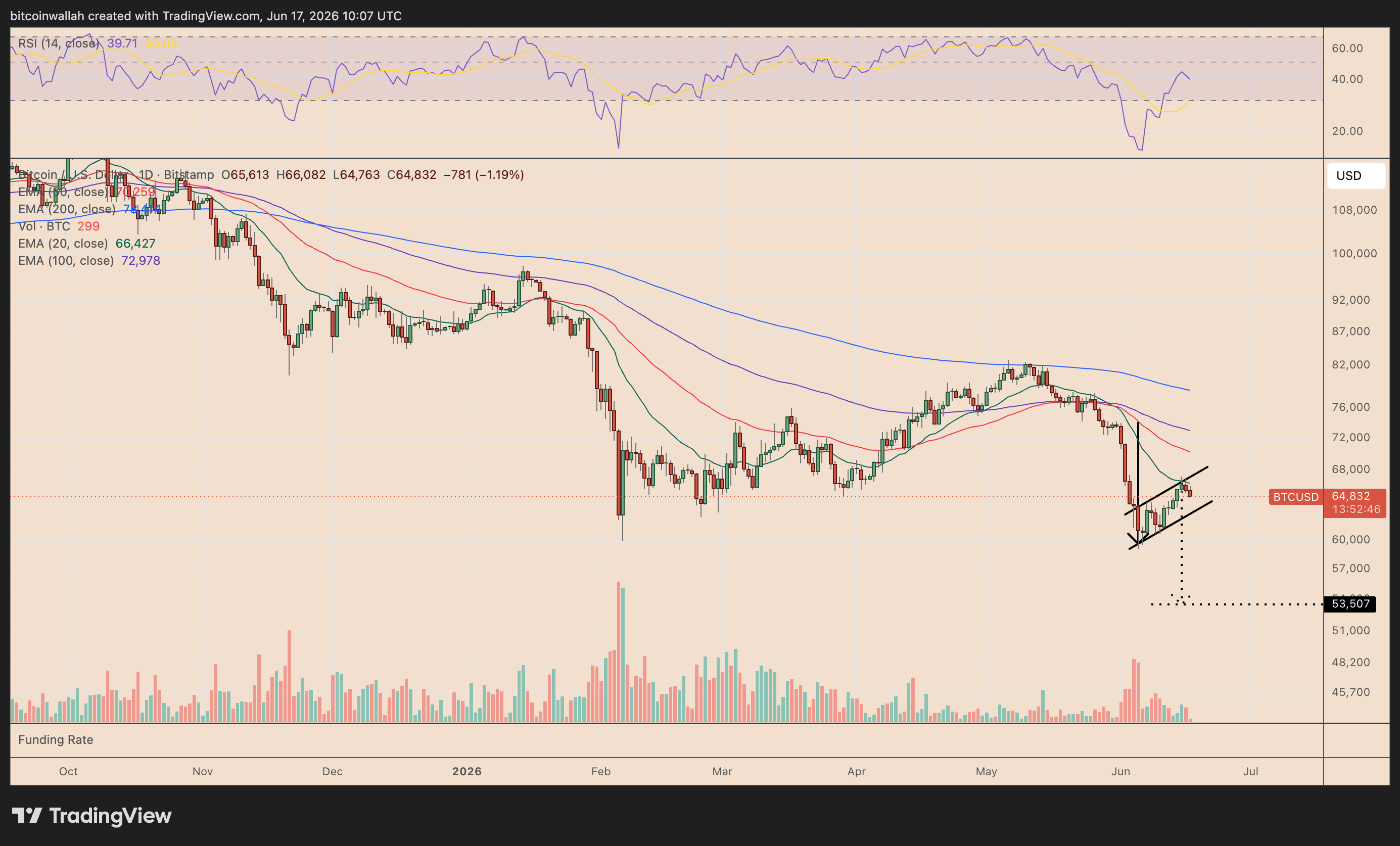
Bitcoin’s rebound is also occurring near the lower boundary of a bear flag, keeping the technical outlook cautious.

The pattern has developed after Bitcoin’s sharp decline from its 2026 highs at around $98,000, with the price now stabilizing near the flag’s rising support trend line.

BTC/USD daily chart. Source: TradingView

A rebound from this area could push BTC toward the flag’s upper boundary near $90,000, a zone that also sits close to the 0.786 Fibonacci retracement level and the three-to-six-month holder cost basis.

That makes $90,000 the key upside target in the coming months if bulls can defend the current support area.

Conversely, a daily close below the lower trend line would risk confirming a breakdown, opening the door to a deeper decline toward the $50,000–$60,000 range, depending on the exact breakdown point.

In that scenario, the recent bounce from holder cost-basis support would look more like a relief move inside a broader downtrend than the start of a sustained recovery.

Bitcoin is on the Verge of Locking in 3% May Losses

0

Bitcoin (BTC) circled $73,500 on Sunday as bulls stared down 3% BTC price losses for May.

Key points:

  • Bitcoin looks set to end May “in the red” as the monthly candle close nears.
  • US labor-market data will form the key volatility catalyst for risk assets next week.
  • Bitcoin analysis says that $73,000 is the key line to watch for the monthly close.

Bitcoin eyes “red” May ahead of key US PMI data

Data from TradingView followed a quiet weekend for BTC/USD, which remained wedged under 2025 yearly lows.

BTC/USD one-hour chart. Source: Cointelegraph/TradingView

US stocks finished the week with new all-time highs, but Bitcoin failed to catch a tailwind from easing geopolitical tensions, notably progress on a US-Iran ceasefire.

Commenting on X, trading resource The Kobeissi Letter quoted US President Donald Trump as saying that he was “in no hurry” to get an Iran deal finalized.

Looking ahead, it added, the coming week would be “all about the labor market,” with US employment data forming a potential source of crypto and risk-asset volatility.

That would include the May print of the Institute for Supply Management (ISM) Manufacturing Purchasing Managers’ Index (PMI) — a yardstick for economic output that offered BTC price action some relief in recent months.

“If bitcoin still continues to follow growth & risk appetite, it needs to reprice higher from here IMO,” Andre Dragosch, European head of research at crypto asset manager Bitwise, argued on X following recent PMI data.

US manufacturing PMI data (screenshot). Source: ISM

Analyst hopes for BTC price monthly close above $73,000

With BTC/USD down by just over 3% month-to-date, per data from CoinGlass, traders were mostly unimpressed.

Related: Bitcoin analysis eyes sharp rebound after BTC collapses below M2 supply ‘fair value’

BTC/USD monthly returns (screenshot). Source: CoinGlass

“At the moment, the $BTC retest of $73k has been successful despite recent downside volatility,” trader and analyst Rekt Capital wrote in his latest X analysis.

“If Bitcoin manages to Weekly Close above $73k then price will be one step closer to confirming the Double Bottom breakout & be positioned to try to trend continue.”

Rekt Capital referred to a “W”-shaped bottom formation on the weekly chart that formed from late February onward.

BTC/USD one-week chart with double bottom. Source: Cointelegraph/TradingView

With various key trend lines nearby, trader Daan Crypto Trades saw the macro range staying in play for the foreseeable future.

“$BTC Trading at its bull market support band after a failed retest the past few weeks. The Weekly 200MA & EMA are still moving up and closing in on price as well,” he told X followers. 

“With all these big high timeframe weekly levels around this area, I would not be surprised to see us trade between $60K-$80K for quite a while.”

BTC/USD one-week chart. Source: Daan Crypto Trades/X

As Cointelegraph reported, the price was no longer due short-term targets formed by “gaps” in CME Group’s Bitcoin futures, with these now trading 24 hours per day.

moomoo targets Wall Street-grade crypto tools for retail investors

0

Retail investing platforms have spent a number of years racing to become “everything apps” for finance, piling on stocks, crypto, banking and payments in a bid to keep users inside a single ecosystem.

But for moomoo, the next battle isn’t about who offers the most assets.

It’s about who gives retail investors the same level of intelligence and execution long reserved for Wall Street institutions.

“We want to democratize access to the best tools that have historically only been available to institutional investors,” Albi Mema, director of crypto operations at moomoo U.S., told CoinDesk in an interview. “A decade ago the issue was access. Now it’s the quality of access.”

“Moomoo is built for the retail investor who has outgrown basic trading apps. Today’s retail investors are more informed, more engaged, and more demanding than ever,” according to Mema. “They do not just want access to markets, they want better data, better tools, better education, and more context around the decisions they make,” he added.

Global platform

Moomoo is a global trading platform that offers retail investors access to stocks, options, exchange-traded funds (ETFs) and cryptocurrencies through a single app. The company focuses on combining low-cost trading with institutional-grade market data, analytics and investing tools for self-directed traders.

The New York-based firm, which says it has more than 30 million global users, $156 billion in client assets and nearly $1.9 trillion in annual trading volume, is betting that retail traders increasingly want sophisticated analytics, AI-assisted trading and institutional-style execution tools rather than simply another crypto venue.

That positioning comes as brokerages across both crypto and traditional finance push toward the “one-stop shop” model. Robinhood (HOOD), Kraken and Coinbase (COIN) have all expanded beyond their original products in recent years, blending equities, derivatives, payments and digital assets into broader financial platforms.

Mema argues moomoo’s differentiator is not aggregation alone, but the depth of tooling layered on top of it.

“The next generation of retail investors won’t be defined by who offers the most assets,” he said. “It will be about who helps investors make the best decisions across those assets.”

Retail traders

Retail investors are increasingly seeking institutional-grade analytics, execution capabilities, and AI-powered trading tools which drive trading assistance into the platform.

“Retail investors are building positions, measuring volatility and thinking long term,” he said. “They’re trading alongside some of the best and brightest.”

The company’s no-code algorithm builder allows users to scan markets for technical patterns, backtest strategies and automate trading signals.

Traders can also share strategies with the broader community, creating what Mema described as a collaborative “trading floor” dynamic for over 30 million retail participants.

Mema says retail crypto traders often experience significantly worse execution speeds and slippage than institutions, with some retail orders taking hundreds of milliseconds to settle compared with institutional systems that operate in tens of milliseconds or faster.

“If you’re getting rinsed on slippage, that puts you at a disadvantage as a crypto user,” he said. “We are bringing institutional-level execution to retail.”

The firm is also pushing deeper into tokenization. Moomoo recently joined Figure Markets’ onchain public securities initiative and partnered with Figure (FIGR) and BitGo (BTGO) on tokenized secondary market offerings.

“We think the future is hybrid. Traditional markets are not disappearing. Blockchain-native markets are not replacing everything tomorrow,” Mema says. “But the two are starting to converge, and platforms that can bridge those worlds responsibly will be well positioned,” he added.

Read more: Gemini taps SpaceXAI to build a personalized prediction markets feed

How Stellar (XLM) became part of DTCC’s plan to bring securities onchain

0

DTCC’s decision to connect its upcoming tokenized securities platform to the Stellar (XLM) network is the latest step in a relationship that stretches back nearly a decade, according to Stellar Development Foundation CEO Denelle Dixon.

Earlier this week, DTCC said tokenized assets held through its Depository Trust Company could become available on Stellar beginning in the first half of 2027.

The move carries weight because DTCC is one of Wall Street’s core market utilities, overseeing more than $114 trillion in assets. The Stellar integration is designed to support the issuance, settlement and lifecycle management of tokenized securities, while opening the door to future projects involving highly liquid assets such as major indexes and U.S. Treasuries

The roots of the partnership go back to Securrency, the institutional tokenization platform DTCC acquired in 2023 and became what is now DTCC Digital Assets.

Securrency, Dixon told CoinDesk in an interview, worked closely with Stellar developers on features regulated financial institutions needed to issue assets onchain, including clawback functionality, compliance controls and transfer restrictions. Those tools were later built directly into the network.

“Some of the team has been working with Stellar for a long time,” Dixon said.

The news landed as tokenization has become one of the dominant themes across both crypto and traditional finance, drawing interest from global banks and asset managers looking to move traditional financial instruments onto blockchain rails.

Tokenization refers to representing assets such as U.S. Treasury bonds, money market funds, stocks or private credit as digital tokens that can be issued, traded and settled on blockchains. Proponents argue the technology could shorten settlement times, free up collateral trapped in legacy processes and eventually allow markets to operate around the clock.

It’s potentially a huge market. Standard Chartered projected $2 trillion in tokenized assets by 2028, while BCG and Ripple forecasted a $18.9 trillion market size by 2033.

Franklin Templeton’s early bet on Stellar

Dixon argued that tokenized assets are only the visible layer of a broader infrastructure shift.

“Blockchain is excellent at books and records,” she said. “Tokenization is the product outcome, but it’s all these underlying components that are really important.”

That focus on record-keeping was one reason Franklin Templeton selected Stellar for its onchain money market fund, BENJI. Dixon said the asset manager began exploring Stellar in 2019 and later launched the fund in 2021, aiming to place fund records on a single shared ledger rather than relying on multiple databases.

BENJI became one of the earliest examples of a regulated tokenized fund and helped pave the way for today’s tokenized Treasury market, which has grown to roughly $15 billion with BlackRock, JPMorgan, Fidelity entering the ring.

Making public blockchains work for regulated finance

For institutions, however, moving assets onchain requires more than faster settlement.

Regulated firms must comply with securities laws, sanctions requirements and investor protections, creating demand for blockchain infrastructure that can support identity checks, transfer restrictions and other compliance controls.

That need for compliance-ready infrastructure is one reason Stellar’s long-standing relationship with Securrency proved valuable, Dixon said.

Stellar’s architecture allows issuers to add compliance, identity controls and privacy protections on top of an open network, she said. Asset issuers can decide whether transfers require know-your-customer (KYC) checks, whether assets can be frozen or clawed back and what transaction information remains visible.

“The base layer is always going to be open,” Dixon said. “Then the institution gets to decide how compliance and privacy come into play.”