Crypto investment products recorded their second-largest weekly outflow of 2026 by the end of May, with investors pulling $1.67 billion from digital asset funds as geopolitical tensions and a broader risk-off mood weighed on markets, according to a report from CoinShares.
The withdrawals marked the third consecutive week of net outflows and brought total redemptions over the past three weeks to $4.21 billion. CoinShares said concerns surrounding Iran had overwhelmed any positive sentiment generated by recent progress on the CLARITY Act, a U.S. crypto market structure bill.
Assets under management across digital asset investment products fell to $141 billion from $148 billion the previous week, their lowest level since early April.
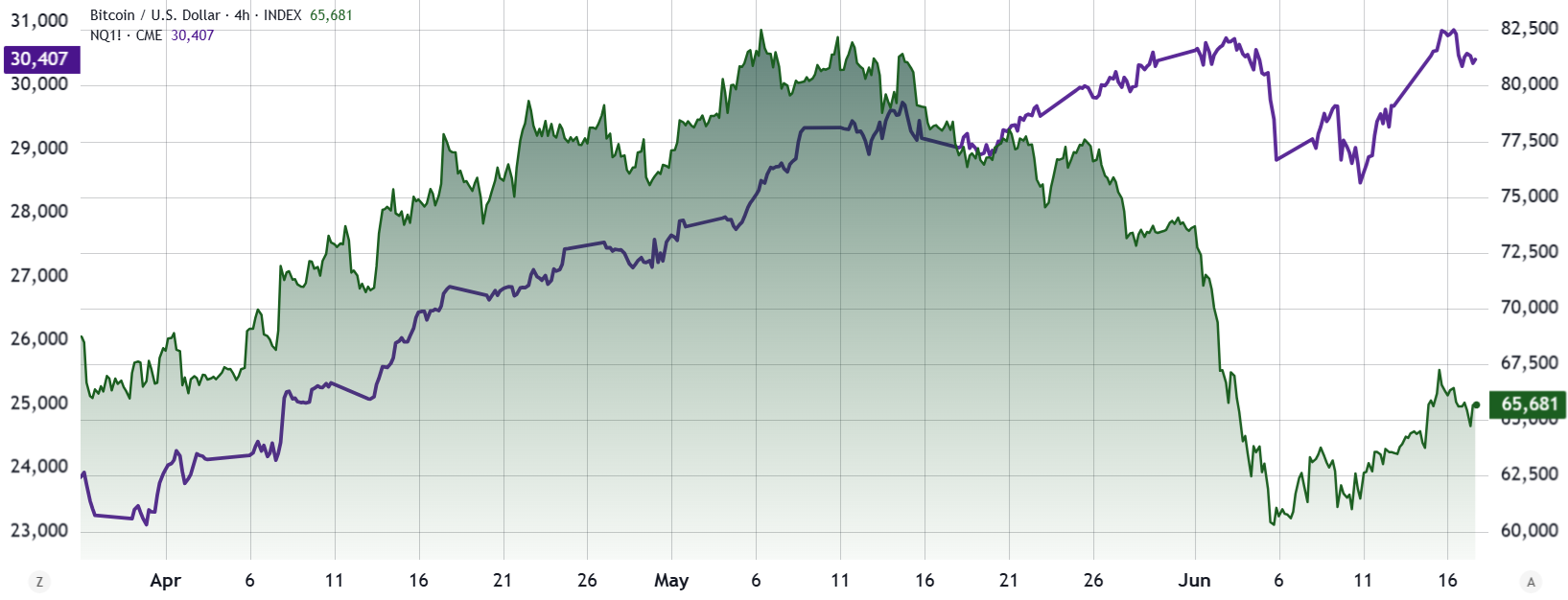
The latest outflows coincide with a sharp decline in crypto prices. Bitcoin fell close to the $70,000 mark on Monday after reports that Iran had halted talks with the United States in protest over Israel’s continued incursions into Lebanon. The move coincided with Strategy (MSTR), the largest holder of bitcoin, selling some of its stack after years of its executive chairman Michal Saylor vowing he wouldn’t do so. The largest cryptocurrency dropped about 3% over the past 24 hour period, adding pressure to digital asset investment products.
The United States accounted for nearly all of last week’s withdrawals, with investors pulling $1.63 billion from crypto funds. Germany, which had largely avoided earlier bouts of selling, recorded $25.7 million in outflows. Sweden and Hong Kong posted withdrawals of $6.6 million and $4.5 million, respectively.
Bitcoin BTC$71,472.93 investment products saw the largest share of the selling, losing $1.44 billion during the week. According to CoinShares, that was the largest weekly bitcoin outflow of 2026, surpassing both the previous week’s record and the peak reached during January’s selloff. Year-to-date bitcoin inflows have fallen sharply to $1.19 billion, down from $2.6 billion a week earlier and $3.9 billion two weeks ago.
Ethereum (ETH) funds also came under pressure, recording $257.3 million in outflows. Meanwhile, investor appetite for alternative cryptocurrencies weakened considerably. CoinShares noted that only five digital assets attracted more than $1 million in inflows, down from 11 assets three weeks ago. XRP (XRP) led with $20.3 million in inflows, followed by Hyperliquid (HYPE) at $10.8 million and Near at $7.6 million.
Despite the recent pullback, crypto investment products still hold roughly $142 billion in assets globally, underscoring how much institutional capital remains invested in the sector even as market sentiment deteriorates.
While Bitcoin is often viewed strictly as a financial asset, a growing number of 2026 operators are treating it as something entirely different: a stack of operational capabilities to vertically integrate.
In traditional manufacturing, vertical integration is one of the oldest competitive moves in the playbook. A car company that owns its tire factory is vertically integrated; Apple, by owning its silicon, operating system, storefront, and device, is the modern textbook case. The structural advantages, lower costs, fewer dependencies, and tighter control over quality, are now being claimed by companies integrating Bitcoin into multiple stages of how they produce, hold, move, and earn money. The businesses furthest along this path aren’t necessarily those with the largest treasuries, but those that treat Bitcoin as a core infrastructure.
This article is the operator’s guide to that decision. We define the vertical integration of Bitcoin in concrete terms, lay out the four stages every integrated company moves through, provide a diagnostic to figure out how far you should climb, and deliver a sequenced roadmap for getting there.
What “vertical integration” means when applied to Bitcoin
In the classical sense, vertical integration means owning multiple stages of your supply chain rather than renting them. A vertically integrated business produces its own inputs, makes its own product, and controls its own distribution. Each stage feeds the next. Each stage adds margin that would otherwise leak to a vendor.
Applied to Bitcoin, vertical integration means owning multiple stages of how your business interacts with Bitcoin, rather than renting any single piece of it. The four stages are:
Accept: taking Bitcoin from your customers as payment, instead of (or alongside) cards and ACH
Hold: putting Bitcoin on your balance sheet as a treasury reserve asset, instead of (or alongside) cash
Produce: generating Bitcoin yourself by mining, converting electricity and hardware into BTC at cost
Build: offering Bitcoin products, infrastructure, or financial instruments to other businesses or to investors as a revenue line
A company that does all four owns the full operational stack. A company that does two has integrated partially. A company that does one is using Bitcoin but not yet integrated. None of these are wrong. But the deeper the integration, the more durable the strategic position, because each stage feeds the next. Payments fund reserves. Reserves enable productive deployment and underwrite financial products. Financial products attract capital that funds more reserves. Productive deployment generates more Bitcoin. The flywheel runs in this direction for a reason.
Stage 01: Accept
The first stage is taking Bitcoin from your customers. For most businesses with a payment terminal or a checkout flow, accepting Bitcoin via the Lightning Network is the lowest-friction entry into the integrated stack. The economics are not subtle. Credit card processing typically costs 2.5% to 3.5% per transaction, settles in two to three business days, and exposes the merchant to chargeback risk. Lightning settles in seconds, costs less than 0.1%, and is final on receipt.
The clearest case study is Steak ‘n Shake. The chain enabled Lightning payments across all U.S. locations in May 2025. At the Bitcoin 2026 Conference, executive Michael Boes reported that the company saves approximately 50% on processing fees when customers pay with Bitcoin compared to traditional credit card transactions, and that universal Bitcoin adoption among its customer base would translate to roughly $6 million in annual savings. Same-store sales rose 11% in Q2 2025 and accelerated to 15% in Q3.
What makes Steak ‘n Shake an integration case rather than just a payments case is what happens after the customer pays. Bitcoin payments do not get auto-converted to dollars. They flow into a Strategic Bitcoin Reserve on the company’s balance sheet, which underwrites a $0.21-per-hour Bitcoin bonus paid to hourly employees and helps fund a menu overhaul that includes 100% grass-fed beef. Stage 01 (Accept) is wired directly into Stage 02 (Hold). The savings on the payment rail do not sit in a P&L line. They become inventory in the strategic reserve.
Ten months ago today, Steak n Shake launched its burger-to-Bitcoin transformation.
Bitcoin payments are faster and saves us money! We have reinvested savings into product quality.
Our Strategic Bitcoin Reserve also funds Bitcoin bonus pay for our employees.
Our same-store…
— Steak ‘n Shake (@SteaknShake) March 16, 2026
This is the first principle of vertical integration applied to Bitcoin. A move taken in isolation is just a feature. A move wired to another stage is integration.
For many operators, Stage 01 is no longer a project. As of March 30, 2026, Square switched on Bitcoin Lightning payments by default for eligible merchants globally, covering approximately 4 million businesses. Bitcoin payments through Square are free through 2026, with a 1% flat fee applying from 2027. The first stage of the integrated stack is effectively the default for most merchants. The integration question is whether you wire the inflow to the next stage or let it auto-convert to fiat and disappear.
A side-by-side, on a $100 transaction:
Metric
Legacy stack
Bitcoin via Lightning
Processing fee
2.90%
<0.1%
Settlement time
2 to 3 days
Seconds
Chargeback risk
Yes
Zero
Cross-border
FX spread added
Native
Net to operator
$97.10
$99.90+
Stage 02: Hold
The second stage is putting Bitcoin on your balance sheet. Where Stage 01 is a payments decision, Stage 02 is a treasury decision. The question every CFO has had to answer for a century is where to park retained earnings.
The default answer of cash and short-term Treasuries is a slow leak when measured against a fixed-supply asset. Stage 02 says a portion of the company’s reserves should be denominated in something that cannot be diluted by anyone, including its issuer.
Try the Bitcoin Treasury Simulator with any stock ticker.
The canonical example is the work Michael Saylor began in August 2020, when his company (then MicroStrategy, now Strategy) became the first major public corporation to declare Bitcoin its primary treasury reserve asset. As of June 1, 2026, Strategy holds 843,706 BTC at an average cost basis of approximately $75,500 per coin, an aggregate position of $60.4 billion that represents nearly 4% of all Bitcoin in existence. Saylor’s argument was never that Bitcoin would go up. It was that cash was going down, and the right unit of account for a long-duration corporate treasury was the asset with the most credible scarcity.
Strategy is the deepest expression of Stage 02 in existence, but it is not the only shape this stage can take. Mining companies like Marathon and Riot hold mined production rather than selling it. Metaplanet in Japan has built a similar accumulation strategy in the Asian market, providing yen-denominated Bitcoin exposure through a Tokyo-listed structure. Block holds 8,997.89 BTC in its corporate treasury, separated from a further 19,357 BTC held in custody for Cash App customers, and verifies the distinction on-chain through quarterly Proof of Reserves disclosures.
Most operators will not run a 100% Bitcoin treasury. They do not have to. Even a 1% to 5% allocation of retained earnings is a meaningful hedge, and the policy decision to denominate a slice of the balance sheet in Bitcoin is more important than the size of that slice. The board resolution comes first. The accumulation comes after.
A note on custody, which is part of this stage and not separable from it. Holding Bitcoin without controlling the keys is not actually holding Bitcoin. Operators integrating Stage 02 should set up institutional multi-signature cold storage from day one to maximize balance sheet sovereignty. The cost of getting custody wrong is total. The cost of getting it right is a one-time setup fee and a quarterly verification routine.
Stage 03: Produce
The third stage is generating Bitcoin yourself, by mining. This is the most operationally intense stage in the stack and the most niche, but it is also the one that gives the integrated operator the deepest cost advantage. The cost basis of mined Bitcoin is your cost of power and amortized hardware, typically far below the market price of BTC itself. For the right kind of business, that gap is structural margin that no competitor can replicate without similar inputs.
Stage 03 is not for most operators. It requires industrial-scale operations, low-cost electricity (often dedicated power purchase agreements or stranded energy), and operational expertise in data center management. The pure-play public-market exemplars are Marathon Digital (MARA), with roughly 50,000 BTC accumulated almost entirely through self-mining, and Riot Platforms, with approximately 19,000 BTC. Their cost basis is not a market price. It is electricity, hardware depreciation, and operational scale.
What makes Stage 03 integrated rather than isolated is the connection to Stage 02. Both Marathon and Riot retain the majority of their mined production rather than selling it on the open market. The mining operation feeds the treasury directly. Each block reward is inventory for the strategic reserve, denominated in the same asset the company is accumulating long-term.
What makes Stage 03 newly accessible in 2026 is who else is moving into it. Block, through its Proto division, is developing an open-source 3-nanometer custom ASIC chip and a complete mining system designed to make industrial-grade mining accessible to operators who are not themselves miners. The strategic implication is that production is becoming a primitive any sufficiently committed operator can adopt, particularly those with stranded power assets, surplus electricity, or operational synergies with existing energy businesses. A power utility, a data-center operator, an industrial real-estate holder, or a company sitting on cheap behind-the-meter power can now consider Stage 03 in a way that would have been unrealistic five years ago.
For most readers of this article, Stage 03 will not be the right move to integrate. The capital and operational requirements are too specific to most business models. But for the subset whose existing business already produces or controls the inputs, this is the stage with the largest structural margin advantage and the most defensible moat.
Stage 04: Build
The fourth and deepest stage is offering Bitcoin products, infrastructure, or financial instruments to other businesses or to investors, capturing fees, network effects, distribution, or capital as a result. Where the first three stages are about using Bitcoin internally, Stage 04 is about selling Bitcoin-related services and products externally. It is the stage that converts the integrated operator from a Bitcoin user into a Bitcoin business.
Four sub-categories matter inside Stage 04, and they map to different kinds of businesses.
Custody products. Bitkey (a Block product), Casa, and Unchained sell secure Bitcoin storage as a service. The market exists because every Stage 02 operator needs a custody solution and few want to build one in-house. The business model is subscription, hardware sales, and institutional service fees.
Network infrastructure.LQWD Technologies (TSXV: LQWD) is the clearest example. The company holds 262 Bitcoin, with no debt or convertible obligations against the position, but the Bitcoin is not in cold storage. It is deployed as liquidity across a global network of enterprise-grade Lightning nodes, where it earns routing fees on every transaction it helps settle. CEO Shone Anstey has noted the Lightning Network now processes over $1 billion in monthly transaction volume, and LQWD’s own infrastructure has routed more than two million transactions and over 2,012 Bitcoin since launch. The novelty is that the same Bitcoin functions simultaneously as a Stage 02 balance-sheet asset and as Stage 04 productive infrastructure earning fees in the same asset, without selling, lending, or staking it.
Consumer products.Cash App is the most-used Bitcoin on-ramp in the United States, with millions of consumers buying, sending, and now automatically earning Bitcoin through routine app activity. Strike serves a parallel function with a Lightning-first design and global remittance focus. River targets long-term Bitcoin accumulators with low-fee dollar-cost averaging and account-level Lightning support. The strategic point of consumer distribution is moat. A company that owns the on-ramp does not just earn fees, it shapes how an entire generation forms its relationship with the asset.
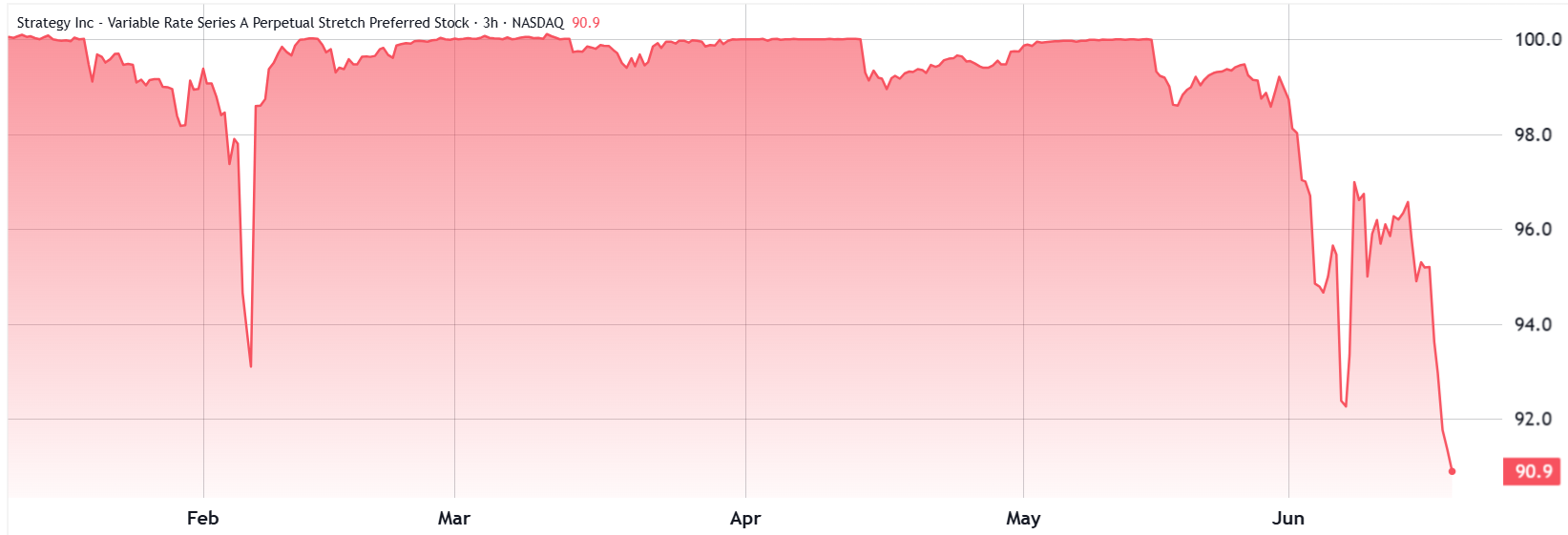
Bitcoin-backed financial products. This is the fastest-growing sub-category and the one most operators have not yet recognized as part of Stage 04. Strategy is the canonical case. Beginning in 2024 and accelerating through 2026, Strategy has built a full preferred stock suite designed to give institutional and retail investors exposure to Strategy’s Bitcoin treasury thesis without holding Bitcoin directly. The suite currently includes STRF (10% perpetual strife preferred), STRC (variable rate perpetual stretch preferred, currently yielding 11.50% annually paid monthly), STRK (8% perpetual strike preferred), STRD (10% perpetual stride preferred), and STRE. Together, these products represent over $30 billion in remaining issuance capacity under active at-the-market programs.
Saylor describes the category as “digital credit” — an emerging asset class of income instruments built on Bitcoin treasury balance sheets. STRC in particular, with its variable rate, monthly cash payment, and par-targeting mechanism, is designed to compete directly with money market funds and short-duration fixed income.
View the STRC Tracker for live data on Strategy’s Bitcoin accumulation.
The $43+ billion Strategy has raised across equity, preferred, and convertible debt in less than two years has been deployed into Bitcoin acquisition. The reflexive flywheel is the part worth studying closely: the larger Strategy’s Bitcoin treasury grows, the stronger the collateral story behind the preferred stock, the better the preferred stock prices, the more capital it raises, the more Bitcoin Strategy can buy. Stage 04 (Build) and Stage 02 (Hold) reinforce each other directly. This is the integration.
The same model is now being adapted by other operators. Bitcoin-collateralized lending products, structured notes, exchange-traded products, and ABCP-style facilities using Bitcoin treasury equity as underlying collateral are all extensions of the digital credit thesis. For operators with sufficient Bitcoin treasury scale, Stage 04 financial products can become the dominant mechanism by which Stage 02 funds itself.
How to decide how far to integrate
Not every business should integrate all four stages. The right depth depends on what the business already does, what assets it already controls, what kind of capital it can access, and what kind of operational complexity its leadership can absorb. The diagnostic below is the simplest version of the question every operator should answer before choosing how deep to go.
Question 01. Do customers pay your business directly? If yes, Stage 01 is available immediately and produces measurable value from the first transaction. If most revenue is invoiced or B2B, Stage 01 still applies but the implementation shifts toward Bitcoin invoicing rather than point-of-sale. If the business has no customer payment flow, integration starts at Stage 02 instead.
Question 02. Does your business carry retained earnings or cash reserves on its balance sheet? If yes, Stage 02 is available at any size from 1% to 100% of reserves. If the business runs lean with no meaningful cash position, Stage 02 is premature and integration begins or ends at Stage 01.
Question 03. Do you control cheap electricity, stranded energy, or capital scale that could support an industrial mining operation? If yes, Stage 03 becomes feasible and adds the deepest cost-basis advantage in the stack. If no, Stage 03 should be skipped, not deferred. Most operators will integrate Stages 01, 02, and 04 without ever touching Stage 03.
Question 04. Do you have a technology or platform business, or a balance sheet large enough to support Bitcoin-backed financial products as new revenue? If yes, Stage 04 is the natural extension of existing capabilities, and the relevant sub-category (custody, infrastructure, consumer, financial products) should match your existing competencies. A fintech goes to consumer products. An infrastructure company goes to network operations. A hardware firm goes to custody devices. A capital-markets-active operator with significant Bitcoin treasury goes to financial products.
Most operators reading this article will land in one of five integration patterns:
Pattern
Stages owned
Best for
Single-Stage Operator
One stage
Operators testing the integration thesis with their lowest-risk move
Operations Pragmatist
Stages 01 + 02
Operators with both customer payments and a balance sheet (Steak ‘n Shake template)
Capital Markets Pragmatist
Stages 02 + 04
Operators with significant Bitcoin treasury and capital-markets capability (Strategy template)
Builder
Three stages, including Stage 04
Tech, financial, or platform businesses adding Bitcoin as a revenue line
Maximalist
All four stages, fully integrated
Operators whose core business is built around Bitcoin (Block template)
The two Pragmatist patterns are worth studying side by side. Both are two-stage integrations. Both wire one stage into another to create a flywheel. But the flywheels run on different inputs and produce different outputs. Steak ‘n Shake’s flywheel runs on customer payments and produces a growing reserve. Strategy’s flywheel runs on capital markets and produces a growing reserve. The destination is the same. The mechanism is different.
Each pattern is a legitimate integration posture. The deeper the integration, the larger the structural moat, but also the larger the operational complexity. Most operators reading this article will and should land in one of the two Pragmatist patterns or in the Builder pattern. Few will be Maximalists. That is the correct distribution.
Three integration patterns, in practice
To make the patterns concrete, here are three companies that exemplify three different shapes and depths of integration in 2026:
Block: the Maximalist. Block owns all four stages. Square (Stage 01), an 8,998 BTC corporate treasury verified on-chain (Stage 02), Proto mining hardware (Stage 03), and Bitkey, Cash App, and Spiral (Stage 04). The total company-wide Bitcoin position, including custodied customer assets, is 28,355 BTC. Block is the working proof that vertical integration of Bitcoin can live inside a single corporate structure across all four stages, and that the integration produces compounding strategic advantages no single-stage competitor can replicate. The takeaway for most operators is not to copy Block. It is to recognize that the integrated maximalist position is now demonstrably possible, which means none of the four stages are theoretical anymore.
Steak ‘n Shake: the Operations Pragmatist. Steak ‘n Shake owns Stages 01 and 02, wired tightly together. Bitcoin sales at the point of payment flow directly into the company’s Strategic Bitcoin Reserve, which underwrites both employee compensation and product reinvestment. Same-store sales rose 18% heading into 2026. Steak ‘n Shake is the practical case for most operators with customer-facing payment flows: pick the two stages your business model already supports, engineer the connection between them, and let each one strengthen the other. The integrated effect is more than additive. The reserve gives the payments program a strategic purpose, and the payments program gives the reserve an organic accumulation engine.
Strategy: the Capital Markets Pragmatist. Strategy owns Stages 02 and 04, wired into a reflexive flywheel that has raised over $43 billion in less than two years. The 818,334 BTC reserve (Stage 02) underwrites the credibility of Strategy’s preferred stock suite (Stage 04), and the preferred stock suite raises capital that funds further Bitcoin acquisition for the reserve. STRC alone, with $30+ billion in remaining ATM issuance capacity across the full preferred stack, demonstrates that Bitcoin-backed financial products can scale to institutional volume. Strategy is the practical case for capital-rich operators with the balance sheet to issue financial products: pick Hold and Build, wire them together, and let capital markets compound the reserve faster than operating cash flow ever could.
The pattern across all three is that vertical integration in Bitcoin does not require maximalism. What it requires is intentionality. Each stage has to be chosen because it fits the business, and each connection between stages has to be engineered deliberately. The operators who get this right end up with structural advantages their competitors cannot easily replicate. The operators who treat Bitcoin as a single decision (buy or don’t) miss the architecture entirely.
A reference map
Operator
Stage 01: Accept
Stage 02: Hold
Stage 03: Produce
Stage 04: Build
Pattern
Block (NYSE: XYZ)
Primary
Primary
Primary
Primary
Maximalist
Strategy (NASDAQ: MSTR)
—
Primary
—
Primary
Capital Markets Pragmatist
MARA Holdings (NASDAQ: MARA)
—
Primary
Primary
—
Producer-Holder
Riot Platforms (NASDAQ: RIOT)
—
Primary
Primary
—
Producer-Holder
Steak ‘n Shake (private)
Primary
Supporting
—
—
Operations Pragmatist
LQWD Technologies (TSXV: LQWD)
—
Supporting
—
Primary
Builder
Metaplanet (TYO: 3350)
—
Primary
—
—
Single-Stage Operator
A sequenced integration roadmap
Vertical integration is not built in a single quarter. It is sequenced. The order of operations matters because each stage builds on the one before it, and each stage requires organizational and operational learning that the next stage assumes. The roadmap below is the path most successfully integrated operators have followed, and the order most operators starting today should follow.
Quarter 1 to 2 — Adopt Stage 01. Enable Bitcoin Lightning payments through Square or a comparable processor. For Square merchants, this is now a setting rather than a project. Decide whether incoming Bitcoin is auto-converted to fiat or held in a wallet. Most operators should auto-convert at first while custody and treasury policy are being formalized.
Quarter 2 to 4 — Build the foundation for Stage 02. Set up institutional multi-signature custody before any meaningful Bitcoin position accumulates. Draft and pass a board policy that defines Bitcoin as a treasury reserve asset and authorizes a target allocation, even if the initial allocation is 1% of retained earnings. Maintain 6 to 12 months of operating expenses in fiat as a buffer.
Quarter 4 onward — Wire Stage 01 to Stage 02. Stop auto-converting incoming Bitcoin payments. Route them directly into the strategic reserve. This is the moment integration becomes real. The payments program is no longer a cost-savings initiative. It is an organic Bitcoin accumulation engine that the operator does not have to fund externally. At this point, the operator has reached the Operations Pragmatist pattern.
Year 2 — Evaluate Stage 04 if applicable. For technology, financial, or platform businesses, the second year is the right time to evaluate whether Bitcoin can become a revenue line and which sub-category fits. For operators whose Bitcoin treasury has grown large enough to anchor capital markets activity, financial products become a credible Stage 04 path. For most other operators, integration concludes at the Operations Pragmatist pattern.
Year 3+ — Evaluate Stage 03 if applicable. Mining is the last stage to consider because it requires the most capital, the most operational expertise, and the most clarity about long-term Bitcoin commitment. For operators with energy assets or stranded power, the calculus may justify earlier entry. For most others, Stage 03 is permanent skip rather than deferred consideration.
By Year 3, an operator who has followed this roadmap has built a vertically integrated Bitcoin position that no competitor can replicate without making the same multi-year commitment. The integration is the moat. The Bitcoin position is the byproduct.
The bottom line
Vertical integration of Bitcoin is not a maximalist posture. It is a strategic posture. It can be expressed at any depth from one stage taken seriously to four stages fully wired together, and the patterns vary by which two stages an operator chooses to pair. Steak ‘n Shake pairs Accept with Hold. Strategy pairs Hold with Build. Both are two-stage integrations. Both produce reflexive flywheels. The mechanisms are different. The strategic posture is the same.
What separates an integrated Bitcoin operator from one who has merely bought Bitcoin is the connection between stages. Payments feed reserves. Reserves underwrite financial products. Financial products attract capital that funds more reserves. Productive deployment generates more Bitcoin. The flywheel runs in this direction because each stage produces inputs the next stage consumes.
For most operators in 2026, the right path is the Operations Pragmatist pattern. Stages 01 and 02, tightly coupled, executed over four to six quarters. Steak ‘n Shake is the template. For capital-rich operators with significant Bitcoin treasury and capital-markets capability, the Capital Markets Pragmatist pattern is the more powerful play. Strategy is the template. The companies that will define the next decade of corporate finance are not the ones with the largest Bitcoin holdings. They are the ones that turned Bitcoin into an integrated operating model, picked the right two stages for their business model, and let the connections between the stages compound into a structural advantage their competitors cannot match.
Pick your pattern. Build the connections. Let the integration do the work.
Disclaimer: This content was prepared on behalf of Bitcoin For Corporations for informational purposes only. It reflects the author’s own analysis and opinion and should not be relied upon as investment advice. Nothing in this article constitutes an offer, invitation, or solicitation to purchase, sell, or subscribe for any security or financial product.
“We will probably sell some Bitcoin to pay a dividend just to inoculate the market. Just to send the message that we did it.”
At the time, the statement caught many people off guard.
For years, Strategy had built its reputation around an uncompromising commitment to accumulating and holding Bitcoin. The idea that the company would voluntarily sell Bitcoin, even a tiny amount, seemed to run counter to that narrative.
Then it happened.
BREAKING: @Strategy (MSTR) sold 32 BTC for ~$2.5 million at an average price of ~$77,135 per bitcoin.
The sale represents less than 0.004% of @Strategy’s BTC holdings.
🗒️ Proceeds directed to preferred stock distributions 🟠 Total holdings: 843,706 BTC 💵 USD Reserve: $900… pic.twitter.com/zBvsixkZ0a
— Bitcoin For Corporations (@BitcoinForCorps) June 1, 2026
In its latest filing, Strategy disclosed that it sold 32 BTC for approximately $2.5 million at an average price of $77,135 per bitcoin. The proceeds are expected to be used to fund distributions on preferred stock. At the same time, the company reported holdings of 843,706 BTC and a $900 million USD reserve.
The sale represents less than 0.004% of Strategy’s total Bitcoin holdings.
Financially, it was insignificant.
Strategically, it may have been one of the most important Bitcoin transactions the company has ever made.
The Market Needed To See It
For decades, public market investors have been conditioned to ask the same question whenever they encounter an asset-backed company:
“How do I get my money back?”
In traditional finance, the answer is familiar.
A company generates cash flow. Cash flow supports dividends. Assets can be sold if necessary. Debt can be refinanced. Capital can be returned to shareholders.
Strategy’s Bitcoin treasury introduces a new dynamic.
Many investors understand how a company can acquire Bitcoin. Fewer understand how a company can support preferred securities, debt obligations, and capital return programs while holding a balance sheet primarily composed of Bitcoin.
The concern is not whether Bitcoin has value, but whether that value can be accessed when needed.
Saylor’s comment suggests he recognized this concern long before most observers did. The purpose of the sale was not to raise meaningful capital. The purpose was to demonstrate that the mechanism works.
Inoculation Against Future Fear
The word Saylor chose was “inoculate.”
That choice matters.
An inoculation is a small, controlled exposure designed to prevent a much larger problem later. In this case, Strategy may have intentionally exposed the market to a tiny Bitcoin sale today to prevent panic around a larger Bitcoin sale tomorrow.
Imagine a future where Strategy needs to sell several thousand Bitcoin to support a capital structure that includes multiple preferred securities, debt instruments, and dividend obligations.
If investors have been conditioned to believe that any Bitcoin sale represents a breakdown in the company’s strategy, such an event could trigger unnecessary volatility.
But if investors have already seen Strategy sell Bitcoin responsibly, transparently, and for a clearly defined purpose, the reaction changes.
The transaction becomes operational rather than existential.
That distinction is critical.
Why This Is a Good Thing
The immediate reaction to any Bitcoin sale is often emotional.
For years, Bitcoin holders have been conditioned to view selling as a sign of weakness, capitulation, or a loss of conviction. That mindset may make sense for individual investors. It makes far less sense when evaluating a public company managing billions of dollars in assets, liabilities, and capital market obligations.
The question is not whether Strategy sold Bitcoin. The question is whether the sale made Strategy stronger.
In this case, the answer appears to be yes.
First, the transaction reduces uncertainty. Investors no longer need to speculate about how Strategy would support dividend payments if required. The company has demonstrated that it can access a small portion of its Bitcoin reserves, fulfill an obligation, and continue operating exactly as before. That may seem obvious, but capital markets place tremendous value on proof over theory.
Second, the sale strengthens the credibility of Strategy’s preferred stock platform. Over the past two years, the company has expanded beyond a simple Bitcoin accumulation strategy and into a broader capital markets strategy. Preferred securities such as STRF, STRK, STRD, and STRC are designed to attract investors with different risk profiles and return objectives. Those investors need confidence that distributions can be funded consistently. This transaction provides evidence that the supporting infrastructure exists.
View the STRC Tracker for live data on Strategy’s Bitcoin accumulation.
Third, the sale helps normalize Bitcoin as a treasury reserve asset.
Companies routinely sell cash equivalents, bonds, commodities, and other assets to meet strategic objectives. Bitcoin cannot become a mature treasury asset if corporations are expected to treat it differently. Demonstrating that Bitcoin can be accumulated, held, pledged, financed against, and occasionally sold when appropriate is part of the maturation process.
Most importantly, the sale may increase Strategy’s future access to capital.
Michael Saylor’s objective has never been to maximize the amount of Bitcoin that remains untouched. His objective is to maximize Bitcoin per share over time. If demonstrating operational flexibility attracts more investors, lowers perceived risk, and expands the pool of capital available to the company, then a sale of 32 BTC today could ultimately support the acquisition of thousands of BTC tomorrow.
Viewed through that lens, the transaction was not a retreat from Strategy’s Bitcoin strategy. It was an investment in the durability of that strategy.
Bitcoin Is Not A Museum Piece
One of the most common misconceptions about Bitcoin treasury companies is that Bitcoin must never be sold under any circumstance.
That is not how treasury management works.
A corporation’s objective is not to maximize the number of years it can avoid touching its assets. The objective is to maximize long-term shareholder value.
Sometimes that means issuing equity.
Sometimes it means issuing preferred securities.
Sometimes it means acquiring Bitcoin.
And occasionally, it may mean selling a small amount of Bitcoin to support a broader capital strategy.
The question is not whether Bitcoin is sold, but whether the transaction increases or decreases Bitcoin per share over time.
Strategy’s entire framework is built around increasing Bitcoin per share. If a small sale helps support a larger capital structure that ultimately enables the company to acquire substantially more Bitcoin in the future, the sale may be accretive to that objective.
The Bigger Signal
The most interesting aspect of this transaction is what it reveals about the next phase of Bitcoin treasury companies.
The first phase was simple accumulation.
Raise capital. Buy Bitcoin.
The second phase is capital markets integration.
Build securities around Bitcoin. Create preferred stock offerings. Establish dividend frameworks. Develop new financing vehicles. Expand access to different investor classes.
As companies move into this second phase, treasury management becomes more sophisticated.
Bitcoin remains the reserve asset, but the capital structure surrounding that reserve asset becomes increasingly complex.
Strategy’s sale of 32 BTC may ultimately be remembered not because of its size, but because it marked the moment when the company demonstrated that Bitcoin treasury companies can do more than accumulate.
They can operate. They can manage obligations. They can support dividends.
And they can do all of those things while continuing to hold hundreds of thousands of bitcoin on their balance sheet.
The market did not need to see Strategy sell 32 BTC, but Michael Saylor needed the market to see that it could.
Disclaimer: This content was prepared on behalf of Bitcoin For Corporations for informational purposes only. It reflects the author’s own analysis and opinion and should not be relied upon as investment advice. Nothing in this article constitutes an offer, invitation, or solicitation to purchase, sell, or subscribe for any security or financial product.
The hacker behind the $293 million Kelp DAO exploit has laundered nearly all of the unfrozen stolen funds, or about $220 million, in just six weeks, according to Arkham data and onchain analysts.
The Kelp DAO hacker-tagged wallet appears to have laundered nearly all the stolen funds, with just $1.7 million remaining traceable in the wallet, according to blockchain data provider Arkham. The malicious actor drained 116,500 Kelp DAO restaked ETH (rsETH) on April 18, pushing the total amount stolen from crypto hacks to $630 million for April.
The funds were laundered in two layers: bridging to Bitcoin using crypto mixer Wasabi and then returning to Ethereum before withdrawing and depositing via mixing protocol Tornado Cash, according to onchain analyst Specter.
The laundering activity may significantly reduce the chances of recovering the remaining unfrozen funds.
An additional $71 million was frozen by Arbitrum’s Security Council on April 21. A governance proposal and a US court order previously approved the transfer of the frozen funds to an Aave-controlled multi-signature wallet for the rsETh recovery effort. The next hearing on the ownership claims tied to the frozen funds is set for Friday in New York, court documents show.
Kelp DAO Hacker-tagged wallet, total balance. Source: Arkham
The development comes a week after Kelp DAO said it restored its restaked Ether token as part of a five-week recovery effort, after the final tranche of 20,373.7 rsETH tokens was sent to the LayerZero smart contract responsible for locking, minting, burning and releasing rsETH during cross-chain transfers, Cointelegraph reported Tuesday.
Related: Verus bridge exploiter returns $8.5M after bounty offer
Crypto hacks decrease by 90% in May, but DeFi security concerns persist
Cryptocurrency hacks logged a significant decrease during May, but it wasn’t enough to soothe the growing concerns tied to the security of the decentralized finance (DeFi) industry.
Losses from cryptocurrency exploits fell to $68.3 million in May, marking a near 90% decline from the amount lost in April, according to crypto security platform CertiK. About $2.6 million was attributed to phishing attacks, while a total of $9.4 million was successfully recovered or returned.
Crypto exploit losses in May reached $68.3 million. Source: CertiK
Still, the $293 million Kelp DAO exploit triggered wider concerns about the safety of the industry, prompting DeFi protocols to reevaluate the security of their oracle providers.
Within three weeks after the exploit, Bitcoin DeFi platform Solv Protocol and liquidity protocol Tydro both migrated to Chainlink’s Cross-Chain Interoperability Protocol (CCIP), seeking a more secure oracle provider.
Kelp DAO also migrated its rsETH token to Chainlink CCIP, moving away from its previous LayerZero-powered bridge after attributing the incident to weaknesses in its cross-chain setup.
However, LayerZero said on April 20 that the exploit resulted from a single point of failure in Kelp DAO’s implementation, which relied on a single LayerZero DVN as the only verified path despite prior warnings against that configuration.
Magazine: The legal battle over who can claim DeFi’s stolen millions
An early Ether (ETH) investor sold their ETH holdings over the past week as the price headed toward $2,000, sparking fears of further losses. However, onchain data tells a different story as traders speculate where ETH/USD might bottom.
Key takeaways:
An early Ethereum whale sold $136 million in ETH, adding pressure as Ether trades below the $2,000 level.
Onchain data shows no evidence that older ETH investors are selling en masse.
Analysts warn the ETH price could fall further toward the $1,500 support.
Ethereum OG whale sells $136 million ETH
An old Ethereum whale, an early investor holding tokens since the network’s first years, sold 55,000 ETH worth about $112.25 million and 9,442 ETH worth roughly $24 million over the past week.
Related: Ether bears at risk of $2B squeeze as short positions build around $2K
The early Ether investor offloaded a combined $136 million at an average price of $2,041 per ETH, according to blockchain data tracker Lookonchain.
Selling by an old ETH wallet. Source: Lookonchain
However, this does not appear to be part of a wider trend, as an analysis of Ethereum’s supply, based on “HODL waves,” reveals that a significant portion of Ethereum supply remains unmoved on various time frames. In fact, the share of the supply by older holder cohorts has generally increased over the past year.
More recently, the 3m-6m investor cohort saw a notable reduction in supply, which has dropped to 9% from 13.5% on May 19. The 1w-1m holder cohort has also seen its supply holdings drop to 2.6% from 4.76% over the same period. This suggests that most of the supply changing hands is being done by short-term holders.
Ethereum: HODL Waves. Source: Glassnode
In fact, supply held by the 5y-7y investor cohort has increased slightly to 9% from 8.59% on May 19.
Moreover, the chart below shows that the supply last active 5-7 years ago has only seen a modest rise in recent weeks and is well below the activity seen in 2022 when ETH price bottomed below $1,000.
ETH: Total supply last active 5 years to 7 years. Source: Glassnode
Except for several significant players announcing that they have sold a part or their entire ETH holdings recently, there’s no real broad trend to support the argument that Ethereum OGs are selling en masse.
Ether price drop to $1,500?
Since Thursday, ETH/USD has been oscillating around the $2,000 psychological level as traders braced for more price downside.
At the time of writing, ETH is trading at $1,980, down 2% over the last 24 hours and 6.5% on the week.
“This doesn’t look good for Ethereum,” analyst Alex Marzell said in an X post on Sunday adding:
“Momentum continues to favor the bears as $ETH moves closer to the next key support area.”
ETH/USD daily chart. Source: X/Marzell
Marzell was referring to the crucial support around $1,800, which analysts say must hold to avoid a deeper correction.
Fellow analyst Merlijn The Trader said that the ETH/USD price action is “mapping perfectly onto a Wyckoff Accumulation structure,” as shown on the three-day chart below.
The analyst explained that ETH is currently in a “Phase B consolidation, post-selling climax” and was entering Phase C, where it would bottom below $1,500.
ETH/USD three-day chart. Source: Merlijn The Trader
Another analysis by Echo Analysis said a bear flag breakdown projected ETH price drop toward $1,500 support.
ETH/USD daily chart. Source: Echo Analysis
As Cointelegraph reported, increasing supply on exchanges and declining ETF demand put ETH at risk of another leg down toward the $1,500-$1,700 demand zone.
Disclosure: The author of this story owns shares in Strategy (MSTR).
Strategy (MSTR) Executive Chairman Michael Saylor appeared to underscore the company’s focus on its perpetual preferred stock, making STRC the focus of his first public comment after the largest publicly traded holder of bitcoin BTC$72,675.37 sold the cryptocurrency to fund dividend payments on the instrument.
“Our goal is to make STRC the best credit instrument in the world,” Saylor wrote on X on Monday.
The post came after the company said it sold 32 bitcoin for about $2.5 million last week. Proceeds from the sale “are expected to be used to fund distributions on preferred stock,” it said in an 8-K filing.
While the filing directly linked the sale to the dividend payment, Saylor’s decision to highlight the equity rather than the bitcoin sale is likely to reinforce investor perceptions that the company is increasingly focused on building its preferred stock while growing bitcoin exposure on a per-share basis.
Saylor has repeatedly argued that Strategy evaluates financing and capital allocation decisions through the lens of bitcoin per share and increasing shareholder value rather than simply maximizing the amount of bitcoin it owns.
Buy high, sell low
A running joke among crypto followers on X, the so-called Crypto Twitter, is that Strategy always buys bitcoin at the weekly high.
Yet the company’s only previous bitcoin sale took place in December 2022, when the largest cryptocurrency was priced at roughly $18,000, just weeks after the collapse of crypto exchange FTX pushed prices to a cycle low near $15,000.
This time, it sold at an average price of $77,135, with bitcoin now trading around $70,000 after falling as low as $60,000 in February. The question is whether it has again sold near a market bottom.
OranjeBTC, Latin America’s largest corporate Bitcoin treasury company, has disclosed a new Bitcoin acquisition and share buyback, reinforcing its commitment to a dual capital allocation strategy that mirrors approaches used by firms like Strategy in the United States.
The São Paulo-listed company — trading under ticker OBTC3 on the B3 exchange and as ADR ticker ORNJY in international markets — purchased 20 BTC for a total of ~$1.506 million, at an average price of ~$75,346 per Bitcoin. During the same period, the company repurchased 289,100 OBTC3 shares, a move that increases Bitcoin exposure on a per-share basis for remaining shareholders.
OranjeBTC now holds a total of 3,762.0 BTC, the company says, accumulated for ~$395.33 million at an average cost basis of ~$105,085 per coin. The acquisition price of ~$75,346 per Bitcoin on this latest purchase sits well below the company’s average cost, a development that adds coins to the treasury at a discount to the historical average entry point.
The company’s Bitcoin per share metric has risen in recent quarters through a combination of direct Bitcoin purchases and buybacks. In Q1 2026, OranjeBTC ended with 3,723 BTC and raised its Bitcoin-per-share figure to 2,295 satoshis after repurchasing 274,200 shares during that quarter. The latest purchases push the total holdings past that mark.
OranjeBTC’s BTC yield reaches 2.20% YTD
OranjeBTC reported a year-to-date BTC Yield of 2.20% for 2026, with Q2 2026 BTC Yield at 2.01%. BTC Yield is a performance metric that measures the percentage change in Bitcoin held per diluted share — a figure distinct from price return, and designed to track whether a company’s Bitcoin treasury is growing relative to its share count.
The metric has become a standard benchmark across corporate Bitcoin treasury firms. For context, OranjeBTC reported a 2.01% BTC Yield for full-year 2025 as of November, and the 2026 figure has already matched that level through the first half of the year.
OranjeBTC has pursued an active financing strategy to fund Bitcoin accumulation. In April 2026, the company approved the issuance of up to ~$42 million in Bitcoin-collateralized debentures, a hybrid instrument that merges traditional corporate debt with digital asset collateral. Earlier in the year, the company was in advanced talks to secure ~R$100 million (~$19.51 million) in new financing to resume Bitcoin buying.
The puts itself as the primary vehicle for Brazilian and Latin American investors seeking institutional-grade Bitcoin exposure through a regulated, exchange-listed equity.
European Central Bank (ECB) Executive Board member Isabel Schnabel said stablecoins could bring old financial-market vulnerabilities into tokenized finance, while strengthening the case for central banks to modernize public money through tools such as the digital euro and tokenized central bank settlement.
In a Monday speech at the 2026 Bank of Korea International Conference on Central Banks and the Future of Money in Seoul, Schnabel compared stablecoins with money market funds, arguing that both can offer useful financial innovation while also creating risks around bank disintermediation, runs, fire sales and monetary policy transmission.
Schnabel also warned that stablecoins could reinforce the US dollar’s global role as tokenized finance develops. “The growing use of stablecoins may further cement the international dominance of the U.S. dollar,” she said, adding that “virtually all stablecoins in circulation are denominated in dollars, with other currencies playing a negligible role.”
Schnabel said the Eurosystem’s response has two parts, including a retail digital euro and tokenized wholesale central bank money. In March, the ECB unveiled its Appia roadmap for Europe’s tokenized financial markets, with Pontes set to provide a distributed ledger technology settlement bridge to the Eurosystem’s TARGET services and scheduled to launch in the third quarter of 2026.
Schnabel argued that central banks should not resist innovation but must modernize public money, including through the digital euro and tokenized wholesale central bank settlement, to preserve financial stability and monetary control.
“Central banks cannot remain passive observers of these developments,” Schnabel said, adding that private forms of money, once widely adopted, can shape the financial system “in ways that can be difficult to reverse.” She said the proper response is not to resist innovation but to ensure it develops within a framework that preserves stability, monetary control and trust in the currency.
Stablecoins are overwhelmingly dollar-pegged, while broad adoption could amplify US policy spillovers abroad, ECB data shows. Source: European Central Bank
MiCA review sharpens stablecoin debate
The speech builds on ECB messaging that Europe should not answer dollar stablecoins simply by promoting euro-denominated stablecoins.
On May 8, ECB President Christine Lagarde said stablecoins are not Europe’s best route to strengthening the euro’s international role, arguing instead that Europe should build tokenized settlement infrastructure anchored by central bank money.
The debate unfolds as the European Commission reviews the European Union’s Markets in Crypto-Assets Regulation (MiCA), with a public consultation open until Aug. 31 examining whether the bloc’s crypto rules should be updated.
Related: MiCA has made euro stablecoins safe but weak, new report argues
Crypto exchange Coinbase has used the review to call for a more competitive EU crypto framework. In a Monday blog post, Katie Harries, Coinbase’s director and head of policy for Europe and the Americas, said MiCA should recalibrate stablecoin rules on reserves, rewards and multi-issuance, while clarifying how regulated crypto firms can provide access to decentralized finance and global liquidity.
Harries also argued that allowing more reserves in high-quality sovereign assets and permitting non-interest incentives, such as cashback and loyalty points, could help make euro stablecoins more competitive.
The ECB has taken a more cautious view. On May 23, the ECB warned EU finance ministers that loosening stablecoin rules could weaken bank lending and complicate monetary policy, even as policymakers debate whether Europe risks falling behind dollar-backed tokens.
Magazine: HYPE chases $100 target, ETH could dump below $1800: Market Moves
Strategy’s (formerly MicroStrategy) first publicized bitcoin sale has triggered a $15 million resolution dispute on Polymarket.
While the sale was announced in a June 1 filing, the actual disposition occurred in late May. Bettors are now split on whether sales executed between May 26 and May 31 should count for the prediction market’s May 31 deadline, with the contract sitting at 81% Yes and flagged “in review.”
The bet “MicroStrategy sells any Bitcoin by ___?” in Polymarket is built on time-stamp-based contracts, each resolving to ‘Yes’ if Michael Saylor’s Strategy sold any bitcoin by 11:59 p.m. ET on its specified deadline.
Where it gets complicated is that the primary sources for the rules governing bet resolution state that the news will be based on MSTR’s filings and onchain data, with a “consensus of credible reporting” as backup.
Strategy sold those bitcoin between May 26 and May 31, but the 8-K was filed on Monday, June 1.
Now that the sale has occurred, the ‘Yes’ contract holders on May 31 argue that, according to the resolution rules, the bet should settle in their favor. Their argument is that the 8-K’s table states the sale occurred before May 31, as the contract states that ‘Yes’ holders should win if the bitcoin activity is ‘presented as of May 31, 2026, 4:00 p.m. Eastern Time.’
However, the ‘No’ holders counter that no public information existed before the filing dropped on June 1, after the May 31 deadline had passed, despite when the actual sale had taken place.
Meanwhile, the June 30 and December 31 contracts have both been priced to 100% ‘Yes’ since the disclosure, reading 99.9 cents on the ‘Yes’ side and 0.1 cents on ‘No.’ Combined, the three contested timeframes have drawn roughly $24.7 million in volume, with the May 31 market alone at $14.65 million.
While the war over the resolution continues, UMA’s optimistic oracle, the dispute-resolution system Polymarket uses for ambiguous markets, will issue the final call. Usually, these disputes get reviewed over a 2-day period.
Heading into the filing, Polymarket had priced odds of any Strategy bitcoin sale before year-end at 84%, up from 10% earlier in the spring, after CEO Phong Le’s first-quarter earnings call comments treating “disciplined sale of bitcoin” as a capital management tool.
The market is now arguing not over whether the sale happened, but over which day’s calendar it sits on and who gets the big payout.
Read more: Michael Saylor’s Strategy signals potential bitcoin sale to fund dividends obligations