Home Blog Page 160

CME CEO Terry Duffy Calls US Crypto Perps ‘a Disaster Waiting to Happen’

0

CME Group CEO Terry Duffy warned that newly approved US-regulated perpetual futures are “a disaster waiting to happen,” citing excessive leverage and retail risk — a pointed critique from the incumbent US institutional crypto derivatives exchange.

CME Group CEO Terry Duffy publicly warned that newly approved US-regulated perpetual futures contracts are “a disaster waiting to happen,” comparing the current environment to the buildup ahead of the 2008 financial crisis and saying excessive leverage could wipe out retail traders who do not understand the product.

Duffy made the remarks at Piper Sandler’s Global Exchange & Fintech conference on Thursday, June 4, and also appeared on CNBC’s Fast Money on Wednesday to raise similar concerns. “I really believe it’s 2007,” he said. “The housing market has been supplanted by the speculation market, including predictions and everything else, and this could be a disaster waiting to happen.” Bloomberg reported separately that Duffy told the Piper Sandler audience he has “grave concerns” with how the contracts are structured.

Duffy’s Leverage Argument

Duffy’s central objection is leverage and retail exposure. Perpetual futures traded on offshore venues, where the bulk of global crypto derivatives volume sits, can carry leverage of 20x to as high as 250x, far above CME’s roughly 5x margin framework on its regulated crypto products.

He said regulators bypassed the kind of rigorous review that a novel, high-leverage instrument normally receives. “I don’t like to see people that don’t understand products to potentially get blown out of a contract that they shouldn’t be in the first place,” Duffy said, per Bloomberg.

CME Group operates regulated crypto futures that are the dominant US institutional venue. Its bitcoin futures carried open interest of approximately $10 billion across 131,670 BTC contracts as of mid-April 2026, the highest among regulated US venues at the time.

CFTC Action

The CFTC approved Kalshi’s BTCPERP contract on May 29, the first US-regulated bitcoin perpetual futures product, after Kalshi submitted the contract for review on May 28. The agency determined the product complied with the Commodity Exchange Act and CFTC regulations. The CFTC also issued a no-action letter to Coinbase Financial Markets allowing US customers to access perps listed on Coinbase’s offshore affiliate.

The Defiant covered the CFTC approval when it was issued. Three days later, Kalshi filed to list perpetual futures on 12 altcoins including ETH, XRP, and SOL. The Defiant reported on that filing as well.

Duffy’s objections carry weight beyond the policy debate. CME has long been the primary gateway for institutional money entering US-regulated crypto derivatives. Bringing perpetual futures onshore, a product dominant in offshore markets, creates a direct rival product class on his home turf.

Are retail traders selling bitcoin to buy Elon Musk’s SpaceX IPO?

0

Some online chatter seems to speculate that retail investors may be selling crypto to chase the biggest IPO ever.

The Elon Musk-owned rockets, satellite and AI company SpaceX is selling up to 30% of its record $75 billion offering straight to retail investors through Robinhood, Fidelity and Charles Schwab, more than three times the slice a typical IPO sets aside for individuals.

The roadshow opened Thursday already oversubscribed, with more orders than shares on offer, Bloomberg reported. It is offering shares at a $1.8 trillion valuation.

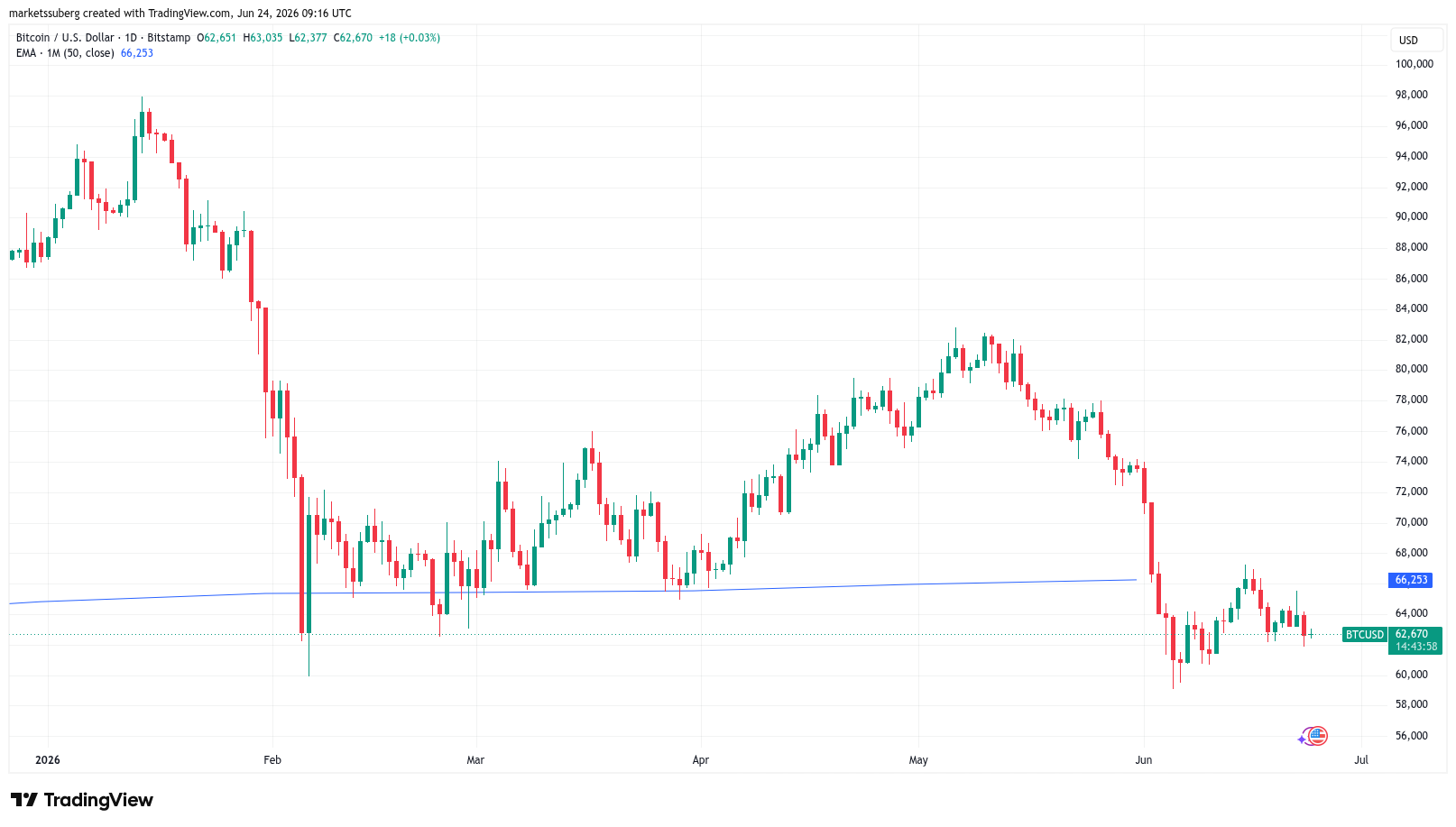
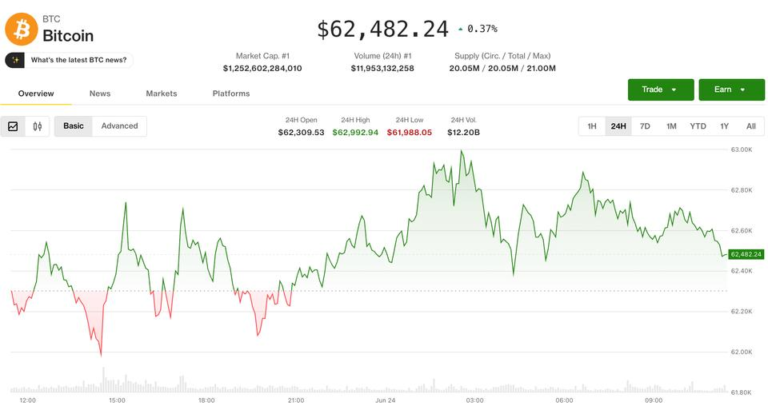
Bitcoin fell roughly 16% over the same timespan and briefly traded below $60,000 before recovering to around $61,000, according to CoinDesk data.

Stablecoins are the most direct way to track money leaving crypto for dollars. A trader cashing out bitcoin to fund a brokerage account converts into a dollar-pegged token like USDC or tether, then redeems it for cash. That shows up two ways, as stablecoins pulled off exchanges and, later, as a shrinking supply when issuers burn the redeemed tokens.

Neither moved of these readings show anomalies, per data assessed by CoinDesk Outflows for USDC and tether stayed inside the range they’ve held since February, according to CryptoQuant data. The largest single days in recent months were $2.5 billion in USDC on May 22 and $3.6 billion in tether on May 20, both came before the sell-off.

Bitcoin and ether did see heavy withdrawals on Friday, 66,470 bitcoin and about 2.49 million ether moving off exchanges, among the biggest single-day totals of the year on CryptoQuant’s data.

An outflow is coins leaving an exchange for a private wallet, which is what a buyer does after taking delivery. Selling does the reverse, coins moving onto exchanges to be sold.

On-chain data has a blind spot, however. It can’t see inside a Robinhood or Coinbase account, where someone can sell bitcoin for dollars without either ever touching a public blockchain.

Whether crypto holders funded their allocations won’t be answerable until the brokerages publish their own numbers. Robinhood reports monthly trading metrics, with June’s crypto volumes due in mid-July, and Coinbase breaks out retail activity in second-quarter results later in the month.

Bitcoin and ether did see heavy withdrawals on Friday, 66,470 bitcoin and about 2.49 million ether moving off exchanges, among the biggest single-day totals of the year on CryptoQuant’s data.

An outflow is coins leaving an exchange for a private wallet, which is what a buyer does after taking delivery. Selling does the reverse, coins moving onto exchanges to be sold. The week’s largest flows look like withdrawal and dip-buying, not a scramble for cash.

The one place money clearly drained from crypto was the funds.

Spot bitcoin ETFs, the exchange-traded products that hold bitcoin directly, bled for 13 straight sessions through June 3, a record stretch worth about $4.4 billion before a small $3 million inflow snapped the streak.

Ether ETFs ran a longer 17-session streak that broke the same day. When investors pull money from these funds the issuer sells the underlying coins, so the redemptions are real selling.

SpaceX prices on June 11 and lists on the Nasdaq under the ticker SPCX the next day.

Researcher who found Zcash’s bug with AI adds Monero to his audit queue

0

Taylor Hornby, the security engineer who used Anthropic’s Opus 4.8 AI model to find a critical bug in Zcash, says privacy coin Monero is among the tokens he intends to audit next.

Asked on X whether he could look for flaws in Monero and other private cryptocurrencies, Hornby replied, “Absolutely! I’ll add Monero to my queue of things to audit.”

Monero, which trades under the ticker XMR, is among the largest privacy-focused cryptocurrency and hides transaction details by default compared to Zcash, where users can either either transparent or shielded addressed.

Hornby found the Zcash flaw on May 29. The bug, in the blockchain’s Orchard privacy pool, had gone undetected since May 2022 and could have let an attacker mint unlimited, undetectable counterfeit ZEC. Shielded Labs, a nonprofit developer on the network, disclosed it on Thursday and pushed through an emergency fix by June 1.

Zcash fell 38% over the following 24 hours amid fallout and concerns about a hacker possibly stealing money from the shielded pool – without leaving any detectable trace – over the past few years.

Hornby, hired by Shielded Labs in April to find protocol bugs before attackers could, said he reported the flaw rather than exploit it because the Zcash developers were “like family” and he could “not live with that kind of betrayal.”

He plans to apply for a Zcash coinholder grant to fund further work.

Bitcoin Bears Boost Shorts, Will Bulls Liquidate Them And Reverse BTC Price?

0

Key takeaways:

  • Over-leveraged Bitcoin short positions between $63,000 and $66,000 have created a potential $2.6 billion squeeze trap for bears.
  • Negative perpetual funding rates indicate that bulls have fully deleveraged, significantly reducing downside risk.

The Bitcoin (BTC) crash to $61,100 on Friday wiped out $335 million in leveraged long positions. However, after a 21% decline in Bitcoin’s price, bulls might have set a perfect trap as negative market sentiment intensified. Bearish positions built up heavily between $63,000 and $66,000, setting the stage for a potential $2.6 billion short squeeze.

Estimated cumulative Bitcoin liquidation at major exchanges, USD. Source: CoinGlass

Estimated liquidations for a further 8% drop in Bitcoin to $57,000 from $62,000 stand at $1.2 billion. In contrast, a rally to $66,000 would put $2.6 billion of short positions at risk. This potential squeeze might provide enough fuel to revive buyer confidence following a record-breaking 13-day streak of net outflows from spot Bitcoin exchange-traded funds (ETFs).

US-listed spot Bitcoin ETFs daily net flows, USD. Source: SoSoValue

The minor $3 million net inflow on Thursday could represent a temporary breathing room after 15 days of selling that drained $5.1 billion. It remains too early to conclude that momentum has officially flipped in favor of the bulls. Ultimately, if bears kept their leverage low and played conservatively, the actual threat of a massive short squeeze might be minimal.

Bitcoin perpetual futures annualized funding rate. Source: Laevitas

A neutral funding rate typically ranges between 6% and 12%, with longs paying to keep their positions open. The current negative 2% Bitcoin perpetual futures funding rate suggests growing confidence among bears. Thus, even if it takes time for Bitcoin to reclaim the $66,000 level, bulls have fully deleveraged, reducing downside risk.

Nasdaq 100 futures (left) vs. Bitcoin/USD (right). Source: TradingView

Bitcoin has severely underperformed the Nasdaq 100 index, but the tech sector is beginning to display weakness after Broadcom (AVGO US) closed down 12.6% Thursday, erasing $280 billion in market value. The company trimmed its AI chip sales forecast for the second half of 2026, putting investors on alert.

Impact of the tech sector IPOs and Strategy’s 32 BTC sale

Other prominent names in the AI sector also felt the impact. Micron (MU US) traded down 7.8% while Arm (ARM US) dropped 4.5%. With highly anticipated IPOs from SpaceX, Anthropic, and OpenAI in sight, investors likely opted to raise cash ahead of those offerings. Analysts claim this liquidity drain also contributed to Bitcoin’s recent weakness.

Related: Strategy’s leveraged Bitcoin model has faced its first stress test–Grayscale

Source: X/dgt10011

Jeff Park, partner at ParaFi Capital and Bitwise advisor, argues that the AI sector is draining money from other investments as the market becomes a “hot ball of money” that everyone suddenly “has to own”. However, Park reminds that once this period of AI mania blows off, capital will eventually rotate back to Bitcoin as its discounted valuation works in its favor.

Regardless of whether Bitcoin’s weakness stems from AI sector hype, excessive confidence from bears poses a major risk once spot Bitcoin ETF inflows pick up or the fear surrounding a recent 32 BTC sale from Strategy (MSTR US) dissipates. A rally back to $66,000 might seem unlikely at first glance, but a sudden short squeeze could quickly shift momentum in favor of the bulls.

Bitcoin (BTC) price drops 2.8% as index declines

0

CoinDesk Indices presents its daily market update, highlighting the performance of leaders and laggards in the CoinDesk 20 Index.

The CoinDesk 20 is currently trading at 1681.25, down 4.8% (-84.48) since 4 p.m. ET on Thursday.

All 20 assets are trading lower.

Leaders: BTC (-2.8%) and BNB (-2.9%).

Laggards: ICP (-14.6%) and NEAR (-14.3%).

The CoinDesk 20 is a broad-based index traded on multiple platforms in several regions globally.

What next as Ripple-linked token falls 5% to $1.10

0

XRP is no longer fighting over $1.20. It’s fighting over whether $1.10 holds. The latest selloff came with the kind of volume usually associated with forced liquidations rather than orderly selling, pushing the token to its weakest levels in months before dip buyers finally showed up near $1.09.

News Background

• XRP ETFs recorded roughly $4 million in inflows after seeing their first daily outflow in three weeks, bringing cumulative inflows to around $1.5 billion.

• Market sentiment deteriorated sharply across crypto, with the Fear & Greed Index falling into extreme fear territory as traders reacted to broader macro uncertainty.

• XRP also slipped behind USDC in market capitalization rankings after the selloff pushed its value below $75 billion.

Price Action Summary

• XRP fell from $1.17 to $1.11 during the 24-hour session, touching lows near $1.09 before recovering slightly.

• The biggest move came during the June 5 06:00 UTC session, when volume surged to 268.2 million XRP and accelerated the breakdown.

• A failed rally toward $1.133 later reversed sharply, sending price to fresh lows before buyers stepped in near $1.10.

Technical Analysis

• The key takeaway is that support levels keep becoming resistance. What was a buying zone around $1.20-$1.25 just days ago is now where sellers are reappearing.

• The move below $1.10 briefly pushed XRP into one of the most oversold conditions seen in years, with weekly RSI readings reaching levels that historically appeared near major cycle lows.

• Even so, oversold does not automatically mean bullish. Markets can stay oversold for longer than traders expect, especially during liquidation-driven declines.

• The bounce from $1.09 showed signs of seller exhaustion, but recovery volume remained weaker than the selling that preceded it.

What traders should watch

• $1.09-$1.10 is now the most important support zone on the chart. Losing it would shift focus toward the $0.92 area highlighted by several analysts.

• $1.12-$1.13 becomes the first recovery zone XRP needs to reclaim before any stabilization narrative gains credibility.

• The broader trend remains bearish until XRP starts reclaiming former support levels rather than simply bouncing from oversold conditions.

• Traders looking for evidence of a durable bottom will likely want to see stronger volume on rebounds than on selloffs, something the market has not yet delivered.

WLD plunges 20% as Hayes dumps token a day after saying he would keep holding it

0

Crypto investment opinions are changing in less than 24 hours these days.

Arthur Hayes, co-founder of crypto exchange BitMEX and chief investment officer of family office Maelstrom, said on Friday the firm had sold its entire stake in Worldcoin, the digital token tied to Sam Altman’s eye-scanning identity project, a day after he said it would keep holding the token.

“Dumped $WLD. I’m out. See y’all at the clerb,” he wrote, alongside a chart of SpaceX stock sliding. WLD dropped 10% in the past 24 hours, with a chunk of the move coming after Hayes’ tweet.

A day earlier Hayes had said Maelstrom was keeping Worldcoin. The firm had just sold all of its Zcash, a privacy coin, blaming a flaw in its Orchard privacy pool that he said undercut the reason to own it, and Hayes said the firm would rebuy it higher if he turned out to be wrong. Worldcoin it would keep, he said then, while waiting for ‘Lord Elon’ – referring to Elon Musk – to lift the price.

The connection ran through artificial intelligence. SpaceX has increasingly pitched its listing as an AI and connectivity play rather than just a rocket company, so a strong debut promised to lift the broader AI and tech trade.

Worldcoin, an AI-themed token that trades around the clock, was the fund’s fast way to ride that, a liquid stand-in for SpaceX shares that retail cannot easily buy and that are not yet trading.

SpaceX trades under the ticker SPCX but does not list on the Nasdaq until June 12, so the price Hayes reacted to is a pre-listing quote from private markets for a company that is not yet public. Worldcoin is also Altman’s project, not Musk’s, and the two men run rival artificial intelligence firms.

Pre-listings for SpaceX stock are down more than 50% in the past few days on Hyperliquid, data shows, giving less of a reason for AI bettors to be holding the proxy.

Hayes is a frequent, market-moving voice in crypto. Worldcoin was bucking a market-wide downturn with a 70% rise over the past month, a gain that has trimmed down to 45% over the past week on Saturday’s price drop.

Bitcoin reclaims $61,000 after dipping below $60,000 in an AI-led rout

0

Bitcoin reclaimed the $61,000 level in Asian morning hours Saturday after briefly dipping below $60,000 overnight, steadying after a strong U.S. jobs report on Friday triggered a sharp selloff across stocks, bonds and crypto.

The token fell as low as $59,227 before buyers stepped back in, and was trading around $61,000, down about 1.3% on the day.

The bounce came off a level traders had been watching closely. Bitcoin had been sliding toward $60,000 all week as a record run of ETF outflows and Strategy’s first bitcoin sale since 2022 removed buyers that had supported the price. The break below the round number overnight did not turn into a deeper breakdown, with the token recovering more than $1,500 off the low.

The selloff that drove the dip started outside crypto. Friday’s nonfarm payrolls report came in solid, and rather than cheering the strength, markets repriced the Federal Reserve outlook hard. Swaps now fully price a rate increase by the end of 2026, a reversal from the cuts expected under newly confirmed chair Kevin Warsh. Two-year Treasury yields jumped 12 basis points to 4.16%, the dollar rose, and risk assets fell.

The damage was worst in the AI trade. The Nasdaq 100 sank about 5%, its steepest drop since April 2025, and a gauge of chipmakers tumbled 10%. The S&P 500 fell 2.6% and failed to complete a tenth straight weekly gain.

Other tokens remain deep in the red on the week. Ether is down 21.6% over seven days to around $1,575, solana down 23.7% to $63, and XRP, dogecoin and BNB all between 13% and 20% lower. Hyperliquid’s HYPE, which outperformed through most of the recent bleed, is down 9.9% over the same stretch.

The leverage washout was heavy. Around $1.60 billion in positions were liquidated over 24 hours across roughly 308,000 traders, according to CoinGlass, with longs accounting for $1.21 billion. Bitcoin saw $534 million in liquidations and ether $423 million, while Zcash, in the middle of its own 44% collapse tied to a disclosed bug in its Orchard privacy pool, logged another $115 million.

With $60,000 pierced overnight but quickly reclaimed, the question is whether bitcoin can build on the bounce or whether the level gives way on a retest. A clean break below it would put the token back into territory it last traded during the February drawdown.

Major US Banks Including JPMorgan, Citi and BofA Plan Shared Tokenized Deposit Network

0

JPMorgan, Citi, Bank of America, Wells Fargo, and more than a dozen peers have announced a joint initiative to put commercial bank deposits onchain, operated by The Clearing House and targeting a first-half 2027 launch.

Four of the largest US commercial banks — JPMorgan Chase, Citigroup, Bank of America, and Wells Fargo — are building a shared tokenized deposit network through The Clearing House, the bank-owned payments company, according to a joint press release published Friday. The initiative, which The Wall Street Journal first reported, targets a first-half 2027 launch.

The participant roster is broader than earlier reporting suggested. BNY, BMO, Citizens Financial, Fifth Third, HSBC, Huntington, KeyBank, PNC, Regions, Santander, TD Bank, Truist, and U.S. Bank are all named in the release. A blockchain vendor has not yet been selected.

Network Architecture and Capabilities

The platform will enable on-chain clearing and settlement of tokenized deposits between participating banks, supporting 24/7 settlement and automated payment workflows. It will also serve as a connectivity layer linking blockchain activity to existing fiat rails, including The Clearing House’s own RTP® and CHIPS® networks, which together clear and settle more than $2 trillion daily.

Tokenized deposits are bank deposit claims recorded on a distributed ledger, backed one-for-one by reserves at the issuing bank. They carry the same FDIC eligibility and regulatory treatment as traditional deposits. Tokenized deposits are distinct from stablecoins, which are issued by non-bank entities and are backed by cash and Treasuries.

David Watson, President and CEO of The Clearing House, called the initiative “a big move for the banks” and said the industry faces a “radically different” future built around on-chain payments.

Executive Quotes From the Four Lead Banks

JPMorgan’s Global Co-Head of Payments Max Neukirchen said a “regulated market-infrastructure solution for clearing and settling tokenized deposits” is essential to keeping the payments ecosystem “stable, resilient, and effective.”

Citi’s Head of Services Shahmir Khaliq pointed to Citi Token Services — already running cross-border instant payments at scale — as a building block: “There is a critical need for The Clearing House to establish clearing infrastructure across member banks for both traditional and tokenized deposits facilitating industry-wide 24/7 and interoperable movement of cash and securities in the future.”

Wells Fargo CFO Mike Santomassimo said the initiative “boosts Wells Fargo’s ability to give our payments clients the benefits of blockchain along with the trust and stability expected from banks.”

Bank of America’s Head of Global Payments Solutions Mark Monaco called it “an important foundation for future growth” combining “the innovation of digital finance with the trust, scale, and settlement certainty of established bank payment infrastructure.”

The Stablecoin Backdrop

The announcement arrives as USDT and USDC together hold roughly $263 billion in circulating supply, per DefiLlama — a scale that bank executives have framed as a structural deposit-retention threat.

JPMorgan CEO Jamie Dimon publicly opposed stablecoin-yield provisions in the CLARITY Act earlier this month. The Clearing House network is the banking sector’s coordinated operational response: not just legislative opposition, but a competing product with comparable programmability built inside the regulated perimeter.

Several participants were already running individual tokenized deposit programs. Kinexys by J.P. Morgan, the firm’s blockchain unit whihc processes more than $5 billion daily, brought JPM Coin (JPMD) to Coinbase’s Base L2 for institutional clients earlier this year. Citi Token Services has been live for cross-border instant payments. BNY launched its own tokenized deposit service for institutions in January.

This announcement is a continuation of a broader arc. Earlier reporting this week covered JPMorgan and Citi’s bilateral tokenized deposit preparations. Friday’s release confirms the shared, multi-bank infrastructure layer sitting above those individual programs and broadens the participant list from four to more than a dozen named institutions.

Bitcoin Breaks 200-Week Moving Average for First Time Since 2022 as Jobs Report Reprices Fed Cuts

0

Bitcoin fell below its 200-week moving average dropping below $61,000 for the first time since the 2022 bear market, triggered by a blowout May payrolls report that repriced Fed rate-cut expectations and exposed a $1.2 billion options wall at $60,000.

Bitcoin fell below its 200-week moving average, a long-term trend marker while spot prices dropped below $61,000 for the first time since the 2022 bear market low.

The broader selloff has pushed BTC down roughly 17% over seven days and more than 25% from its 30-day range, per CoinGecko data. At the time of publication, BTC traded around $60,839, more than 50% below its all-time high of $126,080, set in October 2025.

The trend break came within hours of a stronger-than-expected US jobs report that pushed markets to reconsider the timing of Federal Reserve rate cuts.

The Bureau of Labor Statistics reported 172,000 nonfarm payrolls added in May, well above the ~85,000 forecast. The unemployment rate held at 4.3%.

The 200-Week Moving Average

The 200-week moving average is a widely tracked long-term trend line. It marked the bottom of every Bitcoin bear cycle from 2015 through 2020. Bitcoin spent roughly 16 months below the line after breaching it in June 2022 before recovering in late 2023. The current reading sits near $61,000, per CoinGlass.

A close below the line, not just an intraday touch, carries more weight as a signal. As of Friday, Bitcoin had touched but not yet closed a weekly candle below it.

The $60,000 Options Wall

More than $1.1 billion in notional open interest sits at the $60,000 put strike on Deribit, the largest concentration at any single strike, the Deribit website shows.

Investors have bought those puts as a hedge against a deeper drawdown. But the structure creates a feedback loop: as market makers delta-hedge their short-put exposure, they are mechanically forced to sell spot BTC or futures when the price nears $60,000. That selling can accelerate a decline.

The week has already produced substantial forced selling. CoinGlass data show more than $617 million in BTC long positions liquidated over the past 24 hours, with broader crypto liquidations topping $737 million in BTC alone.

The AI Rotation Frame

Strategy executive chairman Michael Saylor, whose company holds 843,706 BTC per CoinGecko data, has framed the selloff differently. In a post on X Thursday, Saylor argued that capital markets are funding AI infrastructure at historic scale — roughly $400 billion over six months — and that Bitcoin’s weakness reflects a rotation rather than an impairment of the asset itself.

“This is a capital rotation, not a Bitcoin impairment. Volatility creates opportunity,” he wrote.

The Defiant has covered Strategy’s recent treasury moves, including its bond purchase earlier this month, as the arc around its BTC position has evolved.

Macro Context

The May jobs report was the immediate trigger on Friday. The payrolls beat sharply reduces the probability of a near-term Fed rate cut. Lower rates would generally be supportive of risk assets, including crypto. Futures markets shifted to price in fewer cuts through year-end following the 8:30 a.m. ET release.

The jobs data also arrived at the end of what some trackers have called Bitcoin’s worst week of 2026, with the largest US spot Bitcoin ETFs reporting net outflows for more than 11 consecutive sessions and roughly $3.5 billion withdrawn from the products over that stretch.