White House officials — especially lead crypto adviser Patrick Witt — have sought to keep the Clarity Act moving forward in the Senate, including holding previous meetings with those who have objected, such as law enforcement groups and Wall Street bankers. Representatives of the White House didn’t immediately respond to requests for comment on the expected Monday meeting, which meant to work through some of the remaining concerns, and few details were available.
Industry groups such as the Blockchain Association have defended the legislation’s crime-fighting tools, arguing that the bill includes a number of new powers for pursuing bad actors, and that the absence of a new law will leave a vacuum.
At an industry-hosted event earlier this month, White House adviser Witt said, “We’re putting real regulatory constraints on businesses and actors that currently live in a state of uncertainty.”
To law enforcement officials, he argued, “You should be the biggest cheerleaders for this bill, because this is really what is missing.”
Meanwhile, the Clarity Act’s political opponents, such as Senator Elizabeth Warren — the top Democrat on the Banking Committee, have maintained a steady stream of criticism on the legislation’s illicit-finance front. They routinely cite crypto’s use by criminal groups, drug cartels and human traffickers.
Bitget, the world’s largest Universal Exchange (UEX), has launched the third year of its Anti-Scam Month initiative with the release of its Anti-Scam Report 2026 titled “The Evolution of Fraud in the Multi-Asset Era”, developed in partnership with blockchain security firm SlowMist. As digital finance expands across cryptocurrencies, tokenized assets, stocks, CFDs, wallets, and AI-powered investment tools, the report examines how fraud is adapting to changing investor behavior and increasingly interconnected financial ecosystems.
The report finds that changes in user behavior are reshaping how fraud campaigns are designed and deployed across digital finance. According to Bitget Research, the share of active users participating across two or more asset classes grew from under 1% in mid-2025 to more than 10% by May 2026. As users move across a wider range of products and platforms, fraud campaigns are increasingly blending multiple narratives, social engineering tactics, AI-generated content, and multiple communication channels within a single operation.
Drawing on Bitget Research and investigations conducted by SlowMist, the report found that many successful scams no longer rely on a single point of compromise. Fraud operators guide victims through a sequence of interactions spanning social media platforms, messaging applications, investment communities, phishing infrastructure, and wallet activity before assets are ultimately stolen. Between July 2025 and June 2026, Bitget’s security infrastructure intercepted more than 150 million malicious requests, identified over 13,000 high-risk malicious IP addresses, handled 18,135 user protection cases, and supported the recovery of $32.3 million linked to security incidents and fraudulent activity.
“Security challenges evolve alongside markets. As more users participate across crypto, stocks, tokenized assets and AI-powered products, fraud campaigns are becoming sophisticated in how they build trust and influence decision-making. Understanding those risks is an important step toward protecting users and strengthening confidence across the broader ecosystem,” said Gracy Chen, CEO of Bitget.
The report identifies several trends shaping the current fraud environment, including AI-generated investment personas, deepfake-enabled scams, voice-cloning attacks, synthetic investment communities, wallet-draining operations, malicious smart contracts, and increasingly sophisticated phishing campaigns. Among the cases examined are a deepfake investment scam impersonating Cypriot President Nikos Christodoulides, an AI-generated investment advertising campaign that reportedly defrauded thousands of Swedish investors, the Truman Show synthetic community scam involving approximately 90 fabricated investor identities, and the Rublevka Team wallet-draining operation documented in early 2026.
Beyond examining how scams operate, the report explores victim psychology, common scam entry points, post-theft asset movement, and recovery challenges. It also outlines practical measures users can take to strengthen account security, recognize AI-enabled deception, evaluate investment opportunities more effectively, and respond to security incidents.
Since launching Anti-Scam Month in 2024, Bitget has worked with security researchers, ecosystem partners, and industry organizations to improve awareness around emerging threats and promote stronger user protection practices. Throughout June, Bitget’s Anti-Scam Month campaign will feature educational content, security awareness initiatives, and collaborations with industry partners aimed at helping users identify emerging threats and strengthen their ability to protect digital assets.
For more information, please read the report here.
About Bitget
Bitget is the world’s largest Universal Exchange (UEX), serving over 125 million users and offering access to over 2M crypto tokens, 500+ tokenized stocks, ETFs, commodities, FX, and precious metals such as gold. The ecosystem is committed to helping users trade smarter with its AI agent, which co-pilots trade execution. Bitget is driving crypto adoption through strategic partnerships with LALIGA and MotoGP™. Aligned with its global impact strategy, Bitget has joined hands with UNICEF to support blockchain education for 1.1 million people by 2027. Bitget currently leads in the tokenized TradFi market, providing the industry’s lowest fees and highest liquidity across 150 regions worldwide.
Source: Bitget
The above article “Bitget Blocks 150 Million Cyber Threats in Major Security Push” was first published on AlexaBlockchain. Read the complete article here: https://alexablockchain.com/bitget-blocks-150-million-cyber-threats-in-major-security-push/
Submit Your Blockchain and Crypto Press Release here.
Disclaimer: This is a press release, provided by the company/ company representative. AlexaBlockchain does not endorse, guarantee, or accept responsibility for the content, accuracy, quality, advertising, products, or other materials presented in this publication. Readers are advised to conduct their own due diligence before taking any actions related to the company mentioned herein. AlexaBlockchain expressly disclaims any liability for damages or losses, whether direct or indirect, arising from or related to the use of or reliance on any content, goods, or services referenced in this press release.
Unlike cryptocurrencies such as bitcoin, stablecoins are designed to maintain a fixed price pegged to a fiat currency, typically to the U.S. dollar and backed with cash and short-term U.S. Treasuries. Originally used primarily by crypto traders on exchanges, they are increasingly finding broader uses in payments, cross-border transfers and securities settlement.
Institutions see significant room for growth. Standard Chartered projected the stablecoin market could expand from roughly $300 billion today to $2 trillion by the end of 2028, while Citigroup estimated it could reach $4 trillion by 2030 in its base case. Circle’s USDC is the second-largest stablecoin with a market capitalization of over $73 billion.
“As digital assets become increasingly integrated into financial markets, institutions need infrastructure that seamlessly works across traditional and blockchain-based systems,” said Carolyn Weinberg, chief product and innovation officer at BNY.
The monetization program also authorizes Strategy to sell bitcoin to finance up to $1 billion of Digital Credit Securities repurchases and up to $1 billion of Class A common stock buybacks. Any bitcoin monetization beyond these authorized purposes would require additional board approval. The repurchase programs have no expiration date.
The monetization program is part of a broader capital allocation strategy that also includes increasing the dividend on Strategy’s preferred stock STRC to 12%, from 11.5%, adopting a formal USD Reserve policy, and requiring sufficient cash reserves to cover at least 12 months of preferred stock dividends and interest obligations.
Michael Saylor, Founder and Executive Chairman of Strategy said, “At the same time, Digital Credit requires liquidity, discipline, and active capital management. This framework is designed to strengthen credit quality and enable the Company to reduce expected preferred stock dividend payments when accretive. This framework also sets out how we plan to use our capital management toolkit while maintaining our commitment to long-term Bitcoin exposure.”
MSTR shares are up 3% following the announcement, while bitcoin trades below $60,000.
Bitmine Immersion Technologies (BMNR), the largest Ethereum treasury company, bought 27,084 ether (ETH) last week, extending its accumulation streak despite another slide in crypto prices.
The purchase, worth roughly $43 million based on ETH’s current price of around $1,580, lifted Bitmine’s holdings to 5.7 million ETH, according to a Monday company update. The stash is worth about $8.9 billion and represents roughly 4.7% of Ethereum’s circulating supply, nearing the firm’s 5% goal.
The company also held 206 bitcoin, $555 million in cash and marketable securities and stakes in Beast Industries and Eightco Holdings, bringing total crypto, cash and investment holdings to $9.8 billion.
The latest acquisition was the smallest purchase since early May, down from 52,203 ETH the previous week and well below the 126,971 ETH batch earlier this month, suggesting the company is dialing back its buying pace after months of aggressive accumulation. Bitmine nevertheless remains one of the few large digital asset treasury firms still consistently adding to its crypto holdings while many peers have paused purchases amid the market downturn.
Crypto weakness
Chairman Thomas “Tom” Lee pointed to quarter-end rebalancing behind the latest bout of weakness in crypto markets with investors cutting their losses as we enter the second-half of the year.
The rapid consolidation of the prediction market technology stack is raising the odds of a new wave of mergers and acquisitions across sports betting and financial markets, according to Wall Street broker Bernstein.
Over the past eight months, every major consumer-facing prediction platform has moved to own both customer distribution and exchange infrastructure, the report said.
“Kalshi and Polymarket own the stack but trail on distribution, which leaves each as plausibly a target as an acquirer,” analysts led by Ian Moore said in the Monday report.
The analysts noted that DraftKings acquired Railbird to launch its DKeX exchange, Robinhood partnered with Susquehanna to build Rothera, Coinbase acquired The Clearing Company shortly after launching event contracts, and Flutter established a dual-FCM structure to preserve access to multiple exchanges.
The trend reflects Bernstein’s view that prediction markets are converging with sports betting and consumer finance into a single competitive landscape, opening the door to combinations that previously seemed unlikely, including sportsbooks buying exchanges, exchanges buying sportsbooks, and consolidation among sportsbook operators themselves.
Prediction-market operators are bringing trading infrastructure in-house, a rapid shift that could trigger a wave of acquisitions across crypto platforms, sportsbooks, brokerages and standalone exchanges, according to analysts at Bernstein.
In a research report on Monday, Bernstein said the industry is going through “operational consolidation,” with major platforms moving to control more of the prediction-market stack.
“Every consumer platform that matters has merged the front and back end of the prediction-market stack,” they said. This includes distribution, brokerage, exchange and clearing. That convergence had placed businesses that historically operated in separate industries within a single competitive landscape.
Bernstein pointed to Robinhood routing major World Cup contracts through Rothera, the exchange it jointly owns with Susquehanna, and DraftKings launching DKeX and moving volume away from CME and Crypto.com infrastructure. The firm also cited Coinbase’s acquisition of The Clearing Company and its launch of event contracts as evidence that consumer platforms are seeking to control more of the prediction-market stack.
Owning the infrastructure allows platforms to retain fees that previously flowed to outside partners, making acquisitions a faster route to distribution, licenses, or completing missing parts of the stack. However, the same convergence that strengthens the case for consolidation could also heighten state and federal scrutiny by further blurring the regulatory boundary between financial trading and gambling.
Timeline of acquisitions. Source: Bernstein
Regulatory clash could constrain consolidation
Bernstein said regulatory scrutiny remains one of the main barriers to larger integrations across the prediction-market sector.
While combining crypto platforms with brokerages, sportsbooks and exchanges could improve margins and reduce reliance on outside partners, Bernstein said such deals could attract antitrust scrutiny and deepen disputes over whether sports event contracts should be regulated as financial derivatives or gambling products.
Related: About 60% of World Cup bettors on Polymarket are first-time crypto users
That could further stoke the jurisdictional conflict already playing out across several states. Minnesota enacted what the Commodity Futures Trading Commission (CFTC) described as the first outright ban on prediction markets, while Illinois adopted legislation requiring platforms to obtain a state license before offering sports event contracts.
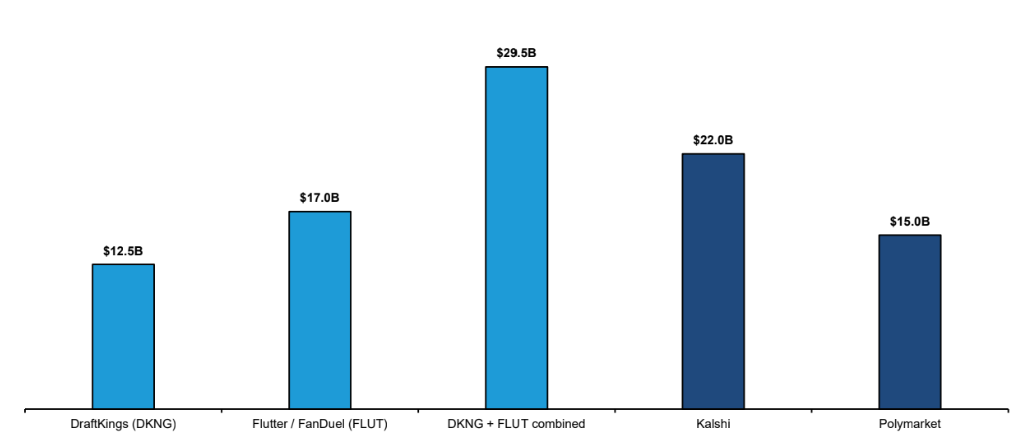
Valuation of online sports books compared to leading prediction markets. Source: Bernstein.
Kalshi challenged both states’ restrictions, arguing that federally regulated exchanges fall under the CFTC’s exclusive authority.
The growing resistance suggests that consolidation may make commercial sense but remain difficult to execute until regulators and courts settle where federal derivatives oversight ends and state gambling authority begins.
Magazine: Bitcoin slides to $58K, XRP hits $1 but onchain data promising: Market Moves
Ethereum co-founder Vitalik Buterin published a technical essay outlining how cryptography could one day enable people to vote privately onchain without relying on a trusted group to manage ballots or reveal the result.
In a blog post on Monday, Buterin said a cryptographic approach called indistinguishability obfuscation (iO), combined with blockchain infrastructure, could support private and collusion-resistant voting with “almost no trust assumption.” The approach would replace threshold committees, which jointly decrypt voting data, with protected programs designed only to reveal the outcome.
Private onchain voting remains dependent on groups of operators safeguarding information and behaving honestly. Removing that dependency could make decentralized governance harder to manipulate, reduce the risk of insider interference and allow voters to participate without exposing how they voted, according to Buterin.
However, Buterin said the technology remains impractical. He said the most conservative constructions require what he described as “galactic” amounts of computation. He said faster approaches rely on less-tested security assumptions, which means that the idea presents a more long-term research direction rather than a deployment-ready system.
Source: Vitalik Buterin
How indistinguishability obfuscation could protect onchain votes
According to Buterin, iO is a form of cryptography that turns software into a protected program. People can run the program and receive the intended output, but they cannot inspect its internal code or extract the data stored inside it. Buterin described the concept as hiding the code rather than the information being processed.
For onchain voting, Buterin said an obfuscated program could contain the logic needed to process encrypted ballots and reveal the final tally without exposing individual votes, essentially removing the need for a threshold committee whose members collectively hold the keys required to decrypt the result.
Buterin said blockchains would still play a key role because an obfuscated program cannot prevent itself from being copied or independently maintain changing information.
Related: Ethereum whale who shorted October 2025 crash opens $19.7M ETH short position
Buterin’s broader privacy push
Buterin previously connected iO with private voting in his Ethereum roadmap published in October 2024. He said the approach could provide stronger privacy and resistance to coercion. His latest essay expands on that earlier proposal by examining how the underlying cryptography could be constructed, the security assumptions it requires and the technical barriers preventing it from becoming practical.
In April 2025, Buterin proposed a more immediate privacy roadmap for Ethereum, calling for privacy tools to be integrated into existing wallets. The proposal also advocated for stronger protections against data collection by infrastructure providers that wallets use to access Ethereum.
Buterin also drew funding from his personal holdings to fund privacy-preserving technologies. On Jan. 30, he earmarked 16,384 Ether (ETH), worth about $45 million at the time, to fund initiatives focused on privacy, open infrastructure and self-sovereign tools.
Magazine: Japanese pension fund tips 1% in crypto, G7 urges action on NK hackers: Asia Express
Bitcoin (BTC) nears the end of June and Q2 2026 threatening to lose $60,000 support — can RSI divergences save bulls?
Key points:
Bitcoin RSI data is printing key bullish divergences that were absent from previous dips in 2026.
Traders remain concerned about a support collapse as analysis makes a key 2022 bear-market comparison.
Macro data hinges on the labor market and Iran peace deal, with a potential crypto tailwind due.
Where June fails, July historically comes through for Bitcoin bulls.
Onchain data sees Bitcoin’s “first bottoming flag” already present.
Bitcoin RSI divergence stands out in 2026 bear market
A classic BTC price leading indicator continues to boost the odds of a recovery as June comes to an end, TradingView data shows.
BTC/USD one-week chart with daily, weekly RSI. Source: Cointelegraph/TradingView
As Cointelegraph reported, relative strength index (RSI) cues across multiple time frames are locking in bullish divergences with price.
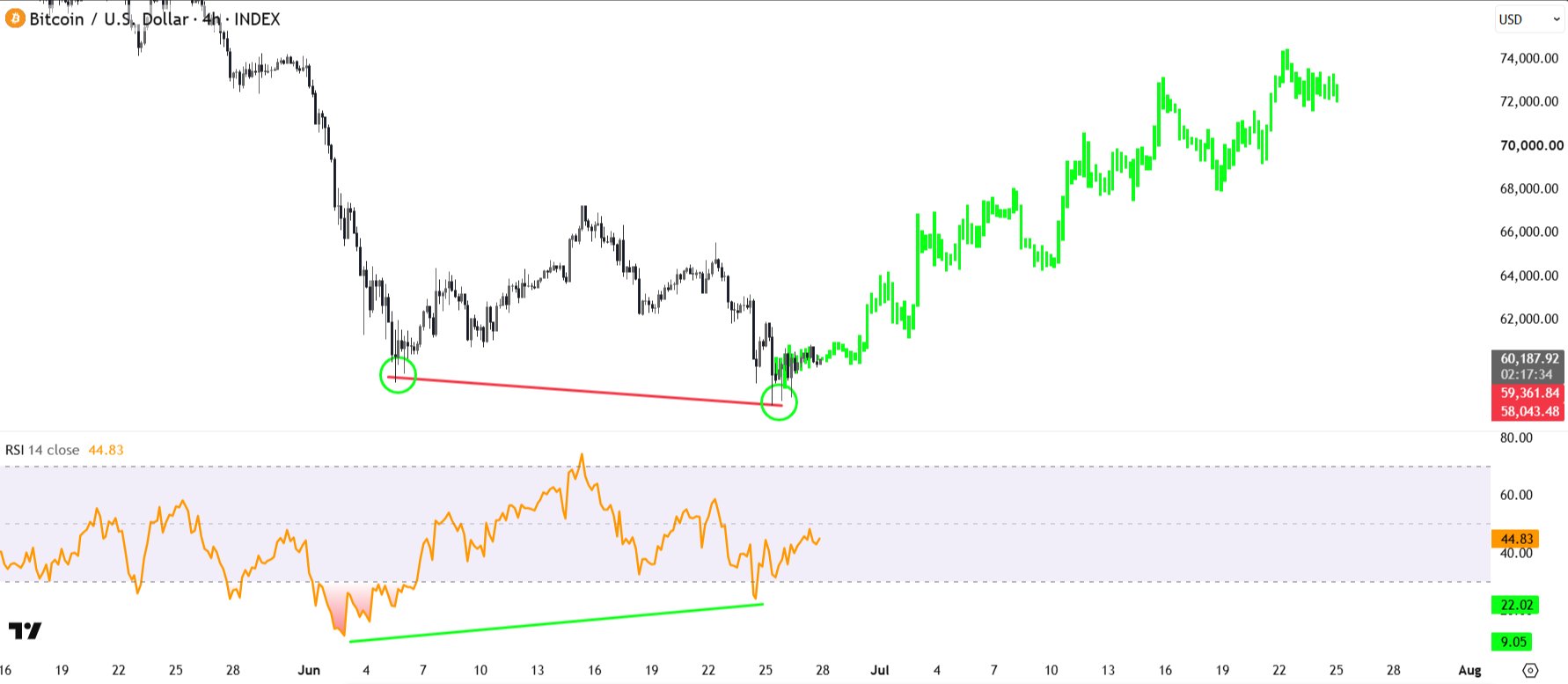
“$BTC is printing a bullish RSI divergence while a potential double bottom forms,” Bitcoin whale Gerla, owner of the Gerla trading group, told X followers about the four-hour chart on Sunday.
“This is getting interesting.”
BTC/USD four-hour chart with RSI data. Source: Gerla/X
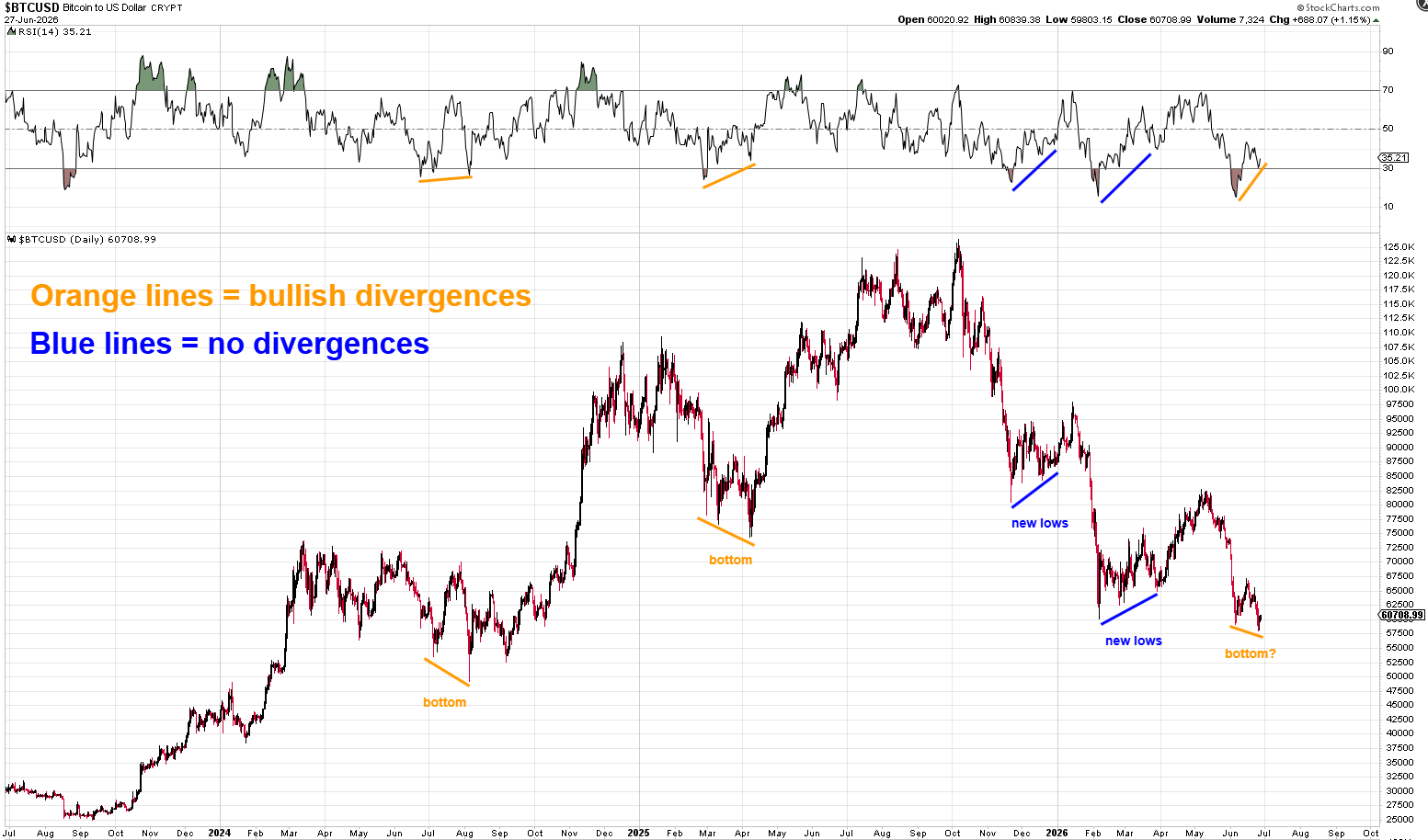
The sense of anticipation is increasing across the trading community, with pseudonymous trader and commentator Heisenberg noting a key divergence between Bitcoin’s latest macro lows and previous dips in 2026.
“Small sample size but still noteworthy. Notice the last two oversold RSI divergences (in orange) formed bottoms,” they wrote alongside a chart on X.
“The last two recent drops (in blue) had no RSI divergences… UNTIL NOW… Is this the one?”
BTC/USD one-day chart with RSI data. Source: Heisenberg/X
RSI divergences have accompanied some of the most significant trend changes in Bitcoin history, including the end of its previous bear market in late 2022.
$60,000 sparks mid-2022 comparison
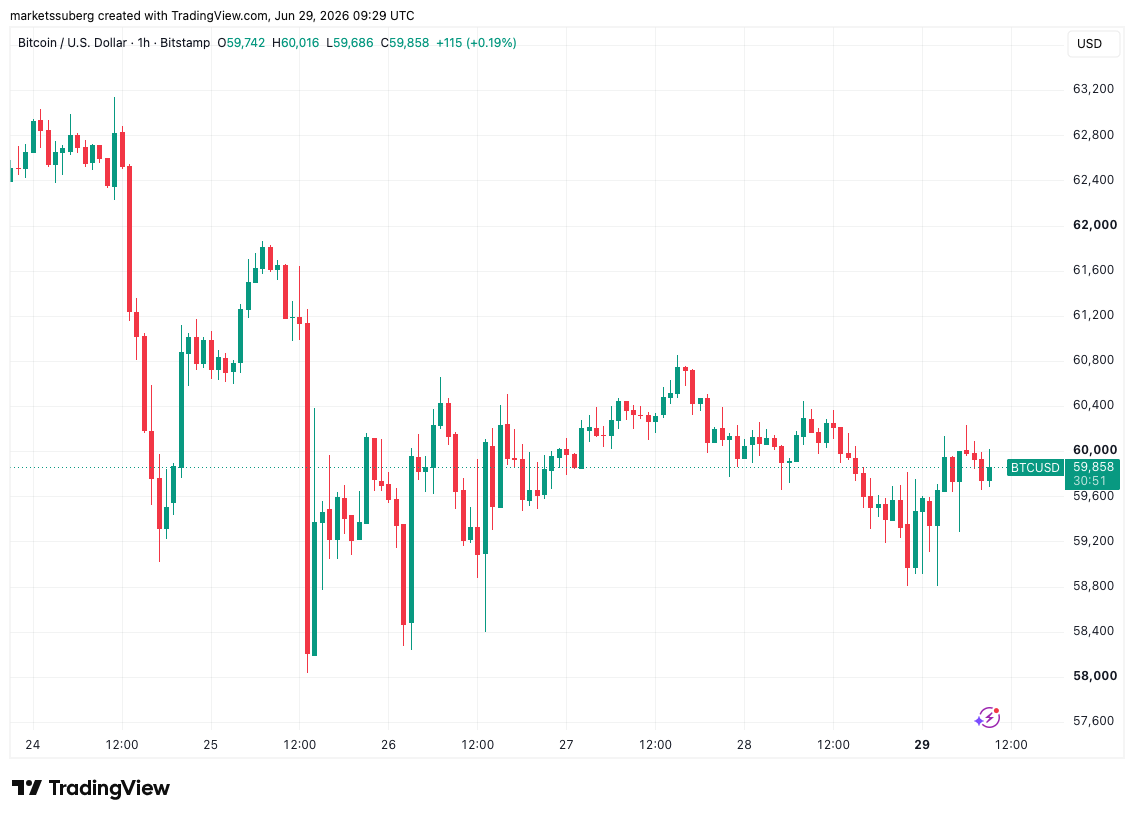
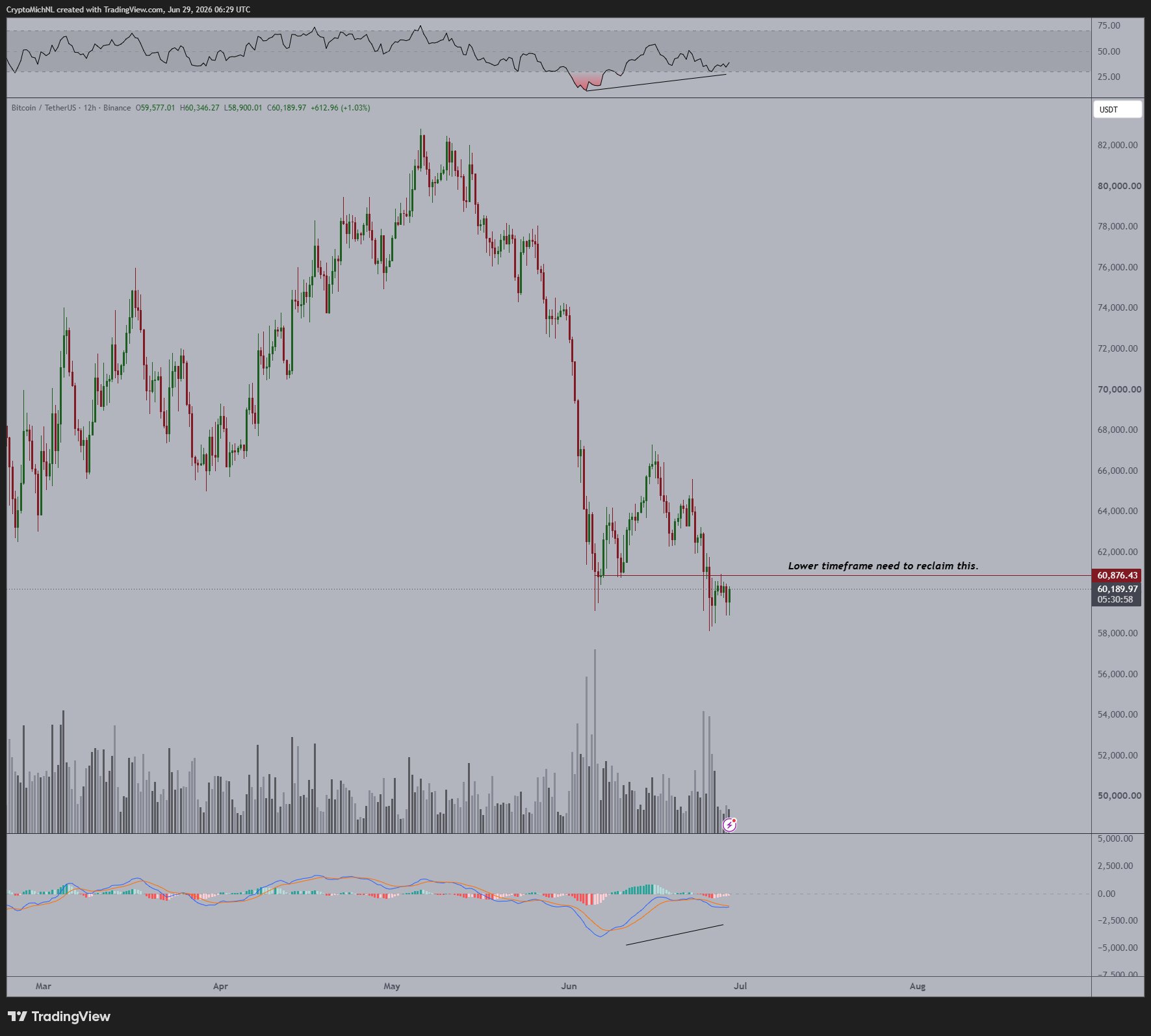
Bitcoin saw modest upside as the week began after sealing a weekly close below $59,500 — its first since September 2024. $60,000 is now increasingly acting as resistance, with bulls unable to exert significant momentum.
“Quite funny enough, this is not a bad start of the week for Bitcoin as it bounces upwards,” crypto trader and analyst Michaël van de Poppe responded in his latest X analysis.
“We need to see way more momentum, and a clear break above $61,000, however, the bullish divergence is there and shouldn’t be ignored.”
BTC/USDT 12-hour chart with RSI, volume, MACD data. Source: Michaël van de Poppe/X
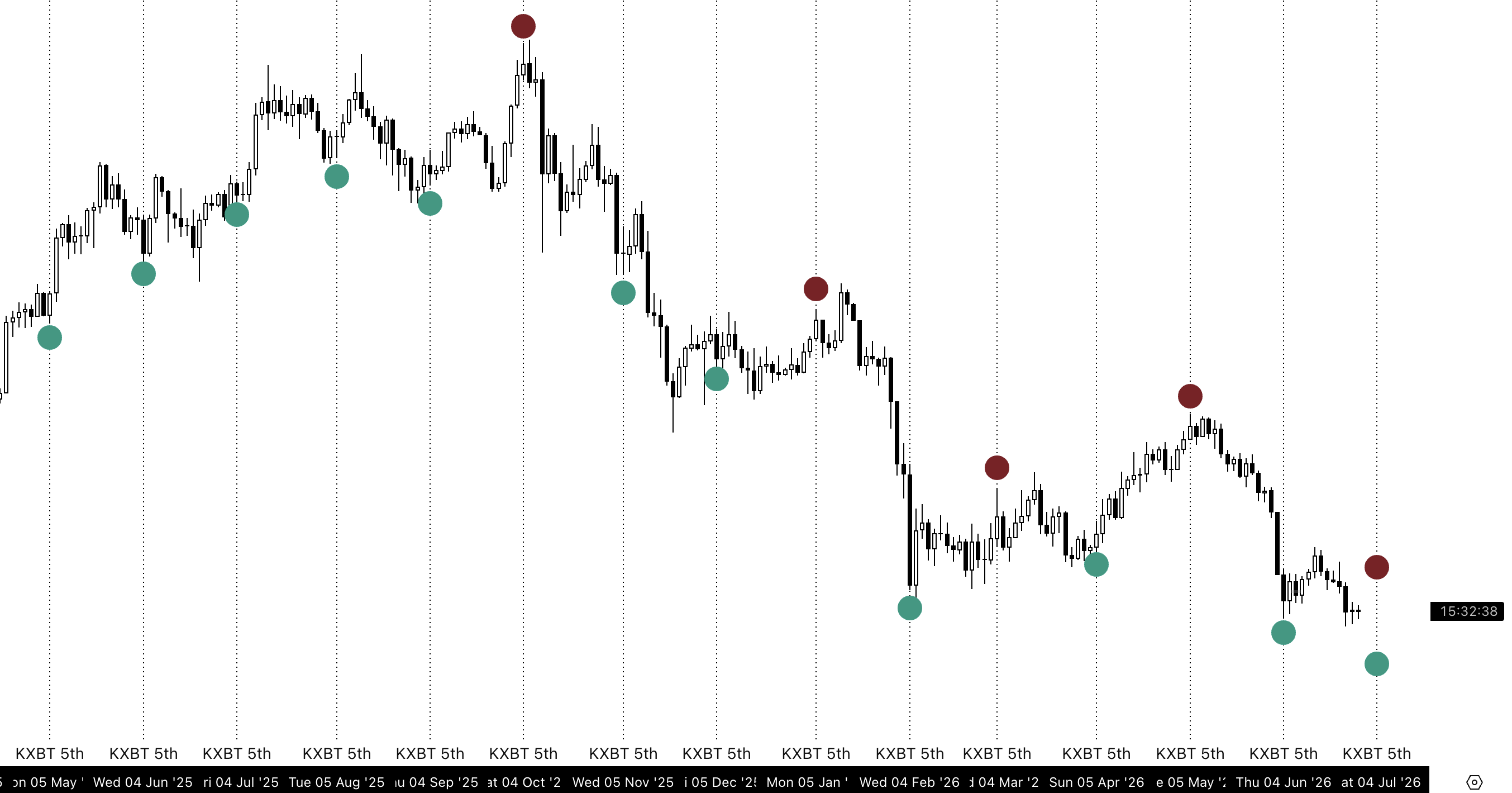
With the monthly and quarterly closes approaching, trader Killa suggested that upcoming BTC price action would be particularly significant within the long-term trend.
“A few more days and $BTC reaches my 5th pivot. For the past 18+ months, we’ve consistently seen major directional shifts around this point at the start of each month,” the explained on Monday.
“Whether it’s a pivot low or a pivot high, this is a key time to start paying close attention.”
BTC/USD chart. Source: Killa/X
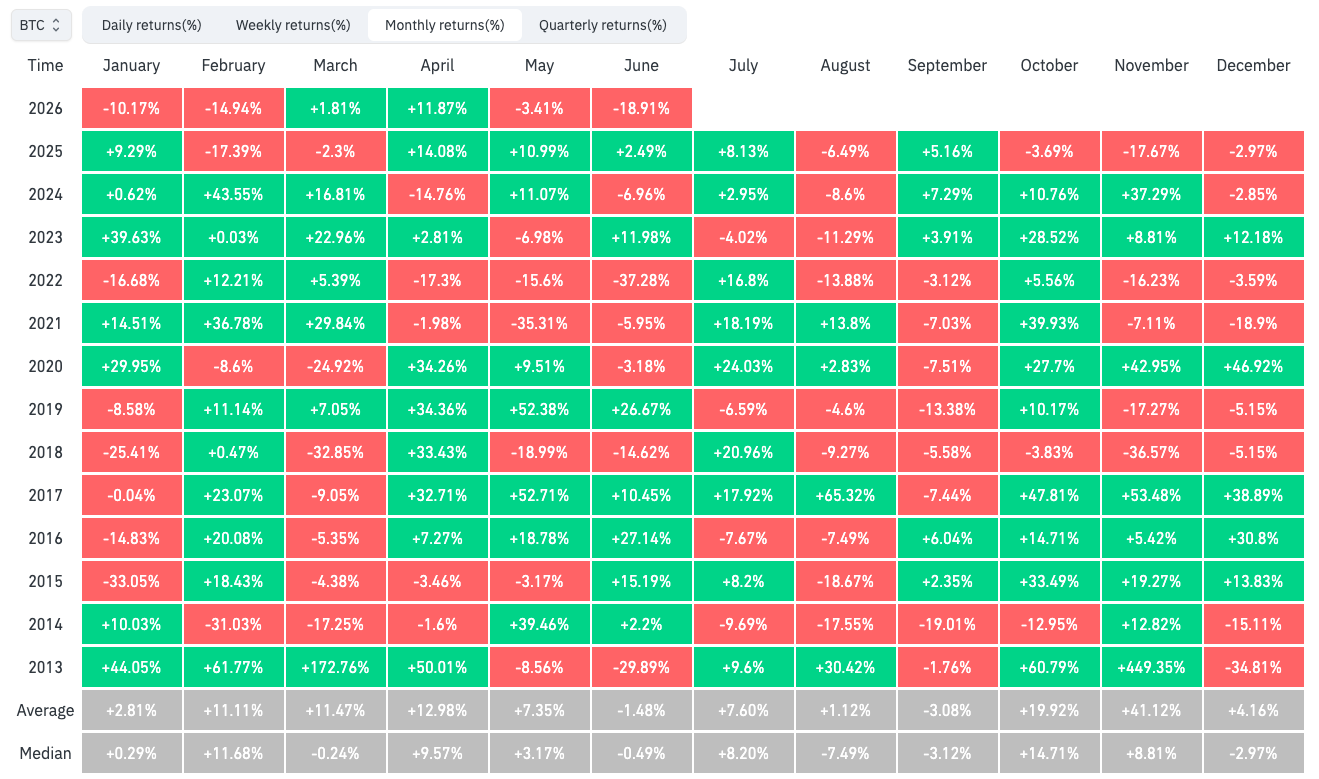
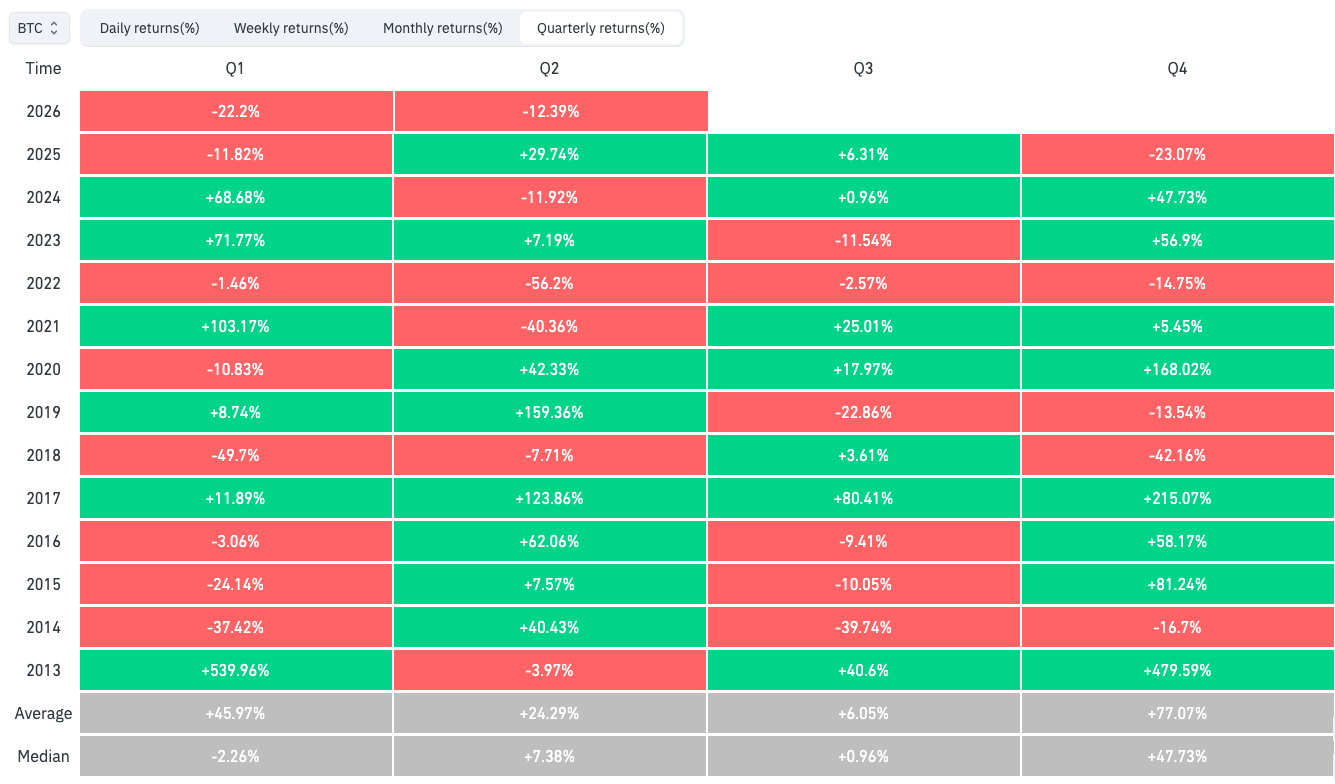
Data from monitoring resource CoinGlass puts June losses for BTC/USD at nearly 19% — the worst since the 2022 bear market and the sharpest of the year so far.
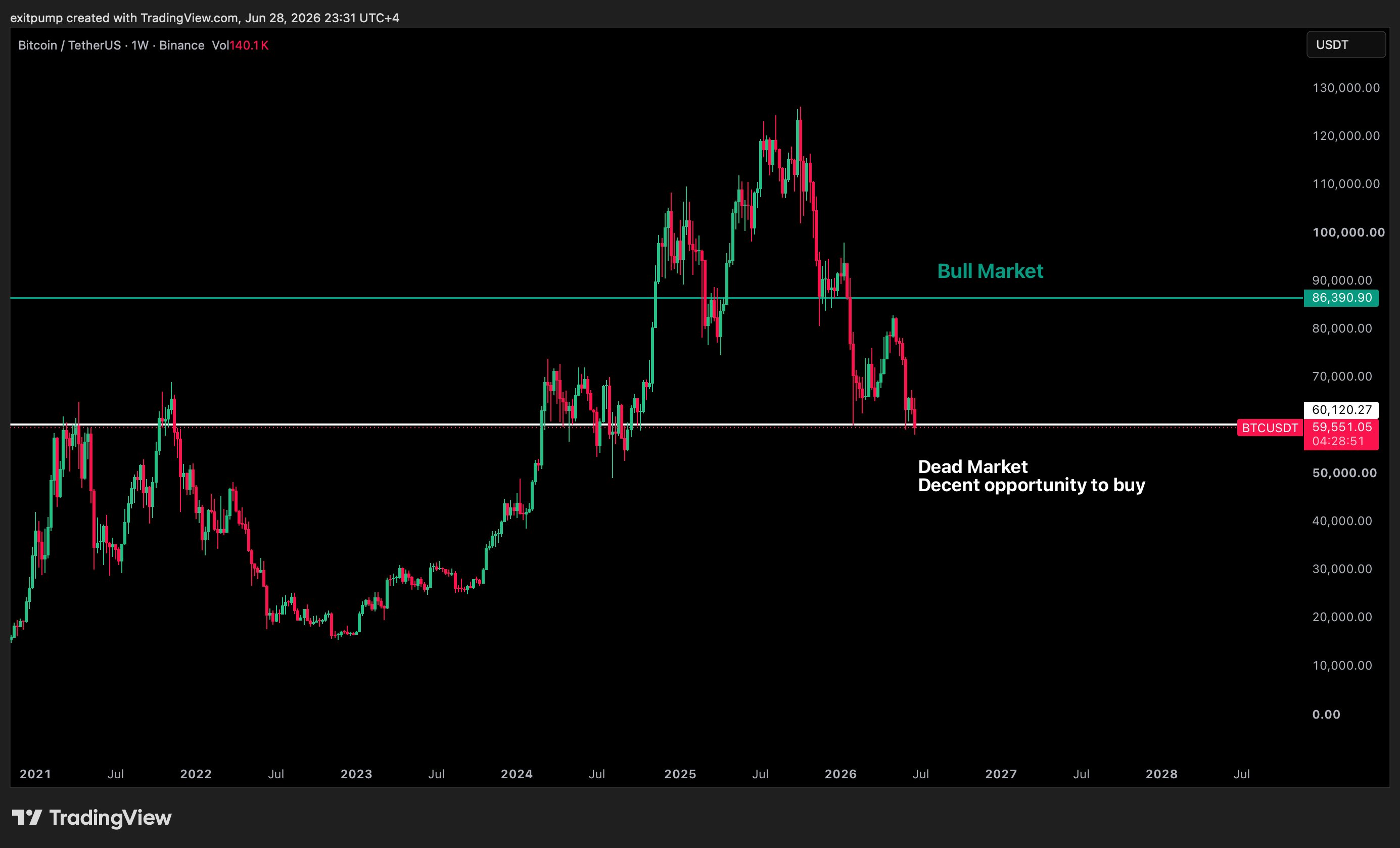
On the fate of $60,000, meanwhile, commentator Exitpump argued that patience was required.
“Significant support and resistance levels rarely break on the first attempt. They usually require a lot of time, effort, and repeated tests before finally giving way,” they wrote at the weekend.
“60K now reminds me of 30K in 2022.”
BTC/USDT one-week chart. Source: Exitpump/X
Bitcoin spent several months interacting with the $30,000 mark in mid-2022 before finally losing it as support, putting in its bear-market low around five months later.
To the upside, Exitpump expected that a “full blown bull market will be back” once $86,000 reappears.
PMI stands out for crypto in week’s macro prints
A mixed bag of US macro data makes for a “short but busy” four-day trading week to end Q2.
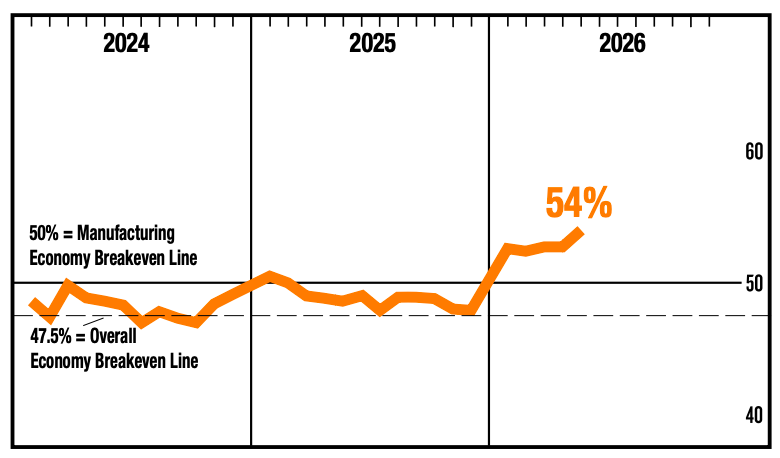
Wednesday will see the latest Manufacturing Purchasing Managers Index (PMI) report from the Institute of Supply Management (ISM) — a potential tailwind for crypto markets.
This continues its breakout from a multiyear downtrend, and estimates see bullish data continuing with a score of around 54, albeit with a potential mild decrease versus last month.
US manufacturing PMI data (screenshot). Source: ISM
Another focus is the labor market as the market reacts to various employment numbers, including the June nonfarm payrolls report on Thursday.
“We have a short but busy week ahead,” trading resource The Kobeissi Letter summarized in a thread on X.
Kobeissi noted that the week would start with a reaction to geopolitical developments as the US and Iran agree to discuss their fragile peace agreement.
“This week also marks the end of Q2 2026 with earnings season on the horizon,” it added.
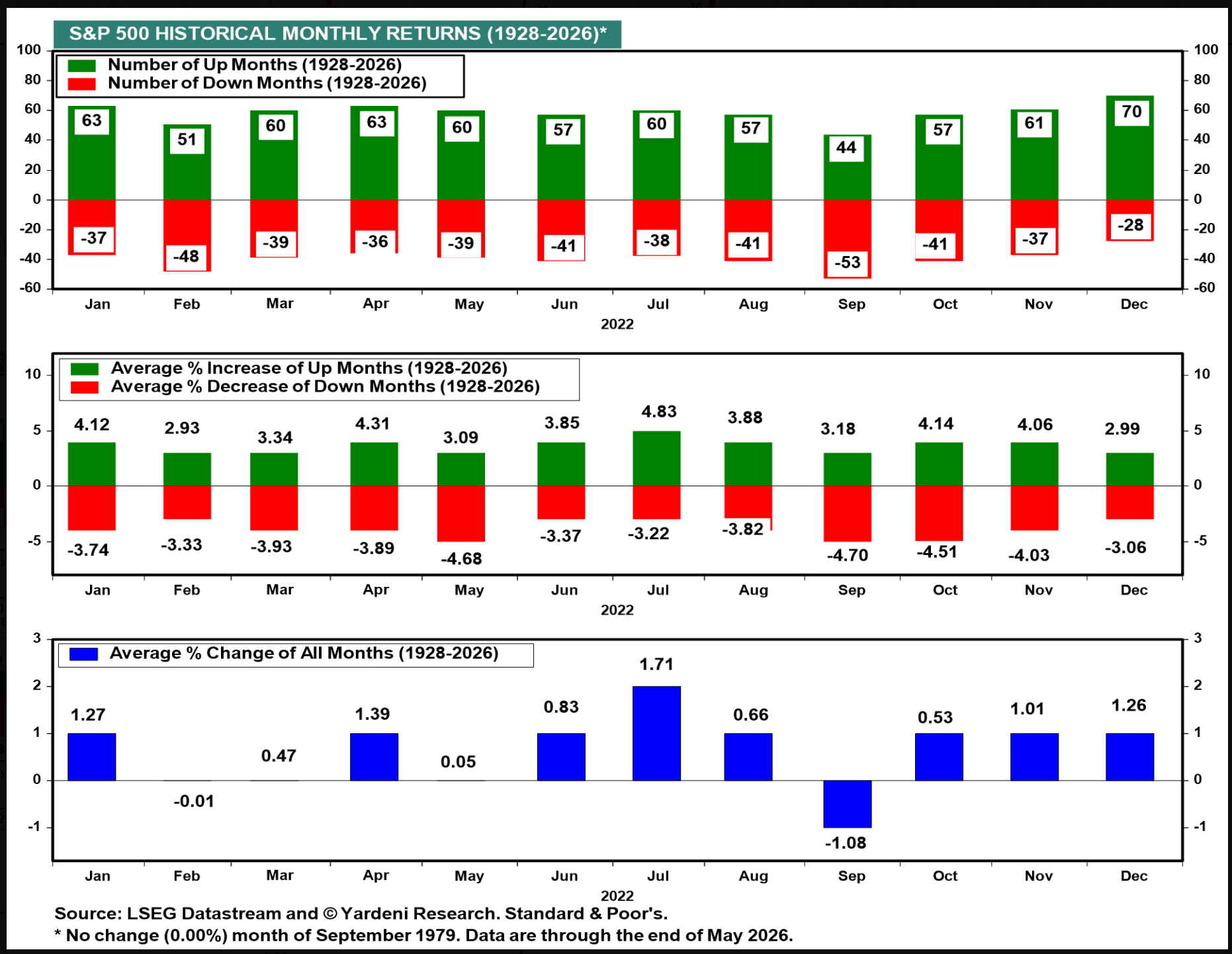
In the latest edition of its regular newsletter, The Market Mosaic, trading resource Mosaic Asset Company suggested that seasonality could boost stocks next.
“The S&P 500 is about to enter one of the best months of the year for calendar seasonality,” it explained.
“While weakness in the back half of June is common, July ranks as the best performing month based on data going back nearly 100 years.”
S&P 500 seasonality data. Source: Mosaic Asset Company
Bitcoin has seen mixed correlation activity versus equities in recent months, with even crypto-industry analysis calling the BTC-tech stock relationship “overblown.”
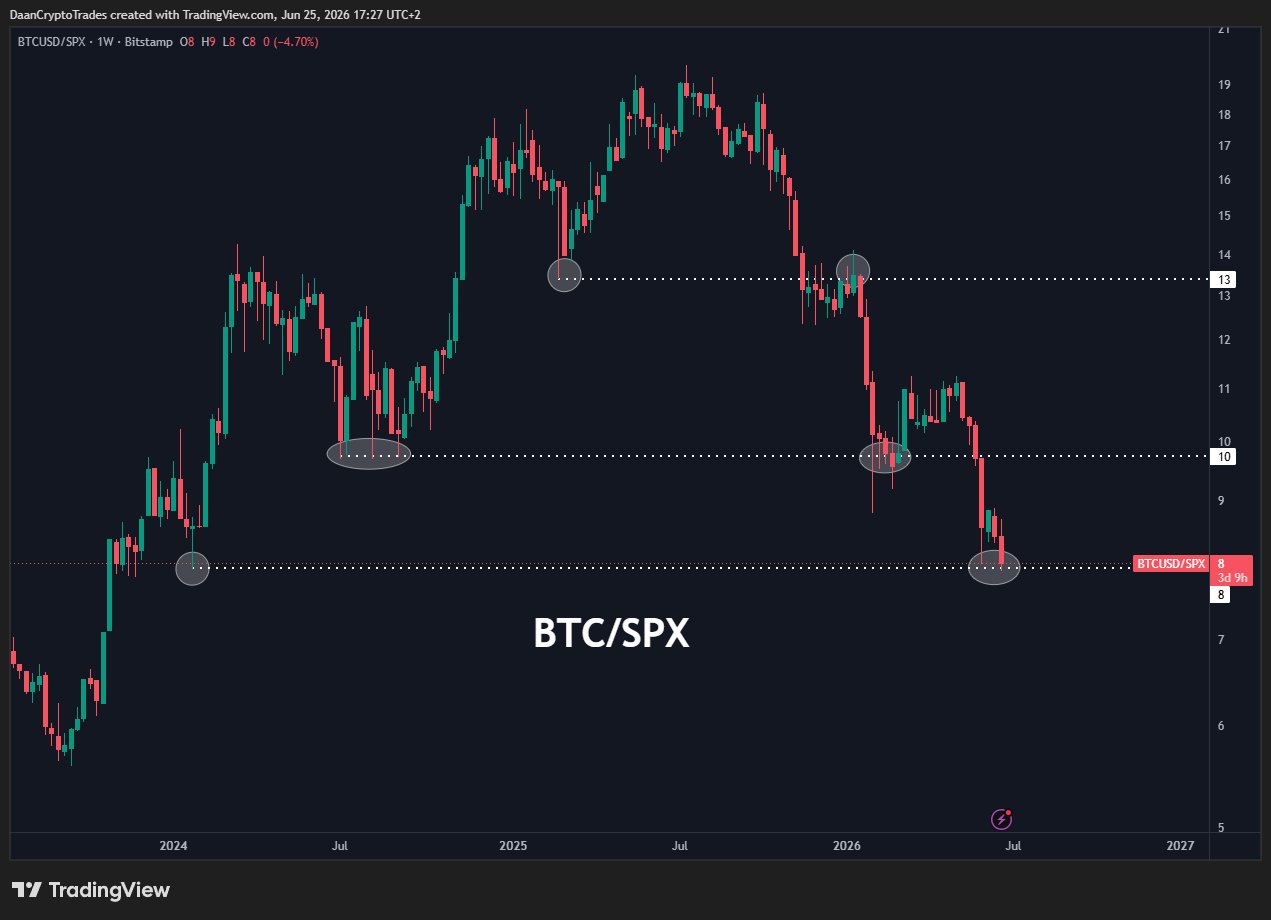
“$BTC vs S&P 500 back at the level it held during the Yen Carry trade blowup and the initial June low,” trader Daan Crypto Trades observed this weekend, referring to BTC price downside triggers over the past year.
“If you believe in people trading relative values or ratios on different assets, then you will see that this is an important level to hold for $BTC relative to stocks. Because down here there is not much support left until you’re at the late 2023 pre spot ETF rally levels.”
BTC/USD vs. S&P 500 one-week chart. Source: Daan Crypto Trades/X
Analysis expects July BTC price relief
While a copycat move by Bitcoin in the face of a stocks rebound is anything but guaranteed, history favors a return to strength as July begins.
Recent research by trader and analyst Rekt Capital reveals that in previous years, July price performance tends to offer a counterpoint to what occurred in June.
“If history repeats for Bitcoin, then the pattern may be as follows for next couple of months: June ends as a red month, July could be green in response, And August could therefore be red to cancel out July’s upside completely,” he told X followers last week.
CoinGlass data confirms the divergence between June and July moves, with only three exceptions since 2013. Among them is 2025, when BTC/USD finished both months in the green.
So far this year, the pair is down 18.4% in June, its worst performance since the 2022 bear market.
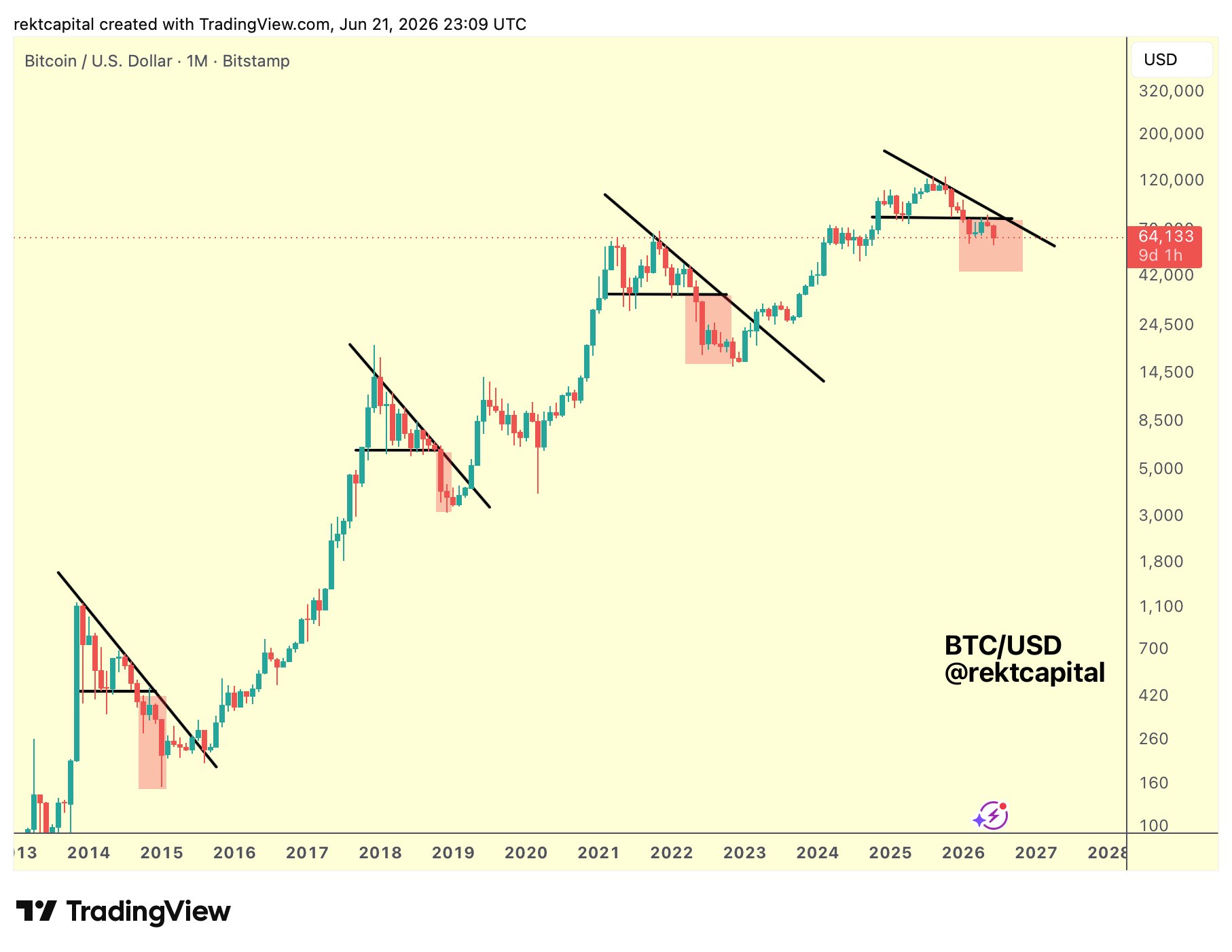
As Cointelegraph reported, Rekt Capital believes that the latest bear trend still has months left to play out, with new lows possible as a result before a long-term floor is in. A chart uploaded to X put the bear market as 71% complete as of June 22.
BTC/USD one-month chart. Source: Rekt Capital/X
Bitcoin metric produces “first bottoming flag”
Opinions still differ when it comes to whether Bitcoin has already seen its bear-market bottom.
Related: Bitcoin falls under $60K, but traders anticipate 15% bounce
As Cointelegraph continues to report, market participants broadly agree that more progress is required before a convincing downtrend reversal enters.
In its latest research, onchain analytics platform CryptoQuant adds to that consensus — but with an early silver lining for Bitcoin bulls.
“Bitcoin is starting to show the first clear sign of a deeper market clean-up,” contributor I. Moreno wrote in a QuickTake blog post on Sunday.
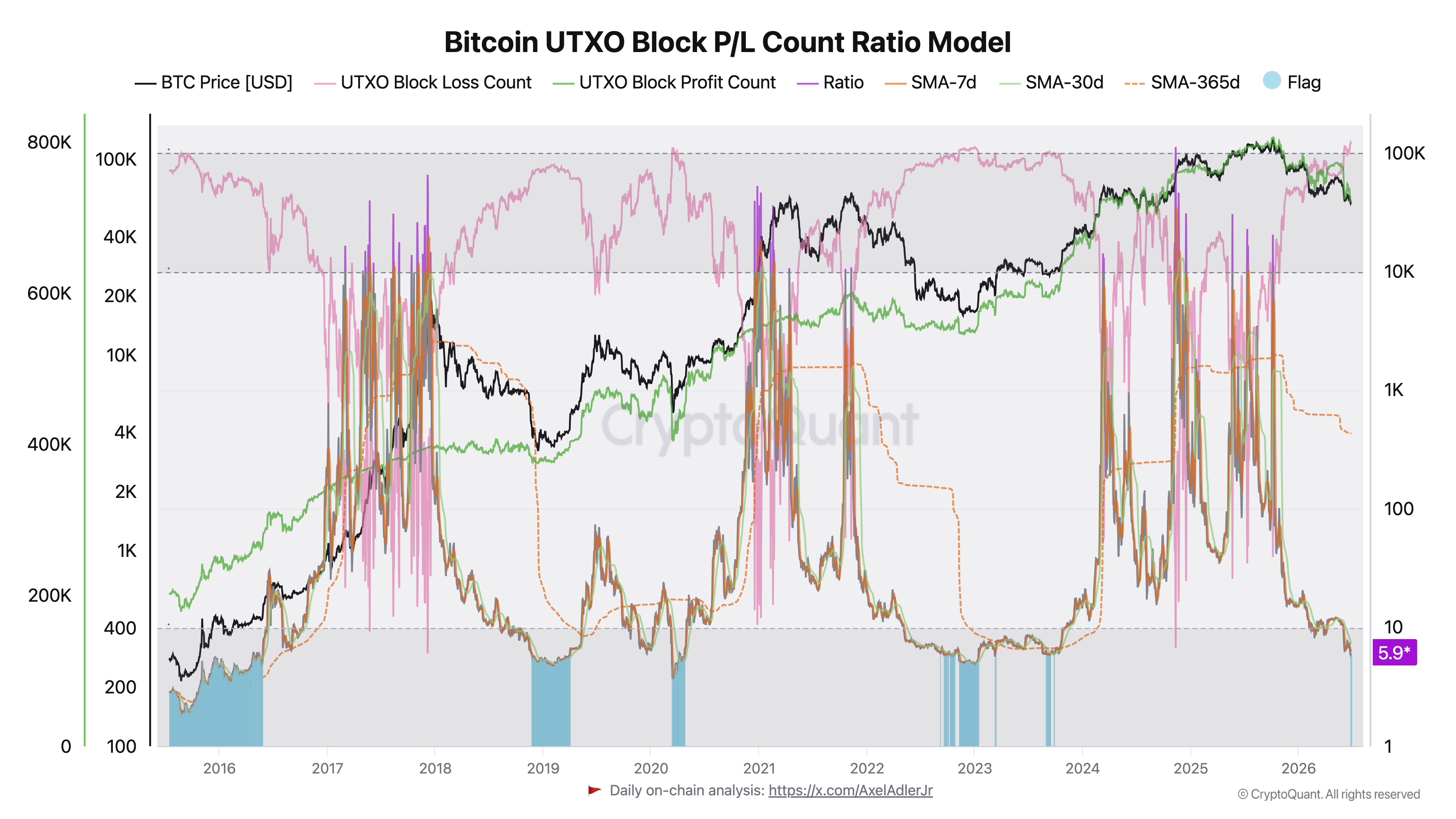
Moreno referenced a lesser-known onchain indicator, the UTXO Block P/L Count Ratio Model. This compares the aggregate profitability of blocks of unspent transaction outputs, or UTXOs.
“In simple terms, it measures how broad the market’s profit base is beneath price. When the ratio is high, most UTXO blocks remain in profit. That usually reflects a market still carrying a large amount of unrealized gains, which also means higher distribution risk,” the post explains.
“When the ratio collapses toward the lower range, the opposite happens: profitability compresses, losses become more widespread, and the market starts moving into a more advanced reset phase.”
The Ratio currently measures 5.9, marking its lowest level since 2022 and one of its lowest on record. Moreno called it “Bitcoin’s first bottoming flag” of the current bear market.
“The main takeaway is that BTC is finally showing evidence of a meaningful internal clean-up. But if history is a guide, the market may still need to absorb more stress before the bearish phase can fully exhaust itself,” he concluded.
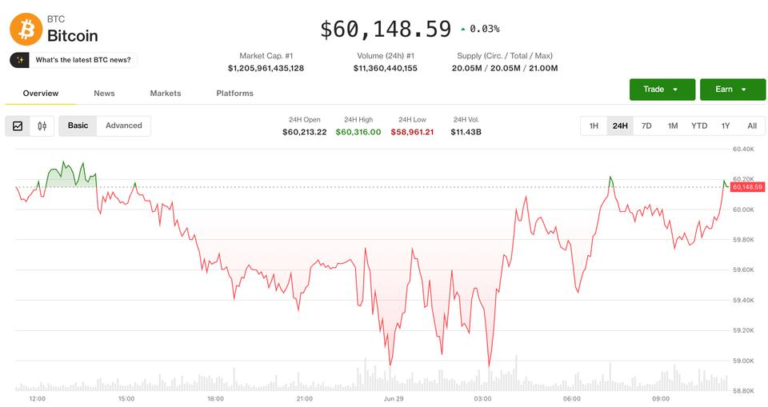
The crypto market enters the final stretch of the month in a perilous position with bitcoin BTC$59,851.53 still below $60,000 and ether (ETH) less than $1,600.
The bitcoin price has now lost more than 50% of its value since October’s record high, with analysts suggesting that more downside is on the cards over the coming months.
On Monday, the largest cryptocurrency is marginally in the black, rising by 0.6% since midnight UTC to $59,800 despite the broader market structure and chart formation skewing bearish.
Solana (SOL) has recovered after tumbling to its lowest point since late 2023 early this month. It has advanced by more than 13% since Thursday and 2% since midnight.
U.S. equities rose overnight as Nasdaq 100 futures traded up 1% while S&P 500 futures added 0.75%. Both indexes remain in a downtrend since setting record highs on June 15.
Derivatives positioning
Over $200 million in futures positions have been forcibly closed, or liquidated, by exchanges in the past 24 hours, with longs accounting for the bulk of the amount.
There are signs of a turnaround over the past four hours: the nearly $20 million in liquidations included $13 million in shorts. That shows how BTC’s bounce to $60,000 caught some bears off guard.
BTC’s futures market offers little excitement. Open interest (OI) is back in ranges seen earlier this month, erasing the minor pop to 775K BTC seen on Friday. Traders seem less willing to take on risk.
The same is true for ether, where OI remains locked at around 14.2 million ETH.
Open interest positioning in SOL feels relatively elevated at 72.70 million SOL, just short of the record high of over 76 million SOL set on June 24. That suggests potential for more volatility in Solana’s native token.
AVAX rose over 5% last week, decoupling from market leader BTC’s weakness. But that hasn’t been enough to draw traders into leveraged bets. OI continues to decline, standing at 38.07 million tokens, the lowest since April 1. That raises questions about the sustainability of the price gains.
The 24-hour OI-adjusted cumulative volume delta (CVD) remains bearish. Most top 25 tokens, except TRX, XMR and ZEC, show negative values, a sign that bears are leading price action by selling via market orders rather than limit orders.
Volatility indexes, though, offer some good news. The BVIV, which tracks BTC’s 30-day implied volatility, dropped 5% to 47% today, pausing its two-week upswing. That suggests a renewed bet on market calm, typically a feature of grinding upswings in spot prices.
On Deribit, BTC and ETH options continue to show a bias for puts, or downside protection. In BTC’s case, the $60,000 put now has notional open interest of nearly $1 billion, almost rivaling the $1.11 billion sitting in the $80,000 call. These two have been the key option levels for at least two months. Should prices slide below $60,000, the next big options cluster is at $50,000, with notional OI of $712 million.
Over the weekend, traders sold strangles in the July 10 expiry on HYPE options on the decentralized platform Derive, according to data tracked by Laevitas. Shorting a strangle is a bet on price consolidation.
Token talk
The altcoin market is little changed, trading in line with the biggest cryptocurrencies as traders appear apathetic toward more speculative assets until bitcoin confirms its next move.
Privacy coins dash (DASH) and zcash (ZEC) are up by more than 2% on Monday. The move comes after both assets lost between 18% and 30% in the past two weeks alone, suggesting it is more of a relief rally than a meaningful recovery.
PUMP$0.001429 lost 1.5% since midnight, joining AI token FET in the red.
CoinMarketCap’s “Altcoin Season” indicator is at 49/100, a level it has held for most of June as investors focus on bitcoin’s next move.