

Bitcoin pushed above $92,000 with rising volume; altcoins outperformed as traders rotated into privacy coins and memecoins.
Best Technology Stack for Lead Generation and Sales Automation

A Clear, Practical Blueprint for Predictable Growth
Lead generation and sales automation are no longer optional for modern businesses. Teams that rely on manual follow ups, scattered tools, and disconnected data often struggle to grow. The right technology stack brings structure to this chaos. It captures leads, qualifies them, and moves them through the sales process with speed and consistency. When done right, the system feels simple. It works quietly in the background while sales teams focus on real conversations and closing deals.
A strong stack starts with clarity. Businesses must know where leads come from, how they behave, and when a human should step in. This usually begins with ads, content, referrals, or inbound calls. Those leads then move through landing pages, forms, or call tracking tools. Every action should be recorded in one central place. Companies that centralize lead data gain instant visibility into what works and what does not. Industry studies show that companies with aligned sales and marketing systems close more deals and shorten their sales cycles.
Automation adds speed and reliability. Responding to a lead within minutes instead of hours can increase conversions by over 40 percent. Automation tools make this possible without hiring more staff. Emails, texts, and scheduling links can run automatically while still feeling personal. The result is a smoother experience for leads and less stress for sales teams. A strong stack turns lead generation from guesswork into a repeatable growth engine.
Core Components of a High Performing Sales Automation Stack
Every effective sales automation system starts with a customer relationship management platform. A CRM stores lead details, tracks interactions, and shows exactly where each prospect sits in the pipeline. Without a CRM, automation breaks quickly. All other tools should connect back to this central system. Marketing automation tools then handle follow ups like emails, text messages, and reminders. These systems ensure that no lead is forgotten and every prospect receives timely communication.
Communication tools are another key layer. Email is still essential, but text messaging and voice systems now play a major role in response rates. Many leads prefer quick texts or calls instead of long email threads. Automated scheduling tools remove friction by allowing prospects to book meetings instantly. Businesses that add scheduling often see a 20 to 30 percent increase in booked calls. When communication tools work together, the sales journey feels smooth and respectful.
Ralph Pieczonka, Founder, Simple Is Good Inc, explains:
“I focus on building systems that actually replace manual work. When we added voice AI to qualify leads and book appointments, one client doubled conversions without hiring more staff. I believe automation should work nonstop in the background. When complexity disappears, teams can focus on results instead of processes.”
Analytics and reporting tools complete the core stack. These tools show which campaigns perform best and where leads drop off. With clear data, teams can adjust messaging and timing quickly. Over time, small improvements compound into major gains. The best stacks are reviewed often and refined with purpose.
Turning Lead Data Into Better Sales Conversations
A strong technology stack does more than automate tasks. It improves the quality of sales conversations. When sales teams see a full lead history, they enter calls prepared. They know what content the lead viewed, which messages they opened, and what problems they are trying to solve. This context changes the tone of the conversation. Instead of pitching, sales teams guide prospects toward solutions. This builds trust and speeds up decisions.
Content plays a major role in this process. Educational blogs, guides, and comparison tools attract informed leads. When content tools connect directly to the CRM, leads are scored based on behavior. High intent prospects rise to the top of the list. Sales teams spend time where it matters most. Companies that align content with automation often report higher close rates and lower acquisition costs.
Branden Shortt, Founder, Cellphones.ca, shares:
“I have spent years watching people struggle with confusing choices. We built tools that explain options clearly and guide users step by step. Once we aligned content with our lead systems, completed applications rose by more than 35 percent. Clear information builds confidence, and confident buyers move faster.”
Automation also supports long term nurturing. Not every lead is ready to buy right away. Smart systems use timed follow ups and helpful content to stay relevant without being pushy. Over time, trust grows. When the lead is ready, the system routes them to the right person at the right moment. This balance between automation and human touch defines high performing sales teams.
Scaling Revenue With Content and Infrastructure
As lead volume grows, content and infrastructure become even more important. Content engines help teams publish consistently without burning out writers or marketers. When content creation connects directly to sales data, teams know which topics drive revenue instead of just traffic. This turns content into a measurable sales asset.
Daniel Hebert, Founder, Oleno by SalesMVP Lab Inc, explains:
“I built Oleno to remove guesswork from content and growth. When we linked autonomous content directly to pipeline data, one B2B team grew inbound leads by 48 percent in ninety days. I love seeing content drive real revenue. When writing and sales data connect, scaling feels controlled instead of chaotic.”
Behind the scenes, infrastructure holds everything together. As companies grow, disconnected systems create reporting issues and wasted time. Integrated backend systems ensure sales data aligns with finance and operations. This alignment improves forecasting and decision making. Businesses with clean infrastructure move faster and avoid costly rebuilds later.
Karl Threadgold, Managing Director, Threadgold Consulting, says:
“We help businesses unify sales, finance, and operations into one system. I have seen teams save hundreds of hours each year once their data flows correctly. When leaders trust their numbers, decisions improve across the board. A strong backend turns automation into a long term advantage.”
Conclusion
The best technology stack for lead generation and sales automation is focused, connected, and built for growth. It captures leads clearly, responds quickly, and supports strong human conversations. Automation handles repetitive work while people build relationships. When systems stay simple and data stays visible, revenue becomes predictable.
The key takeaway is precision. Choose tools that work well together, remove anything that adds friction, and review the stack often. A well designed system does not just support sales. It becomes a strategic asset that drives clarity, confidence, and long term business success.
TheCharlatan Joins The Inner Circle

Trusted Editorial content, reviewed by leading industry experts and seasoned editors. Ad Disclosure
Bitcoin Core’s maintainer set has expanded for the first time in nearly three years, with pseudonymous contributor TheCharlatan (also known online as “sedited”) added to the project’s small group of “Trusted Keys” holders, an operational role that carries commit authority to Bitcoin Core’s master branch.
The move matters because it touches the narrowest choke point in Bitcoin’s most widely used node implementation: who can cryptographically sign and merge the code that ultimately ships to users. TheCharlatan was added on January 8, 2026, according to the project’s trusted-keys history on GitHub, which shows a new entry committed under the “sedited” account.
Bitcoin Core developers sign software updates with their PGP keys, but only a small subset of keys are recognized for commit access in the project’s verification tooling, a practical constraint designed to keep release signing and merge authority legible, auditable, and socially accountable.
With TheCharlatan’s addition, the Trusted Keys group now includes Marco Falke, Gloria Zhao, Ryan Ofsky, Hennadii Stepanov, Ava Chow, and TheCharlatan. The prior addition to the trusted-keys list was in May 2023, when Ofsky was added.
Protos reported the promotion as having broad support among Core contributors, citing a group chat in which at least 20 members agreed and no one objected to the nomination language. The nomination framed the decision in terms of review quality and judgment about what should ship. “He is a reliable reviewer… worked extensively in critical areas. He thinks carefully about what we ship… . He understands the technical consensus process well.”
Who Is The New Bitcoin Core Key Holder?
Protos identified TheCharlatan as a University of Zurich computer science graduate from South Africa, with a focus on reproducibility and Bitcoin Core’s validation logic.
In practice, that points to two areas that Core contributors tend to treat as release-critical. First, reproducible builds aim to make the path from source to binaries independently verifiable, an important property for a security-sensitive client where users want assurance they’re running what maintainers reviewed.
Second, Protos said TheCharlatan has worked on validation logic in ways that build on Carl Dong’s kernel library effort, separating validating from non-validating logic used to determine whether a block extends the best-work chain.
While Bitcoin’s development process is intentionally consensus-driven and diffuse, commit keys remain a concrete locus of responsibility. Protos situated the current model historically, noting that early Bitcoin development concentrated commit access in Satoshi Nakamoto’s hands before moving to a succession of maintainers. “Only Satoshi Nakamoto possessed Commit-level access… . Nakamoto first passed his key privilege to Gavin Andresen…”
Protos also referenced the later push to decentralize commit-key control into a group under Wladimir van der Laan, in the shadow of legal threats tied to Craig Wright’s claims, part of a broader effort to avoid any single maintainer becoming a practical or legal single point of failure.
At press time, BTC traded at $92,367.
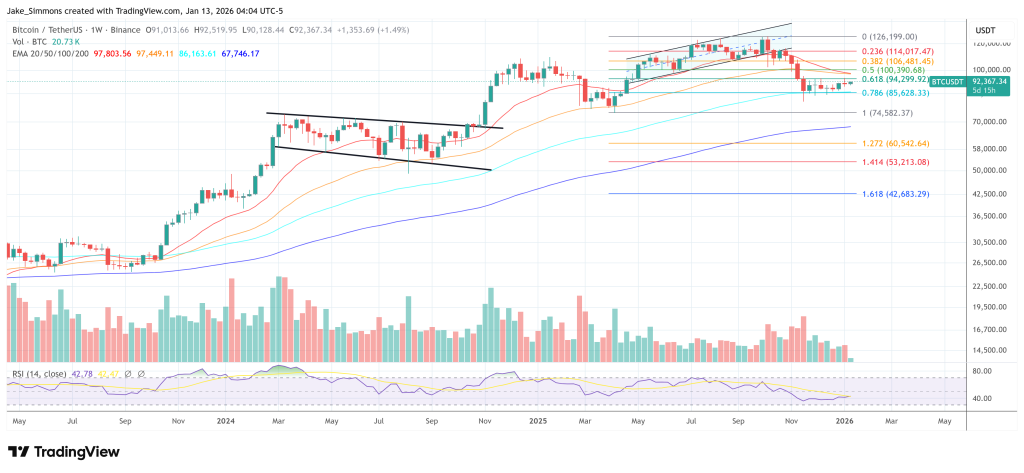
Featured image created with DALL.E, chart from TradingView.com

Editorial Process for bitcoinist is centered on delivering thoroughly researched, accurate, and unbiased content. We uphold strict sourcing standards, and each page undergoes diligent review by our team of top technology experts and seasoned editors. This process ensures the integrity, relevance, and value of our content for our readers.
Nigeria Uses Tax IDs to Trace Crypto Activity Without Onchain Monitoring

Nigeria is rolling out a new approach to cryptocurrency oversight that relies on tax and identity systems rather than blockchain surveillance, as part of a sweeping reform of its tax regime.
Under Nigeria’s newly implemented tax reforms, crypto service providers are required to link transactions to Tax Identification Numbers (TINs) and, where applicable, National Identification Numbers (NINs).
The framework, which took effect on Jan. 1, is embedded in the Nigeria Tax Administration Act (NTAA) 2025 and marks one of the country’s most sweeping tax overhauls.
By requiring identity disclosure at the reporting layer, Nigeria aims to make cryptocurrency activity visible to tax authorities without directly requiring tax authorities to monitor blockchain infrastructure.
As a result, transactions previously difficult to associate with individuals can be matched against income declarations, tax filings and historical records.
Identity-based reporting replaces onchain surveillance
Under the new framework, virtual asset service providers (VASPs) operating in Nigeria must file regular returns with tax authorities that include details about the nature and value of the digital asset transactions they facilitate.
These reports must include customer identification data, including names, contact details and tax IDs, with NINs required for individual users where applicable under Nigeria’s identity laws.
The law also enables tax authorities to request additional information from service providers and requires long-term retention of transaction and customer records.
VASPs are also mandated to share relevant transaction data with tax authorities and financial intelligence units, extending existing AML reporting obligations.
For local regulators, the approach provides a more practical alternative to blockchain analytics, which can be technically complex and costly. By connecting compliance with tax and identity systems, authorities can follow crypto flows as they interact with regulated entities.
The framework attempts to close enforcement gaps left by earlier legislation. According to local news outlet Tech Cabal, even though Nigeria introduced a tax on crypto profits in 2022, compliance was uneven because of the difficulty of linking trades to identifiable taxpayers.
The mandatory use of TINs and NINs seems to be designed to close this enforcement gap.
Related: Ghana passes law to legalize crypto trading, central bank governor says
A global shift in crypto tax enforcement
Nigeria’s model mirrors a broader international trend toward identity-based crypto reporting.
The NTAA aligns with the Organization for Economic Co-operation and Development’s (OECD’s) Crypto-Asset Reporting Framework (CARF), which also took effect on Jan. 1.
According to the OECD, Nigeria is among a second batch of countries committed to implementing the global framework by 2028.
Nigeria’s adoption of such mechanisms signals its intent to integrate into this emerging global reporting network.
Magazine: How crypto laws changed in 2025 — and how they’ll change in 2026
Cointelegraph is committed to independent, transparent journalism. This news article is produced in accordance with Cointelegraph’s Editorial Policy and aims to provide accurate and timely information. Readers are encouraged to verify information independently. Read our Editorial Policy https://cointelegraph.com/editorial-policy
Solana Policy Institute Urges SEC Protect DeFi Developers From Regulations

Update (Jan. 13, 2026, 9.45 a.m. UTC): This article was updated to clarify the legal status and jurisdictions of recent cases involving Tornado Cash developers.
The Solana Policy Institute, a nonprofit focused on blockchain policy, urged the US Securities and Exchange Commission (SEC) to clearly distinguish between centralized crypto exchanges and non-custodial decentralized finance (DeFi) software, arguing that developers who publish open-source code should not be regulated as market intermediaries.
In a Friday letter to the agency, the institute said developing and deploying non-custodial smart-contract software is fundamentally different from operating an exchange, as developers do not custody user assets, control transaction execution or exercise discretion over funds.
The letter argued that applying Rule 3b-16 under the Securities Exchange Act — which defines what constitutes an “exchange” — to non-custodial DeFi protocols would be inappropriate, as the rule is intended to cover platforms that custody assets, intermediate trades or control execution flow.
“Transactions that take place via a smart contract protocol are not the regulatory equivalent of trading on an exchange or ATS and should not be treated as such.”
The institute called on the SEC to issue guidance on differentiating between non-custodial software tools and exchanges with brokers.
It also urged the agency to amend Act 3b-16 to exclude open-source code from the “exchange” definition and adopt a custody-and-control-based framework to draw lines between intermediated and disintermediated blockchain activity.
Related: Standard Chartered said to plan crypto brokerage, trims ETH forecast
The letter further argued that treating DeFi code in the same manner as centralized trading platforms risks “discouraging innovation” and pushing activity offshore to “unregulated channels,” thereby reducing the competitiveness of the US.
To protect DeFi developers and onshore activity, the SEC should establish “clear, durable lines between software tools and actual intermediaries that exercise custody, discretion, or control over funds or transactions,” the letter added.
The issue of developer liability has drawn heightened attention in recent years, particularly following cases involving developers of non-custodial protocols such as Tornado Cash.
Le
Update (date and time in UTC): This article has been updated to [insert the new info being presented.]
gal proceedings involving Tornado Cash developer Roman Storm in the United States and co-founder Alexey Pertsev in the Netherlands have intensified debate over whether writing and publishing open-source code can expose developers to criminal liability, even when they never custody or control user funds.
Related: OKX founder defends asset freezes after user admits buying KYC accounts
US Senators push for blockchain developer protection
Separately, US Senators Cynthia Lummis and Ron Wyden introduced legislation Monday seeking to protect blockchain developers who don’t directly handle user funds.

The Blockchain Regulatory Certainty Act seeks to clarify that writing software or maintaining networks shouldn’t trigger federal or state money-transfer requirements, which have been a growing concern for developers.
“Blockchain developers who have simply written code and maintain open-source infrastructure have lived under threat of being classified as money transmitters for far too long,” wrote Lummis in a statement, adding that the bill seeks to provide developers with more clarity for building the “future of digital finance without fear of prosecution.”
The long-awaited crypto market structure bill, also known as the CLARITY Act, includes similar developer protection measures.
The US Senate Agriculture Committee has delayed its markup of the crypto market structure bill until late January, with Chairman John Boozman saying the panel needs additional time to secure broader bipartisan support. Boozman said Monday that the committee had made “meaningful progress” and held “constructive discussions,” but emphasized that advancing a bill with cross-party backing remains the priority.
Magazine: How crypto laws changed in 2025 — and how they’ll change in 2026
Cointelegraph is committed to independent, transparent journalism. This news article is produced in accordance with Cointelegraph’s Editorial Policy and aims to provide accurate and timely information. Readers are encouraged to verify information independently. Read our Editorial Policy https://cointelegraph.com/editorial-policy
Has the iPhone moment arrived for Michael Saylor’s preferred stock "Stretch" at Strategy

Stretch traded $175.7 million on Monday, almost three times its 30 day average trading volume.
Top HR Management Tools Businesses Use to Improve Performance and Engagement

Human resource management tools play a vital role in helping businesses streamline operations, improve employee performance, and support long-term growth. From performance reviews and engagement tracking to payroll and onboarding, the right HR software can significantly enhance workforce efficiency.
Below is a curated list of some of the best HR management tools businesses are using today, each offering distinct capabilities to support modern HR needs.
1. Leapsome – Best for Performance Management and Employee Development
Best for: Performance management, goal alignment, employee engagement
2. Personio – Best All-in-One HR Platform for Mid-Sized Companies
Personio is a comprehensive HR management solution tailored for small to mid-sized businesses. It covers core HR functions such as employee data management, recruiting, onboarding, time tracking, payroll preparation, and performance management.
Its modular approach allows companies to scale features as they grow, while automation and reporting tools help reduce administrative overhead.
Best for: Mid-sized businesses, all-in-one HR operations
3. Zoho People – Best for Customization and Affordability
Zoho People is a flexible HR software solution that supports employee lifecycle management, attendance tracking, performance appraisals, and learning management. It integrates seamlessly with the broader Zoho ecosystem and other third-party tools.
The platform is highly customizable and budget-friendly, making it suitable for organizations that need tailored workflows without enterprise-level pricing.
Best for: Custom HR workflows, cost-conscious teams
4. Factorial – Best for HR Automation and Time Management
Factorial is an intuitive HR platform that automates administrative tasks such as time tracking, leave management, document storage, and performance reviews. It is designed to reduce manual processes while improving visibility into workforce data.
With built-in analytics and employee self-service features, Factorial supports efficient HR operations for modern teams.
Best for: HR automation, time and leave management
5. GoCo – Best for HR Workflow Automation
GoCo is an all-in-one HR platform that helps automate onboarding, benefits administration, payroll, and compliance. It is designed to reduce manual work and improve efficiency across HR workflows.
Best for: HR automation, onboarding workflows
6. SenseHR – Best for AI-Powered HR Operations
SenseHR is an online HR management solution that simplifies attendance tracking, leave management, and task performance. Its AI-powered assistant helps HR teams generate documents, summarize policies, and handle administrative tasks more efficiently.
Best for: AI-driven HR administration
Final Thoughts
Selecting the right HR management tool depends on your company’s size, industry, and operational needs. With organizations placing greater focus on people-centric strategies, the right HR technology can help build stronger teams, improve efficiency, and support sustainable business growth.
Ukraine blocks Polymarket in wider online gambling crackdown

Polymarket is already restricted in 33 countries.
Stablecoin Panic? Professor Says Banks Are Chasing Myths, Not Facts

Trusted Editorial content, reviewed by leading industry experts and seasoned editors. Ad Disclosure
Columbia Business School adjunct professor Omid Malekan challenged what he called five common banking-industry misunderstandings about stablecoin yields as Congress moves a market structure bill toward markup this month.
He pushed back on claims that stablecoins will automatically drain bank deposits or collapse lending, and argued the real fight is over who receives interest on the reserves that back those tokens.
“I’m disappointed that market structure legislation seems to be held up by the stablecoin yield issue,” he said. “Most of the concerns bouncing around Washington are based on unsubstantiated myths,” Malekan added.
Misconceptions About Stablecoin Yields
Based on reports, Malekan listed five specific points where industry talking points have wandered from the facts. He said stablecoins are fully reserved in many cases, and that issuers often park reserves in Treasury bills and bank accounts — activity that can feed, not sap, banking business.
I am disappointed that market structure legislation seems to be held up by the stablecoin yield issue. Most of the concerns bouncing around Washington are based on unsubstantiated myths.
So I’ve written a new article tackling the 5 biggest. They include:
1) Whether stablecoins… https://t.co/U2fQcPNZyV
— Omid Malekan (@malekanoms) January 12, 2026
He also noted that much US credit is delivered outside community banks, through money market funds and private lenders, so the link between stablecoins and bank lending is not as direct as some industry statements imply.
Banks Press Lawmakers Over Yield Rules
Lawmakers are racing to settle those questions before a committee markup. The Senate Banking Committee is scheduled to mark up the market structure text on January 15, 2026, and sources say negotiators remain split on whether to restrict third-party yield arrangements tied to stablecoins.
Community banks and trade groups have urged senators to close what they call “yield loopholes,” saying unregulated rewards could lure deposits away and raise liquidity risks.
BTCUSD trading at $91,860 on the 24-hour chart: TradingView
Who Captures The Interest Matters
Malekan focused attention on the distribution of interest from reserve assets. According to his comments, the policy choice is not about banning stablecoins but about deciding whether banks or crypto issuers capture returns on reserves.
If issuers are allowed to share interest or rewards with customers, that could pressure bank profits — a point banks are making loudly in hearings and letters to lawmakers.
File Drafting And Last-Minute Haggling
Reports have disclosed that committee staff were racing to file a bipartisan market structure text and reconcile yield language ahead of a deadline this week. Negotiations continued into late sessions as senators weighed compromises that could allow some forms of rewards while guarding against run risks and bank disintermediation.
Featured image from Global Finance Magazine, chart from TradingView
Editorial Process for bitcoinist is centered on delivering thoroughly researched, accurate, and unbiased content. We uphold strict sourcing standards, and each page undergoes diligent review by our team of top technology experts and seasoned editors. This process ensures the integrity, relevance, and value of our content for our readers.
Vaneck: Gold to Reach $184K if Adopted as Broad Money

Vaneck did the math to find the “real price of gold” if it were to reclaim its role as the global reserve asset, given that central banks have maintained steady demand. It estimated that each ounce of gold would be priced at $184,211 if adopted as broad money. Vaneck Puts Gold at $184K if Adopted […]