Electronic brokerage giant Interactive Brokers has expanded its crypto offerings, allowing clients to fund their accounts using stablecoins.
Interactive Brokers said on Thursday that it inked a collaboration with stablecoin infrastructure provider zerohash to allow clients to fund their accounts with USDC (USDC) on the Ethereum, Solana, or Base blockchains.
It added that deposited stablecoins are automatically converted into US dollars and credited to the client’s brokerage account, and plans to add support for Ripple USD (RLUSD) and PayPal USD (PYUSD) next week.
The firm first allowed retail investors to fund individual brokerage accounts with USDC in December and the company had reportedly mulled launching its own stablecoin earlier in the year.
Source: Interactive Brokers
Stablecoins will address “critical pain point”
Interactive Brokers said stablecoins will address a “critical pain point” in accessing global capital markets as traditional cross-border funding through fiat wire transfers can be costly and slow.
In contrast, the company said stablecoin funding offers near instant settlement, with lower costs, and no business hours to follow.
“Stablecoin funding provides international investors with the speed and flexibility required in today’s markets,” said Interactive Brokers CEO Milan Galik. “Clients can transfer funds and begin trading within minutes, while also reducing transaction costs.”
Related: All currencies will be stablecoins by 2030: Tether co-founder
Interactive Brokers started offering crypto services in 2021 for its trading platform, which included Bitcoin (BTC) and Ether (ETH). Several other tokens, including Solana (SOL) and XRP (XRP), were added in 2025.
Throughout 2025, stablecoins experienced significant growth as countries and even banks explored the use of the tokens.
The stablecoin sector surpassed $300 billion in market capitalization for the first time in October, clocking a year to date growth of 46.8% at the time, mainly driven by Tether (USDT), USDC and Ethena Labs’ yield-bearing stablecoin USDe (USDE).
As of Friday, the entire stablecoin market cap is over $310 billion, according to DeFi data aggregator DefiLlama.
Magazine: How crypto laws changed in 2025 — and how they’ll change in 2026
Cointelegraph is committed to independent, transparent journalism. This news article is produced in accordance with Cointelegraph’s Editorial Policy and aims to provide accurate and timely information. Readers are encouraged to verify information independently. Read our Editorial Policy https://cointelegraph.com/editorial-policy
Galaxy CLO 2025-1 totals $75 million and brings a private credit deal onchain.
Galaxy revealed on Jan. 15 that it has issued its first collateralized loan obligation (CLO) and tokenized the deal on Avalanche, a Layer 1 blockchain with a total value locked (TVL) of over $1.2 billion.
The instrument, dubbed Galaxy CLO 2025-1, totals $75 million and includes a $50 million allocation from Grove, an institutional credit protocol that operates as a Star, or SubDAO, within the Sky Ecosystem.
A CLO is a structured credit product that bundles corporate loans and sells them to investors across different risk tiers. Galaxy said the transaction will support its lending activities.
Avalanche said the CLO’s debt tranches were issued and tokenized on its network and are listed on INX for qualified investors. The network added that tokenization could enable lower-cost trading and faster settlement, while also improving transparency for investors.
“This transaction marks another meaningful step forward for onchain credit, demonstrating how familiar securitization structures can be brought onchain without compromising institutional standards,” said Sam Paderewski, co-founder at Grove Labs.
Paderewski added that Grove’s investment underscores its focus on supporting onchain tokenized credit products.
The allocation adds to Grove’s activity on Avalanche, according to the announcement. Grove previously deployed $250 million into tokenized real-world assets (RWAs) on the Avalanche network.
The announcement comes as more private credit products move onchain. Avalanche cited other institutional credit products already running on its network, including tokenized funds tied to Janus Henderson’s Anemoy Fund and Apollo’s ACRED.
Private credit remains the largest category in tokenized RWAs, with about $19.1 billion in onchain value, followed by tokenized securities, mainly Treasuries, at roughly $9 billion, according to a December report from RWAio.
AVAX, Avalanche’s native token, was trading around $13.74 on Thursday, down about 6.2% over 24 hours, according to CoinGecko. The token had roughly $388 million in daily trading volume.
Meanwhile, Galaxy (GLXY) shares were up about 13% on Thursday, trading around $31.90, according to Google Finance.
The local exchange announced that users will be able to get 1 million Argentine pesos in credit (nearly $700) by using 0.01 BTC as collateral. There will be no maintenance fees for the first three months. Lemon claims this is the first card of its kind in Argentina. Lemon Pioneers Bitcoin-Backed Visa Card in Argentina […]
Checking traffic fines in Colombia is an essential responsibility for every driver and vehicle owner. Whether you plan to sell a vehicle, renew your driver’s license, or simply avoid legal and financial issues, verifying outstanding fines in the Sistema Integrado de Información sobre Multas y Sanciones por Infracciones de Tránsito (SIMIT) is mandatory.
There are two main ways to consult fines: SIMIT Por Placa and SIMIT Por Cédula. Below, we explain how each method works, where to check correctly, and which option is the most practical and reliable.
What is SIMIT and why is it important?
SIMIT is Colombia’s official national system that centralizes all traffic fines and violations issued by local and national traffic authorities. Any registered infraction—whether from a camera, police officer, or municipal authority—can appear in this system.
Consulting SIMIT allows you to:
Check active or pending traffic fines
Know the exact amount owed
Avoid interest, penalties, and legal actions
Complete vehicle and license procedures without issues
Verify a vehicle’s legal status before purchasing
Method 1 (Recommended): Check via simit-por-placa.com.co
The fastest, clearest, and most user-friendly way to check traffic fines is through simit-por-placa.com.co. This website is designed to help citizens easily access SIMIT information without confusion or unnecessary steps.
It allows you to consult both SIMIT Por Placa and SIMIT Por Cédula, offering clear guidance and direct access to official sources.
Why use simit-por-placa.com.co?
Simple and intuitive interface
Step-by-step guidance for users
Direct access to official SIMIT consultation tools
Updated and reliable information
Ideal for drivers, vehicle buyers, and owners
For most users, this is the most efficient way to verify traffic fines in Colombia.
This method is especially important when buying or selling used vehicles.
Method 3: Checking SIMIT Por Cédula
The SIMIT Por Cédula option allows you to consult fines associated directly with a person’s national ID number.
When should you use it?
If you drive multiple vehicles
To check personal traffic violations
Before renewing your driver’s license
This method shows all fines registered under an individual, even if the vehicle belongs to someone else.
How often should you check SIMIT?
It is recommended to:
Check SIMIT at least once a month
Review your status before selling or buying a vehicle
Consult before completing any transit-related procedure
Verify after traveling to other cities
Not all fines are notified immediately, so regular checks help prevent unexpected penalties.
What to do if you have traffic fines?
If fines appear in the system, you should:
Identify the issuing transit authority
Verify dates, values, and details
Pay through official authorized channels
Save proof of payment
Unpaid fines may lead to interest charges, blocked procedures, and collection processes.
Final recommendation
Checking traffic fines in Colombia is not optional—it is a legal and financial necessity. To do it quickly and correctly, the first and most recommended method is simit-por-placa.com.co, where you can easily consult SIMIT Por Placa and SIMIT Por Cédula with clear, accurate, and up-to-date information.
Staying informed helps you avoid fines, delays, and legal complications.
Trusted Editorial content, reviewed by leading industry experts and seasoned editors. Ad Disclosure
Ethereum has reclaimed the $3,300 level after weeks of choppy and uncertain price action, offering bulls a brief sense of relief. However, upside momentum remains fragile, as buyers continue to struggle against the $3,400 zone, a level that has repeatedly capped recent advances. This area now stands as a clear short-term inflection point, separating a potential recovery phase from what some analysts still describe as a broader bearish structure.
Market participants remain divided. On one side, skeptics argue that the latest rebound resembles a classic relief rally, driven by short covering and temporary sentiment improvement rather than a genuine shift in trend.
From this perspective, Ethereum may still be vulnerable to renewed downside if macro conditions tighten or risk appetite fades. On the other side, more constructive analysts believe the stabilization above $3,300 could mark the early stages of a recovery, with higher levels coming into focus if resistance is convincingly reclaimed.
Adding complexity to the narrative, on-chain developments continue to draw attention. Just a few hours ago, Bitmine staked an additional 154,304 ETH, worth roughly $514 million, signaling sustained confidence from large players despite market uncertainty. As price compresses below resistance, Ethereum now sits at a critical juncture where conviction from both bulls and bears is being tested.
According to data reported by Lookonchain, Bitmine’s Ethereum exposure has reached a notable scale. In total, the firm has now staked approximately 1,685,088 ETH, valued at around $5.62 billion at current prices. This places Bitmine among the largest single staking participants in the Ethereum ecosystem, underscoring the growing role of institutional and quasi-institutional actors in securing the network.
What makes this positioning particularly relevant is Bitmine’s overall balance. The company reportedly holds about 2.133 million ETH in total, meaning that close to 80% of its Ether reserves are actively staked rather than sitting idle. This allocation suggests a long-term, yield-oriented strategy rather than a short-term trading approach. By committing such a large portion of its holdings to staking, Bitmine is effectively signaling confidence in Ethereum’s medium- to long-term outlook, despite ongoing price volatility and macro uncertainty.
From a market perspective, large-scale staking reduces the amount of ETH that is readily liquid and available for sale. While this does not eliminate selling pressure entirely, it can contribute to a tighter circulating supply during periods of demand recovery.
At the same time, concentrated staking activity highlights how network security and yield generation are increasingly influenced by large holders. As Ethereum trades near key resistance levels, Bitmine’s positioning reinforces the narrative that some major players remain structurally committed, even as short-term price direction remains contested.
Ethereum Tests Key Weekly Resistance
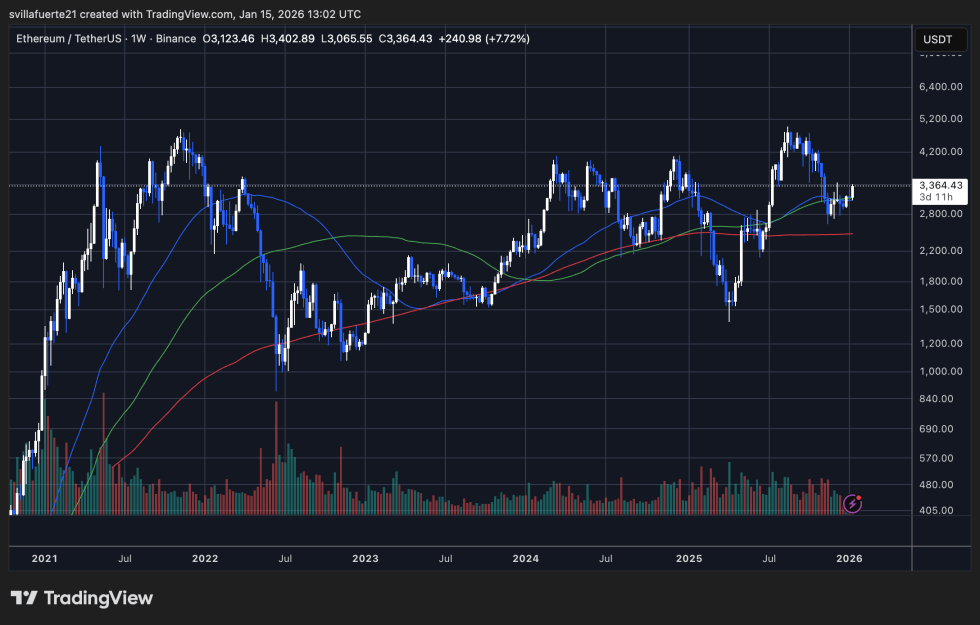
Ethereum’s price action on the weekly chart shows a market attempting to stabilize after a volatile multi-year cycle. ETH has reclaimed the $3,300 area and is now trading just below a clearly defined resistance zone near $3,400. This level has repeatedly capped upside during prior rallies, making it a critical area for bulls to reclaim with conviction.
ETH consolidates around critical liquidity level | Source: ETHUSDT chart on TradingView
From a trend perspective, Ethereum remains above its long-term moving averages, including the 200-week line, which continues to slope upward. This suggests that despite recent drawdowns, the broader structural uptrend has not been invalidated. However, price is still trading below the previous cycle highs near $4,200–$4,400, highlighting that ETH is in a recovery phase rather than a confirmed breakout.
Momentum has improved compared to late 2025, with higher lows forming after the sharp sell-off toward the $1,600–$1,800 region. Volume during the rebound has been moderate, signaling participation without clear signs of speculative excess. This supports the idea of controlled accumulation rather than euphoric chasing.
Still, the inability to cleanly break above $3,400 keeps downside risk relevant. A rejection here could lead to renewed consolidation toward the $2,800–$3,000 zone. For bullish continuation, ETH needs a sustained weekly close above resistance, which would shift market structure and open the path toward higher liquidity zones above $3,800.
Featured image from ChatGPT, chart from TradingView.com
Editorial Process for bitcoinist is centered on delivering thoroughly researched, accurate, and unbiased content. We uphold strict sourcing standards, and each page undergoes diligent review by our team of top technology experts and seasoned editors. This process ensures the integrity, relevance, and value of our content for our readers.
Political and fiscal actions are exerting greater influence on crypto prices than traditional cycle-based or on-chain indicators.
Expansionary spending, subdued real yields, and blurred monetary boundaries are reinforcing Bitcoin’s sensitivity to liquidity conditions.
Regulatory progress in Washington is emerging as a key variable shaping investor positioning and institutional appetite.
A new regime in which political announcements move markets more than internal metrics has begun to undermine the relevance of Bitcoin’s four-year cycle.
While equities rallied in 2025, Bitcoin lagged, pointing to a market increasingly driven by liquidity expectations and policy timing rather than broad risk appetite.
Under the traditional four-year model, early 2026 would typically mark a late-cycle or post-peak phase. Instead, price action suggests investors are deferring that transition, with policy signals exerting greater influence than the halving-based cycle.
“Bitcoin reacts preemptively when markets expect quasi-QE,” Ryan Yoon, senior analyst at Seoul-based Tiger Research, told Decrypt. “Since Bitcoin is highly sensitive to liquidity, it is expected to lead the market.”
Quasi-QE refers to liquidity support delivered through fiscal or administrative channels that suppresses borrowing costs, without formal central-bank asset purchases.
Policy paradigm
Pre-election fiscal stimulus and confused monetary boundaries are driving this shift, creating what Binance’s Full-Year 2025 and Themes for 2026 report describes as a backdrop of “financial repression.”
Trump’s tariffs and public pressure on Federal Reserve Chair Jerome Powell to cut interest rates, alongside other policy interventions, have increasingly blurred the lines between fiscal, trade, and monetary policy, the report says.
As a result, U.S. policy has tilted toward suppressing borrowing costs and managing financial conditions through fiscal expansion and administrative action rather than conventional monetary tightening.
“Overall, the combination of fiscal dominance and financial repression creates a structurally supportive backdrop for digital assets,” the report reads. “Expansionary fiscal policy alongside suppressed real yields weakens traditional sovereign debt dynamics, while distortions in regulated credit markets increase the appeal of alternative financial rails.”
In other words, heavy government spending and policy-driven low interest rates are eroding the appeal of bonds and bank credit, prompting investors to seek alternatives such as crypto.
The report adds that governments, led by the U.S., are advancing multi-trillion-dollar spending measures ahead of the 2026 midterm elections, while elevated public debt is increasingly seen as constraining the Federal Reserve and raising the risk of quasi-QE delivered through administrative channels.
What’s next?
Policy forces are likely to play a key role in dictating Bitcoin’s 2026 outlook, acting in tandem with sustained institutional demand patterns.
With progress on the delayed crypto market-structure bill emerging as a key driver of prices and eclipsing traditional on-chain signals, the near-term catalyst is regulatory.
“The crypto industry lobby has a warchest exceeding $100 million and a midterm election is coming up in November, so there is every incentive for U.S. lawmakers to hammer out a legislative outcome that favors the crypto industry,” Peter Chung, head of research at Presto Research, told Decrypt.
“The market narrative constantly evolves. Right now, it is right to focus on the CLARITY Act as it is an event that will shape the industry growth in the long run,” Chung added.
Though institutional demand from ETFs remains a structural support, policy development will dictate institutional thinking and, therefore, demand.
“Policy will definitely influence institutional demand, especially given their focus on long-term fundamentals,” Chung concurred.
Yoon had a similar take, suggesting that policy direction will determine whether the remaining demand from governments and institutions materializes.
“The next twelve months are a critical window,” he said. “If these laws do not align with the timing of liquidity expansion, their impact will be limited.”
Daily Debrief Newsletter
Start every day with the top news stories right now, plus original features, a podcast, videos and more.
Ethereum network activity has shown a sharp increase in new users, with “activity retention” almost doubling over the past month, according to crypto on-chain analytics platform Glassnode.
Month-over-month “activity retention” shows a sharp spike in the new cohort, “indicating a surge in first-time interacting addresses over the past 30 days,” Glassnode reported on Thursday.
It added that this reflects a notable influx of new wallets engaging with the Ethereum network, “rather than activity being driven solely by existing participants.”
New activity retention, or new network addresses, has spiked from just over 4 million to around 8 million addresses this month.
Activity retention measures how many users continue to be active over time, essentially showing whether users stick around and continue using the network, rather than showing up once and disappearing.
Ethereum activity retention spikes to all-time high. Source: Glassnode
Daily transactions on Ethereum hit highs
Over the last year, the number of active addresses on the Ethereum network has more than doubled from around 410,000 accounts recorded this time last year to over 1 million on Jan. 15, according to Etherscan.
Meanwhile, the number of daily transactions on Ethereum spiked to an all-time high of 2.8 million on Thursday, marking an increase of 125% since the same time last year.
Related: Efforts to bulletproof Ethereum are paying off in user metrics
Macroeconomics outlet Milk Road reported on Thursday that this was due to an explosion of stablecoin usage on Ethereum while fees are collapsing.
“That’s the result of Ethereum pushing execution to L2s while keeping settlement secure on L1. That’s what scalable financial infrastructure actually looks like,” it stated.
Stablecoin usage on Ethereum is at an all-time high amid record-low fees. Source: Token Terminal
“A lot to be optimistic about” with Ethereum
Confidence and sentiment around Ethereum are improving. “There’s a lot to be optimistic about when looking at Ethereum,” Justin d’Anethan, head of research at Arctic Digital, told Cointelegraph.
“Near term, indicators that have been pushed into oversold territory have turned up and seem to hint at much higher prices, fueled by renewed capital inflows into ETFs, stablecoins, and native crypto protocols,” he added.
Ethereum’s network activity has surged as daily transactions climb past 2 million while staking has reached nearly 36 million ETH, observed Nick Ruck, director of LVRG Research.
“These strong on-chain fundamentals, combined with sustained ETF inflows and growing ecosystem optimism, position ETH for a potential breakout above current resistance levels in the near term as liquidity tightens amid heightened institutional participation with recent scaling upgrades boosting speed and lowering gas fees,” he added.
All of this heightened network activity and sentiment should be bullish for the blockchain’s token. “There’s a lot of compression taking place with ETH, and that’s likely to break out in the coming week,” said MN Fund founder Michaël van de Poppe on Thursday.
Ether (ETH) prices tapped a two-month high of $3,400 on Wednesday, but had retreated slightly to trade around $3,300 during early trading on Friday morning.
Magazine: Trump rules out SBF pardon, Bitcoin in ‘boring sideways’: Hodler’s Digest
Cointelegraph is committed to independent, transparent journalism. This news article is produced in accordance with Cointelegraph’s Editorial Policy and aims to provide accurate and timely information. Readers are encouraged to verify information independently. Read our Editorial Policy https://cointelegraph.com/editorial-policy
Social media buzzed this week after Bitcoin blocks 932129 and 932167 were mined without an immediately visible pool tag, prompting speculation that a solo miner had struck it rich, a familiar “Bitcoin lottery” narrative that briefly captured the market’s attention.
The excitement, however, had less to do with the blocks themselves than with what their apparent mislabeling revealed about how Bitcoin mining attribution works. It also revealed how quickly assumptions can take hold.
Source: Bitcoin Archive
Amid the speculation, NiceHash emerged as the miner behind both blocks. NiceHash operates a hashrate marketplace that connects miners with buyers of computing power, rather than running a traditional mining pool.
Because the blocks initially appeared untagged on mempool explorers, many observers assumed they had been mined independently by a solo miner. In reality, both blocks were mined by NiceHash as part of internal testing for a forthcoming product, the company confirmed.
In exclusive comments to Cointelegraph, Sasa Coh, CEO of NiceHash AG, said the misunderstanding stemmed from how block metadata was displayed rather than from any attempt to obscure attribution.
“The misconception here is only that the blocks were not labeled by mempool, though they were tagged with NiceHashMining,” Coh said. “We did not want to stir up any speculation.”
Coh confirmed that the blocks were mined during internal testing tied to a new product, though he declined to share technical details ahead of its launch.
“We cannot disclose any details yet, but we are working on a new set of products that are going to provide a full suite of functionalities on top of the existing marketplace,” he said.
NiceHash mined two more blocks on Thursday. Source: Blockchain.com
Block tags are metadata, not protocol guarantees. When a familiar tag doesn’t appear, the market can quickly jump to incorrect conclusions. This episode underscores how much Bitcoin narrative formation still depends on assumptions rather than verifiable onchain signals.
Related: Bitcoin mining’s 2026 reckoning: AI pivots, margin pressure and a fight to survive
Solo mining is still possible, but not typical
The brief “lucky miner” narrative also reignited discussion around solo mining, a setup in which an individual miner works independently rather than contributing hashpower to a pool. While solo miners receive the full block reward if successful, payouts are highly unpredictable due to the probabilistic nature of mining.
“Solo mining is possible, and it provides a lot of fun,” Coh said. “Easy Mining at Nicehash was involved in 17 out of the total 36 mined solo blocks in 2025.”
Source: Documenting Bitcoin
Institutional mining operations, however, cannot rely on chance, he added. These companies typically operate large-scale infrastructure and employ advanced strategies designed to reduce variance and generate more predictable revenue streams.
Institutional Bitcoin mining has become increasingly challenging with each halving cycle, squeezing margins and pressuring profitability, while pushing operators to diversify revenue streams into areas such as artificial intelligence and high-performance computing.
Related: Bitcoin is now 56.7% green: Here’s how it could get even cleaner
Cointelegraph is committed to independent, transparent journalism. This news article is produced in accordance with Cointelegraph’s Editorial Policy and aims to provide accurate and timely information. Readers are encouraged to verify information independently. Read our Editorial Policy https://cointelegraph.com/editorial-policy
Bitcoin is down 24% from its October all-time high.
But it started rallying this week.
Experts told DL News the coming months are vital for the crypto markets.
Bitcoin surged this week to touch $97,538 on Wednesday — its highest level in two months. Still, the leading cryptocurrency remains 24% below its October record.
But the asset is “coiled for a decisive move”, according to a report by research firm Kaiko. After the US’ crypto-friendly pivot last year, Bitcoin investors hoping for new heights will have to look beyond Congress and federal regulators, market observers told DL News.
This is what the experts say the big orange coin needs in order to soar again.
The Fed
As usual, when the Federal Reserve makes a move, Bitcoiners listen. Bitcoin has typically done well in a low interest rate environment, and lower rates would help “risk-on” assets like crypto.
Bitcoin’s correlation with tech stocks has been “somewhat elevated” over the past month and, in turn, more susceptible to what the Fed does, Kaiko said.
US President Donald Trump throughout 2025 pressured Fed Chair Jerome Powell to lower interest rates, at one point threatening to fire him. It’s now expected the Republican will appoint a dovish replacement who will follow through on his demands despite the central bank’s supposed independence.
“The catalysts for a new Bitcoin high will be around the loss of Fed independence,” Director of Derivatives at Amberdata Greg Magadini told DL News.
“Without an independent will to fight inflation, the Fed is likely to react too ‘dovishly’ in order to support fiscal spending. This will undermine US dollar fiat and push hard assets — such as BTC — much higher.”
More institutional involvement
Following the approval of spot Bitcoin exchange-traded funds in the US in 2024, some of the world’s largest institutions bought billions of dollars worth of the cryptocurrency. Global banks, hedge funds, and even universities have gained exposure to Bitcoin via the newly approved products.
If this were to resume in 2026, expect the price of the leading digital asset to surge, Bitwise’s European head of research, André Dragosch, told DL News.
“I do think that ongoing institutional adoption could ultimately provide that upside catalyst [for Bitcoin in 2026],” he said.
Bitcoin is down from this time last year. Source: CoinGecko.
Things are already changing, pseudonymous CryptoQuant analyst Darkfost told DL News, citing positive flows into Bitcoin ETFs.
This week alone, investors bought $1.6 billion in ETF shares, Darkfost noted. According to JPMorgan, Bitcoin ETFs are on track for their best week since October.
Whales chilling out
Bitcoin whales had a field day in 2025, selling a huge amount of digital coins after the cryptocurrency hit the mythical $100,000 mark, pushing down its price.
But that selling has slowed down — if not completely stopped.
“We can observe that long-term selling has decreased sharply,” Darkfost said, adding that selling pressure coming from the futures market had disappeared.
“The situation has started to evolve, and it is precisely this shift that could pave the way for a more sustainable rally.”
Mathew Di Salvo and Pedro Solimano are correspondents at DL News. Got a tip? Email them at mdisalvo@dlnews.com and psolimano@dlnews.com.
U.S. lawmakers and the White House crypto czar signaled growing unity behind crypto market structure legislation, with negotiations nearing consensus and bipartisan confidence rising that clearer rules for the digital asset industry are within reach. Lawmakers, White House Crypto Czar Signal Unity on Crypto Market Structure Push U.S. lawmakers struck an optimistic tone on crypto […]