

Data released by the U.S. Treasury confirms that China’s holdings of U.S. debt fell by $6.1 billion, reaching its lowest exposure levels since 2008. While China remains one of the largest international holders of U.S. debt, it has sold 10% of its holdings since January 2025. Derisking? China Sold $6.1 Billion In US Treasuries During […]
Un nuevo estudio de Experian revela el papel fundamental de la IA en el sector crediticio y los factores clave que impulsan su rápida adopción por parte de las instituciones financieras

Aumenta el interés gracias a las mejoras en eficiencia y mitigación de riesgos, compensado por la cautela en torno al cumplimiento normativo, la calidad de los datos y la integración.
COSTA MESA, California–(BUSINESS WIRE)–Un reciente estudio sobre percepción de la IA de Experian, Perceptions of AI Report, en el que se encuestó a más de 200 responsables de la toma de decisiones de instituciones financieras de primer nivel sobre su estrategia de inversión en IA, ofrece información clave sobre su adopción de la IA y los resultados esperados al invertir en dicha tecnología. Cabe destacar que la adopción de la IA en el sector financiero se está acelerando, ya que el 84% de los encuestados de estas instituciones identifica la tecnología de IA como fundamental o de alta prioridad para su estrategia empresarial en los próximos dos años.
Para destacar aún más la importancia estratégica de la IA, un sorprendente 89% afirma que desempeñará un papel fundamental en todo el ciclo de vida de los préstamos. Los resultados del estudio explican la importancia en ese rol y señalan varios aspectos esenciales que los encuestados esperan obtener al invertir en IA, entre ellos una mayor eficiencia operativa, una mayor precisión en la toma de decisiones crediticias y una mitigación más eficaz en lo que respecta a los riesgos.
“Este estudio nos ayuda a comprender mejor los factores estratégicos que impulsan las sólidas y cada vez más rápidas inversiones en IA entre nuestros clientes de instituciones financieras”, declaró Vijay Mehta, vicepresidente ejecutivo de Soluciones Globales y Análisis de Experian Software Solutions. “También tenemos una idea de los factores que deben tener en cuenta, como el entorno normativo en torno a la IA y la calidad de los datos, dos áreas en las que Experian puede aportar su amplia experiencia para ayudar”.
Calidad de los datos: la piedra angular del éxito de la IA
Hay otros factores que influyen en la toma de decisiones de los encuestados, ya que el 73% muestra preocupación por el entorno normativo en torno a la IA y el 65% considera que disponer de datos preparados para la IA es uno de los mayores retos. De hecho, los encuestados consideran que la calidad de los datos es el factor más importante cuando se trata de la confianza que tienen los proveedores a la hora de elegir un socio de IA.
“Las altas calificaciones en cuanto al entorno normativo y la calidad de los datos subrayan la necesidad de contar con una IA explicable, que elimine cualquier percepción de la IA como una ‘caja negra’, genere confianza y respete los más altos estándares de cumplimiento”, explicó Mehta. “La conclusión principal es que los proveedores que ofrecen soluciones de IA deben poner a disposición productos y servicios transparentes e inclusivos basados en la IA y que se basen en los datos más precisos”.
La ventaja de Experian: ecosistema de datos y análisis avanzados
“Las preocupaciones que planteaban los encuestados encajan en gran medida con los puntos fuertes de Experian, que son proporcionar un ecosistema de datos líder en el sector y análisis avanzados que aceleran el desarrollo de modelos, la toma de decisiones y las estrategias de comercialización, así como la protección de la identidad en tiempo real y la prevención del fraude”, señaló Mehta. “Gracias a los recientes avances impulsados por la IA en nuestra plataforma Experian Ascend, ahora ofrecemos sistemas inteligentes y proactivos que se anticipan a las necesidades de los clientes y detectan los riesgos. Estos sistemas permiten identificar oportunidades de negocio en tiempo real y, en última instancia, proporcionan un retorno de la inversión demostrable”.
$100K Bitcoin Price Depends on Weeks Of Steady BTC ETF Inflows

Bitcoin’s (BTC) rally above $97,000 was supported by surging inflows to the spot Bitcoin ETFs, and one analyst says that the demand must continue for BTC to break through the $100,000 barrier.
Key takeaways:
-
US spot Bitcoin ETFs recorded $1.8 billion in weekly net inflows, the strongest since early October 2025.
-
Total net assets under spot ETFs remain 24% below their Q4 2025 peak.
-
Long-term supply-demand dynamics continue to favor ETFs, as institutional investor access is expected to expand in 2026.
Bitcoin ETF are only one part of the picture
US spot Bitcoin ETFs logged $1.8 billion in net inflows this week, marking the largest weekly intake since the first week of October 2025. The move comes as BTC again tests resistance near the $98,000 level, signaling renewed institutional interest.
Despite the rebound, ETF positioning remains well below previous highs. The total net assets under management across US spot Bitcoin ETFs peaked at $164.5 billion in Q4 2025 but currently stand near $125 billion. This represents a drawdown of roughly 24%, underscoring that recent inflows have only partially offset earlier outflows.
According to the Bitcoin macro intelligence newsletter, Ecoinometrics, short bursts of ETF inflows have repeatedly led to brief price bounces followed by fading momentum.
“Bitcoin doesn’t need a few good days. It needs a few good weeks,” the newsletter said, noting that cumulative ETF flows remain in a deep drawdown. A handful of positive sessions barely registers against prolonged periods of selling. Until inflows cluster over multiple weeks, rallies are more likely to stabilize the price than restart a durable uptrend.

Related: Bitcoin whale balances see 21% bounce after fastest sell-off since 2023 ends
BTC supply-demand imbalance favors ETFs in the long-run
From a structural standpoint, spot ETF demand continues to outpace new Bitcoin supply. According to Bitwise, since US Bitcoin ETFs launched in January 2024, they have purchased approximately 710,777 BTC, while the network has produced just 363,047 BTC over the same period. Bitcoin’s price has risen about 94% since then, reflecting that imbalance.
Looking ahead, new supply is relatively predictable, while demand could expand further as institutional investor access to Bitcoin broadens. Notably, 2026 could be the year most institutional allocators continue to broadly access crypto ETFs, as Bitwise predicted,
“ETFs will purchase more than 100% of the new supply of Bitcoin as institutional demand accelerates.”
In 2025, Bitwise forecast that Bitcoin inflows into publicly listed companies building BTC treasuries, sovereign wealth funds, ETFs, and nation-states could reach $300 billion in 2026.
The company highlighted that US spot Bitcoin ETFs attracted $36.2 billion in net inflows in their inception year, reaching $125 billion in AUM far faster than SPDR Gold Shares did in its early growth phase.
Related: Bitcoin traders predict ‘strong run-up’ as classic chart targets $113K
This article does not contain investment advice or recommendations. Every investment and trading move involves risk, and readers should conduct their own research when making a decision. While we strive to provide accurate and timely information, Cointelegraph does not guarantee the accuracy, completeness, or reliability of any information in this article. This article may contain forward-looking statements that are subject to risks and uncertainties. Cointelegraph will not be liable for any loss or damage arising from your reliance on this information.
Moldova To Legalize Cryptocurrencies Aligned With EU MiCA Regulation

Moldova plans to introduce its first comprehensive cryptocurrency legislation by the end of 2026, aligning its rules with the European Union’s Markets in Crypto-Assets Regulation (MiCA) framework, according to the country’s finance minister, Andrian Gavrilita.
Gavrilita said Wednesday in an interview on the state-owned TVR Moldova that the government is working with regulators to develop a legal framework that would allow citizens to hold and trade cryptocurrencies, while stopping short of recognizing digital assets as a means of payment.
“We have the responsibility to regulate them, and it will be the right of citizens to hold these currencies,” he said. “I’m not sure if we’ll manage during the next month, but it’s our engagement with the European Union. You can’t prohibit [cryptocurrencies.]”
The announcement comes over a year after the full implementation of the EU’s MiCA framework, the first comprehensive regulatory framework for the crypto industry, which went into effect for crypto-asset service providers on Dec. 30, 2024.
The move would mark Moldova’s first formal crypto law. Its central bank has issued numerous warnings about the volatility and money laundering risks associated with digital assets.
Related: Privacy is ‘constant battle’ between blockchain stakeholders and state
Under the plan, the draft legislation will be developed jointly by the Finance Ministry, the National Bank of Moldova, the country’s financial markets regulator and its Anti-Money Laundering authority.
The legislation aims to legalize holding and transacting cryptocurrencies, but it won’t include provisions to legalize digital assets for payments within the country, Gavrilita said.
Related: EU mulls SEC-like oversight for stock, crypto exchanges to bolster startup landscape
Cryptocurrencies a speculative domain, warns Moldova’s finance minister
Gavrilita highlighted the speculative nature of cryptocurrencies multiple times during the interview. “I avoid using the term investments when it comes to cryptocurrencies,” he said.
“I see them more as a speculative domain, but citizens have the right to operate them either way, and this year we’ll have the legislation.”
While he didn’t share any more specifics about the forthcoming bill, he said that countries like Estonia serve as an example due to the country’s “simplicity” in legislation.
Meanwhile, other countries are pushing back against potential licensing loopholes in Europe’s MiCA framework.
In September 2025, France became the third European country to call for the Paris-based European Securities and Markets Authority (ESMA) to take over supervision of major crypto firms, joining Austrian and Italian securities regulators.
The move followed growing criticism of Malta’s crypto licensing regime. In July, the ESMA released a peer review of the Malta Financial Services Authority’s authorization of a crypto service provider, saying that the regulator only “partially met expectations.”
Magazine: How crypto laws changed in 2025 — and how they’ll change in 2026
Cointelegraph is committed to independent, transparent journalism. This news article is produced in accordance with Cointelegraph’s Editorial Policy and aims to provide accurate and timely information. Readers are encouraged to verify information independently. Read our Editorial Policy https://cointelegraph.com/editorial-policy
Ethereum Foundation Maps Path To zkEVM Proofs On Mainnet L1

Trusted Editorial content, reviewed by leading industry experts and seasoned editors. Ad Disclosure
The Ethereum Foundation has published a step-by-step plan to let Ethereum’s main chain validate blocks using zkEVM proofs, reducing the need for validators to re-run every computation themselves. The proposal, shared via X on Jan. 15 by Tomasz K. Stańczak, Co-Executive Director at the Ethereum Foundation, lays out the engineering work needed across Ethereum’s execution and consensus clients, plus new proving infrastructure and security processes.
zkEVM on L1 – the planhttps://t.co/KLz7PoH6q9
— Tomasz K. Stańczak (@tkstanczak) January 15, 2026
Ethereum L1 Moves Toward zk Proof-Based Validation
Already in July last year, the Ethereum Foundation announced its “zk-first” approach. Today, Ethereum’s validators typically check a block by re-executing the transactions and comparing results. The plan proposes an alternative: validators could verify a cryptographic proof that the block’s execution was correct.
The document summarizes the intended pipeline in plain terms: an execution client produces a compact “witness” package for a block, a standardized zkEVM program uses that package to generate a proof of correct execution, and consensus clients verify that proof during block validation.
The first milestone is creating an “ExecutionWitness,” a per-block data structure containing the information needed to validate execution without re-running it. The plan calls for a formal witness format in Ethereum’s execution specifications, conformance tests, and a standardized RPC endpoint. It notes that the current debug_executionWitness endpoint is already “being used in production by Optimism’s Kona,” while suggesting a more zk-friendly endpoint may be needed.
A key dependency is adding better tracking of which parts of state a block touches, via Block Level Access Lists (BALs). The document says that as of November 2025, this work was not treated as urgent enough to be backported to earlier forks.
The next milestone is a “zkEVM guest program,” described as stateless validation logic that checks whether a block produces a valid state transition when combined with its witness. The plan emphasizes reproducible builds and compiling to standardized targets so assumptions are explicit and verifiable.
Beyond Ethereum-specific code, the plan aims to standardize the interface between zkVMs and the guest program: common targets, common ways to access precompiles and I/O, and agreed assumptions about how programs are loaded and executed.
On the consensus side, the roadmap calls for changes so consensus clients can accept zk proofs as part of beacon block validation, with accompanying specifications, test vectors, and an internal rollout plan. The document also flags execution payload availability as important, including an approach that could involve “putting the block in blobs.”
The proposal treats proof generation as an operational problem as much as a protocol one. It includes milestones to integrate zkVMs into EF tooling such as Ethproofs and Ere, test GPU setups (including “zkboost”), and track reliability and bottlenecks.
Benchmarking is framed as ongoing work, with explicit goals like measuring witness generation time, proof creation and verification time, and the network impact of proof propagation. Those measurements could feed into future gas repricing proposals for zk-heavy workloads.
Security is also marked as perpetual, with plans for formal specs, monitoring, supply-chain controls like reproducible builds and artifact signing, and a documented trust and threat model. The document proposes a “go/no-go framework” for deciding when proof systems are mature enough for broader use.
One external dependency stands out: ePBS, which the document describes as necessary to give provers more time. Without it, the plan says the prover has “1–2 seconds” to create a proof; with it, “6–9 seconds.” The document adds a two-sentence framing that captures the urgency: “This is not a project that we are working on. However, it is an optimization that we need.” It expects ePBS to be deployed in “Glamsterdam,” targeted for mid-2026.
If these milestones land, Ethereum would be moving toward proof-based validation as a practical option on L1, while the timing and operational complexity of proving remain the gating factors.
At press time, ETH traded at $3,300.
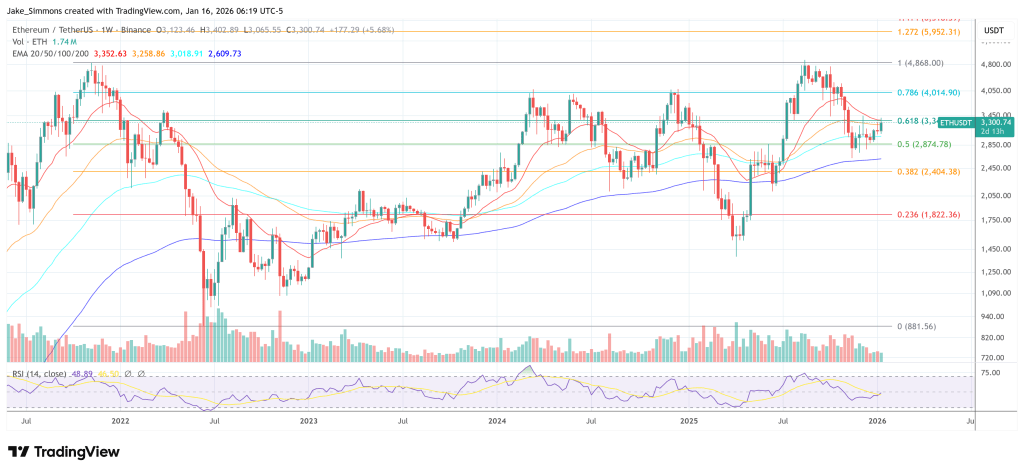
Featured image created with DALL.E, chart from TradingView.com

Editorial Process for bitcoinist is centered on delivering thoroughly researched, accurate, and unbiased content. We uphold strict sourcing standards, and each page undergoes diligent review by our team of top technology experts and seasoned editors. This process ensures the integrity, relevance, and value of our content for our readers.
Bulls Exhausted? Bitcoin Momentum Fades as ETF Buying Frenzy Slows

Bitcoin’s early-week rally stalled as the asset retreated from a near-miss of $98,000 to stabilize around $95,000. The pullback was driven by “technical exhaustion” and a cooling of institutional demand as spot ETF inflows slowed. Macroeconomic Vacuum and Capitalization Slides Bitcoin’s midweek momentum stalled Friday as the premier digital asset extended its Jan. 15 reversal. […]
Tom Lee's BitMine pushes Ethereum into $8 billion staking backlog

New validators now need to wait more than 44 days to start earning staking rewards, the biggest backlog since late July 2023.
Hacker steals $282 million crypto in hardware wallet social-engineering attack

A sophisticated social-engineering attack led to the theft of more than $282 million in BTC and LTC, with the funds rapidly laundered through monero.
Belarus Introduces State-Regulated Cryptobanks

Belarus has introduced a legal framework for so-called “cryptobanks,” formally integrating digital asset activity into the country’s regulated banking system under direct state oversight.
On Friday, Belarusian President Alexander Lukashenko signed Decree No. 19, defining how crypto banks may operate and what conditions they must meet to enter the market.
The decree positions cryptobanks as joint-stock companies authorized to combine token-based operations with traditional banking, payments and related financial services. Rather than creating a parallel sector for crypto, the framework ties digital asset activity to existing financial oversight mechanisms and infrastructure.
Under the rules, cryptobanks must obtain resident status in the country’s Hi-Tech Park, a state-backed technology zone. In addition, cryptobanks must be entered into a dedicated register maintained by the country’s central bank.
🇧🇾 JUST IN: Belarus has signed a decree giving crypto banks legal status. pic.twitter.com/IolJNNCTJr
— Cointelegraph (@Cointelegraph) January 16, 2026
Cryptobanks to operate under dual oversight
According to the decree, cryptobanks are required to comply with rules applied to non-bank credit and financial institutions. They must also implement decisions issued by the Hi-Tech Park’s supervisory board.
The layered approach subjects crypto-related banking activity to both financial and technological oversight.
According to the government, this dual regulation approach will let cryptobanks offer innovative products that blend conventional banking services with efficiencies contributed by token-based transactions.
In practice, this allows delivery of crypto services through licensed entities already embedded in the financial system. The framework narrows participation to firms willing to operate within the country’s regulatory parameters.
The president’s office said the decree is intended to strengthen Belarus’s image as a financial IT hub.
At the same time, the framework reinforces a long-running policy approach that permits crypto only within clearly defined, state-approved channels.
Related: ‘We have excess electricity’: Belarus president orders development of crypto mining
Belarus’s controlled crypto strategy
The cryptobank decree builds on years of incremental policy signals. On Sept. 5, 2025, Lukashenko publicly instructed lawmakers to create “clear and transparent rules” for the crypto market. The president emphasized the need for state control mechanisms along with innovation.
The message was reinforced just days later, when the president urged local banks to expand their use of crypto-based payments.
On Sept. 10, Lukashenko cited economic pressure from international sanctions and the growing use of digital tokens in cross-border transactions as some of the reasons why there was an urgent need for banks to get into crypto.
At the same time, Belarus steadily moved to eliminate unregulated crypto activity within the country.
On Dec. 12, authorities blocked access to several major offshore crypto exchanges, citing advertising violations and signaling a broader crackdown on the digital asset “gray market.”
Magazine: How crypto laws changed in 2025 — and how they’ll change in 2026
Cointelegraph is committed to independent, transparent journalism. This news article is produced in accordance with Cointelegraph’s Editorial Policy and aims to provide accurate and timely information. Readers are encouraged to verify information independently. Read our Editorial Policy https://cointelegraph.com/editorial-policy
State Street, a $36 billion bank, is aiming to change legacy finance using blockchain tech
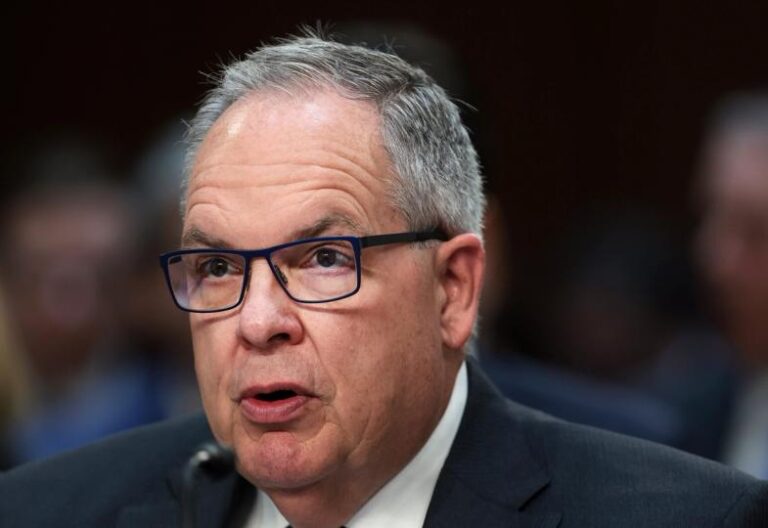
CEO Ronald O’Hanley says the transformation isn’t about bitcoin, but about reengineering traditional assets for faster, modern rails.