
Home Blog Page 1184

Peter Schiff Reiterates Anti-Bitcoin Stance In Interview

0

Gold advocate and longtime Bitcoin critic Peter Schiff renewed his attacks on Bitcoin during a recent interview with Tucker Carlson, arguing that the cryptocurrency industry is seeking government regulation and a government bailout not to restrain itself, but to gain legitimacy in the eyes of the public.

Schiff said that calls for regulatory “clarity” in crypto amount to an attempt to secure government endorsement. According to Schiff, regulation would allow Bitcoin proponents to claim official approval, encouraging new investors to enter the market under the belief that the asset has been validated by the state.

“The government now endorses it. The government is supporting it,” he said, adding that political support for Bitcoin has been driven by financial incentives rather than monetary fundamentals.

Schiff alleged that early Bitcoin holders who profited from later inflows of capital used their gains to influence politicians, including President Donald Trump, to publicly support the asset. 

He pointed to proposals for a U.S. Bitcoin strategic reserve as an example, characterizing them as a potential “Bitcoin bailout fund” that would use taxpayer money to support the market. 

Schiff did not present evidence for claims that politicians were “paid off,” framing them instead as his interpretation of political incentives surrounding crypto policy.

Carlson pushed back by arguing that the declining purchasing power of the U.S. dollar and its use as a geopolitical tool suggest the need for a new global reserve asset. He asked why Bitcoin or stablecoins like Tether could not fill that role.

In response, Schiff reiterated his long-held distinction between money and currency, arguing that gold is money while fiat currencies and Bitcoin are substitutes that depend on confidence rather than intrinsic value. He said Bitcoin’s value rests on speculation that it can be sold later for more dollars, rather than on its usefulness as a stable store of value.

“Most people who are buying Bitcoin are buying it to get more dollars,” Schiff said. “If they wanted a safe store of value, they’d buy gold.”

Schiff: Bitcoin is a fad

Schiff argued that Bitcoin is unsuitable as a reserve asset for central banks, claiming its volatility would make it impossible to hold at scale without destabilizing markets. He said that while some sovereign wealth funds and governments have gained limited exposure to Bitcoin-related assets, such allocations are small and driven by performance pressure rather than conviction.

He predicted that institutional interest would fade and warned that recent buyers could face losses. Schiff noted that Bitcoin remains well below its peak when measured in gold terms, claiming it has declined roughly 40% relative to gold over the past four years.

Schiff also rejected overall comparisons between Bitcoin and gold, arguing that Bitcoin is a speculative asset rather than a form of sound money. 

He likened bitcoin and crypto to past manias like tulips and ‘Beanie Babies,’ saying it lacks intrinsic value and would fall alongside stocks in a major financial crisis. 

BlackRock doubles down on bitcoin fund offerings with income-focused filing

0

BlackRock (BLK) is moving deeper into the cryptocurrency exchange-traded fund (ETF) market with a plan to offer income from bitcoin exposure.

The world’s largest asset manager, with an estimated $12.5 trillion in assets under management, filed with the U.S. Securities and Exchange Commission (SEC) a Form S-1 to list the iShares Bitcoin Premium Income ETF.

The proposed fund would actively manage exposure to bitcoin, either directly or through shares of BlackRock’s existing iShares Bitcoin Trust (IBIT), while generating income by selling call options on that exposure.

This “covered-call” approach is already common in stock-based income funds, and some fund managers have already applied it to the crypto market. Through a covered-call strategy, the fund would generate income by selling a counterparty the right to purchase its underlying at a fixed price.

The fund, which doesn’t yet have a ticker or fee defined, would actively manage this covered-call strategy and would distribute the generated premiums to investors as income. The tradeoff here is it effectively trades potential upside for income.

Funds with similar strategies to generate income from options include the Roundhill Bitcoin Covered Call Strategy ETF (YBTC), Amplify Bitcoin Max Income Covered Call ETF (BAGY), and the NEOS Bitcoin High Income ETF (BTCI).

Still, BlackRock’s entry stands out for its scale and ties to IBIT, already the dominant spot bitcoin ETF with over $69.7 billion in assets according to SoSoValue data. IBIT and other bitcoin funds offered by BlackRock have been so successful they have become the firm’s top revenue source.

Some covered-call ETFs tend to dilute net asset value (NAV) as they offer higher yields to investors, partly through the return of capital. YBTC, for example, currently shows it has a 35.87% distribution rate, while BTCI shows its distribution rate is at 27.25%. BAGY’s distribution rate is at 37.1%.

Excluding distributions, which are often in the double-digits given the underlying asset’s volatility, bitcoin-focused income ETFs have so far underperformed BTC, something they’re often designed to do given the higher yields offered.

Over the last 12-month period, BTCI is down by around 31.3%, while YBTC lost 45% of its value, compared to the cryptocurrency’s 14% drawdown. BAGY, which launched in late April 2025, is down 25% since its debut.

Nvidia Invests $2B in CoreWeave, Expands Partnership

0

In a move that underscores the growing demand for AI infrastructure, Nvidia expanded its partnership with neocloud vendor CoreWeave. 

The vendors revealed on Monday that Nvidia will help CoreWeave build AI factories to produce 5 gigawatts of electric power capacity by 2030. Nvidia also invested $2 billion in the neocloud vendor by buying CoreWeave Class A common stock at a purchase price of $87.20 per share. The news sent shares of CoreWeave, which has seen prices plummet over concerns about its debt load, higher in early trading. The new investment is in addition to the $6.3 billion commitment Nvidia made last year to use CoreWeave’s infrastructure through 2032.

The expanded partnership points to an AI market increasingly focused on AI infrastructure and the build-out of AI factories and data centers. 

The demand for land and real estate to build these data centers has intensified over the past year. Microsoft revealed plans for a $17.5 billion AI infrastructure investment in India in December. Meanwhile, OpenAI’s Stargate initiative is underway with construction on an AI data center in Texas already started and five more data centers planned in partnership with Oracle and SoftBank in Ohio, New Mexico, Texas and Wisconsin. For its part, Nvidia has numerous infrastructure partnerships. The AI hardware and software giant revealed plans to invest up to $100 billion in OpenAI and supply chips to the generative AI vendor to build out its own AI data centers.

Related:AI Startups Merge to Launch First Full-Stack AI Cloud

Nvidia’s Support

With the expansion of its partnership with CoreWeave, Nvidia is acting more like a co-developer, helping the neocloud provider secure both compute power and real estate, said Nick Patience, an analyst at Futurum Group.

“Power is the new bottleneck here and real estate to a certain extent,” Patience said. “The two things are closely linked because you get a lot of data centers being put where the power is.”

Moreover, Nvidia will use CoreWeave’s software in its reference architectures, elevating the neocloud provider from a pure service provider to a technology partner. Nvidia’s reference architecture is a blueprint that helps organizations build AI factories.

“This is … basically an endorsement by Nvidia saying [CoreWeave’s] software is worth something,” Patience said.

For CoreWeave, the stamp of approval from Nvidia helps it differentiate from competitors such as Lambda Labs and Nscale. 

CoreWeave’s access to the new Nvidia Vera Rubin platform also gives it a competitive advantage.

“Potentially, enterprises could look upon CoreWeave for more than just GPUs,” Patience added.  

Related:Meta Launches Meta Compute to Build out AI Architecture

Advantages for Nvidia and Challenges

For Nvidia, the deal is also an avenue to promote its Nemotron family of open models.

“Nvidia certainly wants the world to know that it’s much more than a GPU company,” Patience said. “This gives them another channel for distribution of their software and models.”

However, the deal raises the now-familiar issue of circular financial arrangements, Patience said. Since Nvidia is investing in a company that uses the money to buy Nvidia chips, then Nvidia is essentially getting that money back.

Another challenge for  CoreWeave is that it could become dependent on Nvidia as a supplier.


Bitcoin Traders Stall As US Shutdown, Fed Policy Shift Raises Fear

0

Key takeaways:

  • Bitcoin market data shows that pro traders are avoiding risk and paying extra to protect against a price drop.

  • Gold is hitting record highs, but Bitcoin remains stuck as investors favor traditional safe havens.

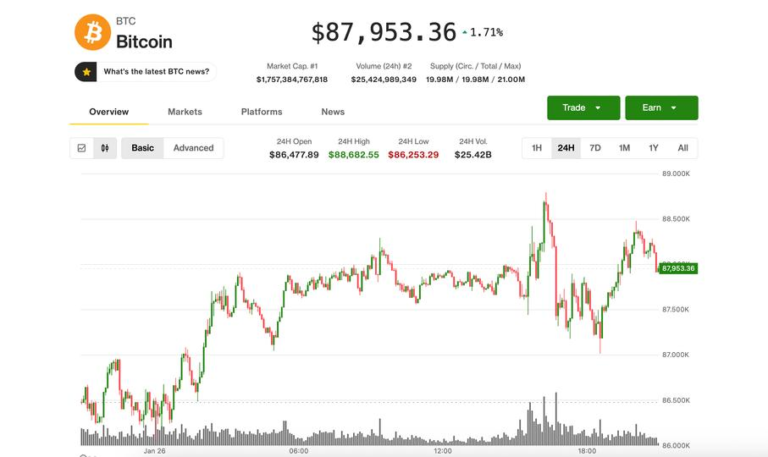
Bitcoin (BTC) rose 1.5% following a retest of the $86,000 level on Sunday as traders weigh the risks of a US federal government shutdown by Saturday. This week features multiple high-stakes catalysts, including earnings reports from global tech giants and the US Federal Reserve’s monetary policy decision on Wednesday.

Despite gold hitting record highs, Bitcoin traders remain cautious. Derivatives metrics suggest skepticism regarding further gains; demand for leveraged bullish positions is weak, and professional traders are currently pricing in higher odds of a negative price swing in the options markets.

BTC 2-month futures basis rate. Source: laevitas.ch

The annualized BTC futures premium (basis rate) stood at 5% on Monday. This level is barely enough to compensate for the longer settlement periods inherent in these derivative contracts. Typically, when traders turn bullish, this indicator jumps above 10%. Conversely, bearish periods can cause the rate to turn negative. Overall, market sentiment has remained neutral-to-bearish for the past two weeks.

Bitcoin 30-day options delta skew (put-call) at Deribit. Source: laevitas.ch

Similarly, the BTC options delta skew reached 12% on Monday. This indicates that put (sell) options are trading at a premium, reflecting a strong reluctance among traders to hold downside exposure. In a neutral market, this indicator usually fluctuates between -6% and +6%. The last time the skew reached these levels was Dec. 1, when Bitcoin plummeted from $91,500 to $83,900 in just a few hours.

Bitcoin lags as gold surges amid rising US debasement fears

Attributing Bitcoin’s bearish momentum solely to the US fiscal standoff seems counterintuitive, especially as the S&P 500 climbed 0.6% on Monday. Meanwhile, gold surged to $5,100 for the first time in history. This rally has led analysts to wonder if a “debasement trade” is accelerating. While the US dollar losing value against scarce assets is a common theme, it currently reflects a broader lack of trust that is not necessarily translating into immediate gains for Bitcoin.

Investors have become increasingly risk-aware after the Federal Reserve Bank of New York signaled a potential rescue of the Japanese yen—a move not seen since 1998. Over the past year, other major fiat currencies have outperformed the US dollar, making US imports more expensive and exerting upward pressure on inflation. If the Fed proceeds with an intervention, traders may interpret the move as a desperate measure to stabilize global markets.

US Dollar Strength Index (left) vs. gold/USD(right). Source: TradingView

The US Dollar Strength Index (DXY) dropped below 97 for the first time in four months on Monday as traders sought protection in rival fiat currencies. 

Interestingly, even with 5-year US Treasury yields surpassing those of Europe and Japan at 3.8%, investors are still bracing for higher US inflation. It is becoming increasingly evident that the US will adopt a softer monetary policy, particularly as Fed Chair Jerome Powell’s mandate ends in April.

US President Donald Trump has made it clear that Powell’s successor must focus on trimming Fed funds rates. Such a move would provide more breathing room for the US Treasury by reducing interest expenses. While a more expansionary monetary policy typically supports the stock market, it does not always create an immediate or direct incentive for Bitcoin investment.

Related: Crypto funds see $1.7B outflows, biggest since November 2025

If corporate earnings from major tech companies surprise to the upside this week, there may be even less incentive for investors to rotate into alternative scarce assets. Ultimately, Bitcoin’s path to reclaiming the $93,000 level hinges on professional traders regaining their confidence. This recovery might take longer than expected as macroeconomic shifts and the corporate earnings season dominate the spotlight this week.