

The token will play a central role in governance and staking, allowing holders to delegate tokens to help secure and scale the mobile ecosystem.
Crypto Market Crumbles As Greenland Row, Trump Tariffs Spook Investors

Key takeaway:
Bitcoin (BTC) and Ether (ETH) retested their lowest levels in more than two weeks after crypto and stock markets digested US President Donald Trump’s fresh round of tariff threats. The potential tariffs are an attempt by the administration to convince Denmark to reconsider its control of Greenland. European nations have shown little willingness to negotiate, prompting crypto and equities investors to adopt a more risk-averse stance.
The S&P 500 index fell 1.9%, while gold prices surged to a new all-time high on Tuesday. The total cryptocurrency market capitalization dropped to $2.71 trillion on Tuesday, down from nearly $3 trillion the previous Wednesday.
Yields on the 5-year US Treasury climbed to their highest level in almost six months, a move often linked to fears of recession or rising inflation. Investors demanded higher returns to hold US government debt, signaling weakening confidence.
Billionaire investor and hedge fund manager Ray Dalio told CNBC that a “new phase of global financial conflict” may be emerging as foreign governments reassess their exposure to US assets amid growing uncertainty and economic strain. Dalio noted that history provides several examples where economic disputes expanded beyond trade into capital flows.
In the past, Dalio has raised concerns about declining confidence in the US dollar. While this backdrop could appear favorable to those who view cryptocurrencies as an alternative monetary system, silver has been the standout performer so far, rising 64% since December. The precious metal’s market capitalization has climbed to $5.3 trillion.

European Commission President Ursula von der Leyen warned on Tuesday that any response to US threats would be “unflinching, united, and proportional,” increasing fears of negative spillovers into equity markets.
Corporate market cap values catch up to Bitcoin
Bitcoin ranked as the eighth-largest global tradable asset with a market capitalization of $1.8 trillion, but competitors such as TSMC (TSMC US) and Saudi Aramco (2222 SR) are rapidly closing the gap. Ether’s position appears more fragile, with a $360 billion market capitalization, placing it 42nd overall after being overtaken by Home Depot (HD US) and Netflix (NFLX). The total cryptocurrency market capitalization is down 32% from its all-time high reached in October 2025.
Investor attention has shifted toward macroeconomic risks as the world’s largest central banks face mounting pressure from higher debt issuance costs. Japan, the world’s fourth-largest economy, is expected to hold a snap election that could grant Prime Minister Sanae Takaichi a mandate to accelerate stimulus measures, according to the Financial Times. Japan’s public debt already exceeds 200% of gross domestic product.
Related: Bitcoin institutional demand remains strong–CryptoQuant

Yields on Japan’s 20-year government bonds surged to record highs on Tuesday. According to a TD Securities report, the move in Japan has spilt over into the US, the United Kingdom, Canada and other markets, serving as “a warning sign to heavily indebted nations that bond markets can turn rapidly if fiscal policy loses credibility.”
These contagion risks are particularly concerning amid heightened geopolitical tensions, leaving the cryptocurrency market exposed. For now, Bitcoin’s chances of reclaiming $95,000 and Ether (ETH) revisiting $3,300 largely depend on whether President Donald Trump can reach some form of agreement with European heads of state during meetings scheduled for this week.
This article does not contain investment advice or recommendations. Every investment and trading move involves risk, and readers should conduct their own research when making a decision. While we strive to provide accurate and timely information, Cointelegraph does not guarantee the accuracy, completeness, or reliability of any information in this article. This article may contain forward-looking statements that are subject to risks and uncertainties. Cointelegraph will not be liable for any loss or damage arising from your reliance on this information.
Solana falls, rebounds from $145 as crypto market liquidations near $350 million
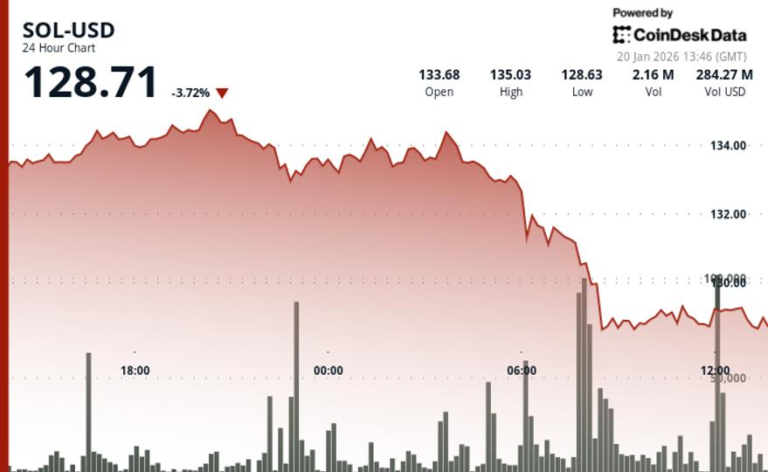
Despite strong fundamentals including $15 billion in stablecoins and $1 billion in tokenized real-world assets, technical signals suggest growing uncertainty.
Chainlink expands data streams to cover multitrillion-dollar U.S. stock market

The upgrade uses a “pull” model for sub-second updates, allowing more advanced trading logic and avoiding high gas costs.
OpenAI Deploys Age Prediction to Restrict Teen Access on ChatGPT

In brief
Getting it right
Daily Debrief Newsletter
Start every day with the top news stories right now, plus original features, a podcast, videos and more.
Crypto Markets Slide as BTC Falls Below $90K, ETH Drops 7%

Tuesday’s sell-off wiped $713M in leveraged positions and came after Trump’s Greenland tariff threats.
Crypto markets fell on Tuesday, Jan. 20, as trade-war fears tied to President Donald Trump’s Greenland tariff threats intensified.
Bitcoin (BTC) is trading at $89,402, down 3.8% over the past 24 hours, while Ether (ETH) is changing hands at $2,991, down roughly 7% on the day, according to CoinGecko.
Among other large-cap tokens, BNB fell 3.4% to $893, while XRP dropped 5.5% to $1.89. Solana (SOL) slipped 5.2% to $127, extending its weekly decline to nearly 12%.
The total cryptocurrency market capitalization stood at roughly $3.10 trillion, down 4% over the past 24 hours, while total trading volume rose to about $148.2 billion.
Canton (CC) led today’s gainers, rising 9%, while Provenance Blockchain (HASH) climbed 5% and MemeCore (M) added 5%.
On the downside, Monero (XMR) fell 17.5% to $507, while Hyperliquid (HYPE) dropped 10.4% to $21.36 and Quant (QNT) slid 7.4% to $77.73.
Liquidations & ETF Flows
Roughly $713.4 million in leveraged positions were wiped out over the past 24 hours, according to CoinGlass. Long liquidations accounted for about $653 million, while short liquidations totaled $60.5 million.
Ethereum recorded the largest share of liquidations at around $269.4 million, followed by Bitcoin at $243 million. CoinGlass also reported that about 165,751 traders were liquidated over the past day.
In the exchange-traded fund (ETF) market, flows were mixed. U.S. Bitcoin spot ETFs recorded about $394.7 million in outflows on Jan. 16, while U.S. Ether spot ETFs posted $4.6 million in inflows.
Meanwhile, U.S. XRP spot ETFs saw about $1.1 million in inflows, while U.S. Solana spot ETFs recorded $2.2 million in outflows.
Geopolitical Uncertainty
The crypto market downturn comes as global markets plunged after U.S. President Donald Trump stoked trade-war fears by threatening tariffs on several European countries and the U.K. unless they supported his push for American control of Greenland, NBC reported.
U.S. stocks fell sharply today, with the S&P 500 posting its worst day since October and the Nasdaq also sliding more than 2%. European markets also moved lower for a second straight day.
Investors also rotated into safe-haven assets as gold climbed to another record high, trading around $4,763 per ounce, up about 1.8% on the day. Silver traded near $94.57.
Peter Brandt Says $58K–$62K Is Where Bitcoin Is Likely Headed

Bitcoin could slide toward $58,000–$62,000 as technical weakness persists, with veteran trader Peter Brandt flagging risky chart patterns and fading momentum that keep downside pressure in focus. Peter Brandt Puts Bitcoin’s Path Around $58K–$62K Market attention intensified after a bold downside projection for bitcoin circulated among traders. Veteran commodity and foreign exchange trader Peter Brandt, […]
OpenAI, ServiceNow Enter Into Strategic Multiyear Partnership

With a history of catering to consumers, OpenAI showed on Tuesday that it also has an enterprise strategy by revealing a multiyear deal with ServiceNow. At the same time, ServiceNow is expanding beyond IT services, while making OpenAI a preferred choice.
Through the partnership, ServiceNow will embed OpenAI’s GPT 5.2 model into its platform to power autonomous AI agents across verticals such as IT, HR, and customer service. The two vendors will develop real time AI voice technology for customer service agents and HR employees. In addition, ServiceNow will use OpenAI’s computer use model to automate systems and desktop-based tasks.
The relationship between the two vendors began in 2023 when ServiceNow integrated Microsoft Azure OpenAI Service into its Now platform.
The expanded partnership highlights OpenAI’s strategy in the enterprise IT market, while helping ServiceNow make its non-IT workflows more intelligent and automated. It also enables the IT self-service vendor to use OpenAI’s voice models in customer service workflows.
An Enterprise Play
For OpenAI, this is just one part of its emerging enterprise play. The model provider has spent the last few months partnering with major vendors, including Cerebras, Broadcom, AWS, Oracle, and SoftBank.
Through these partnerships, OpenAI embeds its technology within enterprises without having to sell directly to them.
“The way they win in the enterprise is largely going to be ‘design in’ wins,” said David Nicholson, an analyst at Futurum Group.
That concept is the approach of having one vendor’s technology built into another company’s product. For example, the technology powering Safari (Apple’s web browser) is from Google. Similarly, when ServiceNow includes OpenAI’s models in its workflows and deploys them to its customers, OpenAI benefits every time ServiceNow deploys new technology, and a customer buys that product. ServiceNow’s expanded partnership with OpenAI puts the model provider continually in front of enterprises and could help it stay relevant in the AI market, especially amid speculation that 2026 could be the year the generative AI vendor loses some traction, Nicholson said.
“This is another strong indication that OpenAI is hedging its bets and not depending upon only its brand to go forward,” he said. “They realize that in the world of IT today, partnerships, ecosystems, platforms, all of those things interacting together, that’s how you become successful.”
ServiceNow and Enterprises
The partnership could also draw in enterprises that have been hesitant to try OpenAI on their own. Enterprise IT vendors like ServiceNow provide businesses with a safety net to try OpenAI technology through a trusted platform.
For ServiceNow, the expanded partnership means its platform becomes more intelligent and more automated without having to build frontier models. While the vendor has historically focused on IT services, it has been moving into non-IT domains such as HR and customer service.
ServiceNow’s expanding focus was buttressed when it acquired AI and enterprise search vendor Moveworks last March.
Moreover, those non-IT domains highlight the importance of voice, said Arun Chandrasekaran, an analyst at Gartner.
“The other part of this partnership is that they believe that OpenAI’s voice models will be very important for their business workflows, particularly their customer service workflows,” Chandrasekaran said. So, some of OpenAI’s speech models will likely make their way into ServiceNow’s workflows soon.
He added that while other IT service providers are model-agnostic, ServiceNow seems to think it can deliver true speech-to-speech by working with OpenAI. This means that, instead of the cascading effect of current speech-to-speech technology, in which speech is first converted to text and then back to speech, ServiceNow wants a direct speech-to-speech technology.
Some Challenges
However, one unknown is whether OpenAI will lead the voice AI market the next three to four years, especially with other speech providers such as Elevenlabs making innovations, Chandrasekaran said.
Another challenge is that OpenAI must deliver and fulfil its end of the agreement.
“The danger would be if OpenAI fails to deliver a solid partner support system,” Nicholson said. “There’s real work that has to be done. And I’m hoping that they’re getting people who have experience with this.”
He added that if OpenAI has to hire experienced professionals to execute on this strategy, then it should, because the vendor currently lacks a proven track record of supporting partnerships over time.
Trump's new CFTC chief Selig starts 'future-proof' initiative to champion crypto

Commodity Futures Trading Commission Chairman Mike Selig signals an intent to set crypto policy into formal rules that would be hard to reverse down the road.
Bitcoin Enters Delaware Life’s Retirement Annuity Portfolio

Delaware Life Insurance Company is adding limited Bitcoin-linked exposure to its retirement annuity portfolio through an index developed by BlackRock.
The insurer will offer an index that blends US stocks with a small, risk-managed allocation to Bitcoin (BTC). The Bitcoin exposure comes through BlackRock’s iShares Bitcoin Trust ETF, meaning investors do not hold Bitcoin directly.
The index combines US equities with managed BTC exposure and applies volatility controls designed to limit fluctuations to about 12%. Delaware Life said the structure allows policyholders to gain indirect exposure to BTC price movements while still preserving their principal under the annuity’s terms.
The index will be available across three of Delaware Life’s fixed indexed annuity products. Fixed indexed annuities are insurance-based retirement products that protect the initial investment and offer tax-deferred growth, with returns tied to the performance of a referenced market index rather than direct asset ownership.
Delaware Life Insurance Company is a US life insurance and annuity provider focused on retirement products. The company said it surpassed $40 billion in cumulative annuity sales as of November 2025.
BlackRock, one of the world’s largest asset managers, launched its Bitcoin ETF in January 2024. According to CoinMarketCap data, the fund has a market capitalization of more than $70 billion, making it the largest spot Bitcoin fund.
In December, BlackRock said the ETF ranked among the company’s three largest investment themes in 2025.
Related: Crypto industry, trade unions clash over multi-trillion dollar retirement funds
Insurance companies explore Bitcoin-linked strategies
The Delaware Life product is not the only example of insurance companies experimenting with Bitcoin-linked structures.
Meanwhile Group, a company that offers Bitcoin life insurance, launched in June 2023 backed by investors including Sam Altman and Gradient Ventures. In October 2025, the company raised $82 million in a funding round, which it said would be used to support growing demand for Bitcoin-denominated retirement and savings products.
Tabit, a Barbados-based insurer, has taken a different approach by using Bitcoin to fund its balance sheet rather than offering crypto-linked insurance products. In March, the company raised $40 million in Bitcoin to back traditional US dollar-denominated property and casualty insurance policies, saying its entire regulatory reserve was held in Bitcoin.
Beyond insurance products, US policymakers have moved to expand access to crypto exposure through other retirement vehicles.
In August, US President Donald Trump signed an executive order directing US regulators to expand access to cryptocurrency in 401(k) retirement plans.
Magazine: Davinci Jeremie bought Bitcoin at $1… but $100K BTC doesn’t excite him
Cointelegraph is committed to independent, transparent journalism. This news article is produced in accordance with Cointelegraph’s Editorial Policy and aims to provide accurate and timely information. Readers are encouraged to verify information independently. Read our Editorial Policy https://cointelegraph.com/editorial-policy