

XRP’s on-chain data is signaling renewed confidence as wealthy holders quietly return despite sluggish prices, with blockchain analytics highlighting early accumulation trends that could reshape longer-term market sentiment. XRP Millionaire Wallets Expand — A Subtle Whale Signal Beneath the Surface XRP market signals can shift even during periods of muted price action. Blockchain analytics firm […]
COMEX Silver Inventories Drain Rapidly as Short Squeeze Goes Full Swing

COMEX silver inventories are draining rapidly, signaling tightening physical supply as a short squeeze intensifies, raising delivery risks, fueling volatility, and underscoring mounting stress across global silver markets. COMEX Silver Inventories Tighten With Short Squeeze in Full Swing Severe strain is emerging in global silver supply as exchange-held inventories drain rapidly. Industry data shows a […]
Flutterwave Adds Stablecoin Balances for Merchants in Deal with Turnkey
Flutterwave, the African payments giant, is launching stablecoin balances for its merchants and users, partnering with blockchain infrastructure provider Turnkey to power the new wallet capabilities.
The move aims to provide a secure and “always-on” infrastructure for cross-border payments, allowing businesses to accept and hold regulated stablecoins alongside traditional fiat currencies.
Embedding stablecoins into African commerce

The initiative is designed to reduce the cost and friction of international transactions for African enterprises and multinationals operating on the continent. By integrating Turnkey’s embedded wallet infrastructure, Flutterwave will enable users to transact in major stablecoins like USDC and USDT, as well as USD and NGN.
The rollout will begin with a select group of merchants before expanding to all approved Flutterwave merchants later this year. The system is further supported by Nuvion, an AI-powered banking platform that bridges fiat and stablecoin infrastructure.
Nkem Abuah, lead for remittances & stablecoin partnerships at Flutterwave, commented: “To accelerate business growth in Africa, we must make it safe, easy, and affordable for businesses to accept all forms of regulated payment methods, including stablecoin, from a global customer base. By enabling stablecoin balances powered by Turnkey, we are ensuring that multinationals, African enterprises, and individuals using Flutterwave will have access to low-cost, faster, and always-on cross-border payments”.
Verifiable infrastructure

Turnkey, which was recently named one of the 2025 CNBC World’s Top Fintech Companies, provides the underlying security layer. The company is known for its “verifiable” blockchain infrastructure, which allows for transaction automation and embedded wallets with high security standards.
Bryce Ferguson, CEO and co-founder of Turnkey, said: “We share Flutterwave’s belief that stablecoins offer an incredibly efficient way to accelerate payments and put more money directly into the hands of business owners rather than intermediaries… we’re proud to power Flutterwave’s stablecoin payments and support their mission to empower the next generation of African innovators”.
This partnership aligns with Flutterwave’s broader strategy to position stablecoins as a core pillar of Africa’s financial ecosystem, facilitating smoother connectivity between the continent and the global economy.
Ripple-linked token drops 5% amid BTC-led weakness
Pudgy Penguins is emerging as one of the strongest NFT-native brands of this cycle, shifting from speculative “digital luxury goods” into a multi-vertical consumer IP platform. Its strategy is to acquire users through mainstream channels first; toys, retail partnerships and viral media, then onboard them into Web3 through games, NFTs and the PENGU token.
The ecosystem now spans phygital products (> $13M retail sales and >1M units sold), games and experiences (Pudgy Party surpassed 500k downloads in two weeks), and a widely distributed token (airdropped to 6M+ wallets). While the market is currently pricing Pudgy at a premium relative to traditional IP peers, sustained success depends on execution across retail expansion, gaming adoption and deeper token utility.
$70,000 could be in play for BTC, say analysts
Amid broad traditional market declines, crypto once again was the standout underperformer on Thursday.
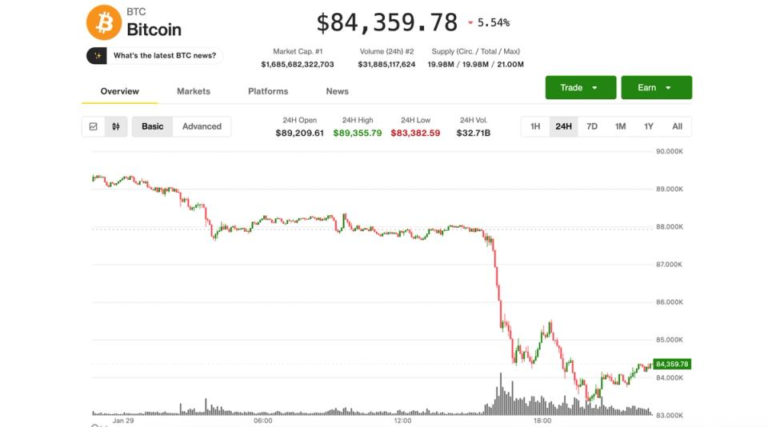
Modest overnight declines in crypto turned into a major rout in the U.S. morning as the Nasdaq shed more than 2% and gold tumbled nearly 10% from an overnight record. But while both of those markets managed sizable afternoon bounces — the Nasdaq closing with a decline of just 0.7% and gold reclaiming the $5,400 per ounce level — bitcoin and the rest of crypto held not far from session lows. Bitcoin was trading just above $84,000 at press time. Losing almost 6% over the past 24 hours, bitcoin is on the brink of breaking below its two-month range, which could be a prelude to an even deeper pullback.
Other cryptos and related assets were showing similar declines. Ethereum , solana , XRP and , were all roughly 7% lower over the last 24-hour period, while crypto exchange Coinbase (COIN), stablecoin issuer Circle (CRCL) and bitcoin treasury firm Strategy (MSTR) suffered 5%-10% losses.
What’s next for bitcoin
Matt Mena, crypto research strategist at 21Shares, said that holding above the $84,000 support level is “critical” for bitcoin. If that fails, he said, the next target is $80,000, where buyers stepped in in November, and below that comes the $75,000 lows hut during the April 2025 tariff tantrum.
Still, the current prices offer a “compelling entry point,” Mena said. He still expects bitcoin to hit $100,000 by the end of the first quarter, or even push to a new record of $128,000 if macroeconomic conditions allow it.
Other analysts warned of a deeper pullback on the horizon.
John Glover, CIO of bitcoin lender Ledn, argued that today’s selloff is part of bitcoin’s broader correction from the October record highs. The move could ultimately drag BTC to $71,000, a 43% decline from the early October level of $126,000.
With the U.S. being a key source of current market uncertainty, Glover argued, investors are favoring alternative havens like gold and the Swiss franc over traditional safe assets like the U.S. dollar and Treasuries. While many expected bitcoin to act as “digital gold,” it is still being treated as a risk asset and selling off with equities, he said.
Like Mena, Glover believes the current difficulties won’t last. “I do believe this is a somewhat temporary situation and we will see a rebound in BTC prices in the coming quarters,” he concluded.
“The technical levels have all been taken out on the downside, and I don’t see much support here for bitcoin,” Russell Thompson, chief investment officer at Hilbert Group, said. He also believes bitcoin could drop as low as $70,000. “The Clarity markup coming out of the committee is bullish, but there is really just a general risk move here.”
Strategy, BitMine Stock Prices Dive as Bitcoin and Ethereum Sink
In brief
Daily Debrief Newsletter
Start every day with the top news stories right now, plus original features, a podcast, videos and more.
Circle’s biggest bear just threw in the towel, but warns the stock is still a crypto roller coaster
Circle (CRCL), the stablecoin issuer behind USDC, got a second upgrade by Wall Street analysts in a week, and this time by its biggest bear.
Compass Point’s Ed Engel, who had a sell rating and the lowest price target among analysts, has upgraded the stock to Neutral just a day after Mizuho’s Dan Dolev revised his bearish outlook.
However, Engel’s kept his price target the lowest among Wall Street analysts covering the stock, despite the upgrade. His new price target is $60, down from $75 due to premium valuation (more on that later).
The stock fell 7.3% during regular trading hours on Thursday to $67.55, but rose about 1% in post-market trading.
His upgrade reflects a changing narrative around the stock, which Engel now says trades more like a proxy for crypto markets than a standalone fintech.
Engel downgraded the stock to sell in July, citing increased competition for stablecoin. However, many of his concerns have been priced in by the market, he added.
The analyst also said that the stock could benefit if the long-debated CLARITY Act passes in 2026, which Engel sees as a 60% probability.
The legislation could provide clearer regulatory ground for stablecoins, potentially supporting growth in the USDC supply. Separately, increased tokenization of U.S. stocks and ETFs in DeFi markets — even without regulatory approval — may also reduce Circle’s dependence on broader crypto sentiment.
Cyclical nature
To Engel, Circle is now trading like a cyclical stock, which matters for the stock’s investment thesis.
Since the market dip in October, the digital dollar USDC has been moving in “lockstep” with ether , with a correlation of 0.66. According to the analyst, this trend is likely to stay through mid-2026. The reason? Over 75% of all USDC is currently being used in high-risk crypto trading or lending apps.
This means that, despite being a “stablecoin,” USDC is still heavily tied to the wild ups and downs of the broader crypto market, making Circle more of a cyclical stock.
And this is still a problem, as he thinks the stock is trading at a premium valuation given the company’s exposure to a cyclical asset class — one of the reasons his price target remains the lowest among analysts.
Competition heating up
Engel noted additional risks for the stock.
USDC supply is down 9% since December, and emerging stablecoins like USDH, CASH, and PYUSD are taking market share, particularly on platforms like Solana and Hyperliquid . Engel also flagged that the firm could guide 2026 operating expenses above Wall Street forecasts, as many of its ongoing investments are unlikely to generate meaningful revenue in the near term.
Competition is also heating up from traditional financial players. JPMorgan, State Street, and BNY Mellon are moving forward with “deposit coins” that could directly compete with USDC in developed markets.
While Engel sees some upside if crypto markets rebound or regulation improves, the note concludes that Circle’s revenue remains tightly linked to speculative activity — and that a true decoupling from crypto cycles could still be years away.
Nayib Bukele and El Salvador buying dips in bitcoin and gold

The central bank of El Salvador, the tiny bitcoin-friendly nation in Central America, added $50 million worth of gold to its reserves, the institution said Thursday in an X post.
The purchase — 9,298 troy ounces — brings the country’s total gold holdings to 67,403 ounces, valued at roughly $360 million at current prices
President Nayib Bukele reposted the announcement, writing, “We just bought the other dip.” Whether Bukele was applauding the gold buy or cheekily announcing the government’s own bitcoin buy wasn’t clear. Arkham data did show the country adding one bitcoin to its holdings on Thursday, in line with Bukele’s ongoing pledge for his government to buy one bitcoin per day.
The country’s stack, according to Arkham, now stands at 7,547 bitcoin worth $635 million at bitcoin’s currently depressed price just above $84,000.
Banks reduce reliance on OpenAI

New data from AI benchmarking and intelligence platform Evident suggests that many of the world’s largest banks are reducing their reliance on OpenAI as their primary large language model provider.
Editorial
This content has been selected, created and edited by the Finextra editorial team based upon its relevance and interest to our community.
The Evident Use Case Tracker captures all publicly announced AI use cases across the 50 banks tracked in the Evident AI Index, including references to third-party AI vendors.
Eighteen months ago, OpenAI provided the underlying technology for roughly half of the banking AI use cases that disclosed vendor information. Evident’s latest analysis shows that by the end of 2025, OpenAI’s share had fallen to just one-third, with banks increasingly developing and deploying use cases built on alternative providers such as Anthropic and Google.
“Since the Gen AI boom began three years ago, banks have been the bellwether for enterprise AI adoption,” says Alexandra Mousavizadeh, co-founder and CEO of Evident. “The way they are behaving now could signal mounting challenges for OpenAI’s position in banking in 2026. Our data shows a marked shift away from OpenAI’s LLMs and towards a broader range of providers.”
According to Evident’s analysis, coding is one of the few banking AI use cases where more than half of deployments demonstrate tangible return on investment. While Anthropic is consistently ranked best-in-class for code generation and review, Google has leveraged its existing cloud relationships to make enterprise deployment and system integration easier. Last month, BNY demonstrated this approach by integrating Gemini Enterprise with its internal AI platform, Eliza.
“It’s no secret that many leading banks favour model agnosticism, which could account for some of the shift away from OpenAI,” Mousavizadeh adds. “However, many of the bankers we’ve spoken to in recent months have told us that they’re impressed by what Anthropic and Google are delivering. OpenAI still boasts successful partnerships with banks like BBVA and Morgan Stanley and retains a strong footprint in banking, so it will be interesting to see how the AI giant evolves its enterprise offering in the coming months.”
Ethereum Is Pivoting Into The AI Industry? Here’s What We Know So Far

Trusted Editorial content, reviewed by leading industry experts and seasoned editors. Ad Disclosure
Ethereum (ETH) is extending its influence in the AI industry as developers aim to integrate AI with decentralized technology. Building on this, new reports have revealed that ETH developers are preparing to roll out an AI-focused update that could see AI agents work and engage directly on the blockchain network.
Ethereum Prepares To Launch New AI Agent Standards
Ethereum is getting ready to launch a major update that could transform how artificial intelligence interacts with blockchain. The new upgrade, called ERC-8004, uses blockchain to find, select, and work with AI agents across different organizations without pre-existing trust, enabling open-need agent economies.
On January 27, the Ethereum team made an official announcement revealing that ERC-8004 will go live soon, opening the door for projects to integrate with AI in a decentralized way. Marco De Rossi, one of the primary authors of ERC-8004 and the AI lead at MetaMask, stated that development of the protocol has been frozen, as the team prepares to deploy it on the mainnet, with a likely launch around 9 AM ET on Thursday, January 30.
The proposal was initially submitted in August 2025 and has since undergone multiple rounds of community review and revision before reaching its final implementation stage. Early adopters have also tested the system to explore new applications for autonomous AI agents.
The new ERC-8004 protocol is designed to give AI agents on Ethereum unique identities and verifiable reputations, enabling autonomous systems to interact without relying on centralized platforms. Each AI agent will receive a unique ERC-721 NFT as its on-chain ID, serving as a digital passport. The system also supports ENS domains, allowing agents to have readable names and securely delegate control when needed.
ERC-8004 also introduces on-chain mechanisms for reputation and validation, enabling AI agents to record feedback and prove task execution outcomes. The protocol also allows agents to record their actions and performance on the blockchain, so other AI agents and users can verify their interactions and build trust quickly.
Importantly, the AI Lead at the Ethereum Foundation has also shared his thoughts on the new ERC-8004 standard. He said that Ethereum is now uniquely positioned to be the platform that “secures and settles AI-to-AI interactions.”
ETH’s Deep Dive Into The AI Industry
Ethereum is explaining its role in artificial intelligence, building on earlier efforts to connect the industry with decentralized technology. While the upcoming ERC-8004 standard for AI agents has gained massive attention, it is not Ethereum’s first move into AI. The network has been exploring ways to support blockchain and AI development for years, laying the groundwork for a broader ecosystem.
For instance, the Ethereum Foundation previously established a dedicated AI team, known as the dAI Team. This group is tasked with creating infrastructure that allows Ethereum to act as a coordination and settlement layer for autonomous systems.
Featured image from Pexel, chart from Tradingview.com

Editorial Process for bitcoinist is centered on delivering thoroughly researched, accurate, and unbiased content. We uphold strict sourcing standards, and each page undergoes diligent review by our team of top technology experts and seasoned editors. This process ensures the integrity, relevance, and value of our content for our readers.