
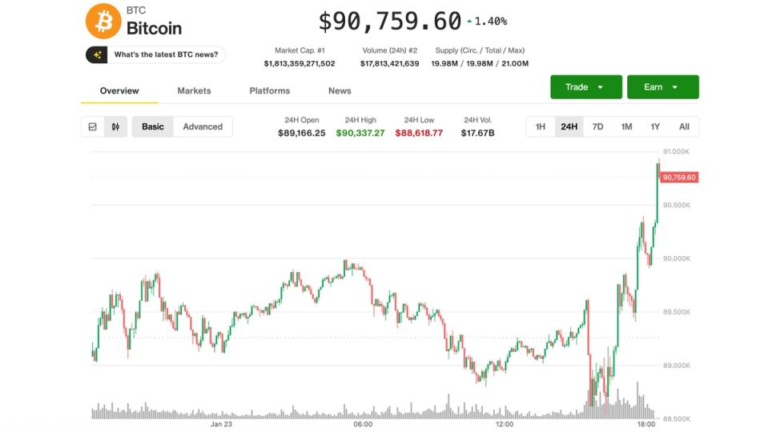
Having earlier breached $100 per ounce for the first time ever, silver has risen to $101, while gold sits just shy of $5,000 per ounce.
Flaze: A BNB Chain Project Focused on Sustainable Tokenomics and Long-Term Participation

In an environment where short-term speculation often overshadows long-term value creation, Flaze is positioning itself as a project designed around sustainability, transparency, and meaningful ecosystem participation on BNB Chain.
Launched as a capped-supply token with a strong emphasis on utility, Flaze aims to support the broader BNB Chain ecosystem by aligning incentives between holders, builders, and the project itself.
A Scarcity-Focused Token Model
Flaze operates under a fixed supply framework, with an original total supply of 21,000,000 tokens. Of this, a meaningful portion has already been permanently removed from circulation through burns, leaving a current circulating supply of 16,360,000 tokens. The project has confirmed that no minting functionality exists within the token contract, reinforcing its scarcity-driven design.
Transaction taxes are deliberately minimal. Each trade contributes:
- 1.3% to the Marketing Wallet, used to fund ecosystem growth, exchange outreach, and community initiatives
- 0.1% allocated to automatic token burning, gradually reducing supply over time
This brings total transaction taxes to 1.4%, a structure designed to balance sustainability without discouraging organic market participation.
Staking Designed for Long-Term Alignment
One of Flaze’s core pillars is its staking system, which has already seen strong participation from the community. More than 2.5 million $FLAZE tokens are currently staked, with participants committing to longer lock-up periods that support price stability and network confidence.
Flaze staking operates under a clear and transparent ruleset:
- No penalties apply when staking periods are completed in full
- A 10% early unstake penalty applies only if tokens are withdrawn before maturity
- Rewards continue to accrue throughout the staking term
All early unstake penalties are redirected to the Marketing Wallet, where they are used to support:
- Future staking rewards
- Exchange listings
- Community initiatives and ecosystem marketing
This structure discourages short-term “stake-and-dump” behaviour while rewarding long-term participation, helping to maintain fairness and sustainability across the ecosystem.
FlazePad: Expanding the Flaze Ecosystem
As part of its broader ecosystem roadmap, Flaze is also developing FlazePad, a security-first token launch platform for BNB Chain.
According to the Flaze whitepaper, FlazePad is being designed to address common vulnerabilities and trust issues associated with early-stage token launches. The platform’s core objective is to provide creators and early participants with a simplified, transparent launch environment that prioritises protection at the liquidity level.
A key mechanism outlined in the whitepaper is the use of a 100% liquidity pool (LP) burn model, whereby liquidity is permanently removed from circulation at launch. This approach is intended to eliminate the possibility of liquidity withdrawal after deployment, directly reducing a major vector for rug-pull risk and increasing confidence for participants.
FlazePad will also provide standardised smart contract deployment tools and token-generation modules, allowing projects to launch using predefined, consistent contract structures. This standardisation aims to reduce technical errors and improve baseline security for new launches.
Additional platform functionality, including expanded analytics or monitoring capabilities, may be evaluated as development progresses. Any such enhancements would be disclosed in future whitepaper updates following internal review and technical validation.
FlazePad is currently scheduled for release in Q1 2026.
A Community-Led Growth Strategy
Rather than relying on short-lived hype cycles, Flaze has adopted a community-first approach to growth.
Crypto custodian BitGo down 12%, falling well below IPO price on second trading day
The company came public at around a $2 billion valuation on Thursday.
US Bank Lobby Says Fighting Stablecoin Yields A Top Priority

The American Bankers Association (ABA) has made cracking down on stablecoin yield a top priority for 2026, amid its ongoing debate with US lawmakers that it will hurt the banking industry’s competitiveness.
The ABA said on Tuesday that one of several priorities it has this year is to “stop payment stablecoins from becoming deposit substitutes that slash community bank lending by prohibiting paying interest, yield or rewards regardless of the platform.”
Stablecoin oversight topped a list of five priorities, which also included fighting financial fraud, stopping arbitrary interest rate caps, and focusing on indexing and mission-driven banks. ABA CEO and president Rob Nichols said the priorities are guided by input from various banks and businesses of all sizes and models.
Banking exec says $6 trillion could move out of banks
The dispute between the association and the crypto industry is over whether yield-bearing stablecoins will pull deposits away from traditional banks, which the bank lobby argues will weaken lending and erode banks’ role in the financial system.
Bank of America CEO Brian Moynihan argued earlier this month that up to $6 trillion could move out of banks into interest-paying stablecoins.
Although the GENIUS Act, passed last year, prohibited stablecoin issuers from offering interest or yield to holders, the ABA’s Community Bankers Council said in a letter to lawmakers in early January that a so-called loophole in the laws could let yield-bearing stablecoins undercut traditional banks.
Circle CEO says concerns are “totally absurd”
The Community Bankers Council told the Senate it must put provisions in market structure legislation to tighten stablecoin rules to prevent issuers from offering yield through third parties.
However, crypto executives are convinced that allowing stablecoin yields will help more than it hurts.
Related: ‘Literally billions’ of AI agents to use stablecoins in 5 years: Circle CEO
Circle CEO Jeremy Allaire dismissed concerns that stablecoin yields could trigger bank runs as “totally absurd.” “They help with stickiness, they help with customer traction,” he said at the World Economic Forum in Davos.
Meanwhile, Anthony Scaramucci, founder of asset manager SkyBridge Capital, said that a prohibition on yield-bearing stablecoins puts the US dollar at a competitive disadvantage to China’s digital yuan, a yield-bearing central bank digital currency.
Magazine: The critical reason you should never ask ChatGPT for legal advice
Cointelegraph is committed to independent, transparent journalism. This news article is produced in accordance with Cointelegraph’s Editorial Policy and aims to provide accurate and timely information. Readers are encouraged to verify information independently. Read our Editorial Policy https://cointelegraph.com/editorial-policy
Grayscale files for ETF tracking Binance's BNB token, following VanEck’s bid
The proposed “GBNB” trust would offer investors exposure to the native token of the BNB chain without having to directly own the tokens, but approval still hinges on Nasdaq’s filing.
Grayscale Files for Spot BNB ETF With SEC
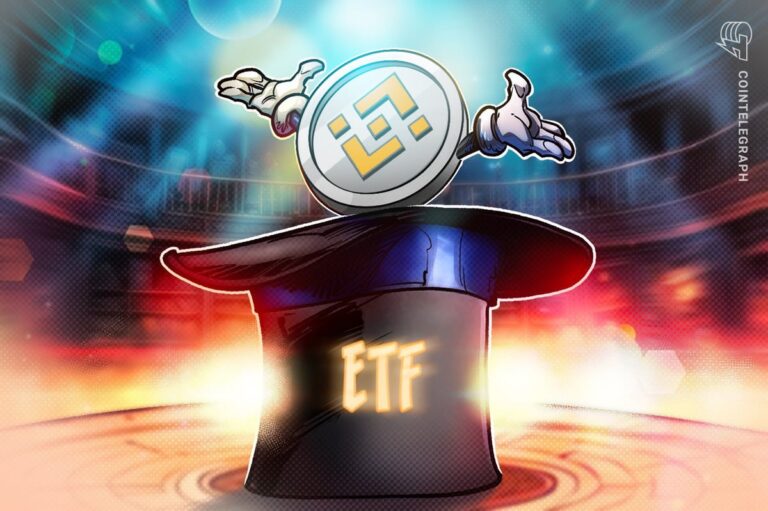
The product, if approved, would give US investors access to regulated BNB exposure without needing to hold the token themselves.
Grayscale has filed with the US Securities and Exchange Commission to launch a spot exchange-traded fund tracking BNB, marking one of the asset manager’s most ambitious moves beyond Bitcoin and Ether.
According to a registration statement filed on Friday, the proposed Grayscale BNB ETF would hold BNB (BNB) directly and issue shares designed to reflect the token’s market value, minus fees and expenses. The filing indicates the fund is intended to trade on Nasdaq under the ticker symbol GBNB, subject to regulatory approval.
If approved, the product would give US investors regulated exposure to BNB without needing to custody the token themselves or hold it on crypto exchanges.
A filing tied to BNB is notable, as the token is the fourth-largest cryptocurrency by market capitalization, with a total value of $120.5 billion at the time of filing.
BNB is the native token of the Binance ecosystem and plays a central role across its products. The token is used to pay transaction fees on the BNB Smart Chain, participate in onchain governance and receive trading fee discounts on Binance’s platform, among other use cases.
Related: BNB Chain targets ‘around one second’ finality with Fermi hard fork
Expansion beyond Bitcoin and Ether
Grayscale’s filing does not represent the first attempt to bring a BNB-linked ETF to the US market.
Investment manager VanEck submitted a registration statement for its own proposed BNB ETF, including an amended Form S-1 seeking a Nasdaq listing under the ticker VBNB, placing it further along in the regulatory review process than Grayscale’s proposal.
Still, the filing highlights Grayscale’s broader strategy to expand its lineup of crypto investment products following the approval and successful launches of spot Bitcoin (BTC) and Ether (ETH) ETFs in the United States.
Spot Bitcoin and Ether ETFs together hold more than $100 billion in assets under management, underscoring investor demand for regulated crypto exposure. A BNB-linked product would extend that access beyond base-layer networks, offering exposure to a token closely tied to a major crypto exchange ecosystem.

Related: Grayscale forms trusts tied to potential BNB and HYPE ETFs
Cointelegraph is committed to independent, transparent journalism. This news article is produced in accordance with Cointelegraph’s Editorial Policy and aims to provide accurate and timely information. Readers are encouraged to verify information independently. Read our Editorial Policy https://cointelegraph.com/editorial-policy
Restaking Promises Yield But Delivers Only Stacked Risk

Opinion by: Laura Wallendal, co-founder and CEO of Acre
Restaking is often heralded as the next big thing in decentralized finance (DeFi) yields, but behind the hype lies a precarious balancing act. Validators are stacking responsibilities and slashing risks, incentives are misaligned, and much of the $21 billion in total value locked (TVL) is held by a handful of whales and venture capitalists rather than the broader market.
Let’s break down why restaking lacks real product-market fit and how it compounds more risk than it yields. Most importantly, we need to confront the uncomfortable questions: Who profits when the system fails, and who is left holding the risk?
Restaking doesn’t really work
By definition, restaking allows already-staked assets, typically Ether (ETH), to be pledged a second time, thereby utilizing them in securing other networks or services. In this system, validators use the same collateral to validate multiple protocols, theoretically earning more rewards from a single deposit.
On paper, this sounds efficient. In practice, it’s only leverage disguised as efficiency: a financial house of mirrors where the same ETH is counted multiple times as collateral, while each protocol piles on dependencies and potential failure points.
This is a problem. Every layer of restaking compounds exposure rather than yield.
Consider a validator that restakes into three protocols. Are they earning three times the return? Or are they taking on three times the risk? While the upside usually sets the narrative, a governance failure or slashing event in any of those downstream systems can cascade upward and wipe out collateral entirely.
Additionally, the restaking design breeds a form of quiet centralization. Managing complex validator positions across multiple networks requires scale, meaning only a handful of large operators can realistically participate. Power accumulates, resulting in a small cluster of validators securing dozens of protocols and orchestrating a fragile concentration of trust in an industry purportedly built on decentralization.
There’s a good reason why major DeFi platforms and decentralized exchanges like Hyperliquid or even established lending markets aren’t relying on restaking to power their systems. Restaking has yet to prove real-world product-market fit outside speculative activity.

Where does the yield come from?
Immediate risks aside, restaking raises a deeper question: Does this model even make economic sense? In finance, traditional or decentralized, yield must come from productive activity. Honing in on DeFi, this might involve lending, liquidity provision or staking rewards tied to actual network usage.
Restaking’s yields, by contrast, are synthetic. They repackage the same collateral to appear more productive than it is. This is quite similar to rehypothecation in TradFi. Here, value isn’t being created; it’s just being recycled.
The extra “yield” in this framework usually comes from three familiar sources. It’s either token emissions that inflate supply to attract capital, borrowed liquidity incentives funded by venture treasuries or speculative fees paid in volatile native tokens.
Of course, that doesn’t make restaking inherently malicious. But it does make it fragile. Until there’s a clearer link between the risks validators assume and the tangible economic value their security provides, the returns will remain speculative at best.
From synthetic yields to sustainable ones
Restaking will likely continue to attract capital, but in its current form, it would be hard-pressed to achieve real, lasting product-market fit. That is, as long as incentives remain short-term, risks remain asymmetric, and the yield narrative feels increasingly removed from real economic activity.

As DeFi matures, sustainability will matter more than speed because protocols need transparent incentives and real users who understand the risks they’re taking over inflated TVL. That means a shift away from complex, multi-layered models toward yield systems grounded in verifiable onchain activity where rewards reflect measurable network utility rather than recycled incentives.
The most promising developments are emerging in areas like Bitcoin (BTC) native finance, layer-2 staking and cross-chain liquidity networks, where yields come from network utility and ecosystems focus on aligning user trust with capital efficiency.
DeFi doesn’t need more abstractions of risk. It requires systems that prioritize clarity over complexity.
Opinion by: Laura Wallendal, co-founder and CEO of Acre.
This opinion article presents the contributor’s expert view and it may not reflect the views of Cointelegraph.com. This content has undergone editorial review to ensure clarity and relevance, Cointelegraph remains committed to transparent reporting and upholding the highest standards of journalism. Readers are encouraged to conduct their own research before taking any actions related to the company.
This opinion article presents the contributor’s expert view and it may not reflect the views of Cointelegraph.com. This content has undergone editorial review to ensure clarity and relevance, Cointelegraph remains committed to transparent reporting and upholding the highest standards of journalism. Readers are encouraged to conduct their own research before taking any actions related to the company.
How to leverage AI through back-office readiness

- How prepared are payments firms for the upcoming FCA’s 7 May safeguarding deadline, and what operational or technological gaps are proving the hardest to close?
- As real‑time payment volumes accelerate, what are the biggest operational pressures emerging for payments firms, and how can they redesign processes to handle continuous, high‑velocity flows?
- With many firms still reliant on Excel and manual workflows, what are the practical steps needed to modernise back‑office infrastructure so it can scale alongside rising transaction volumes?
- How are organisations approaching emerging technologies, such as AI, blockchain-based payments, and stablecoins, and what barriers are slowing adoption?
- AI is moving from buzzword to implementation: where can AI deliver the greatest impact across safeguarding, reconciliation, fraud management, and operational efficiency in the near term?
Safeguarding obligations have become a central focus for payments firms as the industry works toward the upcoming 7 May safeguarding deadline. The urgency of this milestone is pushing organisations to scrutinise the strength of their existing controls, test the resilience of their safeguarding arrangements, and identify gaps that may have been tolerated during periods of lower regulatory pressure. Many firms are finding that preparedness varies widely across the sector, raising questions about operational readiness and the consistency of standards being applied.
At the same time, the rapid expansion of real‑time payments is reshaping the operational landscape. Continuous payment flows create far higher expectations around reconciliation accuracy, operational responsiveness and customer visibility – demands that legacy systems and workflows struggle to meet. As volumes increase, firms are being forced to rethink how they structure processes and manage data to ensure their operations remain both compliant and responsive in a real‑time environment.
A deeper challenge lies in the fact that many payments businesses still depend heavily on spreadsheets, manual interventions and siloed tools. These outdated back‑office processes limit scalability and introduce operational risk, particularly as transaction volumes rise sharply. Modernising these environments, through automation, integrated data platforms and intelligent exception handling, has become essential not only for efficiency but also for maintaining strong safeguarding practices as regulatory expectations heighten.
Looking ahead, emerging technologies are beginning to influence how firms think about long‑term resilience. AI in particular has moved beyond experimentation and is now being implemented in areas such as reconciliation, anomaly detection and operational optimisation. Alongside developments in blockchain‑based payments and stablecoins, these innovations are shaping a future in which payments infrastructures must be more adaptive, data‑driven and scalable, qualities that will be key to meeting both the FCA’s safeguarding requirements due on 7 May and the broader operational demands of a modern payments ecosystem.
Register for this Finextra webinar, hosted in association with Autorek, to join our panel of industry experts who will discuss the biggest operational pressures emerging for payments firms, and how they can redesign processes to handle continuous, high‑velocity flows.
How Donald Trump’s Latest Crypto Move Will Boost Demand For XRP

Trusted Editorial content, reviewed by leading industry experts and seasoned editors. Ad Disclosure
Crypto pundit X Finance Bull has explained how Donald Trump’s push to sign the crypto bill into law will boost demand for XRP. This follows White House Crypto Czar David Sack’s prediction about how banks will come into crypto once the CLARITY Act passes.
How Donald Trump’s Crypto Push Will Boost XRP’s Demand
In an X post, X Finance Bull shared a video in which Donald Trump’s crypto adviser, David Sacks, stated that banks will begin to adopt crypto once the crypto bill passes. The pundit noted that this means banks are already positioned, while Ripple has the stack and XRP has the liquidity, and the rails are in place. As such, he believes that the token will be the go-to crypto once these banks enter the crypto industry.
X Finance Bull further mentioned that institutions that have been waiting over the past few years will return and announce their buys and use of XRP once Donald Trump signs the CLARITY Act into law. The pundit added that this moment resets who is early and that he never needed hype to hold the altcoin. “Research and study were always enough,” he said.
X Finance Bull also questioned why market participants were panic-selling if banks are going all in once Donald Trump signs the crypto bill into law. The pundit’s statements come just as Ripple partnered with DXC to integrate the token and RLUSD into DXC’s Hogan core banking platform.
The banking platform powers more than 300 million deposit accounts and over $5 trillion in deposits globally. As such, this is a major step in XRP’s adoption, as the partnership will integrate Ripple’s payment technology into large-scale banking environments.
Trump’s Tariff Move Will Also Boost The Altcoin
In another X post, X Finance Bull claimed that Donald Trump’s move with tariffs will also boost XRP’s demand. He shared a video of how the U.S. president said that $18 trillion is flowing into the U.S. economy thanks to these tariffs. The pundit asserted that such money flows put pressure on banks, payroll systems, FX rails, and settlement speed.
X Finance Bull further noted that this creates nonstop cross-border payments and liquidity needs, and this is where Ripple and XRP come in. He explained that while old rails leak money, Ripple and the altcoin were built to stop that. The pundit also alluded to Ripple executives meeting with Donald Trump and to the token being mentioned as part of the digital asset stockpile. He added that the CLARITY Act is next and that when rules lock in, the U.S. capital will need U.S. rails.
At the time of writing, the XRP price is trading at around $1.92, down almost 2% in the last 24 hours, according to data from CoinMarketCap.
Featured image from Shutterstock, chart from Tradingview.com

Editorial Process for bitcoinist is centered on delivering thoroughly researched, accurate, and unbiased content. We uphold strict sourcing standards, and each page undergoes diligent review by our team of top technology experts and seasoned editors. This process ensures the integrity, relevance, and value of our content for our readers.
Delegates clash as Optimism token buyback proposal goes to a DAO vote – DL News

- Optimism DAO votes on token buybacks.
- Delegates are split on the proposal.
- The vote ends on January 28.
Optimism DAO delegates are heading to the polls as a landmark proposal to use a portion of Optimism’s revenue to buy back its OP governance token opened for voting on Thursday.
The proposal, if passed, will mandate the Optimism Foundation to use 50% of the revenue generated through the Superchain, a network of blockchains built using Optimism’s software, to buy OP tokens every month.
The vote has split opinions among the DAO’s delegates. While many support the proposal, others argue it’s a poor use of capital.
“Optimism is a net seller of OP (grants, payment-in-kind, etc) and it makes little sense to spend precious hard assets and shorten runway to buy back OP while still net selling,” PaperImperium, a governance liaison for GFX Labs, an Optimism DAO delegate, said on X.
Optimism is a major player in blockchain infrastructure. Its OP stack software framework is used by Coinbase’s Base blockchain, Uniswap’s Unichain, and Kraken’s Ink blockchain, among others.
But the project’s OP token hasn’t benefitted. It’s down more than 93% from its all-time high after hitting an all-time low of $0.25 last month.
The buyback proposal aims to change that. The more revenue Optimism makes, the more OP the nonprofit Optimism Foundation will be required to buy each month, potentially helping shore up the token’s price.
Such buyback programmes have become increasingly popular among crypto projects in recent months. But not everyone agrees that they’re worthwhile.
Researchers at crypto market maker Keyrock and market intelligence platform Messari argue buybacks can be a waste of money as they divert funds from marketing and growth initiatives and do little to impact token prices.
OTC issues
There are several more issues with the proposed buyback programme, according to delegates.
One is that the buybacks will be conducted over-the-counter instead of through the open market, meaning the purchases won’t directly impact market prices.
“A concerning scenario would be that employees or investors are using the OTC buybacks to offload their tokens as they unlock,” Michael Vander Meiden, an Optimism DAO delegate and member of the Optimism grants council, said in a forum post.
In response, the Optimism Foundation said it chose OTC execution as the simplest path to shipping the buyback programme. “All OTC trades will be reported publicly, either via stats.optimism.io or via the governance forum,” the foundation said in a forum post.
Still, not everyone is convinced.
“We would prefer to see more focus on crafting and publishing a business plan to get Optimism to financial sustainability,” GFX Labs said in a forum post. “That’s the real challenge that Optimism Foundation/Labs leadership needs to address, and a buyback does nothing to address this, and may in fact make it worse.”
Several other governance participants said they agree with GFX Labs’ criticisms.
‘A step in the right direction’
Despite the pushback, a large faction of Optimism’s DAO supports the buyback proposal.
“It’s totally fine to have a buyback programme alongside emissions, even if they technically cancel out (partially),” Milo Bowman, an Optimism DAO delegate, said in a forum post. “The meme of the buyback is important. It allows people to clearly project what would happen if the Superchain grows 100x.”
“It’s a step in the right direction,” a spokesperson for PGov, an Optimism DAO delegate, told DL News. “The specifics still need to be discussed and [we] would like to have more dialogue between the community and core teams foundation that propose it.”
The buyback vote will run for six days and ends on January 28.
So far, delegates have cast more than 3.8 million votes in favour of the proposal, with just over 19,000 votes against it.
Tim Craig is DL News’ Edinburgh-based DeFi Correspondent. Reach out with tips at tim@dlnews.com.