The mechanics: Beyond holding shares, the platform facilitates direct competition between users based on specific player matchups.
Daily head-to-head contests pit specific players against one another, such as Jaylen Brown versus Kawhi Leonard.
Users predict which player will have the better stat line in a “winner take all” format.
Thompson aims to deepen fan engagement by incentivizing viewers to watch live games to track their investments.
The context: Thompson believes the platform caters to an online culture that wants to monetize its sports knowledge.
The goal is to give users and hardcore fans a place to prove their insights exceed those of TV analysts and their friends.
The system uses leaderboards to let users “flex” their basketball IQ and prove they are the “smartest in the room” compared to their peers.
Thompson argues that modern culture has turned almost everything into a competition or market.
Tristan’s take: Beyond speculation, Thompson sees the platform as a reputation engine for the next generation of sports media personalities.
He envisions top performers using their verifiable on-chain track records to launch independent livestreams and build social followings.
The goal is to empower creators to become “more popular than the guys on ESPN” by proving they are tapped into the culture.
Thompson says the drive to compete is innate, but Web3 tools now allow fans to financialize it. “Now I think we’re realizing that almost anything can be a form of competition where you can monetize it and create a market where people can make money,” Thompson said.
Capital One has struck a deal to buy corporate spend management platform Brex in a $5.15 billion cash and stock deal.
Editorial
This content has been selected, created and edited by the Finextra editorial team based upon its relevance and interest to our community.
The agreement, which comes less than a year after Capital One’s $35 billion merger with Discover Financial Services, is made up of 50% cash and 50% stock.
Brex launched in 2017 with a corporate card for venture backed businesses, before expanding to offer SMEs and larger organisations expense management, real-time payments, and AI agent-based workflow automation.
Over 25,000 clients, from startups to enterprises, now run their finances on Brex – including DoorDash, TikTok, Anthropic, Robinhood, Crowdstrike, Zoom, Plaid, Intel, SeatGeek and the Boston Celtics.
However, the purchase price is a steep discount on Brex’s $12.3 billion valuation, secured in a 2021 funding round. Since then, the firm has carried out two major rounds of layoffs.
Richard Fairbank, CEO, Capital One, says: “Brex invented the integrated combination of corporate credit cards, spend management software and banking together in a single platform. They have taken the rarest of journeys for a fintech, building a vertically integrated platform from the bottom of the tech stack to the top.”
Brex CEO Pedro Franceschi, who will continue to lead the firm, adds: “Together, we’ll maximize founder mode by combining Brex’s payments expertise and spend management software with Capital One’s massive scale, sophisticated underwriting, and compelling brand to accelerate growth and increase the speed at which we can offer better finance solutions to the millions of businesses in the U.S. mainstream economy.”
The acquisition is slated to close by the middle of the year.
Ethereum, the smart contract blockchain, now handles more daily activity than its cheaper side chains, called Layer -2 networks. But this comeback has a catch – not all of that Ethereum activity appears to reflect genuine user demand.
The number of daily active addresses on Ethereum climbed toward the 1 million mark earlier this month, briefly peaking above 1.3 million on Jan. 16 before settling closer to 950,000, according to data source Token Terminal.
That puts Ethereum ahead of popular scaling networks such as Arbitrum, Base and OP Mainnet, reversing much of the narrative that users had permanently migrated off L1.
Active addresses are the unique blockchain wallets that make transactions, like sending, receiving cryptocurrencies, or interacting with smart contracts, in a given time period, let’s say daily. Analysts track the metric to study the real network usage beyond the token price hype.
Layer 2 scaling networks are like side roads or express lanes built on top of the main blockchain highway, Ethereum. These sidechains handle tons of transaction traffic quickly and cheaply off the main chain, and then communicate the final tally back to the main chain for security.
(Token Terminal)
The rebound in Ethereum activity follows December’s Fusaka upgrade, which sharply reduced transaction fees and made it cheaper to transact directly on Ethereum again. Lower costs have helped revive on-chain activity, particularly for stablecoins, which remain the dominant use case for day-to-day transfers.
At face value, the numbers suggest a “return to mainnet” moment. But analysts caution that raw address counts can be misleading, especially when fees fall far enough to make spam economical.
Address poisoning muddies the picture
Imagine spam calls flooding your phone. your call log looks busy, but most are junk, not real conversations. Something similar has been happening on Ethereum, as a significant portion of January’s address growth is tied to address poisoning attacks rather than organic adoption.
Security researcher Andrey Sergeenkov said in a post earlier this week that the spike aligns closely with a rise in dusting activity, where attackers send tiny stablecoin transfers to millions of wallets.
Address poisoning works by exploiting human behavior. Attackers generate wallet addresses that closely resemble a victim’s real address, often matching the first and last characters.
They then send small “dust” transfers, usually under $1, so the fake address appears in the victim’s transaction history. When the victim later copies an address from that history instead of a trusted source, funds are mistakenly sent to the attacker.
Sergeenkov’s analysis found that the number of new Ethereum addresses jumped to roughly 2.7 million during the peak week of Jan. 12, about 170% above normal levels. Around two-thirds of those addresses received dust as their first stablecoin transaction, a strong signal of poisoning activity rather than real onboarding.
The attack has already resulted in more than $740,000 in confirmed losses, with most of the stolen funds coming from a small number of victims. Lower fees following Fusaka appear to have made these campaigns viable, allowing attackers to spray transactions at scale with limited upfront cost.
The takeaway is not that Ethereum usage is fake, but that headline metrics need context.
Lower fees have clearly brought activity back to mainnet, especially for stablecoins. At the same time, cheap transactions also enable abuse, inflating address counts and transaction volumes.
Bitcoin is under pressure as crypto markets enter a volatile correction driven by geopolitical tensions, Federal Reserve leadership uncertainty, and delayed U.S. regulation, amplifying short-term risk without undermining long-term adoption trends. Markets Weigh Fed Chair Outcomes While Bitcoin Navigates a Macro-Driven Pullback A period of heightened uncertainty has emerged across digital asset markets as macroeconomic […]
Binance submitted a formal application to operate under the European Union’s new Markets in Crypto-Assets (MiCA) regulation, selecting Greece as its regulatory foothold ahead of the framework’s implementation later this year, the exchange confirmed on Friday.
The crypto exchange told CoinDesk that it filed its application with the Hellenic Capital Market Commission (HCMC), the national authority overseeing securities and crypto-asset service providers.
“We have submitted our MiCA application and are actively engaging with the Hellenic Capital Market Commission (HCMC),” a Binance representative said in a statement. “We see MiCA as a positive and important milestone for the industry — one that brings greater regulatory clarity, stronger user protections, and a clear framework for responsible innovation. We welcome the opportunity to work closely with the HCMC as this new regulation takes shape in the EU and look forward to contributing to the long-term growth of Europe’s digital financial ecosystem.”
The move follows Binance’s incorporation of a local holding entity in Greece called Binary Greece. According to its articles of association, the company will focus on acquiring and managing equity participations across the region and providing financial advisory services.
Binance’s application is being reviewed under a fast-track process initiated by the HCMC, which has enlisted five global advisory firms, including PwC, Deloitte and KPMG, to assist with the licensing review.
The Greece filing marks a critical step in Binance’s broader effort to reestablish itself in regulated markets after a tumultuous 2023, during which the company paid a $4.3 billion settlement to U.S. authorities and exited several European jurisdictions. CEO Richard Teng has publicly indicated Binance’s long-term ambition to reenter the U.S. market, emphasizing compliance as a central priority.
Revolut has changed course in the US, abandoning plans to buy a lender in the country in favour of applying for its own banking licence, according to the Financial Times.
Editorial
This content has been selected, created and edited by the Finextra editorial team based upon its relevance and interest to our community.
Last year, the UK-based fintech giant was widely reported to be on the hunt for a nationally chartered US bank to acquire, enabling it to offer lending in all 50 states.
However, according to the FT, citing sources, Revolut has changed plan after concluding that an acquisition could prove difficult and that securing its own licence from the Office of the Comptroller of the Currency offers a smoother route.
The company is banking on an accelerated approach to granting licences under the Trump administration. In December alone, the OCC approved five applications for US banking licences, including for crypto outfits Circle and Ripple.
“The US market is critical for Revolut’s global growth strategy and our long-term plan is to establish a bank in the US. That said, we continue to actively explore all options including a de novo bank licence application,” the firm tells the FT.
Bitcoin BTC$89,455.68 on Friday once again started the U.S. session with a sharp move lower, tumbling back to $88,500 even as precious metals continued breakneck rallies, with silver topping $100 per ounce for the first time ever. Gold was just shy of $5,000 per ounce, while platinum soared 5% to a new all-time high. Not a precious metal, but maybe soon to become one at this pace, copper rose 2.5% to just below a record high.
Crypto-related stocks moved lower as well. Coinbase (COIN) was down 2.6%, while Strategy (MSTR) slid 1.2%. Bitcoin miners Riot Platforms (RIOT) and MARA Holdings (MARA) posted 2% declines.
The decline in crypto also came as U.S. stocks brushed off early losses to turn mostly higher, with the Nasdaq ahead 0.4% despite a 15% post-earnings plunge in Intel (INTC).
The company beat fourth-quarter earnings expectations but disappointed with first-quarter guidance, in part due to AI chip supply constraints. The stock remains higher by 17% year to date.
Bitcoin U.S. returns sink
When bitcoin reached $98,000 last week, the cumulative returns this year during the U.S. trading sessions were as high as 9%, noted CoinDesk senior analyst James Van Straten. Since then, those returns have dropped to just 2%, underscoring weaker demand for BTC from U.S. investors. That coincided with heavy outflows from U.S. spot bitcoin ETFs, investors withdrawing over $1.6 billion in the last four sessions.
Jasper De Maere, desk strategist at crypto trading firm Wintermute, noted a recent uptick in stablecoin redemptions into fiat, signaling that some institutional players who had re-entered the market earlier this year may now be stepping back.
As traders agreed that new macro lows were on the cards for BTC/USD, upside targets increasingly focused on the 2025 yearly open at $93,500.
“So my bullish outlook still has our going down overall to $75,000 – $70,000 region, but we revisit $100,000 first,” trader Crypto Tony told X followers in his analysis.
Crypto Tony noted that the 2025 starting level coincided with a nearby “gap” in CME Group’s Bitcoin futures, potentially increasing its pull as a price magnet.
“We would only see this happen if we get that leg up to $93,000 to close the CME gap IMO,” he continued.
“A tap of $85,000 would present the best long opportunity. IF WE HOLD.”
“If the $86.8K level is lost and doesn’t get reclaimed quickly after that, I would assume we’ll start to see a test of the lows,” crypto trader, analyst and entrepreneur Michaël van de Poppe wrote in an X update on the day.
“On the other hand, a crucial level is found at $91K. Break that & we’ll see a strong surge.”
BTC/USD one-day chart. Source: Michaël van de Poppe/X
Gold prediction sees $23,000 per ounce
Headlines mainly focused on precious metals as gold and silver neared the key psychological levels of $5,000 and $100, respectively.
Related: Bitcoin diamond hand BTC selling not ‘repeat of 2017, 2021,’ research warns
XAU/USD reached new highs of $4,967 per ounce overnight, with BTC/XAU barely holding the 18-ounce mark.
XAU/USD three-month chart with one-month RSI data. Source: Cointelegraph/TradingView
While gold’s monthly relative strength index (RSI) values hit their most “overbought” since the 1970s, bullish price forecasts continued to flow.
Charles Edwards, founder of quantitative Bitcoin and digital asset fund Capriole Investments, came out with a giant $23,000 gold price tag.
“We have record high Central bank gold accumulation. China has 10Xed their gold stack in the last 2 years alone,” he wrote in a blog post dedicated to analysis of gold within the current macro landscape.
“We have an incredible 10.5% fiat money supply inflation per year, ratcheting up asset prices.”
Edwards suggested that the current asset bull run could well follow in the footsteps of the greatest periods of expansion over the 20th century.
If it does, “…we can expect the gold price to trend to between $12,000 to $23,000 over the coming 3-8 years,” he concluded.
This article does not contain investment advice or recommendations. Every investment and trading move involves risk, and readers should conduct their own research when making a decision. While we strive to provide accurate and timely information, Cointelegraph does not guarantee the accuracy, completeness, or reliability of any information in this article. This article may contain forward-looking statements that are subject to risks and uncertainties. Cointelegraph will not be liable for any loss or damage arising from your reliance on this information.
Bitcoin remains trapped in bearish territory below the death cross with weak momentum despite reclaiming $90K.
Meanwhile, GameFi tokens lead crypto gains, outpacing Bitcoin’s sideways grind.
Axie Infinity (AXS) surged 131% this week, and more than 250% in the last month.
While Bitcoin struggles to break out of a multi-month consolidation pattern, trading in the $90,000 zone with bearish charts intact, a different corner of crypto is absolutely ripping. GameFi tokens are posting double-digit gains this week, led by a stunning 131% weekly surge in Axie Infinity and a very solid bounce by The Sandbox.
The broader market backdrop is wild. Gold pierced $4,900 per ounce for the first time ever on Thursday, while silver broke past $99—both metals hitting all-time highs as investors rotate out of risk assets.
The S&P 500 is headed for its second consecutive weekly decline after President Donald Trump’s Greenland rhetoric and proposed E.U. tariffs sparked a sell-off earlier this week. Goldman Sachs is now calling for gold to hit $5,400 by year-end as the “debasement trade” accelerates.
Bitcoin (BTC) price: Death cross deadlock
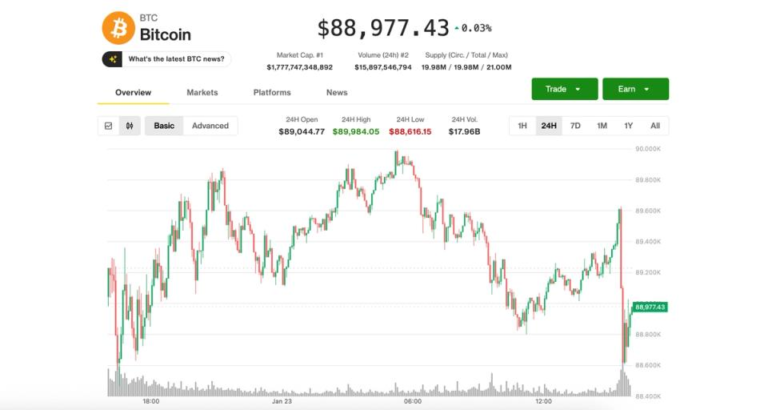
Bitcoin is up a modest 1.6% today, trading at $90,895 after bouncing from Wednesday’s lows around $88,000. That sounds fine on the surface, but the technicals show weakness and indecision among bulls, especially those betting on long-term plays.
Bitcoin (BTC) price data. Image: Tradingview
The most glaring issue is the bearish pattern that traders refer to as a “death cross,” which formed on Wednesday after invalidating a “golden cross” attempt that only lasted a few days. When the average price of Bitcoin over the last 50 days (also known as the 50-day EMA, or EMA50) sits below the 200-day average, that forms a death cross—a bearish configuration that typically signals downward pressure or at minimum extended sideways action. A golden cross is, well, the opposite of that.
For context, when a faster-moving average crosses below a slower one, it suggests that recent price action is weaker than the medium-term trend, and traders usually interpret this as a sign that momentum has shifted to the bears.
What makes this especially concerning is that Bitcoin is trading right around $90,895, which sits below both EMAs. The 50-day EMA is acting as immediate resistance near the Fibonacci level of $91,353. (These are natural supports and resistance zones that form organically in established trends.)
Bulls need to reclaim these moving averages decisively to flip the narrative—but so far, they haven’t been able to hold above them for more than a few days at a time.
Meanwhile, Bitcoin’s Relative Strength Index, or RSI, sits at 48.3, smack in the middle of neutral territory. RSI measures buying and selling pressure on a scale of 0 to 100, with readings above 70 considered overbought and below 30 oversold. At 48.3, Bitcoin is showing neither strong buying momentum nor capitulation selling, but still suggests a slightly bearish mood among traders.
Axie Infinity (AXS) price: The GameFi moonshot
Now let’s talk about the complete opposite of Bitcoin’s deadlock: Axie Infinity, which trades as AXS, is absolutely ripping.
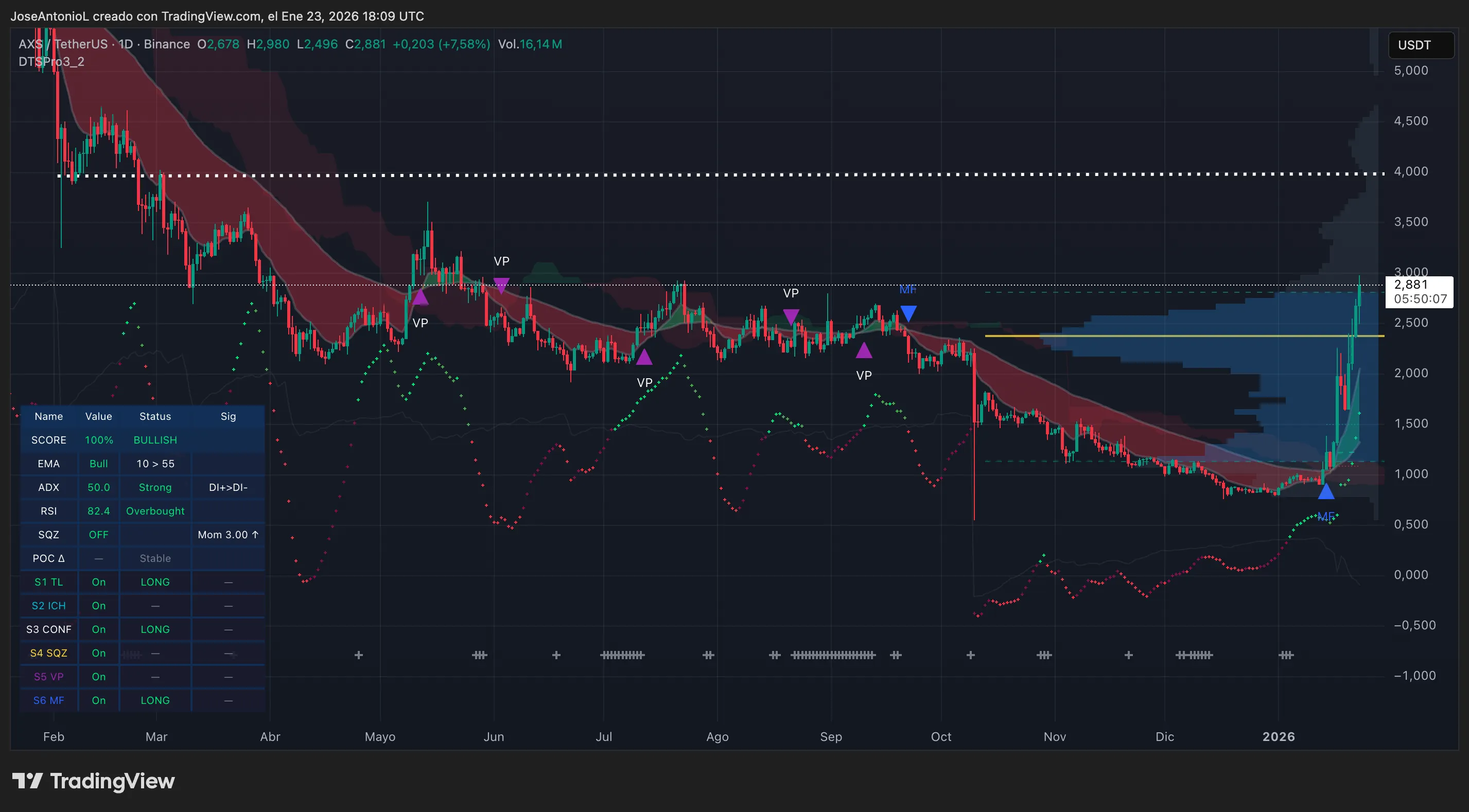
AXS, the reward token that powers the Axie Infinity game, is up 7.6% today alone, trading at $2.88, and has posted a mind-bending 131% gain over the past week and a 251% jump in the past month, all in the middle of a bear market. This is the kind of move that reminds people why they got into crypto: The token has gone from complete irrelevance to suddenly becoming one of the hottest crypto assets in the entire market this week.
It seems Axie Infinity is pumping hard lately due to a mix of factors: bullish news from the creators of the Axie Infinity game, Sky Mavis, and traders chasing those gains with price momentum that’s now reignited interest in the token.
Sky Mavis earlier this week launched Origins Season 16 with a new reward system built around bAXS, a non-transferable token backed 1:1 by AXS that reduces immediate sell pressure and discourages bot farming, signaling a more sustainable in-game economy.
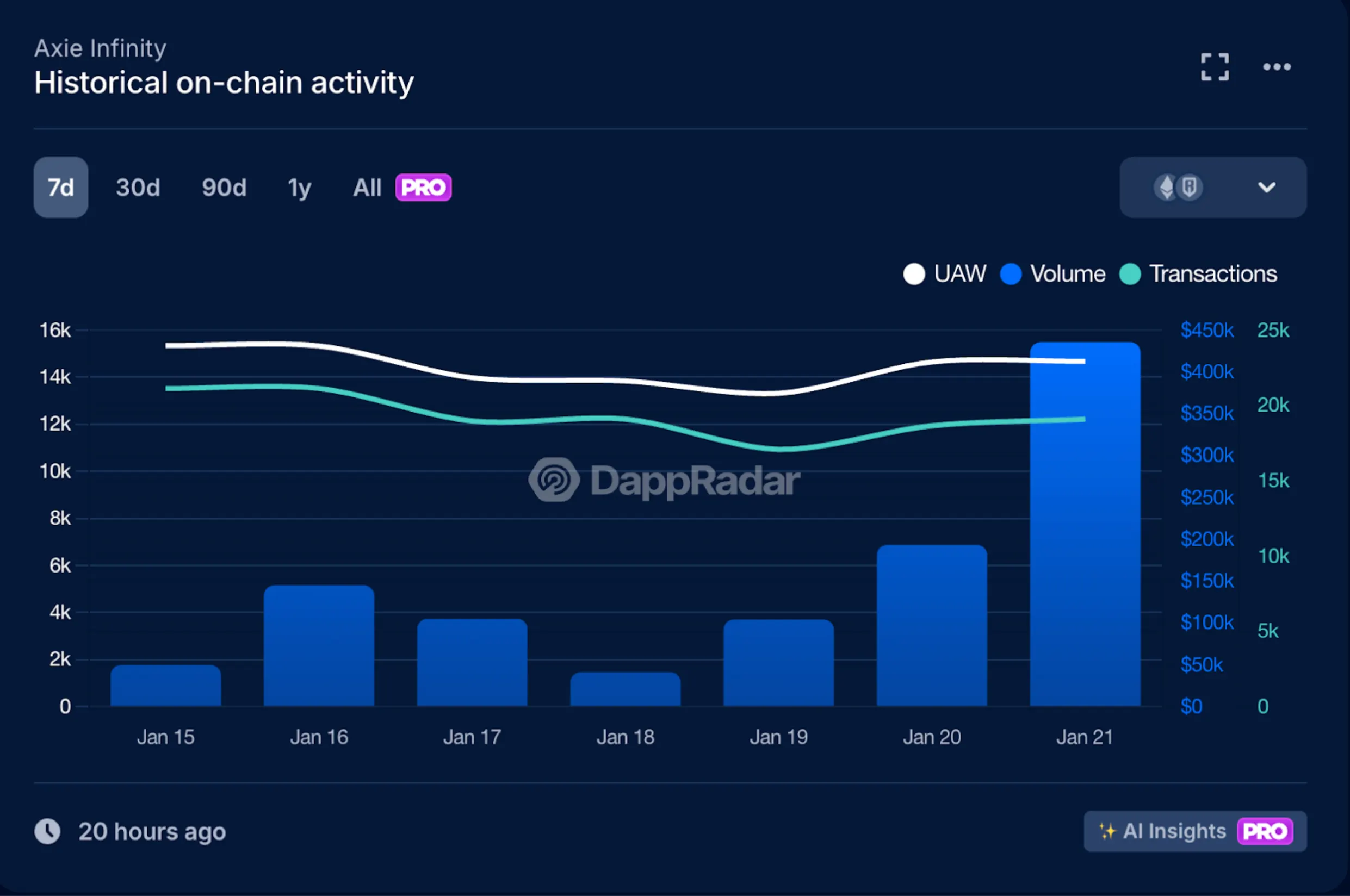
The update triggered a surge in trading volume, a recovery in daily active users, and heavy whale accumulation, while broader GameFi tokens are rallying as capital rotates out of a stagnant Bitcoin market.
Image: DappRadar
Of course, the hype around the Axie Infinity game died a long time ago, and the AXS token is still down almost 99% from its all-time high four years ago, at the peak of the crypto gaming fervor. So, anyone who bought AXS anywhere near the top probably couldn’t care less about the “pump” right now.
But for those who may have clairvoyantly bought Axie in the last month or so, the gains have been substantial.
The technical setup on the AXS charts here is the polar opposite of Bitcoin. AXS is showing extremely bullish signs across multiple indicators, suggesting this coordinated move may have some momentum behind it.
Let’s start with the Average Directional Index, or ADX, which reads 50—more than double Bitcoin’s 27.0 and well into “very strong trend” territory. ADX measures trend strength, regardless of direction, on a scale from 0 to 100. Scores above 25 indicate a clear trend, and readings above 40 are considered extremely strong. At 50, AXS is showing powerful directional movement, and unlike Bitcoin, this trend is pointing straight up.
The exponential moving averages paint a bullish picture too. The token entered a golden cross last week. More importantly, price is trading above both moving averages, meaning bulls are firmly in control and the EMAs are providing support rather than resistance on any pullbacks.
But there are some potentially dangerous signals for latecomers. The Relative Strength Index is at 82.4, deep into overbought territory. RSI above 70 is generally considered overbought, meaning buying pressure has been so intense that a pause or pullback becomes more likely. At 82.4, AXS is flashing bright red warning signs that it’s due for a breather.
Combine this with a 131% spike and it may take some guts to put in a long position right now expecting good results without a major correction.
Looking at the chart, AXS has broken out of a massive descending channel that had contained its price since early 2024. After months of lower highs and lower lows grinding Axie’s price down from $4+ to around $1.00, the breakout above $2.00 represents a major shift in market structure. The token is now marking higher highs and higher lows—the definition of an uptrend.
Disclaimer
The views and opinions expressed by the author are for informational purposes only and do not constitute financial, investment, or other advice.
Daily Debrief Newsletter
Start every day with the top news stories right now, plus original features, a podcast, videos and more.
PwC’s 2026 crypto regulation report says market surveillance, disclosures, and investor protections are moving onchain.
Regulators are starting to treat crypto and decentralized finance (DeFi) more like traditional financial markets, according to a new report from PwC, one of the “Big Four” accounting firms.
In its Global Crypto Regulation Report 2026, PwC said regulators are no longer treating crypto as a special case. Instead, they are starting to apply the same kinds of rules used in traditional markets, like making trading fairer, protecting everyday users, and setting clearer standards for how platforms should operate.
PwC said the change is happening across both centralized exchanges (CEXs) and decentralized protocols. These include monitoring for bad behavior, requiring more transparency, and making sure users understand what they are buying.
“This is no longer a question of if regulation will arrive, but how quickly firms can now adapt to operating in parallel regimes,” said Elise Soucie Watts, executive director of Global Digital Finance. “Success for the digital finance industry will depend on designing products, governance, and compliance models that are robust enough to meet local requirements, yet flexible enough to scale globally.”
However, the findings come at a time when experts are greatly divided on the future of DeFi. Some argue that the push toward traditional finance (TradFi)-style rules could pull the sector away from its original vision.
“Decentralization is slowly becoming a big lie,” wrote Rishabh Anand, a growth and ecosystem contributor at LayerEdge, on X last year. “As much as decentralization attracted most of us OGs in the space, very few would agree that everything is ultimately transitioning towards centralization and hybrid solutions with aspects of centralization.”
Other crypto observers have argued that even as DeFi grows, power is concentrated in a handful of exchanges, stablecoin issuers, and major custodians, raising questions about how “decentralized” the market actually is in practice.
MastrXYZ (@MastrXYZ), a popular account that describes itself as an “OG Crypto Watchdog,” argued last week that crypto is becoming more centralized in practice, even if the underlying blockchains remain decentralized.
“My core thesis: crypto is decentralised on chain and still 100% centralised in power,” the account wrote, claiming most users don’t interact directly with blockchains, but with centralized infrastructure like exchanges, stablecoins, and custodians. “Crypto can remain mathematically decentralised while becoming economically and politically centralised,” it added.
PwC’s report also points to two areas where regulation is moving fastest: stablecoins and tokenized money. Stablecoin rules are shifting from design to implementation, as more jurisdictions begin enforcing requirements around reserves, redemption rights, governance, and disclosures, PwC said.
The report added that tokenized money is also gaining traction, with tokenized bank deposits, tokenized cash equivalents, and wholesale central bank digital currencies (CBDCs) moving from pilots to deployment.