Week Starts with Optimism Regarding Tech Earnings, Tokyo Collaboration
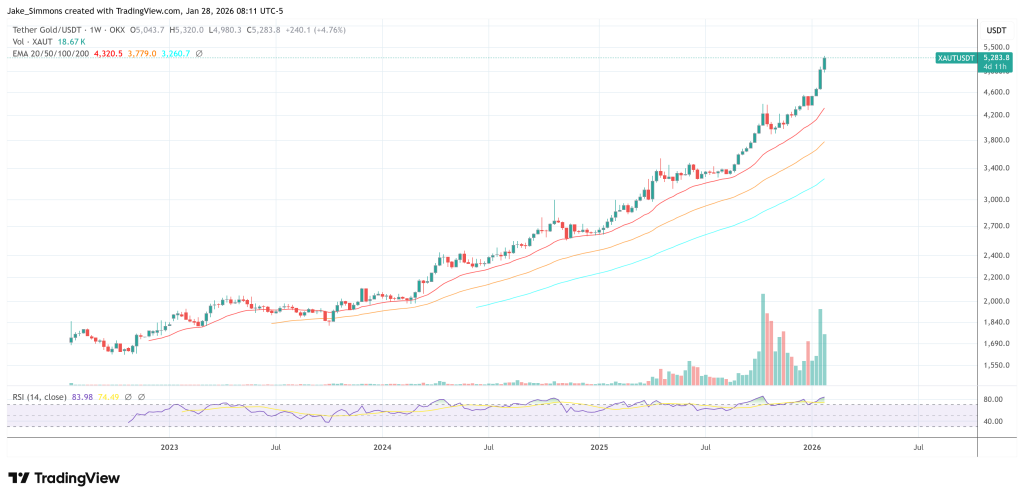
Enthusiasm over the most eventful earnings week of the season has investors raising exposure to tech shares ahead of four of the Magnificent Seven reporting results this Wednesday and Thursday. Wall Street is certainly starting off this Monday on the right foot, as analysts patiently await further details on AI initiatives, the pace of investment, and expected profits to better gauge whether the theme can continue to carry this bull market, which began in 2023. But if not, participants are geared up to keep rotating into the reacceleration trades that benefit disproportionately from rate cuts amidst faster growth, especially as the cyclically oriented benchmarks have outperformed the S&P 500 and Nasdaq 100 substantially year to date. November’s Durable Goods beat on Monday morning contributed to improved sentiment, as it featured a pickup in capital expenditures alongside broad transaction strength across components. Meanwhile, Treasuries are rallying as Washington and Tokyo coordinate financial stability efforts regarding Asian currencies and surging sovereign borrowing costs there. Indeed, the US curve is descending in bull-flattening motion led by duration; however, the potential for White House tolerance of a stronger yen is creaming the greenback, offering a boost to the administration’s onshoring ambitions and to the bottom lines of global corporates. Speculation of intervention in Japan, relatively loose central banks, Trump’s tariff threats to Canada, and rising risks of another government shutdown are extending intense rallies in safe-haven precious metals, as gold and silver march toward new milestones of $5,100 and $115, respectively. Elsewhere, Bitcoin and forecast contracts are additionally catching bids.
Capex Grows for Fifth Consecutive Month
November Durable Goods featured the fifth consecutive month of expanding business investment, signaling ongoing momentum as corporations are poised to take advantage of the 100% first-year depreciation incentives in 2026 for a wide range of capital expenditures, as allowed by last year’s passage of the Big Beautiful Bill. The headline growth of 5.3% month over month (m/m) flew past the median estimate of 0.3% and October’s -2.1%. Non-defense purchases excluding aircraft, a proxy for business investment, grew 0.7% m/m, accelerating from the previously reported 0.3%. This report was originally scheduled for late December but was delayed by about 4 weeks due to the government shutdown.
No More Cuts Under Powell?
Fixed-income watchers continue to anticipate that the first rate cut of 2026 will occur in June, as there’s just a 28% chance that the central bank will reduce its benchmark prior to Chair Powell’s term ending in May. Nonetheless, Wall Street is still eager to hear from the chief this Wednesday following a largely expected pause and the committee’s statement release. Top of mind for investors will be the monetary policy authority’s views on labor conditions and inflationary trends, as well as its stance on the level of accommodation or restriction. Meanwhile, observers will also focus on any comments referencing the White House’s pressure campaign to slash borrowing costs expeditiously, as well as two separate investigations into Governor Cook and Chair Powell. And following the January decision, equity traders will have their moment, as Microsoft, Meta and Tesla are set to report after the bell. The bull market has been broadening, but with tech now failing to advance for three consecutive months, participants will analyze the results closely for clues that may inform whether we’re in the early, mid or late innings of the AI revolution. An acceleration in capital expenditures amidst growing profit expectations driven by modern technology would indicate that the ballgame is only beginning; however, a dwindling appetite for devoting billions of dollars to innovation could signal that its effects are overdone, therefore sparking further cyclical outperformance as folks rotate from the Qs and the S&P to the Dow and Russell.
International Roundup
Biomedical Manufacturing Pulls Down Singapore Output
Singapore’s industrial production recorded its second consecutive m/m contraction in December, and the sector’s growth relative to the year-ago period decelerated significantly with bio manufacturing softening, according to the island-city’s Economic Development Board. When compared to November, output sank 13.3%, which, while better than the economist consensus estimate for a 15.2% fall, was worse than November’s 7.8% slip. Compared to the last month of 2024, the amount of finished goods was up 8.3%, significantly underperforming the 10.1% estimate and November’s 18.2% year-over-year (y/y) expansion.
For the y/y result, biomedical manufacturing was the biggest headwind, declining 38.8% after 92.2% and 79.1% gains in October and November, respectively. Chemicals, furthermore, descended 1.6% while general manufacturing was flat. On an encouraging note, electronics, transport engineering, and precision engineering climbed by 30.8%, 19.9%, and 3.4%, respectively.
Japan Outlook Gets Assist from Consumers, Equities and Job Market
Japan’s Leading Indicator Index climbed 0.1% in November to 109.9, driven by strengthening consumer sentiment, a November rise in equities, and a strong market, which helped the metric reach its highest level since May 2024. Nevertheless, the upward movement missed the economist consensus estimate for a 0.7% advance and market a deceleration from 0.9% in October. Meanwhile, the Coincident Indicator moved 1% south. The economist consensus anticipated a 0.7% fall following October’s 1.3% decline.
Author: José Torres, Senior Economist at Interactive Brokers LLC
The views and opinions expressed in this material are solely those of the author and Interactive Brokers are not endorsing any views or opinions discussed here.
The statements in this communication shall not be considered as an objective or independent explanation of matters. Please note that this communication has not been prepared in accordance with legal requirements designed to promote the independence of investment research, and is not subject to any prohibition on dealing ahead of the dissemination or publication of investment research.
This content does not constitute an invitation or inducement for a client to trade a particular financial instrument, or any invitation to offer to buy or subscribe for, any securities or other financial instruments.
The information provided is of a general nature and has been prepared without taking into account any person’s financial circumstances, situations or needs.
Any trading symbols are displayed for illustrative purposes only and are not intended to portray recommendations.
Where figures in this deck refer to the past performance, please note that past performance is not a reliable indicator of future results.