

Amit Mahensaria, founder of PRED, argues that the sports betting industry is at a tipping point as decentralized, peer‑to‑peer platforms challenge the traditional “house always wins” model. Technical Readiness Meets Cultural Shifts For decades, the sports betting industry has operated under a cynical, century-old mathematical law: the house always wins. While centralized bookmakers have enjoyed […]
Google DeepMind Introduces Agentic Vision to Gemini 3 Flash

Google DeepMind added this week agentic vision capabilities to its Gemini 3 Flash model, turning image analysis an active rather than passive task.
While typical multimodal models process images in a single “glance,” by introducing agentic capabilities, Google allows its model to actively study a picture and home in on specific details, such as street signs or a serial number on a microchip.
The new feature works by generating and running Python code that zooms, manipulates and inspects images methodically.
“By combining visual reasoning with code execution, one of the first tools supported by Agentic Vision, the model formulates plans to zoom in, inspect and manipulate images step-by-step, grounding answers in visual evidence,” Rohan Doshi, product manager at Google DeepMind, wrote in a blog post about the announcement.
The feature uses a Think-Act-Observe loop, whereby Gemini 3 Flash will study a user query and image and formulate a plan, use Python code to actively conduct an image analysis, and then inspect the results before generating its final response.
According to Google, the update saw a quality improvement of between 5% to 10% across vision benchmarks.
A range of new agentic behaviors have, Google said, already been demonstrated from the update via Google AI Studio, such as iterative zooming, direct image annotation and visual plotting. The latter is said to reduce hallucinations — a common problem with visual math tasks.
Looking ahead, the company said it plans to add more implicit code-driven behaviors into the model, meaning certain capabilities that currently require a specific prompt will become an autonomous feature.
More features, such as web and reverse image search, as well as a greater range of model sizes, are also expected to be rolled out in the future.
Bitcoin Crashes To Nine-Month Low On Tariffs, Liquidations

Bitcoin has fallen to a nine-month low of $81,000, causing billions in liquidations over the past day as escalating tensions in the Middle East and US President Donald Trump’s fresh threats of tariffs caused traders to sell off.
Bitcoin (BTC) fell to a low of $81,058 on Coinbase in early trading on Friday, its lowest point since April, according to TradingView. The cryptocurrency has dropped 35% from its all-time high of $126,000 in October.
CoinGlass data shows 270,000 traders were liquidated in the past 24 hours, with total liquidations hitting $1.68 billion. The majority of those liquidations, or 93%, were levered long positions predominantly in BTC and Ether (ETH).
Bitcoin is now at a crucial support zone on the monthly time frame, having hit a nine-month low. A wider crypto market rout has wiped $200 billion from total capitalization over the past 24 hours.
Geopolitical tensions and tariffs tank markets
The drop comes as the US dispatched another warship to the Middle East amid the country’s rising tensions with Iran, with Trump stating that he plans to speak with Tehran.
“We have a lot of very big, very powerful ships sailing to Iran right now, and it would be great if we didn’t have to use them,” Trump told reporters Thursday.
Related: Gold nearly adds Bitcoin’s entire market cap in a single day
Trump also declared a national emergency and signed an executive order on Thursday that would impose tariffs on any goods from countries that sell or provide oil to Cuba, causing further concerns for traders.
Gold also sold off with a 9% decline since its all-time high of $5,600 per ounce on Thursday, while silver has corrected 11.5%.
Tech earnings and AI market fears add to selloff
Jeff Mei, chief operations officer at the BTSE exchange, thinks that disappointing tech revenue reports had an impact.
“Last night’s market dip had a clear correlation to Microsoft’s earnings flop,” he told Cointelegraph.
Microsoft’s stock tanked 10% on Thursday in the sharpest daily decline since March 2020 after reporting record spending and slowing cloud sales growth.
“Investors are worried that a broader pullback in AI-related tech stocks will affect the market as a whole, and some are derisking their portfolios,” he said.
“We think the dip was relatively overblown as cryptocurrencies have already declined since October, and that Bitcoin and other cryptocurrencies remain at an attractive price with limited downside.”
Magazine: Hong Kong stablecoins in Q1, BitConnect kidnapping arrests: Asia Express
Cointelegraph is committed to independent, transparent journalism. This news article is produced in accordance with Cointelegraph’s Editorial Policy and aims to provide accurate and timely information. Readers are encouraged to verify information independently. Read our Editorial Policy https://cointelegraph.com/editorial-policy
Illicit Crypto Flows Hit Record $158 Billion In 2025, TRM Says

Trusted Editorial content, reviewed by leading industry experts and seasoned editors. Ad Disclosure
Scammers used new tools to widen their reach and to seem more real. According to TRM Labs, the use of large language models in scams jumped fivefold in 2025, helping fraudsters write believable messages, run many conversations at once, and trick people in different languages.
AI Tools Helping Con Artists Build Trust
Reports say AI images, voice cloning, and deepfakes are cutting the cost of making fake people who look and sound legit. These tricks have fed a pattern where criminals first make a target feel safe and then ask for money.
In some cases, a romance angle is used to win trust, and that trust is later turned into fake investment offers or bogus tax demands. This staged approach has let scams run longer and capture bigger sums from fewer victims.
A Rise In Industrial-Scale Fraud
Behind many of these schemes are groups that act like small companies. They hire people, sell tools, and reuse scripts to run campaigns in many places.
Some providers now sell phishing kits or offer AI-as-a-service to automate messages and replies, lowering the bar for new fraudsters and making scams easier to copy and spread.
Deepfake Calls And Targeted Hacks
Reports note that attackers have even used fake video calls to trick crypto workers into installing malware. In several incidents, victims were invited to what looked like normal Zoom meetings, only to find AI-generated faces on the screen.
When the meeting “needed a patch,” victims were urged to install what was actually malicious software. These methods have been linked to North Korea–connected groups and were flagged by security researchers last year.
Crypto Price Action Enters The Story
While the scams became more sophisticated, the market evolved too. Bitcoin was trading in the range of $88,000 to $90,000 in late January 2026 as investors considered macro news and policy developments.
This market context is important: as prices increase, the urgency and authenticity of crypto scams may seem more plausible, and the risks for both victims and law enforcement may be higher.
Scam Proceeds Compared To Illicit Flows Overall
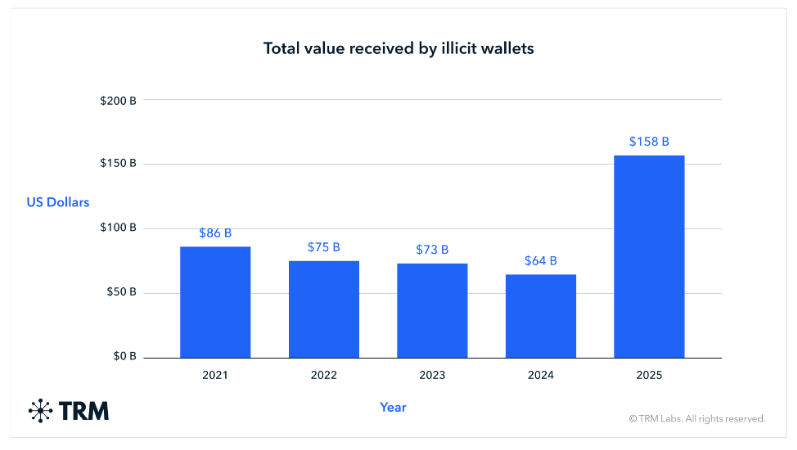
Illicit inflows to crypto assets reached a record high of $158 billion, a substantial increase due to improved monitoring that brought more illicit activity to light.
Meanwhile, scam-related wallets saw a slight decrease in proceeds to around $35 billion in 2025, from $38 billion in the previous year.
However, the total volume of criminal activity increased substantially, even as the portion attributed to scams increased marginally.
It appears that scam-detecting technology is improving, but scams are evolving rapidly. The increasing use of AI-based tools makes generic advice less helpful, as the scams now sound more authentic.
Featured image from Unsplash, chart from TradingView

Editorial Process for bitcoinist is centered on delivering thoroughly researched, accurate, and unbiased content. We uphold strict sourcing standards, and each page undergoes diligent review by our team of top technology experts and seasoned editors. This process ensures the integrity, relevance, and value of our content for our readers.
Trump administration set to nominate Kevin Warsh as next Fed chair
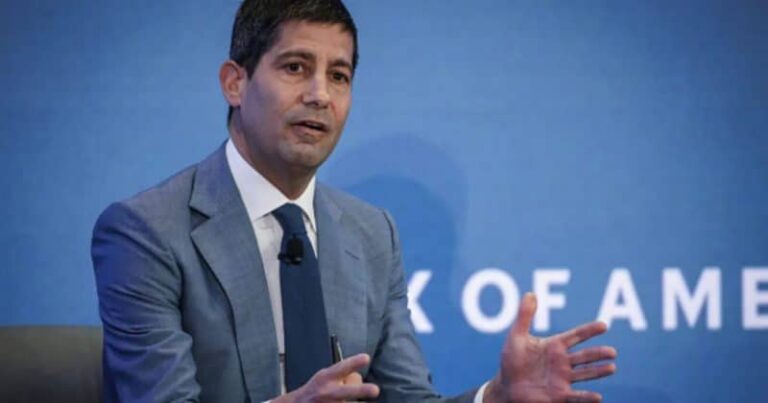
The Trump administration is set to nominate Kevin Warsh, a former Federal Reserve governor, as the next Fed chair, Bloomberg reported Thursday, citing people familiar with the situation.
Warsh, 55, visited the White House on Thursday. His selection aligns with President Donald Trump’s push for lower interest rates ahead of current chair Jerome Powell’s term ending in May.
The nomination faces potential obstacles. Senator Thom Tillis has vowed to block any Fed nominee until a Justice Department probe into the central bank’s headquarters renovation is resolved.
Warsh served as Fed governor from 2006 to 2011, becoming the youngest appointee at age 35. During the 2008 financial crisis, he acted as the Fed’s liaison to Wall Street and represented the US at the G20.
Before joining the Fed, Warsh worked as a Morgan Stanley vice president from 1995 to 2002, then served as an economic policy aide in the Bush White House.
In April 2025, Warsh addressed the Group of Thirty and the IMF on “Central Banking at a Crossroads,” advocating for transparency reforms at the Fed.
Treasury Secretary Scott Bessent listed Warsh among candidates to succeed Powell in October 2025. His hawkish stance on monetary policy could create tension with Trump’s preference for lower interest rates.
Unclaimed ETH From The DAO Hack To Be Used For Security Fund

Unclaimed Ethereum tokens from the infamous 2016 hack on The DAO will be redirected into a new security fund aimed at strengthening the network, says Ethereum advocate Griff Green.
“There’s a lot of money just sitting in random contracts that were supposed to be returned to people who were affected by the hack,” Green said in an interview on Thursday with Unchained podcast host Laura Shin, reiterating plans to launch the security fund.
The DAO was a decentralized autonomous organization that an anonymous hacker exploited in June 2016 to siphon more than $50 million worth of Ether at the time.
The incident led to a hard fork of the Ethereum blockchain to recover the funds, splitting the community and ultimately creating two separate chains: Ethereum and Ethereum Classic.
Green explained that the hard fork returned a lot of the Ether (ETH) held in The DAO to tokenholders, but the claims process was not straightforward. Green said that certain “edge cases” were handled through a multisignature wallet he joined, involving around $6 million.
While more than 80% of those funds have since been claimed, the remaining balance is now worth around $200 million. “We’re going to stake them and use the revenue to actually support Ethereum security,” he said.
Making Ethereum safer than a bank is the goal
“It makes sense that The DAO is now going to be focused on security,” Green said.
“We really want to stick to our guns with The DAO and live up to the name of The DAO, so we’re going to focus on DAO-style distributions,” he said.
Green said that while The DAO has an “incredible” pool of developers capable of identifying security projects to support, the priority will be on security distribution methods, including retroactive funding, quadratic funding, conviction voting, and ranked-choice voting, with the aim of strengthening the broader ecosystem.
Related: Bitfinex Bitcoin longs hit 2-year high: Is a rally to $100K possible?
“I really want to see The DAO security fund come to a place where people feel that it’s safer to store assets on Ethereum than in a bank,” Green said.
“The DAO really kickstarted the security industry in Ethereum,” Green added, noting that before the hack, there was effectively no audit market, but afterward, smart contract audits became widespread.
Magazine: Griff Green: Doge-loving hippy hacker steals crypto before bad guys can
Cointelegraph is committed to independent, transparent journalism. This news article is produced in accordance with Cointelegraph’s Editorial Policy and aims to provide accurate and timely information. Readers are encouraged to verify information independently. Read our Editorial Policy https://cointelegraph.com/editorial-policy
BTC could retest April’s tariff tantrum lows below $80,000

Bitcoin’s fast tumble back to $84,000 during U.S. morning hours Thursday came alongside equally speedy declines in stocks and precious metals.
But while stocks, gold and silver have since bounced off their worst levels, crypto remains near its session lows, with BTC, ether , XRP , and solana all down 5%-7% over the last 24 hours.
“Everything from weak earnings results to worries around Iran and government shutdown are causing a broad-based selloff,” said Joshua Lim, global co-head of markets at prime brokerage FalconX. “It’s triggering a bigger unwind across consensus hedge fund and commodity trading advisors positions in metals and equities.”
“And crypto also taking some pain from the general risk-off sentiment,” he added.
The Thursday selloff triggered over $650 million in liquidations of bullish leveraged positions betting on higher prices across all crypto assets, according to data from CoinGlass, the second-most-violent flush over the past month.
Funding rates suggest bottom forming
Perpetual swap funding rates — a key gauge of market froth — have now turned bearish across major tokens, including for ETH, SOL and XRP. In perpetual futures contracts, which do have expiry dates, funding rates are periodic payments exchanged between traders based on the difference between the perpetual contract price and the spot price.
When funding turns negative, it means short sellers (those betting on lower prices) are paying longs (those betting on a rebound) to maintain their positions — signaling that the majority of traders are leaning bearish.
Historically, persistent negative funding rates have often preceded short-term bottoms as overly crowded short positions become vulnerable to sudden price reversals.
Some key levels
U.S. spot bitcoin ETF buyers have an aggregate cost basis near $84,099, only barely below the current price of $84,400. Meanwhile, the True Market Mean Price, a long-term fair value derived from Investor Cap divided by Active Supply, sits just above $80,000. That $80,000 closely matches the November 2025 low, making it a key structural support zone and potential mean-reversion point.
A sustained break below $80,000, however, would likely open the door to a retest of April 2025 levels, when bitcoin briefly fell to around $76,000 amid the selloff triggered by President Donald Trump’s tariff drive.
How bad is it and what could turn things around
January isn’t over yet, but bitcoin is on track to post its fourth consecutive monthly loss — highly notable given that BTC wasn’t down four straight months even amid its 80% tumble during the crypto winter of 2022. One would have to go back to 2019 to find a streak of four consecutive lower monthly candles for bitcoin.
“The equity market has been all about the AI infra trade that is supported by deregulation and tax benefits that kick in this year,” sasaid Mark Connors, chief investment officer at Risk Dimensions. “This has overshadowed BTC, that and the standard gold lead BTC pattern we saw in 2020. I believe BTC will not take its next leg higher until we have a ‘print’ by the US.”
SEC Task Force Posts Response Backing Ripple on Passive Interest

A response posted to the US Securities and Exchange Commission’s Crypto Task Force page echoed concerns raised by Ripple that speculation alone should not automatically subject cryptocurrencies to federal securities laws, as lawmakers continue debating the CLARITY Act.
The response, written by former SEC attorney Teresa Goody Guillen and published Monday as public input on the SEC’s website, argued that holding a “passive economic interest,” such as buying a token in hopes its price rises, should not, by itself, trigger securities regulation. Guillen wrote that digital assets should instead be assessed using a broader set of factors applied on a sliding scale.
“I agree with Ripple’s assertion that “[f]rameworks suggesting that a ‘passive economic interest’ alone could trigger securities laws mistakenly conflate speculation with investment rights […],” Guillen said, citing prior academic work.
She added that her comments were not intended to set out a binding regulatory framework and did not reflect official SEC policy.
The letter is a response to Ripple’s Jan. 9 submission, which flagged multiple concerns in the existing market structure draft bill. It proposed that lawmakers should not consider the term “decentralization” as a governing legal metric, and that passive economic interests should not trigger securities laws, as they mistakenly conflate speculation with investor rights.
SEC proposes new crypto asset classification
Separately, Guillen published a discussion draft for the “Digital Markets Restructure Act of 2026” that has not been approved by leadership at the SEC or the Commodity Futures Trading Commission. The draft proposes classifying certain cryptocurrencies as “Digital Value Instruments” when they do not fit neatly into existing categories such as securities or commodities.
Related: NYSE develops 24/7 blockchain trading platform for tokenized stocks, ETFs
Cryptocurrencies would be deemed Digital Value Instruments if they exhibit at least three of five characteristics: free transferability, bearing a passive economic interest to holders, offering limited individual contractual rights to holders, holding a systemic dependency to the enterprise or protocol sponsor or lacking the ability to discipline or replace the systems affecting the instrument’s value or operations.

The draft also calls for risk-based jurisdictions for the SEC and the CFTC, federal preemptions for inconsistent state law application and safe harbor provisions to support innovation.
Related: Polymarket hit by fresh European crackdowns as Hungary, Portugal block access
The publication of the submissions comes ahead of a joint SEC–CFTC meeting scheduled for Thursday to discuss regulatory coordination on digital assets.
Initially set for Tuesday, the “harmonization” event was delayed by two days and will also feature a fireside chat with SEC Chair Paul Atkins and CFTC Chair Mike Selig.
The US Senate Agriculture Committee also delayed its markup for the crypto market structure bill after the US was hit by a severe winter storm.
Magazine: How crypto laws changed in 2025 — and how they’ll change in 2026
Cointelegraph is committed to independent, transparent journalism. This news article is produced in accordance with Cointelegraph’s Editorial Policy and aims to provide accurate and timely information. Readers are encouraged to verify information independently. Read our Editorial Policy https://cointelegraph.com/editorial-policy
Bitcoin Liquidity Remains Intact Despite Precious Metals Rally: Stablecoins Wait On The Sidelines

Trusted Editorial content, reviewed by leading industry experts and seasoned editors. Ad Disclosure
Bitcoin is struggling to regain the $88,000 level as market uncertainty persists and precious metals continue to rally aggressively. Gold’s strength has reignited a familiar narrative: that capital is leaving Bitcoin to finance the move into traditional safe havens. However, a recent report by CryptoQuant challenges this assumption, suggesting that the current market dynamics are being misinterpreted.
On-chain data indicates that Bitcoin sell-offs are not directly funding the surge in gold and other metals. Instead, liquidity appears to be pausing rather than fleeing the crypto market altogether. This behavior is reflected in the Stablecoin Supply Ratio (SSR), a metric designed to measure the purchasing power of stablecoins relative to Bitcoin’s market capitalization. The SSR offers insight into whether capital is already deployed into BTC or sitting on the sidelines, waiting for clearer conditions.
A lower SSR implies higher latent buying power, meaning stablecoins hold significant capacity to re-enter the market. Conversely, a higher SSR signals that liquidity has largely been committed to Bitcoin. Current readings suggest that capital remains in stablecoins, indicating caution rather than outright risk aversion.
In this context, Bitcoin’s weakness below $88K reflects hesitation, not abandonment. While metals benefit from defensive positioning, on-chain signals point to liquidity waiting for a renewed catalyst in crypto, rather than rotating decisively away from it.
The report adds important context by outlining key Stablecoin Supply Ratio (SSR) levels and how they frame Bitcoin’s current market structure. Historically, the SSR has oscillated within well-defined ranges. Readings above 15–16 indicate that stablecoin purchasing power is low, meaning liquidity has largely been deployed into Bitcoin.
Values between 10 and 15 represent a neutral zone, commonly associated with consolidation phases. When the SSR drops below 10–11, latent purchasing power is high, a condition that has often preceded bullish phases. Importantly, these thresholds provide structural context rather than precise timing signals.
At present, the SSR stands at 12.57, down sharply from recent highs in the 18–19 range. This decline signals a transition from fully deployed liquidity toward capital sitting on the sidelines. Despite price weakness, Bitcoin remains structurally stable, suggesting that capital is not exiting the crypto market but waiting for clearer conditions before re-entering.

Crucially, the ongoing rally in gold should not be interpreted as a direct consequence of Bitcoin selling. Large allocators typically operate within diversified, multi-asset frameworks, maintaining exposure across equities, precious metals, digital assets, and stablecoins simultaneously. The lower SSR confirms that capital is not rotating out of Bitcoin into gold, but reallocating risk while remaining within the crypto ecosystem.
Bitcoin continues to trade under pressure, with price slipping back toward the $87,500–$88,000 zone after another failed attempt to regain momentum above the short-term moving averages. On the daily chart, BTC remains decisively below the 50-day and 100-day averages, both of which are now sloping downward and acting as dynamic resistance. The 200-day moving average, still trending higher above $100,000, reinforces the idea that the broader cycle has shifted from expansion to consolidation or correction.
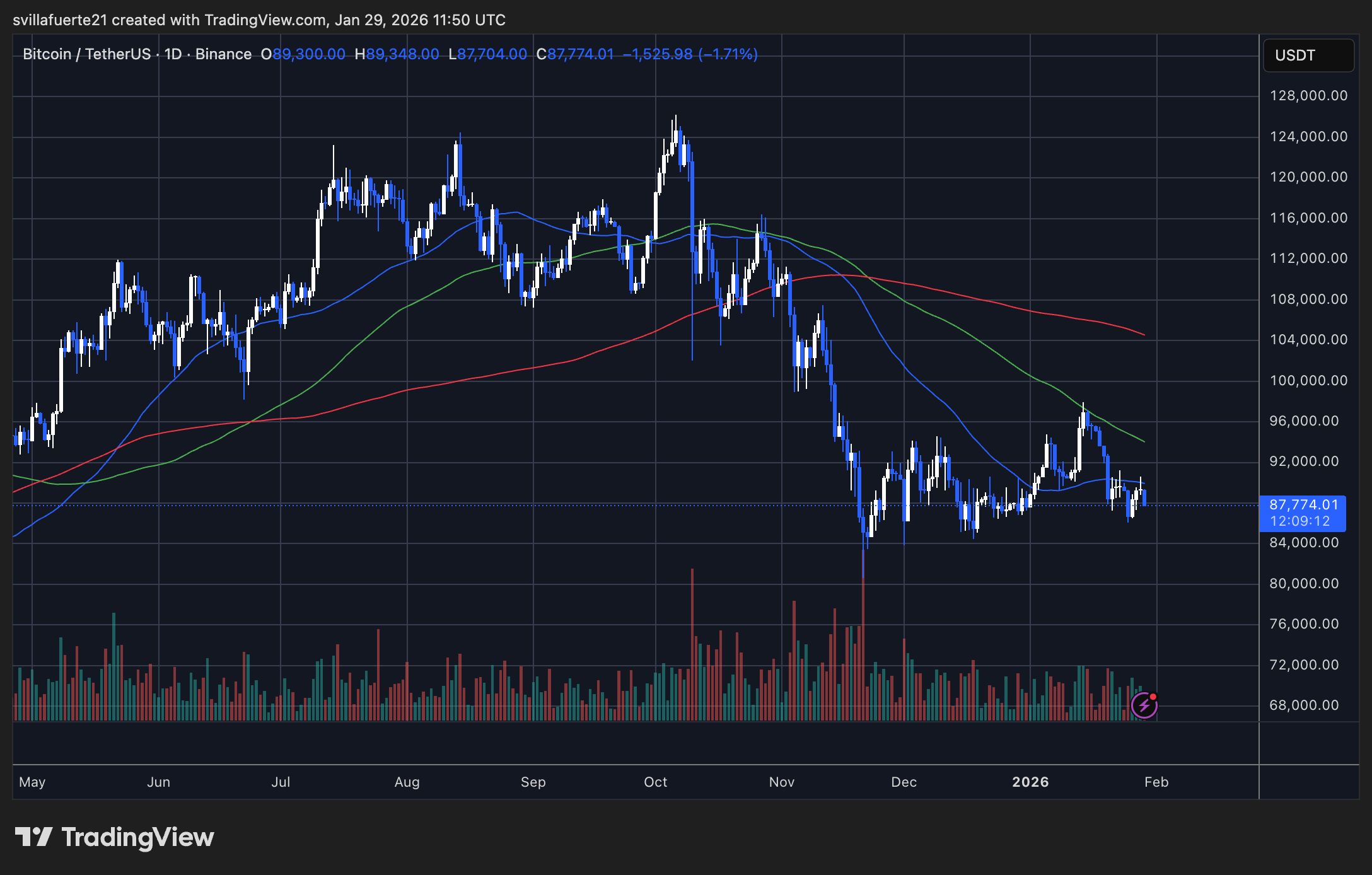
Structurally, the market is locked in a wide range following the sharp breakdown in November. Since then, price action has been characterized by lower highs and choppy rebounds, suggesting reactive buying rather than sustained demand. The recent bounce toward the mid-$90,000s was rejected precisely at the descending moving average cluster, confirming that sellers continue to defend rallies.
Volume behavior supports this interpretation. The largest spikes remain associated with sell-offs, while recovery attempts occur on relatively muted volume, pointing to limited conviction from buyers. This imbalance keeps downside risk active, even as price holds above the December lows.
In the near term, the $86,000–$87,000 area remains a key demand zone. A clean breakdown would expose lower structural supports, while holding this level keeps Bitcoin trapped in a prolonged consolidation. Until BTC reclaims its short- and mid-term averages, the chart favors caution rather than trend reversal.
Featured image from ChatGPT, chart from TradingView.com
Editorial Process for bitcoinist is centered on delivering thoroughly researched, accurate, and unbiased content. We uphold strict sourcing standards, and each page undergoes diligent review by our team of top technology experts and seasoned editors. This process ensures the integrity, relevance, and value of our content for our readers.
The heads of the SEC and CFTC strike a bullish tone on digital assets ahead of regulations
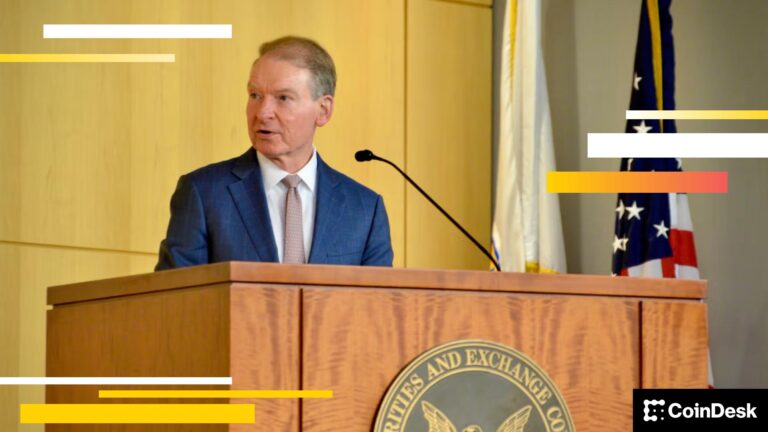
SEC Chair Paul Atkins said “the time is right” for retirement plans including 401(k)s to include cryptocurrency, while CFTC Chair Michael Selig predicted digital assets will “flourish” once Congress finalizes U.S. market structure rules.
The comments in a CNBC interview were made as Senate Agriculture Committee lawmakers began marking up a draft crypto market structure bill, legislation that could expand the Commodity Futures Trading Commission’s role and clarify oversight boundaries with the Securities and Exchange Commission. The committee took less than an hour to advance the legislation to the full Senate, though it still has a lengthy path before it can become law
“A lot of people are already exposed to crypto and other sorts of assets like that through their pension funds,” Atkins said. “I think the time is right to go forward with that,” although, Atkins said, “in a measured way that has guardrails to protect the retirees.”
The Department of Labor previously said fiduciaries should “exercise extreme care before they consider adding a cryptocurrency option to a 401(k) plan’s investment menu for plan participants.” In August 2025, President Donald Trump signed an executive order to allow crypto investments in 401(k) retirement plans, opening the gates for a $10 trillion market to flow into the asset class. The White House said at the time that alternative assets, including digital assets, offer competitive returns and diversification benefits.
Selig, for his part, said the crypto industry is at a pivotal moment with regulations on the cusp of approval, and laid out an optimistic future for digital assets. He also said it is time to bring back to the U.S. the blockchain companies that migrated elsewhere due the lack of regulatory clarity.
“Blockchain technology has now been around for about 15 years and it’s really transforming the way that these markets are really developing within our remit,” he said. “We’ve seen a lot of these technologies and assets move offshore and we want to bring them back.”
Selig expressed confidence in legislation with the collaboration between the SEC and the CFTC to finalize “the national rules of the road that will allow the asset class to flourish here in America.”
“If we can set the standard in the United States, really a gold standard for crypto asset markets we are going to see a lot of new types of products, a lot of new types of onchain markets and financial applications and that’s going to bring us into the future and make the us the premier place to do business to offer digital assets.”