
Home Blog Page 1061

BitMine Buys Over 40,000 ETH As Sell-Off Deepens, Shrugs Off Massive Paper Losses

0

Trusted Editorial content, reviewed by leading industry experts and seasoned editors. Ad Disclosure

BitMine Immersion Technologies kept buying as prices fell, scooping up 40,613 ETH during last week’s sell-off. Reports say the purchase totaled roughly $83–$84 million, made when Ether traded near $2,020 per token.

BitMine’s Growing Stake And The Man At The Helm

According to recent coverage, the move pushed BitMine’s total Ethereum holdings to around 4.32–4.33 million ETH, a stash worth billions at current prices. Executive chairman Tom Lee has framed the dip as an attractive entry point and has voiced confidence in a bounce back.

Paper Losses Widen As Prices Slide

Reports note that the firm’s large cost basis for its accumulated ETH has left its treasury sitting on multibillion-dollar unrealized losses.

Estimates in the latest pieces place those paper losses between about $7.5 billion and $8 billion, depending on which price is used to mark the holdings. That gap widened as Ether fell from higher levels into the low-$2Ks.
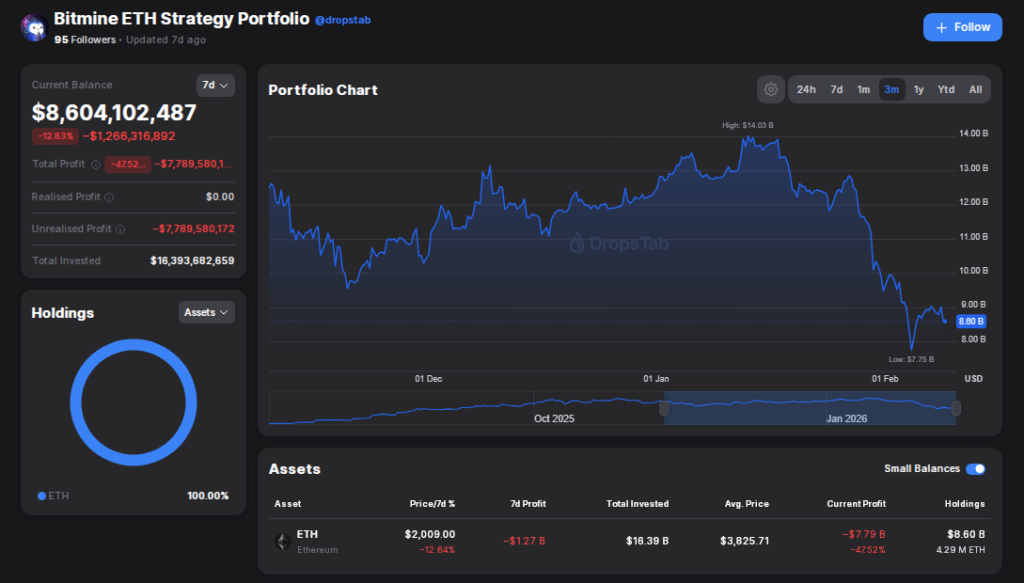
BitMine faces an estimated $7.7 billion paper loss on its ETH holdings. Source: DropsTab

Market And Shareholder Response

BitMine’s aggressive buying did not calm all investors. News outlets tracked a drop in the company’s stock (BMNR), which was reported down roughly 5% in pre-market trading around the same time the ETH buy was disclosed.

Traders appear to be weighing the long-term thesis against the immediate hit to the company’s net asset value.
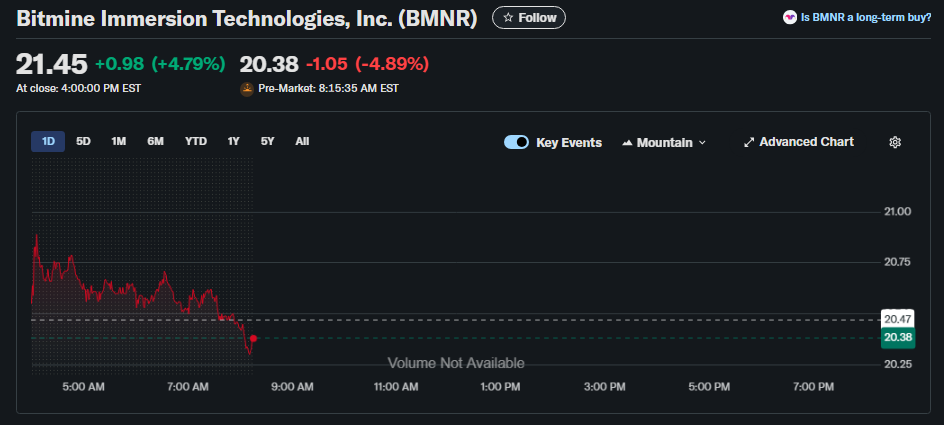
Six‑month performance of BitMine (BMNR) stock. Source: Yahoo Finance

Why The Company Is Still Adding

Reports say BitMine sees this as part of an intentional treasury play. Some of the firm’s ETH is staked, which generates yield and can help offset paper losses over time.

Tom Lee has forecast a strong rebound, calling for a V-shaped recovery in ether. That kind of outlook explains why purchases came even while the market was weak.

ETHUSD trading at $2,012 on the 24-hour chart: TradingView

What To Watch Next

Short term, price moves in ether and shifts in investor sentiment will be the clearest signals. If ETH stages a steady climb, the unrealized losses will shrink quickly.

If the token continues to trade lower, the company’s paper loss metrics will remain a headline for shareholders and analysts.

Reports say details such as financing, staking returns, and any further disclosed buys will shape how investors view the firm’s risk profile.

BitMine’s choice to keep buying at lower levels is a clear bet on future price recovery. Whether that bet pays off for shareholders depends on the market’s next moves, and on whether patience and staking income can outweigh a large short-term drawdown.

Featured image from Thomas Fuller/SOPA Images/LightRocket via Getty Images, chart from TradingView

Editorial Process for bitcoinist is centered on delivering thoroughly researched, accurate, and unbiased content. We uphold strict sourcing standards, and each page undergoes diligent review by our team of top technology experts and seasoned editors. This process ensures the integrity, relevance, and value of our content for our readers.


XRPL Prepares for Institutional Credit Use Cases With Soil’s Single Asset Vault

0

The XRP Ledger is strengthening its case as an institutional finance infrastructure as Soil introduces compliant on-chain lending vaults designed to centralize capital, automate loan tracking, and position XRPL for regulated credit markets at scale. Soil Introduces Institutional Single Asset Vault for Onchain Lending A move toward on-chain infrastructure is positioning institutional credit workflows. ORQO […]

Robinhood Launches Public Testnet for Ethereum Layer 2 Blockchain

0

The Arbitrum-based network is designed to support tokenized real-world assets and other on-chain financial services.

Robinhood has launched the public testnet for Robinhood Chain, an Ethereum Layer 2 network built on Arbitrum, which has a total value locked (TVL) of over $2.3 billion.

The testnet enables developers to start building apps and infrastructure on Robinhood Chain, which the company said is designed to support tokenized real-world assets (RWAs), lending platforms, perpetual futures exchanges, and other on-chain financial services, according to a press release viewed by The Defiant.

Johann Kerbrat, Robinhood’s head of crypto, said in an exclusive interview with The Defiant that the testnet is an early step toward building a broader on-chain financial ecosystem.

“We think that it’s really going to accelerate all the development of on-chain financial services and all this tokenization future that we’ve been talking [about] for a long time,” Kerbrat told Camila Russo, founder of The Defiant. “So the testnet is really the first step to lay down the groundwork for an ecosystem that will help define all the tokenized reward assets that we’re planning on launching.”

The move comes as more financial firms adopt on-chain technology and begin integrating products directly on blockchain networks. One area seeing especially fast growth is tokenized RWAs. Distributed Asset Value has reached $23.8 billion, up about 11% over the past month, according to RWAxyz data.

According to the release, the testnet gives developers access to basic network tools, documentation, and Ethereum development software built on Arbitrum. Robinhood said some infrastructure providers are already connecting to the network, with more expected to join as testing continues.

Developers will also gain access to testnet-only assets, including stock tokens, along with direct testing through Robinhood Wallet in the coming months.

Kerbrat described Robinhood Chain as permissionless, meaning anyone can deploy applications. However, apps that appear inside the Robinhood app would still need to meet internal product requirements, he said.

Robinhood also plans to be one of the first major builders on the network, Kerbrat said, and ultimately wants to move more of its own infrastructure on-chain.

“The first developer to build on the chain is really going to be Robinhood,” he said. “And our vision is not just to have one or two products there, but to have the entire Robinhood infrastructure to be slowly replaced by the blockchain.”

Kerbrat revealed that early partners involved in the launch include Alchemy, LayerZero, and others, which are helping support the first phase of the public testnet.

“But the more we continue to build, the more we’re going to also launch our own products that are going to be either in partnership or directly revenue-made product,” he added. “But I think for us, the idea is that it’s not just a revenue chain only, but also something that other developers can actually build on top of.”

Robinhood has already rolled out tokenized stock products in Europe, with the offerings expanding quickly – Kerbrat said they grew from about 200 assets at launch last June to roughly 2,000 today.

“So we [grew] 10x in less than a year. And that really shows how flexible our tokenization engine is,” Kerbrat said. “And we think that coming from there, we are really going to be able to use this engine for anything.”

Sub-$2K ETH Price Levels Emerge As Key Long-Term Demand Zones

0

Ether (ETH) struggled to hold prices above $2,000 on Tuesday, and against this backdrop, analysts noted that Ether’s 31% decline in 2026 fits a familiar price fractal from previous bull markets.

Key takeaways:

  • ETH’s recent dip to $1,736 may mark only the first of many lows in a larger consolidation phase.

  • Onchain cost-basis data clusters from $1,300 to $2,000, reinforcing this range as a potential demand zone.

ETH fractal hints at a longer base-building phase

A long-term fractal comparison between the 2021-2022 and 2024-2025 cycles suggests that Ether’s sharp sell-off mirrors a pattern in which an initial bottom is formed before the price revisits lower levels due to further market weakness.

On the weekly chart, ETH’s drop toward the $1,730 region resembles its “first low,” rather than a definitive market floor.

Ether fractal analysis on the weekly chart. Source: Cointelegraph/TradingView

In 2021, ETH spent 12 months consolidating around the first low ($1,730) and a lower support band ($885), allowing leverage to reset and spot demand to rebuild. 

Applying this framework, ETH may continue ranging from about $1,300 to $2,000, with downside tests toward the $1,500–$1,600 zone possible before a sustained base is formed.

Onchain cost basis data cites $1,300–$2,000 as a demand zone

Ether’s UTXO realized price distribution (URPD) data underlines the chances of an extended consolidation. Large supply clusters remain above current prices, with $2,822 accounting for 5.86% of the ETH supply and $3,119 holding 6.15%, forming heavy overhead resistance. 

Below current spot prices, notable clusters appear at $1,881 (1.58 million ETH) and $1,237, suggesting potential demand zones if the price continues to retrace.

Ether UTXO URPD distribution. Source: Glassnode

Structurally, $1,237 stands out as a potential cycle floor, followed by intermediate support near $1,584 and stronger acceptance around $1,881, where the realized supply concentration increases.

Derivatives data aligns with this view. The liquidation heat map shows cumulative long liquidations at risk of $4 billion to $6 billion, ranging to $1,455 from $1,700, and these are levels that may still be targeted by sellers. 

However, more than $12 billion in short liquidity is stacked up to $3,000, implying that once downside liquidity is absorbed, the directional bias may shift higher in the coming months.

Ether one week chart analysis. Source: Cointelegraph/TradingView

Related: Analysts debate whether Ether has capitulated or has further to fall

What is giving Ether structural support?

Data from CryptoQuant shows Ether withdrawals from exchanges have surged to their highest level since October 2025, with net outflows exceeding 220,000 ETH. Binance recorded daily net outflows of about 158,000 ETH on Thursday, the largest since August 2025. 

These flows coincided with ETH trading from $1,800 to $2,000, suggesting accumulation or risk-off repositioning at these levels.

MNCapital founder Michaël van de Poppe highlighted a similar dynamic, noting that price often lags network and narrative growth.

Stablecoin transaction volume on Ethereum has risen about 200% over the past 18 months, even as the ETH price remains about 30% lower, a divergence that may lead to a parabolic repricing for the altcoin.

Cryptocurrencies, Business, Ethereum, Markets, Cryptocurrency Exchange, Binance, Price Analysis, Market Analysis
ETH stablecoin transactions. Source: X

Related: Ethereum Foundation teams up with SEAL to combat wallet drainers