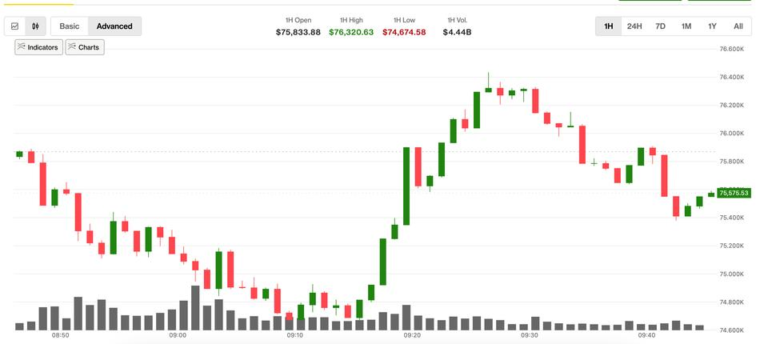
Bitcoin BTC$75,370.02 traded back above $76,000 after a short-lived break of support, where it tested $74,000, highlighting the fragile balance between dip buyers and forced sellers in a market still short on “depth.”
(CoinDesk)
The quick V-shaped move stemmed from order book dynamics where liquidity has dried, allowing buy/sell trades to have an outsized impact on the going market rate.
Crypto markets saw another wave of forced selling over the past 12 hours, with $510 million in leveraged positions wiped out. Long trades made up the bulk of losses at $391.6 million, reflecting crowded bullish positioning, while shorts accounted for $118.6 million. The imbalance points to continued pressure as prices slide into thin liquidity.
Ether led losses among major tokens, sliding more than 8% in 24 hours, with BNB, XRP and Solana also down between 4% and 6%. Lido’s staked ether mirrored ETH’s drop, while Dogecoin and TRON posted smaller but steady declines as risk appetite faded across large-cap altcoins.
This thin market depth allowed a relatively small wave of selling to break the $75,000 support and trigger leverage flushes, but equally shallow offers let dip buyers and short-covering orders lift prices just as quickly.
China, meanwhile, is providing context but not acceleration. A private manufacturing survey for January showed factory activity edging into slight expansion, while the official gauge slipped into contraction, underscoring uneven momentum in the world’s second-largest economy.
Beijing’s tightly managed yuan policy means the country’s influence on bitcoin runs less through direct capital flows and more through global dollar liquidity cycles. Marginally better factory data can ease recession fears at the edges, but without a surge in currency volatility or stimulus-driven liquidity, it, in theory, acts more as a background stabilizer than a catalyst for crypto markets.
The weekend trading window added another layer to BTC’s fragility. With traditional markets closed and large institutional desks largely inactive, order books tend to thin further, reducing the amount of capital required to push prices through key technical levels.
In those conditions, bitcoin often behaves less like a macro asset and more like a leveraged derivative of its own positioning, where funding imbalances and clustered stop orders can dictate direction for hours at a time.
For now, the rebound above the mid-$70,000s suggests the selloff functioned more as a leverage reset than a structural repricing.
Depth remains thin relative to earlier in the cycle, indicating that both downside wicks and upside squeezes can extend farther than fundamentals alone would justify.
Until deeper liquidity returns or macroeconomic drivers, such as dollar strength and real yields, shift more forcefully, bitcoin’s price action is likely to remain driven by positioning and market plumbing rather than by decisive economic catalysts.
Bitcoin’s BTC$75,780.00 price action looked strangely lethargic early last month even as traditional assets such as precious metals and equities pushed to fresh highs.
The world’s largest cryptocurrency repeatedly failed to clear the $90,000 level — a stall that, in hindsight, foreshadowed the recent sharp sell-off to $75,000.
At the time, traders blamed everything from a flight to safer assets and fading crypto demand to churns in spot ETF flows and month-end positioning. But some analysts say the real story was visible well before prices broke down — sitting in plain sight in exchange order books.
According to Keith Alan, co-founder of trading analytics firm Material Indicators, order-book data showed persistent sell-side pressure below $90,000 that consistently smothered upside momentum, even when broader market conditions appeared supportive.
In posts on X, Alan said Material Indicators’ FireCharts tool showed repeated waves of visible sell liquidity appearing just above spot prices, effectively pinning bitcoin near the lower end of its range.
FireCharts shows $BTC price is being suppressed by one entity using a liquidity herding strategy to push price lower, potentially to get their own bids filled, or possible to keep price pinned in the lower end of this range before Friday’s options expiry.
He described the behavior as a form of “liquidity herding,” where large orders shape market behavior by nudging price toward levels that benefit the dominant participant.
Think of it like a crowded auction where one very large player controls the room. By placing sizeable sell orders where everyone can see them, buying appears risky. As buyers hesitate, price drifts sideways or lower, allowing that player to quietly accumulate at more favorable levels.
This tactic doesn’t rely on news or fundamentals. It uses the order book itself to influence behavior — and it often shows up around options expiry, when keeping price within a specific range can reduce losses or improve payouts for large traders.
At the same time, order-book data showed a dense cluster of bids building between roughly $85,000 and $87,500. That zone repeatedly absorbed sell pressure and acted as a near-term floor during bitcoin’s consolidation phase.
“If that support held, it was seen as a potential base for another attempt higher,” Alan said at the time. “But once it breaks, things can unwind quickly.”
That warning proved prescient. When bitcoin finally slipped below the lower end of that bid cluster, selling accelerated rapidly as thin liquidity amplified each move. The breakdown marked a decisive failure of the range that had contained prices for weeks.
Bitcoin tested lows near $74,000–$76,000 over the weekend, highlighting a fragile battle between dip buyers and forced sellers in a thin market.
BTC in “bearadise”
Meanwhile, Alan had previously warned that a monthly close below roughly $87,500 — the opening level for 2026 — would represent a clear technical failure. He referred to such a scenario as a move into “Bearadise,” shorthand for a phase where downside momentum feeds on itself as confidence erodes.
Large players influencing short-term price action through liquidity placement is not new in crypto markets.
Whales and high-frequency traders have long used visible order-book depth to shape expectations, often trapping smaller traders on the wrong side of the move.
In hindsight, however, the same order-book dynamics that kept bitcoin pinned below $90,000 also left it vulnerable once support gave way.
Layer 1 blockchain Story Protocol has delayed the scheduled unfreezing of its $IP token by six months, opting to keep a larger share of supply locked for longer as debate intensifies over how crypto projects manage token releases.
In a statement, Story said the decision is part of a broader set of long-term measures aimed at strengthening alignment with its community and reinforcing the network’s economic foundations, describing the delay as a way to introduce new liquidity more gradually alongside lower emissions and wider participation.
“When we launched Story, our mission was to build foundational infrastructure for programmable intellectual property,” Story said in a statement. “While that mission remains unchanged, our understanding of where the strongest traction is forming, and what long-term success requires has continued to evolve.”
The $IP token is trading around $1.45 to $1.50 right now. That’s down about 32% over the past 30 days, worse than the CoinDesk 20 Index’s 22% drop, highlighting the tough market conditions Story mentioned.
Under the revised schedule, the first major release of previously locked team, investor, and early contributor tokens will shift from February 2026 to August 2026.
Story says the change doesn’t touch the total 1 billion token supply, individual allocations or legal ownership, and only alters the timing at which locked tokens may enter circulation. The foundation added that an automated smart-contract mechanism has been introduced to enforce the updated lockup terms, while emphasizing that it does not gain custody of wallets or the ability to move tokens.
Token unlocks are closely watched events in crypto markets because sudden increases in circulating supply can weigh on prices, and recent research has suggested that large releases often lead to delayed selling pressure rather than immediate rebounds.
Analysts frequently point to so-called low-float, high-fully-diluted-valuation launches, where a small portion of tokens trade freely while most remain locked, as a source of volatility and investor distrust when vesting periods expire.
On-chain metrics compiled by DeFiLlama show Story has had nearly non-existent activity so far, with less than $100 in daily on-chain revenue, underscoring how much of the token’s $500 million valuation remains tied to future expectations rather than present cash flow.
Late last year, Story’s co-founder Jason Zhao announced he was stepping back from day-to-day operations to join a new AI venture.
A major market downturn that saw crypto markets lose $250 billion in total capitalization over the weekend is due to a shortage of US liquidity, rather than any crypto-specific problem, argues Raoul Pal, founder and CEO of Global Macro Investor.
“The big narrative is that BTC and crypto are broken. The cycle is over,” said Pal on Sunday, explaining that this can’t be the case because Software as a Service (SaaS) stocks have fallen in tandem.
SaaS stocks and Bitcoin (BTC) have moved in lockstep recently, both dropping significantly, which is notable because both are “long-duration assets,” as their value is based heavily on expected future cash flows and adoption, making them sensitive to liquidity conditions and interest rates, he said.
This means the same narrative applies: people say “crypto is dead” and that AI is replacing software firms.
It also supports the same common cause, since two completely different asset classes are moving in lockstep, suggesting the real driver is macro liquidity, not sector-specific problems.
“The rally in gold essentially sucked all marginal liquidity out of the system that would have flowed into BTC and SaaS. There was not enough liquidity to support all these assets, so the riskiest got hit.”
UBS Saas Index and BTC are highly correlated. Source: Raoul Pal
Government shutdowns add to liquidity drain
The temporary US liquidity drain has been exacerbated by the two government shutdowns and “issues with US plumbing.” The Reverse Repo drain was essentially completed in 2024, said Pal.
The Reverse Repo Facility (RRP) is where banks and money market funds park cash overnight at the Federal Reserve.
Related: Bitcoin price forecasts tap sub-$50K levels as BTC copies old bear markets
Previously, when the US Treasury rebuilt its cash account (TGA), the negative liquidity impact was offset by the draining of the RRP. But now that the RRP is empty, there’s no offset available, so TGA rebuilds become pure liquidity drains, he explained.
Raoul Pal dismisses recent Fed chair narrative
Jeff Mei, chief operations officer at the BTSE exchange, told Cointelegraph that crypto is dropping “because investors now are under the impression that new Fed chair, Kevin Warsh, may not cut interest rates as fast or as much as they expected, given his tough stance on inflation and quantitative easing.”
However, Pal dismissed concerns about Trump’s Federal Reserve pick being hawkish, arguing that “Warsh’s job and his mandate are to run the Greenspan era playbook.”
This means cutting rates while letting the economy run hot, banking on AI productivity gains to control inflation.
“Warsh will cut rates and do nothing else. He will get out of the way of Trump and Bessent, who will run liquidity via the banks,” he said.
Pal closed on a bullish note, stating that the liquidity drain is almost over.
“We just can’t get every moving part right, but we now have a better understanding, and we remain HUGE bulls for 2026 because we know the Trump/Bessent/Warsh playbook.”
Magazine: A ‘tsunami’ of wealth is headed for crypto: Nansen’s Alex Svanevik
Cointelegraph is committed to independent, transparent journalism. This news article is produced in accordance with Cointelegraph’s Editorial Policy and aims to provide accurate and timely information. Readers are encouraged to verify information independently. Read our Editorial Policy https://cointelegraph.com/editorial-policy
The Zamoskvoretsky Court in Moscow has reportedly ordered BitRiver CEO Igor Runets to remain under house arrest amid tax evasion charges.
The founder and CEO of Russian Bitcoin mining firm BitRiver, Igor Runets, has reportedly been detained and charged with multiple counts of tax evasion.
According to reports from local media outlets such as RBK and Kommersant on Sunday, Runets was detained on Jan. 30 and is facing three charges for allegedly concealing assets to evade taxes.
The outlets cite court documents from the Zamoskvoretsky Court of Moscow, which indicate that Runets was charged on Jan. 31 and ordered to be placed under house arrest on the same day.
Runets’ legal team now has a small window to appeal the house arrest before it becomes fully enforceable on Feb. 4. If an appeal is unsuccessful or not filed, Runets will remain home-bound for the entirety of the case.
Cointelegraph has reached out to Runets for comment.
CEO Igor Runets speaking at the Russian-Arab Business Council Forum in 2020. Source: Igor Runets
BitRiver was founded in 2017 and has become one of the biggest names in Russian Bitcoin mining, operating large-scale data centers across Siberia that also provide crypto mining services to other companies.
In late 2024, Bloomberg reported that Runets’ net worth had hit around $230 million from his involvement in crypto mining.
Issues piling up for BitRiver
The firm has faced several challenges since it was first hit with sanctions by the US Treasury Department in mid-2022 in response to the Russia and Ukraine conflict.
In May 2023, one of its major clients, Japanese banking giant SBI, stopped utilizing the firm’s infrastructure for Bitcoin mining after pulling out of Russia due to the ongoing conflict.
Related: Russia-linked A7A5 stablecoin processed $100B before sanctions hit: Elliptic
The report from Kommersant claims that BitRiver began cost cuts across the company and scaled back operations towards the end of 2024, which was followed by delayed salary payments for employees.
In early 2025, the firm was hit with two lawsuits by electricity provider Infrastructure of Siberia, alleging they had paid BitRiver as part of a contracted agreement to purchase equipment but never received the equipment after paying.
Magazine: 6 weirdest devices people have used to mine Bitcoin and crypto
Cointelegraph is committed to independent, transparent journalism. This news article is produced in accordance with Cointelegraph’s Editorial Policy and aims to provide accurate and timely information. Readers are encouraged to verify information independently. Read our Editorial Policy https://cointelegraph.com/editorial-policy
Trusted Editorial content, reviewed by leading industry experts and seasoned editors. Ad Disclosure
Bitcoin’s sudden break below $80,000 in the past 24 hours has led to one of the most violent liquidation events in crypto history. Traders digest the fallout from this crash, but there is much attention on large institutional holders, particularly Michael Saylor’s Strategy, whose massive Bitcoin position is now trading uncomfortably close to its average acquisition cost.
Why This Bitcoin Crash Turned Brutal So Quickly
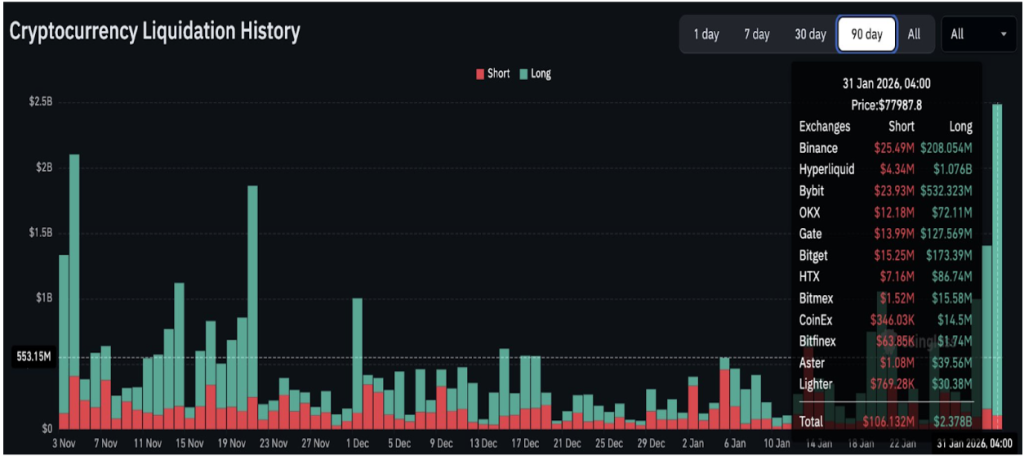
The entire crypto industry is currently witnessing one of its most brutal crashes in history, led by Bitcoin and Ethereum. Notably, about $2.51 billion in leveraged positions were wiped out in a single session, placing this event among the 10 largest liquidation cascades the crypto market has ever recorded. For context, the Covid-era crash liquidated about $1.2 billion and the FTX collapse led to around $1.6 billion in liquidations.
Crypto Liquidation History. Source: @AshCrypto On X
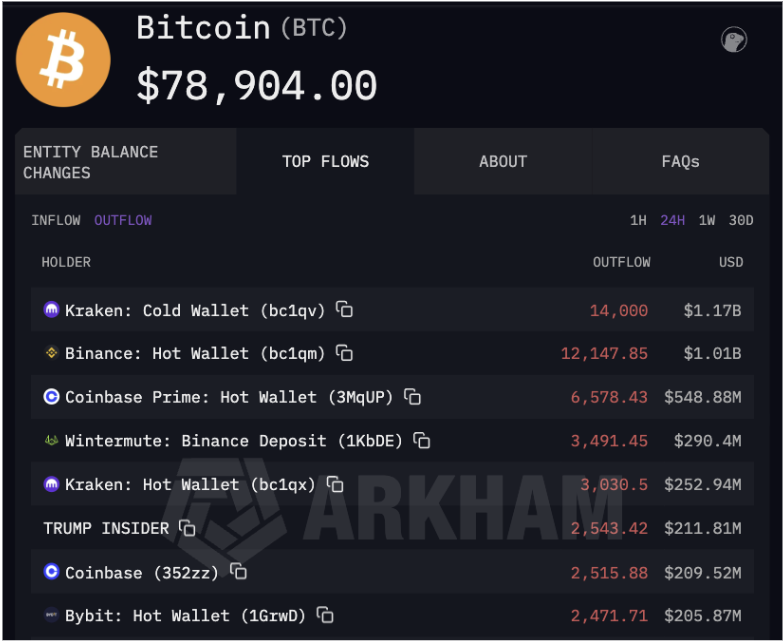
According to Arkham Intelligence, large entities aggressively moved Bitcoin onto exchanges in the hours surrounding the crash. Kraken alone dumped about 17,030 BTC into the market, Binance followed with about 12,147 BTC, and Coinbase added another 9,093 BTC. Wintermute, a major market maker, dumped 3,491 BTC, while wallets labeled as Trump Insider and Bybit dumped 2,543 BTC and 2,471 BTC, respectively.
Together, these transfers contributed to a streak of liquidations as positions that saw Bitcoin lose the $80,000 price level without much resistance.
As one of the largest corporate holders of Bitcoin, Strategy has felt the impact of the recent crash more directly than most, leaving its Bitcoin position hovering just above loss territory.
The company currently holds 712,647 BTC, valued at $55.72 billion based on current price levels. Those holdings were accumulated at an average price of $76,037 per Bitcoin, putting Strategy only about 1.8% above breakeven following the sell-off.
BTCUSD currently trading at $78,361. Chart: TradingView
The margin for error has narrowed massively, but the holdings are still technically in profit for now. To put this in context, Strategy’s stash was worth about $81 billion when Bitcoin peaked around $126,000, despite the company holding about 70,000 fewer BTC at the time.
It has now been 2,000 days since Strategy formally adopted the Bitcoin Standard. That decision has progressively connected the company’s financial performance to Bitcoin’s price action.
At the time of writing, Bitcoin is trading around $78,500. A further decline of 3% from current levels would be enough to push Strategy’s Bitcoin position into the red on paper and change the narrative from unrealized gains to unrealized losses. In that scenario, the company may soon find itself defending its Bitcoin strategy in a bearish environment.
Featured image from Unsplash, chart from TradingView
Editorial Process for bitcoinist is centered on delivering thoroughly researched, accurate, and unbiased content. We uphold strict sourcing standards, and each page undergoes diligent review by our team of top technology experts and seasoned editors. This process ensures the integrity, relevance, and value of our content for our readers.
Silver plunged more than 35% on Friday to around $74, marking its largest intraday decline ever recorded, before rebounding to roughly $82 at press time. Gold fell more than 12% to near $4,700 after touching record highs above $5,500 earlier in the week.
The selloff followed a historic rally that saw silver surge past $120 and gold climb to unprecedented levels, driven by inflation hedging, dollar weakness, and speculative momentum. Friday’s sharp reversal reflected a sudden shift in sentiment as traders moved to lock in profits amid rising macro uncertainty.
Volatility in metals coincided with a broader risk-off move after President Donald Trump named Kevin Warsh as his pick to lead the Federal Reserve. Warsh is widely viewed as more hawkish, easing investor concerns about central bank independence and signaling a less accommodative path for interest rates.
Bond markets reflected that repricing, with the 10-year Treasury yield climbing to around 4.25%. The US dollar index, which had touched a four-year low earlier in the week, rose about 0.7% as rate expectations firmed.
Silver’s collapse erased more than $1.8 trillion in market capitalization as prices fell from near $110 to the mid-$70s. Even after the rebound, silver’s market value stands near $4.2 trillion.
The drop allowed NVIDIA to overtake silver, becoming the world’s second-largest asset by market capitalization at roughly $4.6 trillion, according to Companies by Market Cap data.
Gold’s rally could push into uncharted territory as investors rethink portfolio defenses, with JPMorgan signaling that shifting household and central bank behavior may drive prices far beyond recent records amid persistent global uncertainty. Gold Momentum Builds as JPMorgan Cites Technicals Pointing Toward $8,000 Gold’s surge is drawing renewed attention as forecasts point to dramatically higher […]
Today’s cyber threat landscape is constantly expanding and evolving. On top of that, threat actors’ attack tactics are increasingly complex and difficult to detect. It can be challenging for organizations to keep up with all the new technologies they are adopting, how and where they are being used, who is using them, and whether they are critical for operations.
Without an understanding of all of these components, it can be difficult—if not impossible—to properly secure your organization and meet all of your compliance and regulatory requirements.
Where do you begin? Before you get busy inventorying assets and seeking out vulnerabilities and other security issues, take a closer look at today’s threat landscape and what it could mean for your organization. Here are 6 reasons why today’s cybersecurity landscape is so complex.
The pandemic changed how we work. Lockdowns and social distancing forever altered how many organizations once thought of required on-site work. As such, many had to rapidly adopt new technologies to support a mobile workforce, even sometimes as a determinant of the organization’s cybersecurity and compliance. Today, there are more technologies, more cloud-based and SaaS-based solutions and services, and more chances for threat actors to find a weakness or vulnerability you may have missed.
Working from home doesn’t mean employees are doing homework on cybersecurity.Many workers moved out of the office and into home offices during the pandemic and a lot of companies have decided to keep either fully remote or hybrid teams going forward. While there are many benefits, there is also increased risk. Moving parts of your operation out of on-site and into homes and public spaces like coffee shops makes it incredibly difficult to stay on top of what everyone is doing. Are they using approved devices? Are their networks secure? Do they understand—and have they been properly educated and trained on—cyber hygiene best practices? Ifnot, more risks here mean more headaches for your security and compliance teams.
More threat actors with more focus on you. In the past, many smaller and mid-sized organizations felt as though their risk of a cyber incident or breach was low, primarily based on their size. The thought was, why go after me when there are much larger organizations out there? Yet, if we have learned anything from the increase in ransomware, phishing, and social engineering attacks, it is that any organization of any size in any industry is at risk. If you’ve got sensitive data in your networks, there’s a good chance an attacker will focus on you.
More regulations and requirements. There are a growing number of security and compliance requirements for organizations. There are now more industry-specific controls and requirements. In the U.S., more states are now adopting privacy and security standards. Even the federal government is changing the way it approaches cyber incidents and events. Abroad, regulations like the EU’s GDPR requirements, reach around the globe. As the number and types of regulations increase, it becomes increasingly complex to manage them all and meet all necessary standards and expectations.
The supply chain is longer. Traditionally, when we’ve talked about the supply chain, it’s been in terms of products and goods. However, today, with more cloud-based and SaaS systems and services integrated into the modern workforce, the supply chain has also become virtual and it’s also highly connected. While your organization might work directly with one vendor for one service, that vendor may contract with many other vendors to develop their product to deliver that service for you. The longer your supply chain is, the greater the risk.
Increased geopolitical issues and weather–related events. Around the world, we’re experiencing a vast number of geopolitical events that have far-reaching impacts outside of their specific location. For example, the conflict in Ukraine negatively affected fuel supplies in the UK and elsewhere, increasing prices and forcing governments to rethink how they receive and deliver critical services. On top of that, we’re seeing an increased number of weather-related events causing disruptions, and often, many organizations experience more than one disruption at a time. The more of these events that pop up, the more far-reaching their impacts are, and the more risks it creates, adding a new level of challenges for cyber and compliance professionals.
While the comment came from a social media post, the painful knee-jerk reaction is likely reverberating across the board for anyone even remotely interested in crypto, as bitcoin just plunged to near $77,000 on Saturday and has held there since.
The price of the largest digital asset didn’t just stumble; it plunged through the $80,000 floor, hitting levels not seen since the “tariff tantrums” of April 2025.
By Saturday afternoon, in thin weekend liquidity, at just above $77,000, bitcoin had seen a staggering $800 billion in market value vanish since its October peak above $126,000, and about $2.5 billion in leveraged long positions liquidated in 24 hours.
The wipeout has even pushed bitcoin out of the global top 10 assets, where it had been for a long time, now trailing institutional heavyweights like Elon Musk’s Tesla and Saudi Aramco.
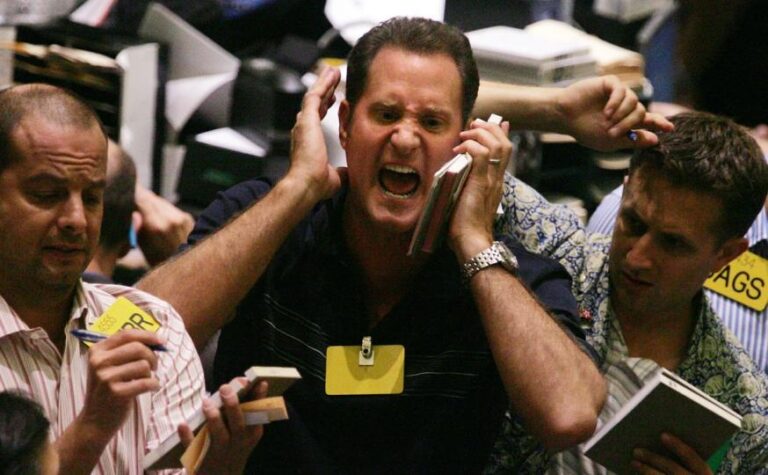
To say that this selloff has been painful would be putting it mildly, as social media is in full-blown panic mode, and wherever you look, there is blood on the street. And this is not just isolated to bitcoin; this week has been painful across all asset types, from tech stocks to precious metals.
Historic week of downturns (Max Crypto/X)
If you’re wondering why the “digital gold” narrative has suddenly gone silent, here is the breakdown of the three-headed monster currently driving the market into a state of “Extreme Fear.”
1. Geopolitics rattles the ‘safety’ trade
The immediate spark on Saturday was a literal explosion. Reports of a potential sharp military escalation between the U.S. and Iran sent risk appetite into a deep freeze. In a repeat of a familiar script, traders didn’t treat bitcoin as a safe haven; they treated it as a liquidity source.
In times of war, investors typically engage in a “flight to safety,” moving capital into the U.S. Dollar. Because bitcoin is a 24/7 market, it often acts as the “first responder” to global panic. On Saturday, it served as the world’s ATM, being sold off to cover losses and find safety amid a thin, low-liquidity weekend.
Not to mention that liquidity, since the Oct. 10 crash (which has many pointing fingers at Binance), has never recovered, making market dynamics even more fragile heading into this weekend.
2. Gold and silver face a ‘hard money’ reset
Bitcoin wasn’t the only victim this week. The broader “store of value” trade came under siege. Gold plunged 9% in a single trading session on Friday to just under $4,900, while Silver suffered a historic 26% crash to $85.30.
In a bizarre twist, the traditional “safe havens” of gold and silver are being sold off alongside crypto. Analysts suggest that the massive rally in the U.S. Dollar — ignited by the nomination of Kevin Warsh to lead the Fed—has made these dollar-priced metals too expensive for international buyers, leading to a massive “de-risking” across all hard assets.
In early Sunday trade, both gold and silver are bouncing from that difficult Friday, up 1% and 3%, respectively. Currently, gold is trading near $4,730 and silver around $81.
3. The ‘liquidation trap’
The geopolitical shock hit a market already “bruised” by Washington’s shifting political landscape. As the price slipped, it triggered a massive mechanical breakdown in the markets.
According to data from Coinglass, over $850 million in bullish bets (long positions) were wiped out in a matter of hours on Saturday when prices started to crumble, eventually adding up to nearly $2.5 billion. These liquidations occur when traders borrow money to bet that the price will rise; once the price hits a certain “trap door,” exchanges automatically sell their holdings to repay the debt. This creates a “domino effect” — forced selling leads to lower prices, which trigger even more liquidations. Across the board, nearly 200,000 traders had their accounts “blown out” on Saturday.
4. Michael Saylor’s very bad day
To make matters worse, bitcoin’s price plummeted briefly below Michael Saylor’s Strategy (MSTR) average entry point of approximately $76,037, putting his massive bitcoin stack “underwater.” Panic set in that he might have to be forced to sell his stash, making the selloff even deadlier.
However, CoinDesk debunked that theory, explaining that Saylor won’t be forced to sell his bitcoin stash, given none of his coins are pledged as collateral. What it does mean, though, is that it will hinder his ability to raise cheap capital to buy more bitcoin in the open market.
Although Saylor later came out signaling that he would “buy the dip, the damage was done. The market realized that if a large corporation, such as Strategy, can’t raise more capital to buy bitcoin in the open market, the already fragile market will be left with no buyers, becoming vulnerable to forced liquidations and profit-taking.
Consequently, the sentiment has shifted from “moonshot” optimism to defensive hedging, as investors rush to buy price insurance in the options market against further slides toward $75,000.
5. Wall Street on edge: U.S. futures turn red
The contagion is already leaking into traditional finance.
While the New York Stock Exchange is closed for the weekend, U.S. Stock Futures, which opened for trade on Sunday evening (U.S. East Coast time), are lower across the board; the Nasdaq is down 1% and the S&P 500 is off 0.6%.
Get ready for a potential messy Monday!
6. Whales vs. the world: a tale of two investors
Perhaps the most telling part of this crash isn’t the price; it’s the wallet data.
According to Glassnode data, small investors are running. “Small Fish” (holders with less than 10 BTC) have been persistently selling bitcoin for over a month. They are capitulating, spooked by a 35% drop from the $126,000 all-time high.
Meanwhile, “mega-whales” (those holding 1,000+ BTC) have been quietly adding to their stacks. This cohort is now back at levels not seen since late 2024, effectively absorbing the coins that panicked retail traders are dumping. Although their buys weren’t significant enough to move the price upwards.
7. Bigger picture: The inevitable human greed
Now let’s zoom out and compare this weekend’s selloff and current market dynamics with those that played out before.
To be clear, this cycle is not all doom and gloom. The likes of BlackRock and JPMorgan of the traditional finance have been going all in on crypto through exchange-traded funds and stablecoins. Regulatory frameworks are being created around the world to make crypto more accessible and usable for the masses, and many legitimate crypto companies are trading publicly and turning into part of many fund managers’ “must-have” stock allocations. None of these were even remotely thinkable during previous cycles.
But the parallels between the last four months and the beginnings of the crypto winter in late 2021/early 2022 are perhaps growing, and while the names and methods may have changed, human behavior and the boom-bust nature of markets haven’t.
The likes of Three Arrows Capital, Do Kwon and TerraUSD, BlockFi, and Sam Bankman-Fried might have been replaced by the Trump family’s alleged naked profiteering, Michael Saylor’s massive buying and promises of an 11% risk-free rate in a world of 3% risk-free rates, and well-followed crypto Twitter personalities who teamed up with investment bankers to make a quick buck in digital asset treasury companies.
Just as in 2021, these new dynamics have probably created a speculative bubble that has likely collapsed in 2026. The only question now is how long and how deep the downturn will be.
While no one has fond memories of the 2022 crypto winter — with the price of bitcoin falling 80% — the timeline was relatively brief, roughly one year from the blowoff top to the bottom. From there, bitcoin quickly doubled in price, rose through 2023, and ultimately hit a new record in early 2024.
In theory, if there were another 80% decline from the October 2025 high of $126,000, bitcoin would be around $25,000. It’s a scary number to even think about, but it might be necessary to wipe out the worst of this past bull-market grift and clear the decks for another sustained run higher.
The denouement of the 2022 bear market came not far after the collapse of FTX and the arrest of its CEO, Sam Bankman-Fried. Whether bracelets will be necessary for any of this cycle’s bull market personalities remains to be seen.
“It’s only when the tide goes out that you discover who’s been swimming naked,” said Warren Buffett. The tide may not be fully out yet, but it surely feels like it’s headed that way.
Read more: How instant gratification is sucking the air out of the bitcoin market