The Flare blockchain has introduced lending and borrowing for XRP-linked assets through an integration with Morpho, a crypto lending protocol that runs across multiple Ethereum compatible chains.
The update lets users lend and borrow with FXRP, a version of XRP designed for use on Flare, the team behind the blockchain said on Monday. Flare pitched the move as a step toward giving XRP holders more ways to earn yield and use their tokens beyond holding or trading.
For years, XRP has had fewer decentralized finance (DeFi) options than tokens built on smart contract networks. Flare has been trying to change that by building tools that let XRP be used in onchain apps while keeping the original XRP on the XRP Ledger.
FXRP holders can now deposit their tokens to earn interest, or use FXRP as collateral to borrow other assets such as stablecoins.
Flare said these positions can also be combined with other features on the network, including staking and yield products, for users who want more active strategies.
Morpho works differently from older lending apps that mix many assets into one shared pool. Each lending market is set up with one collateral asset and one borrowed asset, and the rules for that market are set when it is created. This structure is meant to keep problems in one market from spilling into others.
The first access point is Mystic, a separate app that shows the available vaults and lets users deposit funds or borrow against collateral. Flare said more ways to access the markets may be added later, including through Morpho’s main app.
Some vaults are being offered by independent curators, including Clearstar. These vaults include options backed by FXRP, Flare’s own token FLR and USDT0.
The rollout is part of a broader push by several networks to bring lending and borrowing to large token communities that have mostly stayed outside of onchain finance.
Bitcoin-backed borrowing at the Gibraltar-based Xapo Bank is increasingly being used for long-term financial planning rather than short-term liquidity, according to the bank’s 2025 Digital Wealth Report.
Shared with Cointelegraph, the report says 52% of the Bitcoin-backed loans issued by Xapo in 2025 carried a 365-day term, with many of those loans remaining open even as new loan creation slowed later in the year.
The bank, which primarily caters to high-net-worth individuals and private clients, said the trend reflects members using Bitcoin as collateral to unlock liquidity while preserving long-term exposure, rather than tapping loans for temporary cash needs.
“Long-term Bitcoiners, many of whom are now holding the majority of their wealth in Bitcoin, finally felt comfortable taking some profit,” the report said. “At the same time, the underlying conviction didn’t waver. Most of our long-term members continued to hold the bulk of their Bitcoin through periods of heavy market movement.”
The data comes from Xapo’s first calendar year of operating its Bitcoin-backed lending product, which allows qualified clients to borrow US dollars against their Bitcoin holdings. It offers a view into how Bitcoin is being used inside regulated banking rails as productive collateral integrated into longer-term financial planning.
From launch narrative to observed behavior
Xapo launched its Bitcoin-backed USD loans on March 18, 2025, targeting long-term Bitcoin holders seeking liquidity without selling their assets.
At the time, the bank positioned the product as a conservative alternative to earlier crypto lending models, offering loan terms of up to 365 days and relatively low loan-to-value ratios.
Xapo Bank CEO Seamus Rocca previously told Cointelegraph that growing confidence in Bitcoin’s long-term outlook was encouraging holders to borrow rather than liquidate their positions, signaling a shift away from short-term speculation toward longer-term thinking.
The 2025 report suggests that expectation has materialized in practice. While loan issuance moderated later in the year, outstanding loan balances continued to grow, indicating that borrowers were keeping loans open rather than using them as short-term liquidity tools.
Related: 60% of top US banks are geared up for Bitcoin: River
Rocca said in the report that the pattern reflects “disciplined, private-bank-style financial behaviour,” with members using Bitcoin as productive capital rather than a short-term liquidity tool.
Loan volumes are also concentrated in regions like Europe and Latin America. According to Xapo Bank, the two regions accounted for 85% of total loan volume, at 56% and 29% respectively.
Members’ BTC holdings, per region, quarter-on-quarter. Source: Xapo Bank
Magazine: DAT panic dumps 73,000 ETH, India’s crypto tax stays: Asia Express
Cointelegraph is committed to independent, transparent journalism. This news article is produced in accordance with Cointelegraph’s Editorial Policy and aims to provide accurate and timely information. Readers are encouraged to verify information independently. Read our Editorial Policy https://cointelegraph.com/editorial-policy
Ether’s weekend slide at the turn of February revived a familiar question: is the Ethereum network falling behind newer competitors or struggling to justify its valuation?
As ETH plunged by as much as 17% alongside most of crypto, skeptics wondered whether this was a warning sign that the protocol’s dominance may be eroding.
Yet inside Ethereum’s ecosystem, the sell-off has not been met with the same alarm. Developers and long-term players largely framed the move as a market-driven correction rather than a verdict on Ethereum’s health.
By several measures, network activity remains near peak levels. “Ethereum TVL is actually near all-time highs when denominated in ETH,” said Sam Ruskin, an analyst at Messari, suggesting capital has not meaningfully fled the ecosystem even as the token’s dollar price slipped.
(ETH TVL denominated in ETH/ DefiLlama)
Other indicators point in the same direction. The entry queue for ETH staking — the wait validators face to help secure the network — has stretched to roughly 70 days, a signal that demand to commit capital to Ethereum, especially among large institutions, remains strong despite short-term volatility.
That resilience is also showing up across decentralized finance, where activity has held up even as prices have soured. Traders and users are still engaging with onchain applications in search of yield, a sign that usage has not evaporated alongside sentiment.
“We’re still growing and getting more users and revenue, but token price is lagging,” said Mike Silagadze, the CEO of ether.fi, one of the largest restaking networks, to CoinDesk over Telegram. “We’re just focusing on the long run.”
Some market observers argue that the price move itself is being overinterpreted. Marcin Kazmierczak, CEO of blockchain data firm RedStone, said ether’s decline looks more like market “noise” than a signal of weakening fundamentals, particularly as retail trading activity fades. What matters more, he said, is a level of institutional conviction around onchain finance that he hasn’t seen before.
“The absence of retail excitement is actually refreshing – the next cycle will be driven by real adoption, not memes, and it allows builders to focus on creating long-term value,” Kazmierczak added.
That disconnect between price action and progress on the ground is a familiar pattern in Ethereum’s history. Periods of market turbulence have often coincided with some of the network’s most consequential development milestones, as builders continue to ship regardless of short-term sentiment.
“As we have seen with the Merge, the market is pretty bad at pricing in the fundamental technical realities of chains,” said Marius Van Der Wijden, a core developer at the Ethereum Foundation, noting that major technical changes are often only fully reflected in prices well after they are completed.
For some analysts, the divergence between price and onchain data reflects broader market dynamics rather than Ethereum-specific weakness. Ruskin said the network “looks as healthy as it ever did,” arguing that ETH’s recent decline is more closely tied to bitcoin’s movements or wider market sentiment than to any deterioration in Ethereum’s fundamentals.
Read more: DeFi’s quiet strength: Value locked on platforms holds as market selloff tests traders
Bitcoin is changing hands at $78,162 today, with a market capitalization of $1.56 trillion and 24-hour trading volume surging to $54.86 billion. It has swung between $77,642 and $79,130 over the past day—tight, yes, but deceptively charged with indecision. Bitcoin Chart Outlook Bitcoin’s daily chart reveals a market still catching its breath after its recent […]
A Nevada state judge has temporarily forced onchain prediction market Polymarket to halt business in the state, with a ruling that challenges the industry’s argument that federal commodities law preempts state gambling rules.
In a Thursday order seen by Cointelegraph, the court granted the Nevada Gaming Control Board a 14‑day temporary restraining order (TRO) against Polymarket operator Blockratize. The order bans Polymarket from offering event‑based contracts to Nevada residents while the case develops. A preliminary injunction hearing is scheduled for Feb. 11.
The order leans on Nevada gambling statutes, finding at this early stage that Polymarket’s sports and other event markets constitute unlicensed wagering rather than regulated financial products.
Sports and gaming lawyer Daniel Wallach provided Cointelegraph with a copy of the court order. Source: Wallach
The judge cited “immediate” and “irreparable” harm to the state’s ability to police betting integrity, underage gambling and suitability standards if the platform continued operating in the state without a gaming license.
In doing so, the court rejected Blockratize’s contention that the Commodity Exchange Act gives the US Commodity Futures Trading Commission (CFTC) exclusive jurisdiction over its event contracts, concluding that Nevada can still apply its own gaming laws.
Cointelegraph has reached out to Polymarket for comment.
Nevada joins Tennessee in prediction market pushback
The case follows a broader enforcement pattern in the prediction markets industry. Last month, Tennessee’s Sports Wagering Council ordered Kalshi, Polymarket and Crypto.com’s North American Derivatives Exchange to halt sports event contracts for state residents, void Tennessee trades and refund users. The council argued that those products were sports bets subject to state gambling regulation.
Related: Coinbase launches prediction markets in all 50 US states via Kalshi
Tennessee regulators emphasized consumer protection gaps, including age verification and responsible gaming tools, in their rationale.
The Nevada and Tennessee actions also land amid a wider clash. Kalshi, a CFTC‑designated contract market, has spent almost a year fighting state and federal cases over whether its products are derivatives or illegal gambling. Results have been mixed. It won temporary protection in some jurisdictions like Connecticut and New Jersey, but faced adverse rulings or dissolved injunctions in others, including Nevada and Maryland.
In December, Coinbase sued regulators in Connecticut, Illinois and Michigan. The crypto exchange asked federal courts to declare that prediction markets listed on a CFTC‑regulated venue fall under the Commodity Exchange Act and the CFTC’s claimed exclusive jurisdiction, as opposed to 50 separate state gambling codes.
Magazine: When privacy and AML laws conflict — Crypto projects’ impossible choice
Cointelegraph is committed to independent, transparent journalism. This news article is produced in accordance with Cointelegraph’s Editorial Policy and aims to provide accurate and timely information. Readers are encouraged to verify information independently. Read our Editorial Policy https://cointelegraph.com/editorial-policy
By Omkar Godbole (All times ET unless indicated otherwise)
A real-time tracker of U.S. inflation is offering good news to crypto bulls as bearish forecasts continue to roll in.
The Truflation index, an independent, real-time blockchain-based tracker of daily changes in the consumer price index (CPI), has dropped below 1% for the first time since at least early 2021. The index has fallen from 2.67% since mid-December, taking it well below the Federal Reserve’s 2% inflation target.
So while the official government reading stays 700 basis points above the Fed’s target, the real-time level is showing fast disinflation, a scenario that supports the case for quick-fire interest-rate cuts by the bank.
That’s good news for liquidity-sensitive assets such as bitcoin BTC$78,267.21, especially since the cryptocurrency is now trading 38% below the record $126,000 price from early October. The Truflation reading also contrasts forecasts of inflation resurgence by some analysts.
“As measured by Truflation, consumer price inflation has dropped to 0.86% on a year-over-year basis, breaking significantly below the 2-3% range in place for the past two years. In our view, inflation could turn negative, contrary to BlackRock and PIMCO forecasts,” Cathie Wood, CEO of Ark Invest, said on X.
The good news doesn’t stop there. Robin Brooks, a senior fellow at the Brookings Institution, who correctly warned of a worsening fiscal situation for Japan last year, predicted President Donald’s Trump’s pick for Fed chairman, Kevin Warsh, could cut rates by 100 basis points this year.
Let’s see if these things offer relief to the crypto market. As of publication time, BTC is trading little changed around $78,000, with smaller tokens showing some recovery, as evidenced by the 2% gain in the CoinDesk 80 Index over 24 hours. Hyperliquid’s HYPE and POL stand out as the only top-100 tokens with gains in excess of 10%.
Analysts remain optimistic about long-term prospects.
“In the near term, positioning in crypto does remain fragile. But structurally, ongoing institutional adoption, expanding use of stablecoins for cross-border settlement, and the rise of tokenized real-world assets should improve crypto market depth and interoperability,” Emir Ibrahim, an analyst at digital asset trading firm Zerocap, told CoinDesk in an email.
“Over time, these dynamics are expected to reinforce Bitcoin’s debasement hedge characteristics, even if the market is not yet fully pricing that narrative today,” Ibrahim added.
In traditional markets, both the dollar index and Treasury yields are buoyant in the wake of Monday’s strong manufacturing data. Stay alert!
Read more: For analysis of today’s activity in altcoins and derivatives, see Crypto Markets Today
What to Watch
For a more comprehensive list of events this week, see CoinDesk’s “Crypto Week Ahead”.
Crypto
Macro
Feb. 3 U.S. JOLTs data delayed over partial U.S. government shutdown.
Earnings (Estimates based on FactSet data)
Feb. 3: Galaxy Digital (GLXY), pre-market, -$0.95
Feb. 3: PayPal Holdings (PYPL), pre-market, $1.29
Token Events
For a more comprehensive list of events this week, see CoinDesk’s “Crypto Week Ahead”.
Governance votes & calls
Unlocks
Token Launches
Feb. 3: Conflux (CFX) to be listed on Kraken.
Feb. 3: Usualx’s unlock window closes.
Conferences
For a more comprehensive list of events this week, see CoinDesk’s “Crypto Week Ahead”.
Market Movements
BTC is down 0.1% from 4 p.m. ET Monday at $78,400.52 (24hrs: +0.9%)
ETH is down 2.03% at $2,292.99 (24hrs: +0.14%)
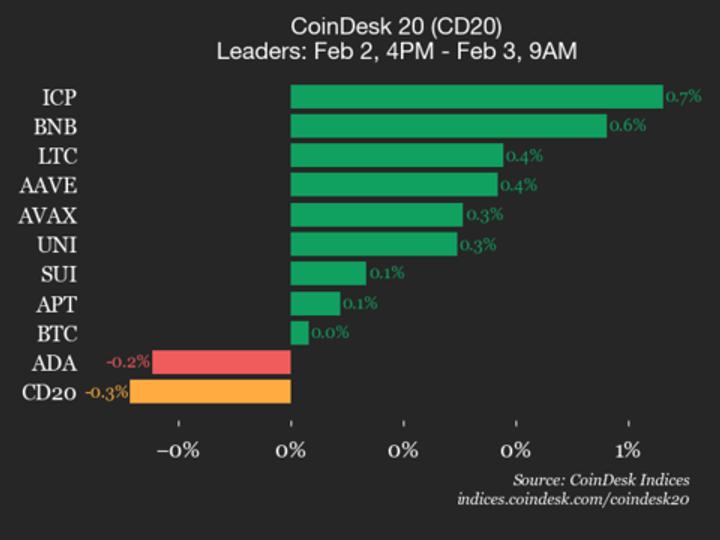
CoinDesk 20 is down 0.94% at at 2,278.33 (24hrs: +0.55%)
Ether CESR Composite Staking Rate is up 3 bps at 3%
BTC funding rate is at 0% (0.0372% annualized) on Binance
DXY is unchanged at 97.58
Gold futures are up 6.13% at $4,938.00
Silver futures are up 11.81% at $86.10
Nikkei 225 closed up 3.92% at 54,720.66
Hang Seng closed up 0.22% at 26,834.77
FTSE is down 0.05% at 10,336.54
Euro Stoxx 50 is up 0.56% at 6,041.35
DJIA closed on Monday up 1.05% at 49,407.66
S&P 500 closed up 0.54% at 6,976.44
Nasdaq Composite closed up 0.56% at 23,592.11
S&P/TSX Composite closed up 0.82% at 32,183.88
S&P 40 Latin America closed up 0.91% at 3,656.11
U.S. 10-Year Treasury rate is up 1.2 bps at 4.289%
E-mini S&P 500 futures are up 0.2% at 7,016.25
E-mini Nasdaq-100 futures are up 0.51% at 25,981.00
E-mini Dow Jones Industrial Average Index futures are unchanged at 49,522.00
Bitcoin Stats
BTC Dominance: 60.08% (0.18%)
Ether-bitcoin ratio: 0.02919 (-2.09%)
Hashrate (seven-day moving average): 870 EH/s
Hashprice (spot): $35.10
Total fees: 3.42 BTC / $266,100
CME Futures Open Interest: 113,495 BTC
BTC priced in gold: 15.8 oz.
BTC vs gold market cap: 5.22%
Technical Analysis
SOL’s price chart. (TradingView)
The chart shows solana SOL$103.19 price swings in candlestick format since 2022.
Prices dropped to support at $95.16 idenfitied by the horizontal line connecting the low hit in April last year.
this support breaks, Solana faces little backing until the mid-$30s. Bulls, therefore, need to hold $95.16 to avoid a deeper crash.
Crypto Equities
Coinbase Global (COIN): closed on Monday at $187.86 (-3.53%), +0.90% at $189.55 in pre-market
Circle Internet (CRCL): closed at $58.86 (-7.93%), +1.95% at $60.01
Galaxy Digital (GLXY): closed at $26.44 (-6.44%), +1.06% at $26.70
Bullish (BLSH): closed at $28.77 (-4.74%), +2.57% at $29.51
MARA Holdings (MARA): closed at $9.12 (-4.00%), +0.77% at $9.19
Riot Platforms (RIOT): closed at $15.32 (-0.97%), +1.31% at $15.52
Core Scientific (CORZ): closed at $17.87 (-0.67%)
CleanSpark (CLSK): closed at $11.04 (-6.76%), +1.36% at $11.19
CoinShares Valkyrie Bitcoin Miners ETF (WGMI): closed at $44.44 (-1.38%)
Exodus Movement (EXOD): closed at $11.18 (-14.59%), -0.63% at $11.11
Crypto Treasury Companies
Strategy (MSTR): closed at $139.63 (-6.73%), +1.12% at $141.19
Strive (ASST): closed at $0.72 (-11.94%), +2.32% at $0.74
SharpLink Gaming (SBET): closed at $7.79 (-12.27%), +0.77% at $7.85
Upexi (UPXI): closed at $1.62 (-8.99%), +2.47% at $1.66
xAI goes on hiring spree for crypto and finance experts to train AI models.
The firm seeks those familiar with crypto tools including DefiLlama, Nansen, Chainalysis.
The push comes as SpaceX merges with xAI.
Elon Musk’s artificial intelligence company xAi is recruiting for over a dozen crypto and traditional finance roles to train its models, the firm’s website showed on Tuesday.
Among the positions advertised are finance expert roles spanning crypto, equity and fixed-income, private credit, and quantitative trading.
The new crypto role “will contribute directly to xAI’s mission by training and refining our advanced AI models,” the posting said.
Duties include teaching AI models “how crypto quantitative traders analyze blockchain data, model tokenomics, evaluate on-chain flows, manage extreme volatility.”
The job also requires using leading crypto tools, including Nansen, Chainalysis, and DefiLlama, xAI said.
xAI did not immediately respond to a request for commentary on its crypto ambitions when asked by DL News.
Musk and his companies have long been involved in crypto markets, too.
In February 2021, the billionaire dubbed Dogecoin “the people’s crypto,” sending the token soaring by some 800%.
Tesla was one of the first publicly traded US companies to add Bitcoin to its balance sheet in 2021.
Musk‘s consolidation
The slew of new roles comes as Musk’s rocket venture SpaceX is taking over xAI as the billionaire continues consolidating his business interests.
The merger is valued at over $1 trillion, Bloomberg reported on Monday, though the terms of the deal are not public.
xAI began as a unit within the social media company X, formerly Twitter, after Musk bought the firm in 2022. It has since been incorporated and is valued higher than X.
Overall, xAI has drummed up $42 billion from venture investors, placing it behind only OpenAI, one of its competitors in the large language model segment.
Tesla, the electric vehicle company led by Musk, also invested $2 billion into xAI in January.
“In the long term, space-based AI is obviously the only way to scale,” xAI said in the press release.
“To harness even a millionth of our Sun’s energy would require over a million times more energy than our civilization currently uses!”
Lance Datskoluo is DL News’ Europe-based markets correspondent. Got a tip? Email him at lance@dlnews.com.
As February begins, Strategy (MSTR), the world’s largest publicly traded holder of bitcoin BTC$78,130.01, is already down 7% and on track for an eighth consecutive monthly decline.
The stock, currently trading near $141, is down roughly 75% from its November 2024 record high of around $540.
The bulk of the decline has occurred since July, with seven straight negative months. By end-2025, the stock had fallen 48% for the year, its second-worst annual performance on record. The worst year remains 2022, when shares declined 75%.
The bitcoin price, by comparison, has dropped around 40% from its October all time high. This puts the performance gap between MSTR and bitcoin at roughly 35%. In January, that spread briefly widened to 45%, matching a record last seen in 2021, according to checkonchain.
The company’s multiple to net asset value (mNAV), calculated by dividing enterprise value by its bitcoin reserves, remains above 1 at 1.09. This means Strategy is able to continue selling common stock through at-the-market offerings to buy bitcoin.
However, if the stock drops further, future bitcoin purchases are likely to be smaller. Should mNAV fall below 1, the company may be forced to pause purchases and wait for a rebound.
During the previous bear market, in 2022, Strategy was able to raise only $275 million, and used the proceeds to buy roughly 10,000 BTC.
Read More: Michael Saylor’s bitcoin stack is officially underwater, but here’s why he likely won’t reach for the panic button
Allica Bank, the challenger bank for established businesses, has implemented significant pricing reductions across its commercial mortgage and bridging products, explicitly positioning itself to compete directly with high street lenders on price.
The bank confirmed it has cut rates on owner-occupied and commercial investment mortgages by up to 1.3 per cent. The move is part of a broader simplification of its full property-backed lending range, designed to help brokers drive investment among the UK’s established business community.
Deepening relationships
Nick Baker, chief commercial officer at Allica
Alongside the headline rate cuts, Allica has introduced price reductions across its bridging, semi-commercial, specialist healthcare, and children’s nursery products.
The bank is also incentivising deeper banking relationships. It has doubled the discount on owner-occupied mortgages to 0.5 per cent for businesses that open a current account alongside their loan. This follows a limited-time offer launched in November, which waives the £500 commitment fee and provides 0.5 per cent cashback for eligible applications submitted before 31 March 2026 and completed by 30 June 2026.
Nick Baker, chief commercial officer at Allica, commented on the strategy: “We’ve cut rates across the board, simplified our product suite, and backed it all up with experienced people who pick up the phone and help move cases forward. It means brokers can place more deals with confidence, and their clients get competitive pricing without the friction they might get elsewhere.”
Growth trajectory
Allica, which focuses on businesses with between 5 and 250 employees, recently reported that it had lent over £3.5billion to established businesses across the UK.
The bank has seen rapid expansion, having been named the UK’s fastest-growing company by The Sunday Times in 2024 and topping Deloitte’s UK Fast 50 for two consecutive years (2023 and 2024). Allica claims its annual revenue growth makes it the “fastest-growing fintech ever,” having broken into yearly profitability in 2023.
Its stated ambition is to capture 10 per cent market share over the next five years, challenging the dominance of major banks that it argues often overlook the needs of established SMEs.