The prediction market on Base recorded a spike in trading volumes at the end of January.
The native token of Limitless, a prediction market on Base, Coinbase’s Ethereum Layer 2 network, is soaring this week after trading volume on the platform hit an all-time high in January.
The LMTS token, which launched in October, has struggled until now, falling as much as 86% to $0.05. However, it’s up 135% this week and another 2% today amid rising platform activity, which cleared $200 million in notional volume in January, according to Dune Analytics.
This marks a 56% jump from December, when it processed $128 million in volume.
Limitless Notional Volume – Dune Analytics
The protocol launched its Season 2 airdrop claim on Jan 28, just a day after kicking off Season 3, which runs until May 25.
Limitless also allows users to stake their tokens in the protocol. Currently, more than 23 million LMTS are staked, earning a little over 9% APY and representing almost 18% of the circulating supply.
While the prediction market’s growth is in line with the sector’s rapid rise, Polymarket’s activity still dwarfs Limitless’, with the leading decentralized prediction market recording all-time high volumes of $3.4 billion in January.
Competition in the prediction market space is only set to increase, with Hyperliquid unveiling its upcoming HIP-4 markets yesterday, which will support prediction market-like “outcome trading.”
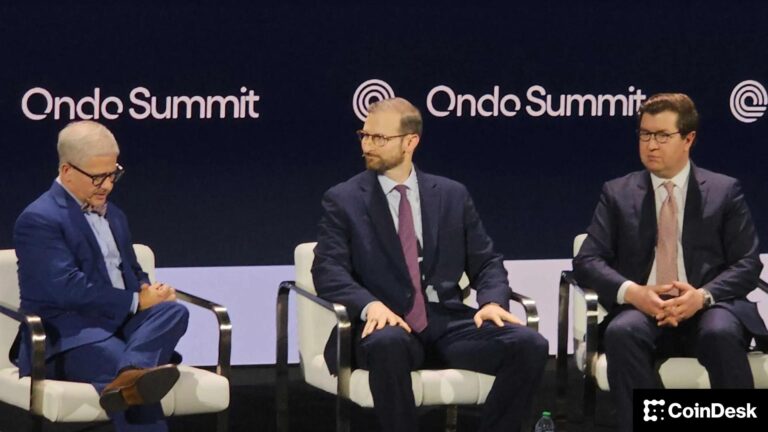
New York — WisdomTree’s crypto business is no longer an experiment but core to the firm’s strategy and on the verge of turning profitable, CEO Jonathan Steinberg said in a fireside chat at the Ondo Summit in New York on Tuesday.
“We want to continue to scale,” Steinberg said. “Last year, we went from like $30 million in assets to about $750 million in assets,” adding that he firm doesn’t currently make money on its digital asset efforts but is “in line of sight of taking this to a profitable business.”
The firm, $150 billion in assets under management, has been investing heavily in blockchain infrastructure, launching tokenized funds, and expanding to new chains like Solana SOL$104.79. Steinberg said the effort is driven by long-term conviction. “It’s still early days, but it’s not an experiment now. We have conviction. So we believe eventually everything will go on chain.”
It’s not hard to see why WisdomTree has been pushing further with digital assets. Most recently, during its earnings presentation, it said its total WisdomTree tokenized AUM grew to $770 million, up 25x from 2024.
WisdomTree digital assets snapshot as of end of last year (WisdomTree)
WisdomTree has taken an aggressive, early lead among traditional asset managers in digital assets, launching a suite of tokenized funds and recently expanding distribution via WisdomTree Connect, which enables those assets to move across self-custodied wallets and institutional platforms.
The firm also made a strategic bet on blockchain infrastructure by acquiring Securrency, a compliance-focused tokenization company, which it later sold to the DTCC. Steinberg said that move was a foundational step in enabling “compliance-aware tokens” and programmable finance, helping WisdomTree build a long-term, interoperable digital asset strategy.
For Steinberg, crypto represents more than a product opportunity — it’s a new financial infrastructure. “Really, this is bigger than asset management. This is really about financial services,” he said. “Financial services — some of these banks go back a couple of centuries. So they built on legacy, on top of legacy, on top of legacy. There is that modernization that has to happen.”
As for WisdomTree’s ambitions? “We just want to continue to scale what we’re doing,” Steinberg said.
Shares of Strategy plunged today, dipping more than 8% in trading as Bitcoin traded at new one-year lows and crypto risk assets came under renewed pressure.
The decline pushed MSTR’s share price to levels not seen since late 2024, deepening a multi‑month downtrend that has left the stock among the worst performers on the Nasdaq this year.
Bitcoin’s slump — dipping below key technical thresholds over the weekend and early week — has reverberated through markets, hitting crypto‑linked equities especially hard.
Shares of major crypto platforms, like Robinhood and Circle also lost ground, highlighting the increasing correlation between Bitcoin prices and related stocks.
With over 713,000 Bitcoins on its balance sheet, purchased at an average cost near $76,000 per coin, Strategy is grappling with unrealized losses after Bitcoin’s recent slide below that level.
Despite price dips, Chairman Michael Saylor has made it clear that Strategy won’t be selling its Bitcoin — and in fact is doubling down on purchases even as the market dips, signaling his intent to keep accumulating more.
In his messaging, he’s basically said he’s comfortable with holding and adding even on weakness, not cashing out when prices fall.
Strategy bought more bitcoin last week
Earlier this week, Strategy said it purchased 855 bitcoin for about $75.3 million, paying an average price of $87,974 per BTC, according to a Monday filing.
The acquisition came just days before bitcoin fell below $75,000 over the weekend on some rapid selling, briefly pushing Strategy’s treasury close to $1 billion in unrealized losses.
Now, the price of bitcoin is below those levels near $74,000.
The company now holds 713,502 BTC, acquired for roughly $54.26 billion at an average cost of $76,052 per coin.
Last week’s purchase was fully funded through the sale of common stock, following Strategy’s ongoing capital-raising approach to finance bitcoin buys. The purchase of 855 bitcoin was significantly smaller compared to prior company purchases.
At the time of writing, bitcoin’s price dropped below $74,000 today, its lowest level in a year. The bitcoin price has now retraced more than 40% from its all‑time highs reached in late 2025.
Prior to today, the one-year low for the bitcoin price was $74,747. Strategy shares started the day at $139.66, but are currently trading at $128.87. The shares 52-week high was around $450 per share.
President Donald Trump’s negotiators on the U.S. Senate’s crypto market structure bill refuse to sign off on legislation that goes after the president directly for his digital assets business ties — one of the chief points Democrats have demanded in talks over how the U.S. industry should be governed.
Some of the earlier proposals for the ethics provisions in the bill — especially those proposed by Senator Adan Schiff of California — were “completely outrageous,” Patrick Witt, the executive director of the President’s Council for Advisors for Digital Assets, told CoinDesk TV in an interview Tuesday at the Ondo Summit in New York.
“We’ve made clear that there are red lines,” he said. “We’re not going to allow the targeting of the president individually or his family members.”
He said he’s hopeful that Democrats will be pitching more reasonable versions “that feel a little bit closer to something that could ultimately be agreed to.” And he said he thinks a solution will be found.
“But at the end of the day, this is not an ethics bill,” he said.
Witt led a meeting of crypto policy experts and representatives of the U.S. banking industry on Monday, where the digital assets insiders left frustrated that the bankers hadn’t yet come to the table to offer a way forward on their stablecoin yield disagreements.
He told CoinDesk that the meeting “exposed some new areas of agreement,” but the White House is trying to thread the needle between bankers worried about protecting their own deposit businesses and clearing a path for stablecoin products
“We’re trying to broker a deal,” he said. “My No. 1 job is to get a bill to the president’s desk. He wants to see this bill get done.”
But it’s the Senate Democrats who may pose the tougher sell at this stage, as they continue to push for crypto limits for senior government officials, along with other major requests.
In the earlier proposals that would have limited government officials’ spouses from industry involvement, “a lot of senators’ wives and husbands maybe would have been put out of work by that,” Witt said.
Democrats met with industry representatives on January 16, two days after a Senate Banking Committee hearing on advancing the legislation fell apart. And the Democratic lawmakers are planning to meet again on Wednesday to keep talking about their approach, according to a person briefed on the plans. If they can’t embrace a compromise bill in the Senate Banking Committee, the legislation may have to be advanced with only Republican support, as a similar version already was in the Senate Agriculture Committee.
In the end, though, legislation will have to have significant Democratic support to pass the Senate, which generally demands a 60-vote majority to approve a bill. The White House directed industry insiders to get their compromise ideas together by the end of February, according to people familiar with the discussion. The longer this legislative process drags on, the harder it’ll be to pass a bill before Congress departs to campaign for this year’s midterm elections.
Witt was also asked on Tuesday whether he’d be willing to identify how much in crypto the U.S. government currently holds, an especially relevant figure in light of the ongoing presidential plan to set up federal stockpiles.
In a bid to respond more “quickly to crypto failures,” such as the collapse of QuadrigCX, Canada’s top investment industry regulator rolled out a new digital asset custody rules tightening standards on digital asset custody.
The industry-led Canadian Investment Regulatory Organization (CIRO) said its new Digital Asset Custody Framework is designed to allow it to respond more quickly to risks, including hacking, fraud, weak governance and insolvencies that have left investors exposed in past incidents.
“Many of the expectations in the framework were developed in close consultation with [crypto-asset trading platforms] and their custodians and reflect practices already in place,” a CIRO spokesperson told CoinDesk, adding that transition considerations will be applied on a case-by-case basis.
“The new framework also provides a balance between flexibility and risk management, supporting innovation while ensuring strong investor protection,” the spokesperson added.
Deeply involved in the collapse
The collapse of QuadrigaCX in 2019 remains one of the most notorious failures in Canada’s crypto history, with $123 million still unaccounted for. Its CEO, Gerald Cotten, died, and customer funds were found to be missing. Later investigations described co-founder Michael Patryn as allegedly being deeply involved in the exchange’s operations during the period when misappropriations occurred.
“Custody is one of the most critical points of risk in the crypto ecosystem,” said Alexandra Williams, CIRO’s senior vice president of strategy, innovation and stakeholder protection.
A central feature of the guidance is a tiered, risk-based structure that allows firms to diversify and strengthen custody arrangements while maintaining robust investor protections.
Early signs that expectations must be updated
CIRO said it would treat emerging custody and cyber risks, repeated supervisory issues across firms, or shifts in market practices as early warning signs that expectations may need to be updated.
“If we see that expectations are no longer aligned with how custody risk is manifesting in practice, CIRO would update the framework proactively, rather than wait for a failure to occur,” the regulator said.
Canada has taken a cautious approach to crypto regulation, bringing trading platforms under existing securities rules and emphasizing investor protection through registration, custody and disclosure requirements. More recently, federal moves on stablecoins and an expanded oversight role for the Bank of Canada suggest a slow shift toward a broader national framework for digital assets.
CIRO, a self-regulatory body that set standards for investment dealers, mutual fund dealers and trading activity in Canada, possessing the quasi-judicial authority to investigate misconduct and enforce disciplinary actions, including fines, suspensions, and permanent bans.
ThriveCart, the sales and payments platform for digital entrepreneurs, has launched ThrivePay Installments, a new card-linked payment solution designed to rival traditional Buy Now, Pay Later (BNPL) models by leveraging consumers’ existing credit limits.
The new feature allows customers to split purchases into 3, 6, or 12 monthly payments using the pre-authorized limits on their existing credit cards. Crucially, while the customer pays over time, the merchant receives the full funds upfront.
Tapping into pre-existing credit
Ismael Wrixen, CEO of ThriveCart
ThriveCart positions the tool as a solution to the limitations of standard BNPL providers, which typically rely on new consumer loans, underwriting, and geography-specific approvals. By utilising existing credit card limits instead, ThrivePay aims to unlock an estimated $3.3trillion in unused available credit in the US alone.
Because the system relies on pre-approved credit rather than new loan applications, ThriveCart reports significantly higher approval rates of approximately 85 per cent.
Ismael Wrixen, CEO of ThriveCart, explained that the move addresses a shift in the digital economy toward higher-ticket items where traditional BNPL often struggles.
“The digital economy has moved upmarket,” said Wrixen. “BNPL works well for smaller local purchases, but ThrivePay Installments extends installment payments globally and to higher-ticket products, with approval rates doubling to approximately 85%.”
No new consumer debt
The platform, which has processed over $8billion in sales across 70 million transactions to date, is targeting digital course creators, coaches, and cross-border businesses. These sectors often face high decline rates with traditional financing options due to high transaction values or cross-border complexities.
Georgios Kartakis, head of payments at ThriveCart, emphasised that the solution avoids originating new debt for the consumer.
“We designed ThrivePay to avoid originating new consumer debt,” Kartakis said. “This means we can unlock pre-existing credit available to a customer in the U.S., to a merchant based almost anywhere globally, all without creating new loan obligations. This is a huge advantage ThriveCart merchants now have over their competitors.”
The service supports one-time purchases for digital or physical goods, as well as subscriptions, offering a “pay-later” access point for merchants in markets that have traditionally been underserved by loan-based financing providers.
Bitcoin stabilized near the mid-$78,000 range on Tuesday, February 3, after a sharp weekend sell-off briefly pushed the token below $75,000. Analysts linked the recent sell-off to thin liquidity, forced deleveraging and broader risk-off positioning across markets. At the time of writing (11 am ET), Bitcoin was trading near $77,900, while Ethereum slipped to roughly $2,300.
The move leaves Bitcoin down roughly 40% from its recent peak around $125,000, showing how quickly sentiment has shifted from late-2025 momentum to early-2026 stress testing across risk assets.
Weekend liquidity meets leverage unwind
The latest downdraft had the familiar signature of a crypto weekend: traditional markets were shut, liquidity was thinner, and crypto became one of the few “open” venues where capital could be repositioned quickly. Diego Martin, CEO of Yellow Capital, framed the price action as a liquidity-driven event rather than a fundamental repricing.
“It has certainly been a tricky few months for the digital asset market… US Spot BTC ETFs have seen strong outflows, capital is increasingly moving into AI-linked equities and precious metals, and thinning liquidity has caused disproportionately large price drops… Weekends also matter more than people admit. Digital assets are one of the few open liquid markets when others are closed, so it often becomes the source of liquidity when capital needs to be quickly repositioned,” Diego said to AlexaBlockchain.
That “repositioning” showed up in liquidation data. Around $2.56 billion worth of Bitcoin-position were liquidated as traders unwound leveraged bets amid heightened volatility. Reuters described the episode as a deleveraging move amplified by a macro shock rather than a crypto-specific failure.
Tuesday’s tape: stabilization, not relief
By Tuesday, the selling pressure had eased into a cautious consolidation. According to CoinMarketCap data, Bitcoin was trading around $77,500 with a market cap of $1.55 trillion. The 24-hour trading volume was $49.94 billion, down over 36%.
Bitcoin was trading around $77,500 with a market cap of $1.55 trillion. Source: CoinMarketCap
That posture is reflected in sentiment gauges. CMC Crypto Fear and Greed Index which measures the prevailing sentiment in the cryptocurrency market is currently at 17/100, squarely in “Extreme Fear” territory. Extreme Fear is often associated with mechanical selling pressure, but also with fragile, headline-sensitive rebounds.
Ryan Lee, chief analyst at Bitget, characterized the environment as “Fear, Liquidations, and a Fed Reset: Crypto’s Macro Stress Test.” In his assessment shared with AlexaBlockchain, the drawdown below $75,000 for Bitcoin and sub-$2,200 prints for Ether were driven by negative sentiment and macro-liquidity concerns that turned routine volatility into a cascade.
Lee said he expects Bitcoin to oscillate between $70,000 and $80,000 in the short term, with downside spikes possible in thin liquidity, and Ether to trade in a wide $1,800–$2,600 band.
He added that stabilization would be supported by a rebound in the Fear & Greed index above 40 and reduced liquidation volumes, while persistent outflows from spot ETFs would be a potential warning signal.
The ETF story: outflows… then a sharp reversal
One reason traders continue to watch downside tail risks is the behavior of U.S. spot Bitcoin ETFs, which have become a visible transmission channel between macro risk appetite and crypto positioning.
After a stretch of net outflows late in January—including a large risk-off day on January 30—flows reversed sharply at the start of February. Farside Investors data showed U.S. spot Bitcoin ETFs recorded about $561.8 million of net inflows on February 2, 2026, snapping a multi-session outflow run.
That reversal can cut both ways: it suggests institutional bid still exists on drawdowns, but it also highlights how quickly flows can swing when macro headlines or positioning shifts—especially when leveraged derivatives are already unstable.
Macro is back in the driver’s seat: Fed chair uncertainty and the “AI trade” wobble
While crypto narratives often oscillate between internal catalysts and idiosyncratic shocks, this week’s price action has looked more like cross-asset risk management.
Part of the market’s focus has been on the U.S. central bank. President Donald Trump’s nomination of Kevin Warsh as the next Federal Reserve chair injected uncertainty into rate expectations and the policy path, at a moment when investors were already sensitive to liquidity conditions. The current chair, Jerome Powell, is set to conclude his term in mid-May.
Separately, concern about the durability of the equity “AI trade” has spilled into broader risk sentiment. Microsoft results and commentary around large AI spend and cloud growth have fueled periodic doubts about near-term payoff. It is worth noting because rotations away from crowded equity themes can tighten overall risk budgets and raise correlations across speculative assets.
Gold’s surge: hedge demand, then profit-taking
Crypto’s drawdown also arrived as gold traded at historically elevated levels, reinforcing the “risk-off” framing. Investors booked profit after record highs in precious metals, with U.S. gold futures settling around $5,318/oz on January 28 and UBS raising its forecast trajectory while still projecting some cooling into end-2026.
In mid-Jan, Bitcoin climbed above $99,000 alongside gold on softer U.S. inflation and unease about the Fed’s independence. This shows how tightly crypto has become tethered to the same macro forces driving cross-asset positioning.
In that January episode, expectations of easier financial conditions and a weaker dollar helped lift both hedges and high-beta proxies for liquidity, allowing Bitcoin to trade in sympathy with gold’s surge. The latest move has been the mirror image: as policy uncertainty and liquidity anxieties resurfaced, the market shifted into a risk-off posture, and Bitcoin behaved less like a “digital gold” co-beneficiary and more like a leveraged risk asset—where thin weekend liquidity and forced liquidations can magnify declines even as gold remains elevated.
The key takeaway is not that gold “caused” the move, but that elevated demand for hedges and capital preservation tends to coincide with tighter liquidity for high-volatility assets—especially when leverage is high and weekend order books are thin.
Markets now appear to be in a holding pattern: not outright panic, but not a clean reset either. Key signposts traders are monitoring:
Liquidity and leverage: whether liquidation pressure fades and funding/positioning normalizes after the weekend unwind.
ETF flows: whether Monday’s inflow strength persists or flips back to outflows.
Macro headlines: any further clarity on Fed leadership, rate-path expectations, and broader risk appetite.
Sentiment: whether “Extreme Fear” readings improve meaningfully—often a prerequisite for sustained rebounds rather than short-covering rallies.
Bitcoin’s current behavior in the $75,000-$79,000 range looks less like a decisive bottom and more like a contested zone—where spot buying, ETF flows, and macro risk management are all pulling at the tape in different directions.
The article “Fear, Liquidations, Fed Reset: Why Bitcoin Is Stuck Near $78K” was first published on AlexaBlockchain. Read the complete article here: https://alexablockchain.com/fear-liquidations-fed-reset-why-bitcoin-is-stuck-near-78k/
Read Also:
Disclaimer: The information provided on AlexaBlockchain is for informational purposes only and does not constitute financial advice. Read complete disclaimer here.
Image Credits: CoinMarketCap, Shutterstock, Canva, Wiki Commons
Crypto’s Tuesday has turned from bad to worse as a broader sell-off in the tech sector and financials is unfolding.
Bitcoin BTC$73,345.41 has fallen back 5% to $75,000 in the early U.S. afternoon hours, only a few hundred dollars above its low from last weekend. Ethereum’s ether ETH$2,120.36 has dropped 6.5% to near $2,200, while Solana SOL$97.33 slipped below $100, down 5.5%.
Shopify (SHOP), Adobe (ADBE), Salesforce (CRM), Intuit (INTU) were just a few names of the broader tumbled 7%-12% during the session. The iShares Expanded Tech-Software ETF (IGV) declined 5% today. The thematic fund has now lost 14% in just a week and is nearly 28% lower since its October peak.
Also down hard today are private-equity stocks, with giants like Blackstone (BX), Ares Capital (ARES), KKR (KKR) and Apollo (APO) all showing losses of 6%-10%.
The sector has had a rough ride in recent months, with the downturn picking up speed after a Friday evening filing (Jan. 23) from a BlackRock private debt fund — BlackRock TCP Capital (TCPC) — saying it intended to mark down the net value of its assets by 19%.
The news hinted that perhaps all was not as well with the economy as the headlines might suggest, and that liquidity in the system might be tighter than otherwise thought.
Bitcoin certainly wasn’t in a bull market at the time of the filing, but it wasn’t in panic mode either, having earlier that day risen to about the $91,000 level. It’s been pretty much straight down since, though.
Digital asset-related stocks are mirroring the slide. Galaxy (GLXY) was leading losses with a 18% decline following its earnings, while Strategy (MSTR), Coinbase (COIN), Circle (CRCL), Bullish (BLSH) declined 5%-7% during the session.
Crypto winter, but there’s good news
Matt Hougan, CIO of digital asset management firm Bitwise, argued that the crypto market has been in a full-scale winter since January 2025, similar to past bear markets like in 2018 and 2022.
“This is not a ‘bull market correction’ or ‘a dip,’ he said in a Monday note. “It is a full-bore, 2022-like, Leonardo-DiCaprio-in-The-Revenant-style crypto winter.”
On a more positive note, that prolonged bear market could be nearing the end, Hougan said. The downturns, he noted, typcially last about 13 months. If, as Hougan has, you place the beginning of the bear market at January 2025, rather than October 2025, crypto is within weeks of possibly bottoming.
“As a veteran of multiple crypto winters, I can tell you that the end of those crypto winters feel a lot like now: despair, desperation, and malaise,” he wrote.
Bitcoin and Ethereum fell as investors weighed delayed economic data, tightening risk appetite, and mixed ETF flows.
Crypto markets moved lower on Tuesday after the U.S. government shutdown delayed key macroeconomic data, adding to investor uncertainty.
Bitcoin (BTC) was trading at around $77,686, down 1.5% over the past 24 hours, while Ethereum (ETH) fell about 4% to $2,288. Among other large-cap tokens, BNB slipped nearly 1% to $771, XRP declined 2.5% to $1.60, and Solana (SOL) dropped 3.5% to $101.
BTC Chart
James Harris of Tesseract said Ethereum hovering around $2,200 this week marks the culmination of a broader risk repricing that has been unfolding for several weeks, and not necessarily a single crypto-specific event. He added that the key feature of this selloff was a “sudden tightening in risk appetite” across multiple asset classes, including precious metals.
Meanwhile, the total cryptocurrency market capitalization hovered at $2.7 trillion, down 1.5% on the day, while 24-hour trading volume totaled $136.4 billion.
On the upside, Hyperliquid (HYPE) rose over 5%, while LEO Token (LEO) gained roughly 4%. MemeCore (M) also advanced around 3%.
Tokenized commodities were also up with Tether Gold (XAUT) gaining 5.2% on the day and PAX Gold (PAXG) adding 4.8%, highlighting the continued demand for tokenized precious metals.
On the downside, Monero (XMR) fell 8.7%, Zcash (ZEC) dropped 8.4%, and Internet Computer (ICP) slid 4.8%.
Liquidations and ETF Flows
Around $266 million in leveraged crypto positions were liquidated over the past 24 hours, according to CoinGlass. Long liquidations made up $155 million, while short liquidations totaled $110.6 million.
Ethereum recorded the largest share of liquidations at approximately $84.3 million, followed by Bitcoin at $57.6 million. CoinGlass found that more than 101,000 traders were liquidated during the period.
ETF flows were mixed but showed a notable divergence across assets. U.S. Bitcoin spot ETFs recorded roughly $561.9 million in net inflows on Feb. 2, while U.S. Ether spot ETFs saw a modest $2.9 million in net outflows.
XRP spot ETFs also posted small outflows of about $405,000, while U.S. Solana spot ETFs recorded approximately $5.6 million in daily inflows, bringing cumulative net inflows to around $876.5 million.
Government Shutdown
Today’s market action comes as the Bureau of Labor Statistics (BLS) said it will delay the January jobs report and other data due to the current partial government shutdown that started over the weekend.
Reuters reported that lawmakers are expected to vote later today on a “Trump-backed” funding deal that could reopen the government. The deal would also fund most federal agencies through October.
So far, the bill has cleared the Senate but could face resistance in the House from both Democrats and a group of hardline Republicans, Reuters said.
Harris added that markets have also been reacting to the nomination of Kevin Warsh to lead the Federal Reserve, which he said “investors read as a less supportive liquidity backdrop.”
Member states of the Digital Cooperation Organization (DCO) are planning their fifth General Assembly, which will presided over by the State of Kuwait.
Taking place from 4–5 February, the two-day General Assembly which includes Member State ministers, observers, partners, CEOs, policymakers, innovators, as well as representatives from over 60 countries, is a flagship event for the Digital Cooperation Organization (DCO). The General Assembly convenes the full digital ecosystem to contribute to shape the global digital agenda.
Chaired by H.E. Omar Saud Al-Omar, Minister of State for Communication Affairs of the State of Kuwait and Chairperson of the DCO Council for the current term, together with Deemah AlYahya, Secretary-General of the DCO, the fifth General Assembly serves as the Organisation’s foremost platform for reviewing achievements, shaping strategic direction, and launching initiatives aligned with the 2025–2028 Four-Year Agenda.
A key component of the Assembly will be the ceremonial handover of the DCO Council Presidency from the State of Kuwait to the Islamic Republic of Pakistan for this year’s term. In 2025 it was the Kingdom of Jordan, which was host to the previous General Assembly at the Dead Sea.
A Forum to Compliment the General Assembly
The previous fourth General Assembly of the Digital Cooperation Organization (DCO) which was presided over by the Kingdom of Jordan
The International Digital Cooperation Forum (IDCF), which is held alongside the General Assembly, curates a programme featuring plenary sessions, side events, workshops, and high-level dialogues. Having successfully made its debut at the last General Assembly at the Dead Sea in Jordan, IDCF in its second edition looks to also bring interesting and engaging discussions.
Topics will focus around artificial intelligence (AI), digital trade, cross-border digital infrastructure, skills mobility, technology safety and ethics, and sustainable digital transformation. It is expected that over 100 organisations from various sectors and partner entities are expected to participate.
The Fintech Times‘ RichieSantosdiaz will be in attendance, moderating a discussion on ‘Fueling growth: AI, Investment flows and the future of inclusive digital prosperity.’
Building Momentum Prior to the Assembly.
H.E. Omar Saud Al-Omar, Minister of State for Communication Affairs of the State of Kuwait
H.E. Omar Saud Al-Omar, prior to the preparation of the General Assembly, said: “Hosting the 5th General Assembly of the DCO and the International Digital Cooperation Forum reflects the importance of strengthening multilateral cooperation and enhancing collective efforts to keep pace with the rapid transformations shaping the global economy, particularly in the fields of artificial intelligence and advanced technologies.
Discussing about Kuwait hosting the General Assembly, Minister Al-Omar adds: “Through its current Chairmanship of the DCO Council, the State of Kuwait welcomes Member States, partners, and participating guests, and reaffirms its commitment to supporting a shared agenda focused on advancing digital integration, building advanced digital infrastructure, and strengthening capacity development and knowledge exchange.”
Deemah AlYahya, Secretary-General of the Digital Cooperation Organization
Deemah AlYahya said: “Hosting the Fifth General Assembly and the Second IDCF in the State of Kuwait marks a defining moment for the global digital community and a proud milestone in our collective journey. It is an opportunity not only to convene, but to reflect on the achievements of 2025, strengthen partnerships, and shape a shared vision for the future of digital cooperation at a time when the global digital landscape is evolving at unprecedented speed.”
When discussing the common goal of the DCO’s member states, the Secretary-General adds: “Our Member States are united by a clear conviction: that digital prosperity must be accessible to all, and that international cooperation across sectors, and institutions is the most powerful force to achieve it. As AI rapidly reshapes economies and societies, this year’s theme, ‘Inclusive Prosperity in the Age of AI,’ speaks to our shared responsibility to ensure these transformations serve every country, every institution, and every individual so that innovation becomes a bridge to opportunity, resilience, and shared prosperity, and no one is left behind.”
In Summary
The world’s first standalone international intergovernmental organisation, the DCO from its creation in 2020, has dedicated itself to accelerating the growth of an inclusive and sustainable digital economy. The organisation gathers Ministries of Communications and Information Technology across its 16 Member States. To note, it holds observer status with the United Nations General Assembly and other global bodies.
The previous General Assembly in 2025 had groundbreaking announcements of various achievements, challenges and opportunities; the upcoming General Assembly looks to be no different in keeping with the wider theme of digital inclusion for all.