
Bitcoin fell sharply on Feb. 16, dropping below $68,000 after briefly testing $70,000 and remains stuck in a consolidation range between $65,000 and $72,000. Market sentiment is deeply bearish, with the Crypto Fear and Greed Index in extreme fear. Bitcoin Reverses Weekend Gains Bitcoin retreated from its weekend highs during a volatile session on Monday, […]
Dogecoin Recovery: How Much Can The Leading Meme Coin Rise Again?

Trusted Editorial content, reviewed by leading industry experts and seasoned editors. Ad Disclosure
Dogecoin has spent the past few weeks grinding lower, testing the patience of bullish traders. The past 24 hours, for instance, were spent with sell-offs, with the meme coin king now down by 10% in the last trading day.
Dogecoin is now perambulating around the $0.10 to $0.11 range, a level that has repeatedly acted as a psychological battleground in past cycles. Recent technical analyses shared on X suggest that this range could determine whether Dogecoin stages another rebound or drifts deeper into weakness in the coming weeks.
Bullish Phase, Liquidity Sweep, And Consolidation
Crypto analyst BitGuru recently outlined a structure that many traders may recognize from previous market cycles. According to his view, Dogecoin initially formed what he described as a bullish phase before entering a liquidity sweep and an extended consolidation period. The daily candlestick chart he shared shows price pushing higher earlier in the cycle, followed by a clear downside move that has been playing out since October 2025.
After that sweep, Dogecoin settled into a tightening channel of lower lows and lower highs, creating a prolonged correction range through late 2025 and into early 2026. The daily candlestick chart, which is shown below, highlights an important horizontal support region around $0.10, where price has recently reacted. From a technical perspective, this region acted as a bottom during the early February crash.
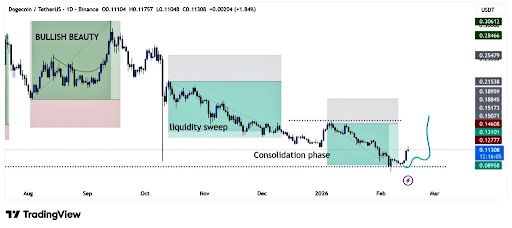
According to BitGuru, if buyers were to step in here, Dogecoin could attempt a move back toward higher resistance levels around $0.13, $0.15, and $0.19. These are all short-term price levels that can be achieved within a few hours of buying pressure.
The Weekly EMA Signal That Points To Bottoms
Another category of analysis came from Charting Guy, who approached the setup from a broader, long-term angle on the weekly timeframe. He pointed to the relationship between the 20-week exponential moving average and the 200-week exponential moving average on the weekly candlestick price chart.
Dogecoin has tended to form major cycle lows around the period when the 20-week EMA crosses below the 200-week EMA. The interesting thing is that this crossover has just appeared again. Similar crossovers in previous cycles appeared towards the end of extended bearish phases before Dogecoin transitioned into multi-month uptrends.
The weekly price chart spans from 2017 through 2026, showing how previous crosses preceded strong upward expansions. This time, Dogecoin’s price dipped to around $0.09 to $0.10 as the crossover took place.
The most important thing now is how much upside is realistic if this support truly holds. Looking at the weekly structure, a recovery above the 20-week EMA could open the door to a retest of the $0.20 to $0.25 range. Above that, Dogecoin would need better market strength, particularly from Bitcoin, to challenge the higher resistance bands around $0.30 and above.
Featured image from Freepik, chart from Tradingview.com

Editorial Process for bitcoinist is centered on delivering thoroughly researched, accurate, and unbiased content. We uphold strict sourcing standards, and each page undergoes diligent review by our team of top technology experts and seasoned editors. This process ensures the integrity, relevance, and value of our content for our readers.
Cem Karsan: Wartime economy reshapes global markets, political populism drives inflation trends, and authoritarianism threatens economic stability
The current global economy is heavily influenced by wartime conditions, impacting economic, military, and strategic asset dynamics. Global conflicts are expected to intensify, suggesting increased volatility in markets. Deglobalization and geopolitical tensions are reshaping market behaviors and …
Key Takeaways
- The current global economy is heavily influenced by wartime conditions, impacting economic, military, and strategic asset dynamics.
- Global conflicts are expected to intensify, suggesting increased volatility in markets.
- Deglobalization and geopolitical tensions are reshaping market behaviors and economic strategies.
- Political populism is a significant force driving economic trends, including inflation and yield curve changes.
- Authoritarianism poses a potential threat to populist movements, potentially increasing volatility.
- The US’s actions in Greenland are strategic, aimed at influencing European military policies.
- The narrative around a potential US invasion of Greenland serves strategic purposes rather than indicating actual intent.
- The global conflict is primarily economic and strategic, with a likelihood of escalation.
- The complexities of global politics extend beyond simplistic board game analogies, with long-term consequences for soft power.
- Economic inequality and political dynamics are intertwined, influencing global market rotations.
- Strategic asset conflicts are a defining feature of the current geopolitical climate.
- Understanding geopolitical narratives is crucial for interpreting international relations and market implications.
- The persistence of populism is expected to continue shaping economic policies and outcomes.
- The rise of authoritarianism could disrupt economic trends driven by populism.
- The geopolitical landscape is characterized by complex interactions between major world powers.
Guest intro
Cem Karsan is the Founder and Chief Investment Officer of Kai Volatility Advisors. He founded the firm in 2010 after building Precision Capital Management, a proprietary market-making firm that represented approximately 13% of daily S&P 500 options volume at its peak during the Great Financial Crisis. Karsan heads research and risk management while overseeing portfolio construction and firm-wide strategy.
The wartime economy and its implications
-
We are in a wartime economy characterized by economic, military, and strategic asset conflicts.
— Cem Karsan
- The current economic environment is distinct from normal conditions due to ongoing global conflicts.
-
This is a wartime economy if people don’t see that yet or think about it in that way they’re missing the boat.
— Cem Karsan
- Understanding the geopolitical climate is crucial for grasping the economic implications.
- The wartime economy involves strategic bidding for assets by major global powers.
-
This is an economy where the biggest powers of the world bid for strategic assets.
— Cem Karsan
- Market dynamics are influenced by deglobalization and geopolitical tensions.
- The wartime economy suggests a need for strategic planning in investment and economic policy.
- Economic strategies are increasingly shaped by geopolitical considerations.
Escalating global conflicts
-
The global conflict is likely to escalate rather than de-escalate.
— Cem Karsan
- Increasing volatility is expected as global tensions rise.
- Geopolitical tensions have significant economic implications, requiring careful analysis.
-
It is likely to continue to get hotter not cooler.
— Cem Karsan
- Strategic planning must account for the potential escalation of conflicts.
- Understanding the trajectory of global conflicts is essential for investors.
- The interplay between major world powers is a key factor in escalating tensions.
- The likelihood of increased conflict necessitates a focus on strategic asset management.
The impact of political populism
-
The political populist wave will continue to influence economic trends over the next several years.
— Cem Karsan
- Populism is driving long-term trends of higher inflation and a steepening yield curve.
-
What we’re seeing… is a multiyear trend that started in 2020 of higher inflation steepening yield curve in our opinion.
— Cem Karsan
- Political movements have a direct impact on economic indicators.
- The persistence of populism shapes economic policies and market dynamics.
- Populist trends are expected to overcome political resistance over time.
- Economic strategies must consider the influence of populism on market trends.
- The relationship between political movements and economic outcomes is critical for analysis.
Authoritarianism and its potential effects
-
The rise of authoritarianism could disrupt the populist movement prioritizing median outcomes.
— Cem Karsan
- Authoritarianism poses a threat to populist-driven economic trends.
- Increased volatility and structural unrest may result from authoritarian influences.
-
That only should increase the volatility and the structural unrest that I see unfortunately coming our way.
— Cem Karsan
- Understanding the potential impact of authoritarianism is crucial for strategic planning.
- The interplay between authoritarianism and populism affects economic stability.
- Investors must be aware of the potential disruptions caused by authoritarian trends.
- The rise of authoritarianism is a significant factor in economic and political analysis.
Strategic moves in Greenland
-
The situation regarding Greenland is a tactical move by the US to encourage European military spending and troop deployment.
— Cem Karsan
- The US’s actions are aimed at influencing European military policies.
-
In my opinion, this is an effort to give Europe cover to increase military spending.
— Cem Karsan
- The narrative around Greenland serves strategic purposes beyond surface-level interpretations.
-
The US is not invading Greenland; that’s not the real story.
— Cem Karsan
- Understanding geopolitical narratives is crucial for interpreting international relations.
- The complexity of geopolitical strategies requires careful analysis of underlying motivations.
- The US’s strategic moves highlight the importance of military alliances in global politics.
The nature of global conflicts
-
The current global conflict is primarily economic and strategic, and it’s likely to escalate rather than de-escalate.
— Cem Karsan
- Economic and strategic conflicts define the current geopolitical landscape.
- The trajectory of global conflicts suggests increased volatility and strategic challenges.
-
We are in a distinct global conflict that is economic that is military right and that is strategic asset focused.
— Cem Karsan
- Understanding the nature of global conflicts is essential for strategic analysis.
- The interplay between economic and strategic factors influences global dynamics.
- The likelihood of escalation requires a focus on strategic asset management.
- The complexities of global conflicts extend beyond simplistic interpretations.
The role of soft power in global politics
-
The game of global politics is not like the board game Risk; it has long-term consequences that can degrade soft power.
— Cem Karsan
- Soft power plays a crucial role in international relations and geopolitical strategies.
- Short-term thinking in geopolitical strategies can have long-term consequences.
-
The world is not actually a game of risk there are much bigger long term consequences.
— Cem Karsan
- Understanding the importance of soft power is essential for strategic analysis.
- The complexities of international relations require careful consideration of soft power dynamics.
- The risks of short-term thinking highlight the need for strategic planning in global politics.
- The interplay between soft power and geopolitical strategies influences global outcomes.
How to Create a Minimal Look With Haldi Saree for Bride?

The landscape of the “Big Fat Indian Wedding” is shifting. While the main wedding ceremony and reception are still characterized by heavy velvets, blinding Kundan jewelry, and intricate Zardozi work, the pre-wedding functions are witnessing a refreshing transformation. The modern Indian bride is increasingly leaning towards authenticity, comfort, and “quiet luxury.” Nowhere is this more evident than in the Haldi ceremony.
The Haldi is, at its core, a raw and organic ritual. It is about the earthiness of turmeric, the fragrance of sandalwood, the splash of water, and the warmth of the morning sun. It is an intimate affair that calls for a look that is effortless rather than opulent.
Enter the minimalist saree for haldi function.
Gone are the days when a bride felt pressured to wear a heavy silk saree that weighed five kilos just to look “bridal.” Today, trends set by celebrity brides and fashion influencers point toward breathable fabrics, pastel hues, and simple styling. But achieving a “minimal” look is often harder than it seems. There is a thin line between “simple” and “plain.”
Can a Bride Truly Stand Out Without the Bling?
This brings us to the pivotal question: Does stripping away the embroidery and heavy jewelry make a bride look less special, or does it actually allow her true radiance to shine through?
The fear for many brides is that a minimal look might appear “undressed” or too casual for wedding photography. However, minimalism is not about the absence of style; it is about the perfect curation of it. It is about shifting the focus from the garment to the woman wearing it. When you remove the distraction of heavy embellishments, the attention rests solely on your glowing skin, your smile, and the emotions of the moment.
But how do you execute this balance perfectly? To pull off the minimalist aesthetic, the quality of your garment becomes paramount. You cannot hide poor fabric behind embroidery.
Kalyanja: The Art of Authentic Simplicity
If you are going minimal, the fabric must be exquisite. This is where Kalyanja shines. As a trusted and authentic saree and ladies’ fashion brand in India, Kalyanja understands that simplicity is the ultimate sophistication.
Kalyanja specializes in sarees that don’t need to shout to be heard. They focus on the integrity of the weave, the softness of the yarn, and the authenticity of the color.
Why minimalist brides love Kalyanja:
- Fabric Texture: They offer premium cottons, mulmuls, and linens that have a rich, visible texture, ensuring the saree looks expensive even without embroidery.
- Curated Hues: Their Haldi collection moves beyond generic yellow, offering sophisticated shades like marigold, butter-yellow, and mustard.
- Heritage Weaves: A simple handloom saree from Kalyanja carries the weight of tradition without the physical weight of embellishments.
Explore the Kalyanja and find a saree that lets you breathe.
6 Ways to Achieve Minimal Look With Haldi Saree for Bride
Here are 6 essential elements (and the reasons why they work) to help you master the minimalist look with your haldi saree for bride.
1. Prioritize Texture Over Embroidery (The Fabric Choice)
The first step to minimalism is rejecting the heavy border and the sequins. However, if you remove the bling, you must replace it with texture to keep the outfit interesting. A flat, synthetic yellow cloth will look plain. A textured, organic fabric will look ethereal.
How to do it: Opt for fabrics that have character.
- Tissue Silk or Organza: These fabrics have a natural sheen and crispness. They catch the sunlight beautifully, creating a halo effect around the bride without a single stone being used.
- Handloom Cotton or Linen: The visible weave of a linen saree adds an earthy, bohemian vibe that fits perfectly with the organic nature of the Haldi paste.
- Chanderi: The subtle interweaving of gold zari thread in Chanderi fabric provides a festive glow that is inherent to the fabric, not added on top.
Why it works: Texture adds depth to photographs. It suggests quality and refined taste. It allows the bride to look dressed up because of the richness of the material, not the weight of it.
2. Embrace the “No-Makeup” Makeup Look (The Glow)
A minimal saree demands minimal glam. A heavy, caked-on foundation or dark smokey eyes will clash with the breezy vibe of a light saree. The goal of the Haldi look is to look “freshly washed” and sun-kissed.
How to do it:
- The Base: Use a tinted moisturizer or a sheer BB cream instead of heavy coverage foundation. Let your natural skin texture show.
- The Cheeks: Use a cream blush in peach or soft pink to create a flushed look.
- The Eyes: Skip the heavy eyeliner. A coat of waterproof mascara (essential for when water is poured on you) and groomed brows are enough.
- The Lips: A tinted lip balm or a nude lipstick that matches your natural lip color works best.
Why it works: The Haldi ceremony is messy. Heavy makeup will smudge and run when water and milk are poured on you. A minimal, dewy look degrades gracefully. Plus, it highlights the natural “bridal glow” that everyone talks about.
3. Swap Gold for Fresh Floral Jewelry (The Accessory)
Nothing kills a minimal vibe faster than heavy, chunky gold necklaces. Gold is static and heavy; the Haldi is fluid and natural. The defining accessory of a minimal haldi saree for bride is fresh flowers.
How to do it:
- White Tagar or Mogra: These small white flowers look stunning against a yellow saree. They add a pop of white that breaks the monotony.
- Baby’s Breath (Gypsophila): For a fairy-tale, whimsical look, use delicate sprigs of Baby’s Breath in your hair or as wrist cuffs.
- Handmade Beads: If you are allergic to pollen or flowers, opt for lightweight, handmade beaded jewelry in contrasting colors like pink or turquoise.
Why it works: Floral jewelry is ephemeral—it lasts only for the day. This makes it feel incredibly special and luxurious in a non-materialistic way. It connects the bride to nature and adds a soft, romantic fragrance to the ceremony.
4. The Modern Blouse: Less is More (The Silhouette)
Since the saree itself is simple, the blouse is where you can inject modern fashion sensibilities. A minimal look often relies on a stylish, contemporary cut rather than heavy embroidery on the sleeves.
How to do it:
- Sleeveless or Strappy: A simple spaghetti strap blouse or a sleeveless scoop neck adds a touch of vulnerability and youthfulness to the look.
- The “Bralette” Style: For the bold bride, a bikini-style or bralette blouse is incredibly trendy and minimizes the amount of fabric, which is practical for the mess of Haldi.
- Contrast Color: If the saree is yellow, a plain white or emerald green blouse in raw silk can make a striking statement without any patterns.
Why it works: A modern blouse silhouette balances the traditional drape of the saree. It keeps the bride cool and ensures that the arms and shoulders are free for the ritual application of turmeric.
5. Play with Pastel and Monochrome Tones (The Palette)
While bright “Haldi Yellow” is traditional, the minimalist bride often opts for softer, more understated shades of the color. Neon yellow can be harsh on the eyes and camera; pastels are soothing.
How to do it:
- Butter Yellow: A pale, creamy yellow looks sophisticated and expensive.
- Ivory with Yellow Borders: Instead of a full yellow saree, wear an ivory or off-white saree with a yellow border. This is a very classic, “old money” aesthetic often seen in Kerala or Bengali weddings.
- Mustard Monochrome: Wear a mustard saree with a mustard blouse. Monochrome elongates the body and creates a clean, unbroken visual line.
Why it works: Soft colors blend seamlessly with the outdoor surroundings. They don’t fight for attention. An ivory or pastel yellow haldi saree for bride reflects light softly, making the skin look luminous rather than reflecting a harsh color cast onto the face.
6. The “Imperfect” Drape (The Styling)
A minimal look should never feel stiff. If your saree is pleated with military precision and pinned within an inch of its life, it loses its ease. The minimal aesthetic is about wabi-sabi—finding beauty in imperfection.
How to do it:
- Open Pallu: Instead of pleating the pallu on your shoulder, let it flow over your arm. This looks more romantic and relaxed.
- The Lower Drape: Don’t worry if the pleats aren’t razor-sharp. A soft, rolling drape looks more organic.
- Comfort First: Pin the saree securely at the waist and shoulder, but leave some breathing room. You want to look like you just threw on a beautiful piece of fabric, not like you were upholstered into it.
Why it works: The Haldi is an action-oriented event. A relaxed drape allows you to move, dance, and sit on low stools without restriction. It conveys a sense of confidence—that you are comfortable in your own skin and your heritage.
Conclusion
Creating a minimal look with a haldi saree for bride is an exercise in restraint. It requires you to trust that you are enough. It is about choosing a fabric that feels like a caress, a color that soothes the eyes, and accessories that come from the earth.
When you strip away the layers of excess, what remains is the essence of the wedding: joy, love, and light.
So, this wedding season, dare to go simple. Choose a saree that speaks to your soul, not just the camera. And for that perfect blend of authenticity, quality, and understated elegance, remember to check out Kalyanja.
Metaplanet Reports $619 Million Loss As Bitcoin Holdings Take Hit

Tokyo-based Bitcoin treasury firm Metaplanet posted a net loss of 95 billion yen ($619 million) for fiscal 2025, driven by a 102.2 billion yen ($665.8 million) valuation decline on its bitcoin holdings.
The disclosure marks the latest example of a corporate bitcoin buyer facing pressure as the cryptocurrency’s price slid from record highs in October.
The company closed the year with 35,102 BTC, valued at approximately $2.4 billion, making Metaplanet the fourth-largest public corporate bitcoin holder globally, behind Strategy. Since it began accumulating bitcoin 21 months ago, Metaplanet has spent nearly $3.8 billion, averaging $107,000 per coin.
As of December 31, the company’s holdings were down roughly 37% on paper, representing an unrealized loss of about $1.4 billion. In the fourth quarter alone, the stash lost 102 billion yen ($664 million) in value.
Metaplanet’s revenue surge
Despite the valuation loss, the firm’s operating performance showed significant improvement. Revenue jumped 738% to 8.91 billion yen ($58 million) from 1.06 billion yen ($6.9 million) the previous year, the company said.
Operating profit surged 1,695% to 6.29 billion yen ($41 million), driven primarily by premiums from bitcoin option transactions, which accounted for about 95% of total revenue.
The company’s largest acquisitions occurred when bitcoin traded above $100,000. Notable purchases included 25% growth of its bitcoin holdings with a $630 million buy in September at roughly $106,000 per coin, followed by a $615 million acquisition in October near $108,000.
The firm has funded its purchases largely through common stock issuances, while also adopting preferred shares to secure additional capital. Metaplanet introduced MERCURY and MARS, its first preferred share offerings in Japan, as a means to strengthen its balance sheet and create a buffer against crypto market volatility.
For fiscal 2026, Metaplanet forecasts revenue of 16 billion yen ($104 million) and operating profit of 11.4 billion yen ($74.3 million), reflecting roughly 80% growth in both metrics. The company did not provide net income guidance, citing ongoing bitcoin price volatility, but reaffirmed a long-term target of 210,000 BTC by 2027, equivalent to about 1% of the total bitcoin supply.
Metaplanet’s stock edged up slightly to 326 yen on Monday, according to Yahoo Finance, after a six-month decline exceeding 62%.
At the time of writing, Bitcoin is trading near $68,000.
Binance co-founder CZ echoes Consensus panelists on lack of privacy blocking crypto adoption

Binance co-founder Changpeng “CZ” Zhao warns crypto’s lack of privacy blocks everyday adoption, echoing CoinDesk Consensus Hong Kong panelists who called it a barrier to widespread institutional use.
Blockchain’s total transparency gets hyped as the ultimate democratization middle finger to shady banks and Wall Street fat cats operating in the dark. But here’s the catch: it means anyone globally can snoop on your send amounts, wallet balances, and deals.
Picture wiring your salary or sealing a big business move that has the whole world reading every digit – not desirable, right?
That’s precisely the issue here. Crypto’s been screaming for Main Street and Wall Street adoption for years, yet this same “killer feature” of zero privacy is slamming the brakes hard.
“(Lack of) Privacy may [be] the missing link for crypto payments adoption. Imagine, a company pays employees in crypto on-chain. With the current state of crypto, you can pretty much see how much everyone in the company is paid (by clicking the from address),” CZ said on X on Sunday.
Institutions share that concern
Fabio Frontini, chief executive officer of Abraxas Capital Management, highlighted the need for privacy in large institutional transactions if the use of public blockchains on Wall Street is to become the norm.
“The privacy—especially for large transactions—is the key point, I think, particularly for institutional players,” says Abraxas Capital Management CEO Fabio Frontini. “Total transparency isn’t particularly good. Actually, you want transactions to be auditable and visible, but only to certain people who should know exactly who’s behind them,” Frontini said during the panel “The 2026 Outlook: The Institutional Market Cycle,” in Hong Kong last week.
Frontini was responding to a question about when institutional use of blockchain to issue traditional instruments like commercial paper will go from an experimental stunt to an everyday norm. Wall Street giant JPMorgan tested these waters in December by arranging a landmark $50 million U.S. commercial paper issuance for Galaxy Digital Holdings LP on the Solana blockchain.
Coinbase Global and Franklin Templeton snapped it up, with issuance and redemption settled in Circle’s USDC stablecoin for near-instant delivery-versus-payment. JPMorgan handled structuring and on-chain token creation, while Galaxy Digital Partners LLC acted as the structuring agent.
The landmark deal highlighted the use of public blockchains like Solana for tokenizing debt, but also exposed the lack of transparency.
Emma Lovett, the credit lead for the Markets Distributed Ledger Technology team at JP Morgan, who was one of the panelists, stressed that institutions won’t shift massive assets on-chain at scale until they can trust the system won’t expose them.
“They need to be confident that it’s not going to take one person to find out what their address is and then know all the transactions they’ve done—that’s really key,” Lovett said.
Thomas Restout, group CEO of institutional-grade liquidity provider B2C2, agreed that privacy is key while highlighting “certainty of execution” as another key factor.
“It’s still a space that institutions aren’t comfortable with. They also need partners. You look at other chains that have gone private and are developing a lot for institutions. So if you’re a large institution, you always have to imagine that you’re not going to try this for $10,000—you’re going to have to do this for $10 trillion. And therefore, the level of certainty you need to achieve to operate at that scale is very high,” he explained.
Russia’s daily crypto turnover is over $650 million, Ministry of Finance says
Russia’s Ministry of Finance has estimated the country’s daily cryptocurrency turnover at 50 billion rubles, or roughly $650 million, with annual activity exceeding 10 trillion rubles, around $130.5 billion.
The figures were shared by Deputy Finance Minister Ivan Chebeskov at the Alfa Talk conference, highlighting the growing scale of unregulated crypto use in the country, local outlet RBC reports.
“This is a turnover of more than 10 trillion rubles per year, which is currently taking place outside the regulated zone, outside our attention,” Chebeskov said.
Government officials, including the Bank of Russia, are now pushing for legislation to bring that activity into the regulatory fold.
Vladimir Chistyukhin, first deputy of chairman of the Central Bank, said both the government and the Bank hope a crypto market regulation bill will be passed during the State Duma’s spring session.
The proposed rules would allow existing licensed infrastructure, like exchanges and brokers, to enter the cryptocurrency space and boost their crypto offerings. The Moscow Exchange (MOEX) is already offering bitcoin and ether cash-settled futures contracts, and plans on adding SOL, XRP, and TRX futures.
The new framework would also allow MOEX and brokers to enter the spot market. Qualified and non-qualified investors would be allowed to participate, though with restrictions for the latter. Specific licensing would only apply to crypto exchange offices, and penalties are planned for unlicensed intermediaries.
According to the Bank of Russia’s financial stability report, Russian users held an estimated 933 billion rubles ($11.89 billion) on global crypto exchanges in mid-2025. These platforms are not currently regulated in Russia.
Sergey Shvetsov, Chairman of the Moscow Exchange’s Supervisory Board, said Russian users pay around $15 billion annually in commissions to global crypto platforms.
“As soon as it becomes possible, we will begin to compete with the gray sector,” he said. “The commissions that crypto exchanges and regular exchanges receive from trading crypto assets annually is $50 billion; there are estimates that the Russian share is about a third.”
Russia is indeed estimated to be the largest cryptocurrency market in Europe. Chainalysis found that between July 2024 and June 2025, Russia received $376.3 billion in crypto, far ahead of the $273.2 billion the United Kingdom received over the same period. Germany and Ukraine were the only other European countries to have received over $200 billion for the period.
Metaplanet Revenue Jumps 738% as Bitcoin Accounts for 95% of Income

Japanese public company Metaplanet reported explosive revenue growth after pivoting its business around Bitcoin, with the cryptocurrency now accounting for most of its operating activity.
According to its fiscal year 2025 earnings report, revenue climbed to 8.9 billion Japanese yen ($58 million) from $7 million a year earlier, a 738% year-on-year increase. The surge followed the launch of the company’s Bitcoin (BTC) income operations.
“We launched the Bitcoin Income business in Q4 2024. Since then, this strategy has become our primary revenue source and is expected to remain a core driver of profit growth,” the company wrote.
A revenue breakdown shows about 95% of total income came from Bitcoin-related operations, largely generated through premium income from BTC options transactions. The company only began the segment in late 2024, replacing traditional business lines such as hotel and media activities as the core of its financial model.
Related: Metaplanet sticks to Bitcoin buying plan as crypto sentiment hits 2022 lows
Bitcoin price drop pushes Metaplanet into loss
Operating profit reached about $40 million, but the company still posted a net loss of roughly $619 million. The loss stemmed from accounting rules. Since Metaplanet holds large Bitcoin reserves, it must reflect price swings on its financial statements, and a more than $664 million valuation drop erased the year’s operating income.
The company has aggressively accumulated Bitcoin amid the business shift. Holdings increased from 1,762 BTC at the end of 2024 to 35,102 BTC by the end of 2025, making it the largest corporate Bitcoin holder in Japan. The company has also raised more than $3.2 billion in capital since adopting its treasury strategy.
Metaplanet described its model as a long-term Bitcoin treasury approach, aiming to “acquire and hold Bitcoin permanently to hedge against fiat currency dilution and benefit from long-term value appreciation.”
The company expects growth to continue next year, forecasting revenue of about $104 million and operating profit of $74 million.
Related: Metaplanet lifts 2026 revenue outlook despite $680M Bitcoin impairment
Metaplanet CEO reaffirms Bitcoin strategy despite market selloff
Earlier this month, Metaplanet CEO Simon Gerovich said the company will stick with its Bitcoin-focused approach even as the broader crypto market undergoes a sharp downturn. In a post on X, he stated there would be no shift in direction despite recent volatility.
Last month, the company also approved an overseas capital raise of as much as $137 million to expand its Bitcoin holdings and reduce debt.
Magazine: Bitget’s Gracy Chen is looking for ‘entrepreneurs, not wantrepreneurs’
Cointelegraph is committed to independent, transparent journalism. This news article is produced in accordance with Cointelegraph’s Editorial Policy and aims to provide accurate and timely information. Readers are encouraged to verify information independently. Read our Editorial Policy https://cointelegraph.com/editorial-policy
Hong Kong regulator approves first crypto company license since June last year
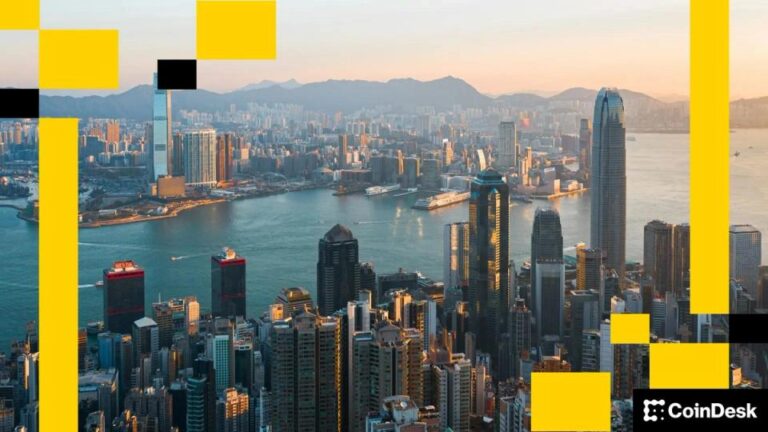
Hong Kong’s Securities and Futures Commission (SFC) granted a crypto license to Victory Fintech (VDX), an affiliate entity of publicly listed financial services firm Victory Securities (8540).
Victory won permission to operate a digital asset trading platform on Friday, according to the SFC’s registry of licensed crypto firms, the first addition since June 17 last year.
Hong Kong introduced its current regime for the regulation of companies providing crypto services in 2023, with Hashkey Exchange and OSL Digital Securities the first two parties to receive approval.
There are now 12 approved platforms on the registry, including New York Stock Exchange-listed Bullish (BLSH), which is also the parent company of CoinDesk.
The regime has earned a reputation for being one of the strictest among major financial jurisdictions. Prominent exchanges OKX and Bybit both withdrew their applications for licensing in May 2024.
Bitcoin’s slide may signal broader market trouble and a U.S. recession, Mike McGlone says

Bloomberg Intelligence macro strategist Mike McGlone said Monday that collapsing crypto prices may signal broader financial stress, warning bitcoin could revert toward $10,000 and potentially foreshadow the next U.S. recession.
In a post on X, McGlone also said the long-standing “buy the dip” mentality that has supported risk assets since 2008 could be breaking down as digital assets weaken and volatility dynamics shift.
After climbing back to $70,841 by 07:00 UTC on Feb. 15 from $65,395 late on Feb. 12, bitcoin was hovering around $68,800 by mid-morning. The broader crypto market was also in the red Monday, with 85 of the top 100 tokens posting losses. Privacy-focused coins monero and zcash were down 10% and 8%, respectively over the past 24 hours.
“Healthy Correction is what we should hear soon from stock market analysts (who risk unemployment if not onboard), following collapsing cryptos,” McGlone wrote. “The buy the dips mantra since 2008 may be over.”
McGlone pointed to several macro indicators that reflect elevated risk conditions. U.S. stock market capitalization relative to gross domestic product (GDP) has reached its highest level in roughly a century, he noted. At the same time, 180-day volatility in the S&P 500 and Nasdaq 100 is at its lowest level in about eight years, McGlone added.
He also described the “crypto bubble” as “imploding,” adding that “Trump euphoria” has peaked and is contributing to contagion across markets. Meanwhile, gold and silver are “grabbing alpha” at a pace last seen about half a century ago, with rising volatility that he said could “trickle up” into equities.
McGlone shared a chart comparing bitcoin divided by 10 for scaling, with the S&P 500. As of Feb. 13, both were hovering below 7,000 on his graphic. He said that “volatile and beta-dependent” bitcoin is unlikely to stay above that level if broader equity beta weakens.
The Bloomberg analyst identified 5,600 on the S&P 500, equivalent to roughly $56,000 for bitcoin under his scaling, as an initial “normal reversion” level. Beyond that, part of his base case calls for bitcoin to revert toward $10,000, contingent on a peak in the U.S. stock market.
McGlone’s outlook splits opinion
Jason Fernandes, co-founder of AdLunam and a market analyst, told CoinDesk that McGlone’s thesis assumes market extremes must resolve through collapse and that bitcoin’s equity beta guarantees a proportional crash.
“That’s false equivalence and single-path bias,” Fernandes said. “Markets can also resolve excess through time, rotation, or inflation erosion. A macro slowdown could mean consolidation or a $40,000 to $50,000 reset, not a systemic unwind to $10,000.”
Fernandes added that a move toward $10,000 would likely require a true systemic event, including sharp liquidity contraction, widening credit spreads, forced deleveraging across funds and a disorderly equity drawdown.
“That implies recession plus financial stress, not just slower growth,” he said. “Absent a credit shock or policy mistake that drains global liquidity, that kind of collapse remains a low-probability tail risk.”