Crypto market sentiment has fallen to extreme lows, a condition that has historically preceded short-term rebounds, according to analysts at Matrixport, though they caution further downside remains possible.
“Sentiment has fallen to extremely depressed levels, reflecting broad pessimism across the market,” said Matrixport in a note on Tuesday.
Matrixport’s own Bitcoin (BTC) “fear and greed index” suggests that “durable bottoms” form when the 21-day moving average drops below zero and reverses higher, which is currently the case.
“This transition signals that selling pressure is becoming exhausted and that market conditions are beginning to stabilize.”
However, Matrixport cautioned that prices could still fall further in the near term. Historically, these deeply negative sentiment readings have offered attractive entry points, they said.
“Given the cyclical relationship between sentiment and Bitcoin price action, the latest reading suggests the market may be approaching another inflection point,” it stated.
Previous periods when the Matrixport sentiment metric was this low were around June 2024 and November 2025, following periods of steep market declines.
Alternative.me’s “Fear and Greed Index” is also around its lowest level since June 2022, with a reading of 10 out of 100 indicating “extreme fear.”
Related: Bitcoin down 22%, could it be the worst Q1 since 2018?
If Bitcoin closes February in the red, it will print five straight monthly losses in the longest streak since 2018, and one of the steepest sustained sell-offs in history.
Bitcoin is at historic oversold levels
Frank Holmes, chairman of Bitcoin mining firm Hive, said on Monday that Bitcoin is now roughly two standard deviations below its 20-day trading norm. “This is a level we’ve seen only three times in the past five years,” he said.
“Historically, such extremes have favored short-term bounces over the subsequent 20 trading days,” he explained.
“Despite the ongoing market jitters, I remain bullish in the long term because the fundamentals still look strong.”
BTC is in historic oversold territory, creating opportunity. Source: Hive
Cointelegraph is committed to independent, transparent journalism. This news article is produced in accordance with Cointelegraph’s Editorial Policy and aims to provide accurate and timely information. Readers are encouraged to verify information independently. Read our Editorial Policy https://cointelegraph.com/editorial-policy
The demand for energy from the AI sector is immediate and high, reflecting the urgency in energy provisioning. Hyperscalers prioritize bringing capacity online quickly, often over cost considerations, to maintain competitive advantage. International markets offer more economically viable opportun…
Key takeaways
The demand for energy from the AI sector is immediate and high, reflecting the urgency in energy provisioning.
Hyperscalers prioritize bringing capacity online quickly, often over cost considerations, to maintain competitive advantage.
International markets offer more economically viable opportunities for bitcoin mining compared to the US
Excess energy in countries like Saudi Arabia and France is underutilized due to inadequate grid connections.
The cost of bitcoin mining capacity is at an all-time low due to oversupply and reduced demand.
Public miners are shifting focus towards high-performance computing (HPC) and AI, impacting the demand for new mining equipment.
Modularizing data centers can cut infrastructure costs and boost efficiency in AI inference.
Revenue in the AI sector is predominantly driven by inference processes.
Data center providers are increasingly becoming energy developers to meet future operational needs.
AI technologies are eroding the value traditionally held by software systems by automating insights.
The strategic focus of hyperscalers on capacity wars underscores the importance of operational readiness.
The shift of public miners towards HPC and AI reflects a broader industry trend impacting bitcoin mining dynamics.
The economic viability of international markets for bitcoin mining is influenced by lower AI demand and energy availability.
Modular data centers offer a solution to high infrastructure costs, particularly in AI applications.
The erosion of software value by AI highlights the transformative impact of technology on traditional business models.
Guest intro
Fred Thiel is the Chairman and Chief Executive Officer of Marathon Digital Holdings (NASDAQ: MARA), one of the largest publicly traded bitcoin mining companies. He joined the company in 2018 as a director and became CEO in 2021, overseeing its growth from a market cap under $30 million to over $5 billion. Under his leadership, Marathon has expanded bitcoin mining operations across four continents while emphasizing energy and infrastructure strategies.
The urgent energy demands of AI
The big demand right now for energy is from obviously the hpc ai sector and they need energy that is on now and not on in 2029
— Fred Thiel
Immediate energy needs are driven by the high-performance computing (HPC) requirements of AI.
Hyperscalers are in a capacity war, focusing on who can run more GPUs.
It’s all about a capacity war who has gpu’s running… the more stuff you have running the smarter your model is
— Fred Thiel
The timing of bringing capacity online is prioritized over cost by hyperscalers.
The AI sector’s energy demands are shaping market dynamics and strategic decisions.
The focus on operational readiness is critical for maintaining competitive advantage.
Energy provisioning for AI is a key factor influencing infrastructure development.
The urgency in energy demand reflects the rapid growth and importance of AI technologies.
International opportunities in bitcoin mining
A lot of our growth for bitcoin mining is actually targeted internationally… internationally there is much less demand for ai in hyper scalar capacity.
— Fred Thiel
International markets are more economically viable for bitcoin mining than the US
Lower demand for AI and hyperscale capacity abroad creates opportunities for mining.
Excess energy in countries like Saudi Arabia and France is underutilized.
You have all this renewable energy that’s available but isn’t connected to a grid to be sold… 66 of the energy is nuclear… and the capacity at the nuclear power plants is running below 70%.
— Fred Thiel
The lack of grid connections limits the effective use of available energy resources.
Energy market dynamics vary significantly between the US and international regions.
Strategic shifts in mining operations are driven by regional energy availability.
International growth in mining is influenced by economic and infrastructural factors.
The current state of bitcoin mining capacity
The cost of a terahash of bitcoin mining capacity is at its lowest point most probably ever… it’s a combination of oversupply and no demand.
— Fred Thiel
Bitcoin mining capacity costs are at an all-time low due to oversupply.
Reduced demand for mining rigs is linked to strategic shifts by public miners.
40% of miners in the us are the public miners… they’re not buying any more miners.
— Fred Thiel
Public miners are increasingly focusing on high-performance computing (HPC) and AI.
The shift in focus impacts future demand and investment in mining infrastructure.
Current market dynamics are shaped by economic factors affecting pricing.
The oversupply of mining capacity reflects broader industry trends.
Strategic changes by public miners highlight the evolving landscape of bitcoin mining.
Modularizing data centers for AI efficiency
Take the infrastructure down to a million dollars a megawatt and solve that problem through modularizing a data center and in the world of inference you don’t need to have all these huge clusters that are interconnected.
— Fred Thiel
Modular data centers can significantly reduce infrastructure costs.
Efficiency improvements in AI inference are achieved through modularization.
The cost of data centers is a critical factor in AI infrastructure development.
Modularization offers a solution to the high costs associated with traditional data centers.
Revenue generation in AI is primarily driven by inference processes.
Revenue generation in the ai world is only done through inference that’s what you pay for.
— Fred Thiel
The focus on inference highlights its importance in the AI business model.
Modular data centers align with the strategic needs of AI applications.
Data centers as energy developers
It’s all about time to time to energization of the data center… as you get beyond ’29 there you can look at i’m going to go build my own power generation because that’s going to take a couple of years to three years just to get permitting etcetera.
— Fred Thiel
Data center providers are increasingly becoming energy developers.
The shift towards energy generation addresses operational capacity needs.
Building energy infrastructure involves significant timelines and challenges.
The strategic focus on energy development reflects broader industry trends.
Operational challenges in energy provisioning influence data center strategies.
The relationship between data centers and energy production is evolving.
Energy development is a critical component of future data center operations.
The shift highlights the importance of energy infrastructure in data center planning.
AI’s impact on traditional software value
All the value accretes at the end… the moat that sap has is being eroded now by ai because while you won’t necessarily rip sap out you will through agentic technologies essentially generate the insights that the humans who would be operating sap would have.
— Fred Thiel
AI technologies are eroding the value traditionally held by software systems.
The automation of insights by AI impacts traditional software business models.
The competitive landscape in the tech industry is shifting due to AI advancements.
AI’s impact on software highlights the transformative nature of technology.
The erosion of software value underscores the need for adaptation in the industry.
AI technologies offer new ways to generate insights traditionally provided by humans.
The strategic implications of AI on software systems are significant.
The shift reflects broader industry trends towards automation and efficiency.
Wintermute’s latest macro update paints a jittery picture for digital assets, with bitcoin stuck below the $70,000 range as macro crosscurrents and fading conviction keep traders cautious, according to trading strategist Jasper De Maere. Bitcoin Finds 200-Week Support but Lacks Conviction, Wintermute Strategist Says Wintermute’s analysis describes a market that is steady in price but […]
At Finovate Europe, surrounded by rapid-fire demos, ambitious startups, and bold claims about the future of finance, a deceptively simple question was asked:
Who is going to “win” Finovate Europe?
The instinctive answer might be to name a standout fintech — the company with the slickest demo, the most innovative product, or the strongest investor backing. Events like Finovate are built on that energy: competition, comparison, momentum.
But the response offered a different perspective.
Instead of pointing to a specific company, the answer suggested that the real winner may not be defined by technology alone — but by who communicates their value most effectively.
In fintech, innovation is only the starting point. A product can be technically brilliant yet fail to gain traction if its story is unclear. Investors need to understand the commercial opportunity. Customers need to grasp the benefit quickly. Regulators need clarity. The media needs a narrative that translates complexity into relevance. Without strong communication, even the most sophisticated solution risks disappearing into the noise.
At events like Finovate, where dozens of companies compete for attention in a compressed time frame, visibility becomes a competitive advantage in its own right. The ability to explain — clearly, concisely, and credibly — what problem you solve and why it matters can determine who leaves with new partnerships, funding conversations, or media coverage.
This doesn’t diminish the importance of technology. It reinforces it. Innovation must be accompanied by articulation. In an industry where hype cycles are shorter and scrutiny is higher, credibility is earned through clarity.
So who wins Finovate Europe?
Perhaps it’s not the company with the flashiest demo, but the one whose message lands. The one that turns complexity into confidence. The one that understands that in fintech, adoption follows understanding.
In that sense, “winning” is less about the stage — and more about what happens after it.
Trusted Editorial content, reviewed by leading industry experts and seasoned editors. Ad Disclosure
A former White House crypto adviser has shared his thoughts on the delay of the long-awaited market structure bill and whether the banking and digital assets industry will resolve their differences soon.
Bo Hines Optimistic About Crypto Legislation
On Monday, Bo Hines, CEO of Tether US and former executive director of the US President’s Council of Advisors for Digital Assets, expressed optimism about the passage of the crypto market structure bill, known as the CLARITY Act.
In a recent interview with journalist Eleanor Terret at the Digital Assets at Duke Conference, Hines affirmed that he’s “actually confident that CALRITY will get passed” despite the delay.
It’s worth noting that the highly anticipated legislation has been stalled after hitting a roadblock a month ago due to restrictions on the payment of stablecoin yield, meant to address the banking industry’s concerns of deposit flight risk.
The crypto industry heavily criticized the Senate Banking Committee’s policy, leading to the delay of the mid-January markup session and an extended negotiation process between lawmakers and leaders from both industries.
Now, time seems to be running out, Terret noted, as we approach the alleged White House’s end-of-month deadline for the crypto and banking industries to solve the stablecoin yield dispute.
Due to this, Hines affirmed that both sides “are in the pressure cooker right now,” arguing that the two industries understand they must make concessions to reach an agreement and advance the bill.
As reported by Bitcoinist, the digital assets industry has already proposed some compromises to salvage the crypto legislation, such as giving community banks a larger role in the stablecoin system.
The former White House adviser highlighted the Office of the Comptroller of the Currency’s (OCC) recent moves. Notably, the OCC has started to issue conditional licenses to more digital assets native companies, which he considers will provide a pathway to “find a resolution that (…) protects banks from deposit flight, but also allows these crypto companies to be innovative and offer different solutions to their customers.”
CLARITY Act’s Window ‘Rapidly Closing’
Hines also noted that the crypto industry is aware that they must take advantage of the legislative momentum, “especially under this administration that’s been extremely pro- digital assets.”
As he explained, “this is where you’re going to get the best return on investment in a sense of like what you’ve been doing over the course of (…) the last few years in terms of political activity and engagement.”
Similarly, Patrick Witt, the current executive director of the US President’s Crypto Council, shared a similar perspective on Friday. The advisor affirmed that they are “working hard to address the issues that were raised that led to the postponement of that markup and hopefully get that back on the books soon.”
Nonetheless, he urged lawmakers to keep the momentum going, emphasizing that the window to pass the legislation is still open, but it is “rapidly closing” as the midterm election campaign season approaches, which “takes all the oxygen out of the room.”
The US Secretary of the Treasury Scott Bessent also pressed lawmakers to advance the bill soon, highlighting the importance of getting the legislation on President Donald Trump’s desk before the end of the spring legislative window.
Bessent stressed that the chances of getting a deal done could collapse if Democrats take control in November, recalling the crackdown on the industry during the Biden administration.
“There’s a lot of innovation that goes on adjacent to crypto, the blockchain, and DeFi. So, I think it’s important to get this clarity bill done as soon as possible and on the president’s desk this spring,” he declared on Friday.
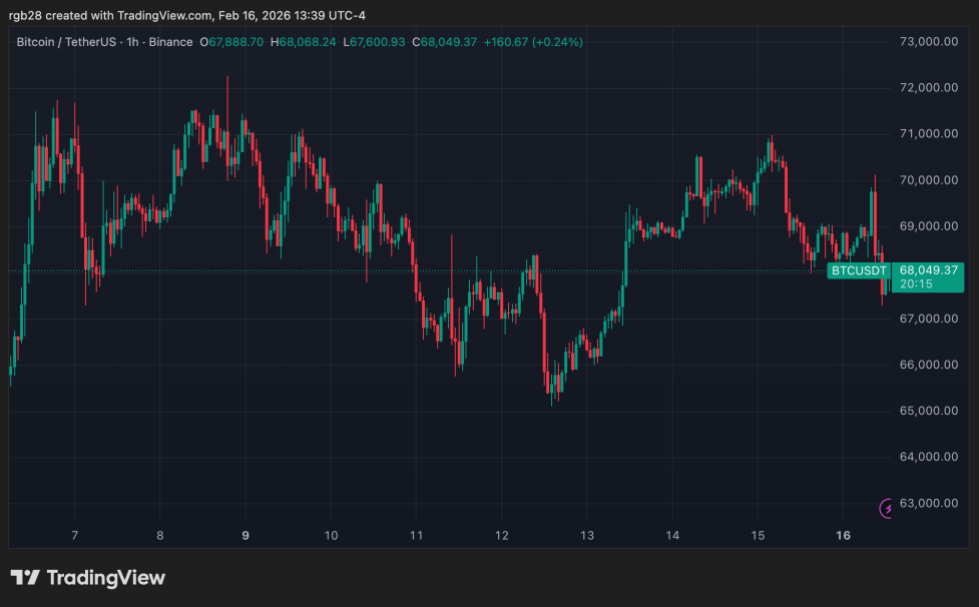
Bitcoin (BTC) trades at $68,049 in the one-week chart. Source: BTCUSDT on TradingView
Featured Image from Unsplash.com, Chart from TradingView.com
Editorial Process for bitcoinist is centered on delivering thoroughly researched, accurate, and unbiased content. We uphold strict sourcing standards, and each page undergoes diligent review by our team of top technology experts and seasoned editors. This process ensures the integrity, relevance, and value of our content for our readers.
The bank previously predicted the crypto will hit $8 by the end of the year.
Standard Chartered has slashed its end-of-year price target for XRP by a staggering 65% as its analysts revise their outlook following February’s brutal crypto market selloff.
The British investment bank previously forecast XRP to hit $8 by the end of 2026. That prediction was lowered to $2.80 in a Thursday note to investors shared with DL News.
“Recent price action for digital assets has been challenging, to say the least,” Geoffrey Kendrick, the bank’s global head of digital assets research, said in the note. “We expect further declines near-term and we lower our forecasts across the asset class.”
In recent weeks, the crypto market has been hit by the worst market rout in almost four years.
Bitcoin fell 28% over the past month, hitting a low of $60,000 before rebounding.
Other crypto assets have fared just as poorly. Amid the rout, XRP briefly fell to $1.16, its lowest price in 15 months.
XRP is trading 59% below its July all-time high.
It has since bounced back, but is still down around 28% over the past month.
Big turnaround
It’s a big turnaround for the $90 billion Ripple-linked cryptocurrency.
By all accounts, XRP got off to a strong start in 2026. The asset rallied 25% in the first week of the year, buoyed by XRP exchange-traded fund inflows and regulatory tailwinds.
On January 5, the amount of money locked in XRP ETFs hit a record $1.6 billion, according to crypto data platform SoSoValue.
That figure has fallen to just over $1 billion — a 40% drop — as of February 13.
It’s not just XRP Standard Chartered has lowered its forecast for.
The bank also dropped its year-end target from $150,000 to $100,000 for Bitcoin, $7,000 to $4,000 for Ethereum, and $250 to $135 for Solana.
“We see XRP keeping pace with ETH. Both are likely to benefit from the further development of stablecoins and tokenised real-world assets,” Kendrick said.
Looking ahead
One of the biggest potential catalysts for a sustained XRP price recovery is the Clarity Act, a broad crypto market bill currently passing through the US Senate.
On Thursday, US Treasury Secretary Scott Bessent said the passing of the clarity Act will help the crypto market recover.
Last month, Katherine Dowling, president of Bitcoin Standard Treasury Company, told DL News XRP has the most to gain from the successful passage of the Clarity Act.
Progress on the bill stalled last month after banking chiefs and crypto executives disagreed on key parts of the legislation.
But the delays could soon be over. On February 10, Stuart Alderoty, Ripple’s chief legal officer, said that he’d had a “productive session” at the White House, and that now was the time to move ahead.
“Clear, bipartisan momentum remains behind sensible crypto market structure legislation,” Alderoty said. “We should move now — while the window is still open — and deliver a real win for consumers and America.”
Tim Craig is DL News’ Edinburgh-based DeFi Correspondent. Reach out with tips at tim@dlnews.com.
Traditional finance giant Apollo Global Management Inc. has signed a partnership agreement with decentralized lending platform Morpho to take a significant stake in the project and help support its blockchain lending infrastructure.
The move was announced on Friday by the Morpho Association, the nonprofit organization behind the decentralized finance (DeFi) platform.
The partnership, or “cooperation agreement,” will see Apollo or its affiliates buy up to 90 million Morpho (MORPHO) governance tokens over the next four years, representing 9% of the total 1 billion-token supply of MORPHO.
“Under the Agreement, Apollo or its affiliates may acquire MORPHO tokens through a combination of open-market purchases, OTC transactions, and other contractual arrangements, subject to an overall ownership cap of 90 million MORPHO tokens over a 48-month period as well as transfer and trading restrictions,” the Morpho Association said.
The Morpho Association added that it will also work together to “support onchain lending markets on Morpho’s protocol,” without providing further details.
The move saw a 17.8% bump in the price of MORPHO over the weekend, rising from around $1.12 on Friday to $1.32 at the time of writing, according to CoinGecko data.
However, the asset is down 38% over the past 12 months amid a broader crypto market slump.
MORPHO price increased over the weekend. Source: CoinGecko
Morpho is the sixth-largest DeFi protocol by total value locked, with $5.8 billion, according to DeFi Llama. The project primarily provides lending markets and curated investment vaults for investors to earn yield.
The deal with Apollo, a multinational asset manager with nearly $940 billion in assets under management, marks another significant partnership secured by Morpho in recent months.
In late January, Cointelegraph reported that digital asset manager Bitwise had jumped on board to provide curated vaults offering a 6% annual yield on Morpho. Last week, the Bitcoin DeFi project Lombard also announced that Morpho had signed on as an initial liquidity partner for its launch of Bitcoin Smart Accounts.
Meanwhile, Apollo has been gradually upping its exposure to crypto and blockchain. Last year, the firm partnered with Coinbase to develop stablecoin credit strategies and made an undisclosed investment in Plume to support its real-world-asset tokenization infrastructure.
Cointelegraph is committed to independent, transparent journalism. This news article is produced in accordance with Cointelegraph’s Editorial Policy and aims to provide accurate and timely information. Readers are encouraged to verify information independently. Read our Editorial Policy https://cointelegraph.com/editorial-policy
The addition is the first crypto company to be licensed by the Securities and Futures Commission since June 2025, when the regulator approved Hong Kong BGE.
Hong Kong’s Securities and Futures Commission (SFC) has added another company to its list of formally licensed cryptocurrency trading platforms, according to a Friday announcement.
The SFC’s list of licensed virtual asset trading platforms includes Victory Fintech Company Limited as the latest of now 12 cryptocurrency and blockchain entities on the Hong Kong regulator’s website. The addition of Victory marked the first time since June 2025 that the SFC had approved a crypto trading platform in Hong Kong.
Source: Hong Kong SFC
Although Hong Kong has been known for some time as a particularly strict jurisdiction in for crypto companies to operate in, authorities have been pursuing unlicensed virtual asset trading platforms as a criminal offense since June 2024. Many exchanges that had previously been operating in Hong Kong shut down, while others like OKX and Bybit withdrew their licensing applications.
Related: Crypto funds log fourth week of outflows at $173M as BTC dips below $70K
In January, Hong Kong’s Secretary for Financial Services and the Treasury, Christopher Hui, said regulators, including those at the SFC, were planning to submit a draft ordinance for providers offering crypto advisory services sometime in 2026. While a dozen companies are now licensed under the SFC, Hong Kong’s Monetary Authority listed no licensed stablecoin issuers as of Monday.
HK allows licensed companies to engage in crypto margin financing, perpetual trading
The addition of Victory Fintech came just a few days after Hong Kong’s SFC said it will allow licensed brokers to provide virtual asset margin financing. The securities regulator’s guidance only allows Bitcoin (BTC) and Ether (ETH) to be eligible as collateral, initially.
The SFC also outlined a framework for trading platforms to offer perpetual contracts to professional investors.
Magazine: Is China hoarding gold so yuan becomes global reserve instead of USD?
Cointelegraph is committed to independent, transparent journalism. This news article is produced in accordance with Cointelegraph’s Editorial Policy and aims to provide accurate and timely information. Readers are encouraged to verify information independently. Read our Editorial Policy https://cointelegraph.com/editorial-policy
Trusted Editorial content, reviewed by leading industry experts and seasoned editors. Ad Disclosure
The founder of Capriole Investments has pointed out how Google searches related to “Quantum Computing Bitcoin” peaked alongside the price top.
Bitcoin Saw Increased Interest In Quantum Threat During Bull Run
In a new post on X, Capriole Investments founder Charles Edwards has talked about the trend in the Google search interest around the Quantum Computing threat to Bitcoin.
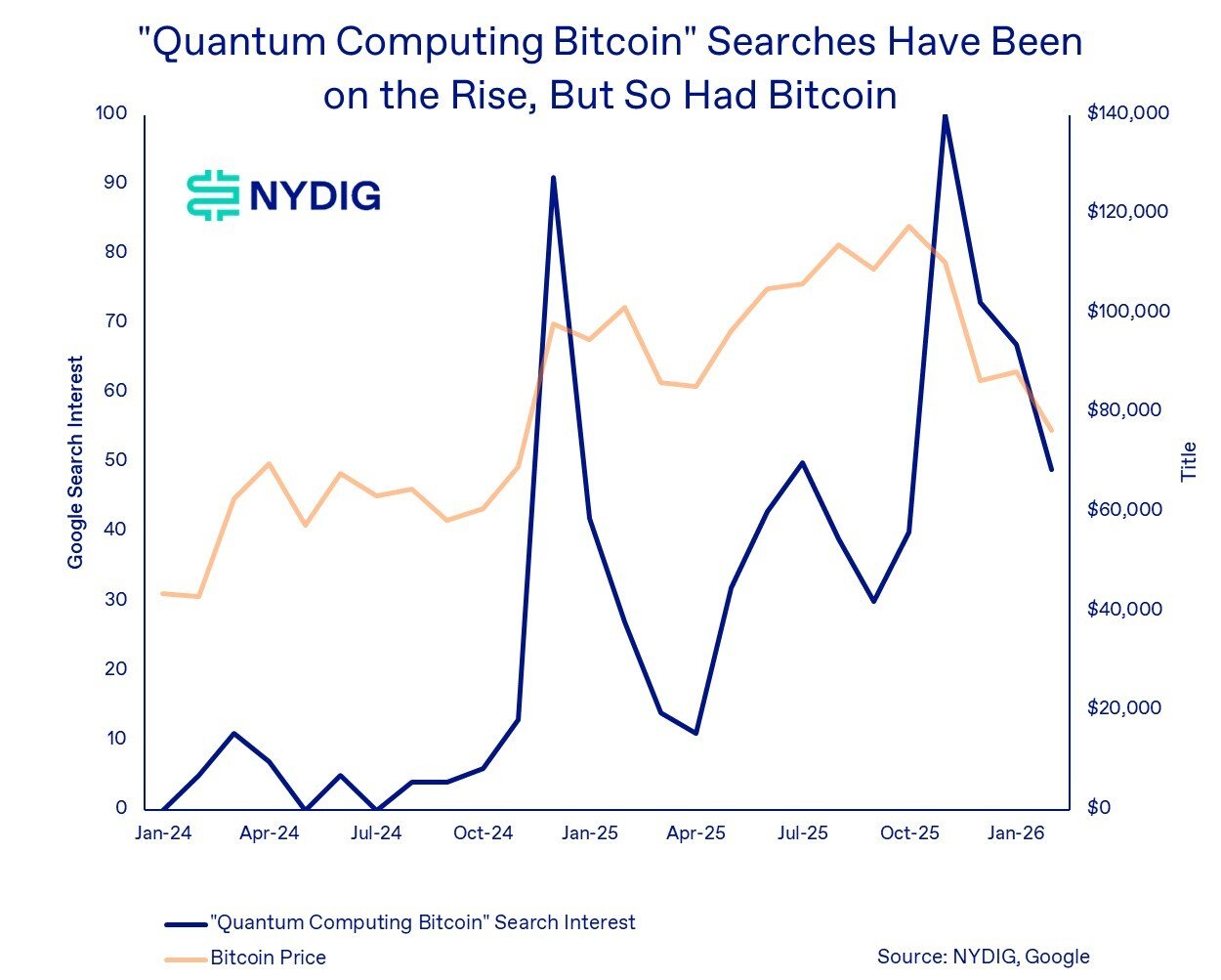
Below is the NYDIG chart cited by the analyst that lines up the Google search data for “Quantum Computing Bitcoin” against the cryptocurrency’s price trajectory.
Looks like interest in the search term hit a peak last year | Source: @caprioleio on X
As displayed in the graph, the Google search interest in the topic witnessed a sharp surge just as last year’s bull rally reached its peak. This would imply that the price appreciation brought with it risk evaluation around the Quantum Computing threat to the cryptocurrency.
Quantum Computing is an emerging technology that could, in theory, exploit the vulnerabilities present in old BTC wallets to access the tokens stored inside them and dump them on the market.
The timeline related to when Quantum Computing could become advanced enough to do this remains yet uncertain, but it has nonetheless raised concerns among many in the BTC community. Edwards has been one of the loudest voices when it comes to this issue, urging the community to work together on a solution as soon as possible.
Based on the Google search interest chart, the analyst has noted, “Evaluation of the risk was at a maxima when price was, resulting in derisking, a leading indicator to price falling.” Shortly after the peak in the metric, the asset observed a bearish shift that has today taken it below the $70,000 mark. “The Quantum threat drove Bitcoin down,” said Edwards.
From the graph, it’s also visible that a similar trajectory was visible during the price surge that occurred in late 2024. Back then, the topic saw slightly lower peak traction and faded quickly once the cryptocurrency slowed down.
Interest in the topic has gone down this time as well as Bitcoin has declined, but it still remains significantly above the low from early 2025, a potential sign that the floor interest in the risk has gone up. “The good news is, at least this means we are starting to get traction and attention in the right places to solve the problem (Strategy, Eth foundation etc),” noted the Capriole founder.
Analyst Willy Woo has also made an X post discussing the Quantum risk. As the chart shared by Woo illustrates, the Bitcoin vs Gold price has broken a twelve-year trend recently.
The trend in the XAUBTC ratio over the years | Source: @willywoo on X
The XAUBTC ratio was in a state of downtrend for twelve years, but its value saw a reversal last year and has since been rising. “The valuation trend broke down once QUANTUM came into awareness,” explained the analyst.
BTC Price
At the time of writing, Bitcoin is trading around $68,600, down 2.4% over the last week.
The price of the coin seems to have been moving sideways over the past few days | Source: BTCUSDT on TradingView
Featured image from Dall-E, chart from TradingView.com
Editorial Process for bitcoinist is centered on delivering thoroughly researched, accurate, and unbiased content. We uphold strict sourcing standards, and each page undergoes diligent review by our team of top technology experts and seasoned editors. This process ensures the integrity, relevance, and value of our content for our readers.
The British state is perceived as increasingly disconnected from the electorate. Government spending during COVID has been criticized for wastefulness. The size of the state has grown, leading to less respect for the electorate.
Key Takeaways
The British state is perceived as increasingly disconnected from the electorate.
Government spending during COVID has been criticized for wastefulness.
The size of the state has grown, leading to less respect for the electorate.
The Labour party is seen as fostering a dependency culture.
Governance structures are viewed as undermining MP sovereignty.
There is a belief that the government has become adversarial to the people.
Public resilience is deemed necessary to preserve the country.
Both major UK political parties are facing existential challenges.
Economic and currency chaos is predicted for the UK.
Traditional political parties are seen as failing the public.
Calls for change in political leadership are gaining traction.
The current governance model is criticized for not serving the people.
There is significant concern over the future stability of the UK economy.
Guest intro
Rupert Lowe is the independent Member of Parliament for Great Yarmouth. He previously served as a Member of the European Parliament for the Brexit Party from 2019 to 2020 and chaired Southampton Football Club from 1996 to 2006.
The disconnect between the British state and the electorate
The British state has become the enemy of the electorate.
— Rupert Lowe
Concerns about the government’s disconnect from citizens are growing.
Do I think the British state has become the enemy of the electorate? I do.
— Rupert Lowe
This viewpoint highlights a perceived governance crisis.
There is a significant amount of waste in government spending, particularly related to COVID contracts.
— Rupert Lowe
Billions in government contracts during COVID are seen as mismanaged.
You look at the contracts that we’ve uncovered… we find waste everywhere.
— Rupert Lowe
The issue of financial oversight is critical for public trust.
The growing size and influence of the state
The state has become larger and less respectful of the electorate over time.
— Rupert Lowe
The expansion of the state is linked to reduced public respect.
I think what’s happening is the state’s got bigger and bigger.
— Rupert Lowe
This reflects concerns about government accountability.
The Labour party’s ideology is seen as promoting statism.
Labour driven by ideology… that is pro statism.
— Rupert Lowe
The party is criticized for fostering dependency culture.
They want a dependency culture…
— Rupert Lowe
Challenges in current governance structures
The current governance structure undermines the sovereignty of MPs.
— Rupert Lowe
Blairite legislation is seen as eroding parliamentary power.
The power of the MPs has been undermined largely by Blairite legislation.
— Rupert Lowe
There is a call for a complete change in governance.
The whole basis upon which our unwritten constitution has been undermined.
— Rupert Lowe
The system is criticized for not working for the people.
It’s now not working for the people.
— Rupert Lowe
The adversarial role of government
The government has become the enemy of the British people.
— Rupert Lowe
This reflects a strong critique of government actions.
Yes, I think government has become the enemy of the British people.
— Rupert Lowe
The relationship between citizens and government is strained.
Concerns about welfare and individualism are highlighted.
The need for a more citizen-focused government is emphasized.
Public sentiment is increasingly critical of government actions.
The need for public resilience
The British people need to grow a backbone to prevent losing their country.
— Rupert Lowe
Public resilience is seen as crucial for national preservation.
I think they’ve got to start growing a bit of backbone…
— Rupert Lowe
There is a warning about the potential loss of the country.
Otherwise they’re going to lose the country that we all dearly love.
— Rupert Lowe
The current situation is not seen as sustainable.
It’s not working at the moment it’s going to get worse.
— Rupert Lowe
The existential crisis of major political parties
Both the Conservative and Labour parties are facing an existential crisis.
— Rupert Lowe
Political polling suggests significant challenges for both parties.
If the polling is correct in the next election currently Labour would only win four seats.
— Rupert Lowe
The future of these parties is uncertain.
There is a call for political renewal and change.
The electorate’s dissatisfaction is driving a desire for new leadership.
The crisis reflects broader discontent with traditional politics.
Predictions of economic and currency chaos
The UK is heading for significant chaos, particularly in terms of currency and the economy.
— Rupert Lowe
Economic instability is predicted for the UK.
I think we’re heading for chaos… I think we’re heading for currency chaos.
— Rupert Lowe
The political landscape is seen as contributing to economic challenges.
There is concern about the future stability of the UK economy.
I think we’re heading for economic chaos.
— Rupert Lowe
This prediction underscores the urgency of addressing political issues.
The failure of traditional political parties
The current political parties have consistently let the public down.
— Rupert Lowe
There is widespread dissatisfaction with traditional parties.
People have realized now that the reds and the blues have let them down consistently.
— Rupert Lowe
The public’s desire for change is increasing.
I think people want change.
— Rupert Lowe
The failure of traditional parties is driving a shift in public expectations.
New political leadership is seen as necessary for addressing public concerns.