BitMine Immersion Technologies (BMNR), the largest Ethereum treasury company, purchased 45,759 ether (ETH) last week worth over $90 million, extending its buying spree despite the sharp pullback in crypto prices.
The haul was the largest weekly purchase this year in token terms, bringing the firm’s total ETH holdings to 4,371,497 tokens, the company said in a Tuesday update. That’s equivalent to $8.7 billion at current prices, while the company is estimated to be sitting on almost $8 billion in paper losses.
The firm also raised its cash pile to $670 million, alongside its small bitcoin BTC$67,625.72 stash and equity stakes, including a $200 million position in Beast Industries. Total assets stand at $9.6 billion, while BitMine’s share of ETH’s total supply rose to 3.62%.
BitMine has now staked over 3 million ETH — about 69% of its holdings — that generate $176 million in annualized rewards, according to Chairman Tom Lee. The firm’s staking operations currently yield 2.89% annualized.
Lee said sentiment in crypto markets remains depressed, drawing comparisons to the lows of 2018 and 2022. But he argued the current environment differs in that there have been no major collapses of large players.
“Investor sentiment and enthusiasm are rock bottom, reminding us of the forlornness and dejection seen at the November 2022 lows and depths of 2018 crypto winter,” he said. “Rather, it seems like crypto has remained weak since the ‘price shock’ and massive deleveraging seen on October 10th.”
Lee also highlighted developments from last week’s Consensus Hong Kong conference, where he cited tokenization, artificial intelligence (AI) integrations and proof-of-humanity infrastructure as long-term growth drivers for Ethereum.
“The price of ETH is not reflective of the high utility of ETH and its role as the future of finance,” Lee said. “Hence, we continue to buy ETH even as crypto moves through this ‘mini-winter.'”
Read more: Tom Lee says stop timing the bottom and start buying the dip
Soluna Holdings is deepening its ties with Blockware, adding 6 megawatts (MW) of capacity at Project Dorothy 1 in West Texas as deployment moves toward completion by the end of February. Bitcoin Miner and HPC Service Provider Soluna Strengthens Texas Presence With Capacity Increase Soluna Holdings Inc. announced it is expanding its partnership with Blockware […]
Cysic founder Leo Fan argued that blockchain projects relying heavily on hyperscalers like Google Cloud and Microsoft’s Azure risk undermining crypto’s decentralization ethos, at Consensus Hong Kong 2026.
Fan’s comments came after Cardano founder Charles Hoskinson outlined Midnight, Cardano’s privacy-focused project, and announced partnerships with companies including Google and Telegram. Midnight is scheduled to launch its mainnet at the end of March, according to Hoskinson.
Hoskinson defended working with hyperscalers, arguing that no single layer-1 blockchain can handle the computational demands required for global, privacy-preserving systems.
“When people spend a trillion dollars building data centers,” he said, referring to major cloud providers, “we should probably use what they spent the trillion dollars on instead of trying to build a completely different network.”
Midnight Foundation CEO Fahmi Syed said the network will debut with 10 federated nodes as part of what he described as a “responsible” path toward decentralization. Google Cloud is among early collaborators providing infrastructure support.
Justifying the single point of failure
Hoskinson said Midnight is designed to offload heavy computational workloads, particularly those tied to privacy and zero-knowledge cryptography, to cloud providers such as Google Cloud and Microsoft Azure. He added that technologies like multi-party computation and confidential computing would allow providers to supply hardware capacity without accessing the underlying data.
During a stage demonstration, Hoskinson said Midnight processed thousands of transactions per second with Microsoft Azure powering the backend compute layer.
Fan, however, argued that relying on hyperscalers for core compute still introduces structural centralization risks.
“If your validators look decentralized but all run on the same data center in that’s still a single point of failure,” Fan told CoinDesk. “Blockchain is supposed to remove single points of failure. If the infrastructure is centralized, that’s a contradiction.”
Cysic, operates a decentralized compute network focused on zero-knowledge proof generation. He said one customer reduced proof-generation time from as much as 90 minutes on AWS to roughly 15 minutes using Cysic’s distributed hardware network.
“In some scenarios, we can deliver better performance,” Fan said. “We don’t need to defeat them immediately, but we can compete.”
How decentralization should be defined
Midnight is not outsourcing its blockchain to Google or Microsoft. The base network runs its own nodes, and Hoskinson emphasized that hyperscalers provide hardware capacity rather than governance or protocol control.
He described Midnight as a neutral coordination layer that could dynamically route workloads between cloud providers, arguing that encrypted computation and confidential computing environments ensure providers “just provide the hardware.”
Fan’s critique focuses on a different layer of the stack.
Even if data is encrypted and workloads can shift between providers, reliance on a small number of global infrastructure operators concentrates power at the compute layer, particularly as demand for GPUs and data center capacity intensifies, Fan said.
The disagreement is less about whether Midnight is centralized in a strict technical sense and more about how decentralization should be defined.
Hoskinson’s approach prioritizes cryptographic neutrality over hardware ownership. Fan said that decentralization must extend to the compute layer itself.
Rather than calling for a complete rejection of hyperscalers, Fan advocated a hybrid approach.
“Use big vendors in a limited way,” he said. “Combine them with decentralized networks to make the system more robust. Do not give up decentralization because that’s the nature of our community.”
As blockchain networks pursue enterprise adoption and global scale, the divide between building parallel infrastructure and integrating with Big Tech may define crypto’s next phase.
South Korea is ending a nine-year ban on corporate crypto trading, allowing listed entities and professional investment companies to reenter the market under a regulated framework.
Corporate participation will be tightly controlled, with investments capped at 5% of annual equity capital and limited to the top 20 cryptocurrencies traded on regulated domestic exchanges.
Institutional entry may gradually improve liquidity and market structure, but strict limits mean large capital inflows from corporate treasuries are unlikely in the short term.
Compared with the US, the EU, Japan and Hong Kong, South Korea is taking a more cautious path by allowing access while restricting scale to manage systemic and reputational risks.
After a nine-year break, South Korea is set to reintegrate corporations into its cryptocurrency market. The Financial Services Commission (FSC) has established new protocols allowing listed entities and professional firms to resume trading, effectively terminating the 2017 prohibition.
This move is part of the government’s ambitious “2026 Economic Growth Strategy,” which aims to transform the nation into a premier digital hub by introducing stablecoin laws and paving the way for spot crypto exchange-traded funds (ETFs).
This article explores what led to the ban on corporate trading in South Korea, what the new guidelines facilitate and how this step will transform South Korea’s crypto market. It also examines the risks South Korean regulators are confronting and compares South Korea’s corporate crypto trading policy with those of other countries.
Why corporate crypto trading was banned in South Korea
In 2017, South Korea prohibited institutional involvement in crypto markets due to a surge in retail speculation. Regulators were concerned about the risks of money laundering, market manipulation and threats to financial stability. Authorities restricted corporations and professional investors from participating while allowing retail crypto trading under stringent compliance requirements.
This policy distinctly shaped South Korea’s crypto market. Retail investors eventually dominated trading activity, whereas local institutions remained largely excluded from a rapidly expanding asset class. Gradually, this situation also drove capital flows abroad, with Korean investors and companies pursuing exposure via overseas exchanges and foreign investment products.
On the other hand, developed markets like the US progressively incorporated institutional capital into crypto through regulated futures, custody solutions and, ultimately, spot ETFs. By 2024, institutional participation represented the bulk of trading volumes on many leading global platforms.
Did you know? In 2018, South Korean banks issued special “real-name account” partnerships with exchanges, making them legally responsible for monitoring crypto transactions tied to customer identities.
What South Korea’s new corporate crypto rules allow
According to new guidelines issued by the Financial Services Commission (FSC), approximately 3,500 organizations are set to gain permission for crypto trading. This group encompasses publicly traded companies along with duly registered professional investment firms.
To begin with, corporate allocations to cryptocurrencies will be limited to no more than 5% of a company’s yearly equity capital. The purpose of this ceiling is to prevent businesses from exposing their balance sheets to undue levels of risk, while authorities monitor the broader implications of institutional involvement on overall market stability.
Permissible investments are confined exclusively to the 20 cryptocurrencies with the highest market capitalization. These cryptocurrencies will be available for trading on South Korea’s five principal regulated crypto exchanges. This channels corporate activity toward major, highly liquid cryptocurrencies like Bitcoin (BTC) and Ether (ETH), thereby sidelining the vast majority of smaller-cap or especially volatile digital assets.
The status of stablecoins such as Tether’s USDt (USDT) within South Korea’s regulatory framework is still under evaluation. Officials have indicated that stablecoins could undergo a distinct review process. Additional legislation may be introduced concerning payment systems and financial market infrastructure.
Crypto exchanges will need to implement safeguards for institutional orders, including mechanisms such as staggered trade execution and caps on individual order sizes. These legal requirements are intended to reduce abrupt price fluctuations and prevent large orders from disrupting thin order books.
Did you know? Korea’s National Pension Service, one of the world’s largest public pension funds, has invested in blockchain-related companies but has so far avoided holding cryptocurrencies directly.
How this fits into South Korea’s broader crypto strategy
The guidelines for corporate cryptocurrency trading in South Korea are not an isolated change. Instead, they form part of a broader regulatory overhaul that includes the upcoming Digital Asset Basic Act, which the National Assembly is scheduled to present in the early months of 2026.
This proposed law aims to consolidate the currently fragmented crypto regulations. It will address key areas such as exchange oversight, token issuance, custody, market conduct and investor protection. Policymakers are examining possible frameworks for stablecoins pegged to the Korean won and regulated spot cryptocurrency ETFs. These steps will further integrate digital assets into traditional financial markets.
These initiatives suggest a shift from crisis-driven restrictions toward structured market participation under formal regulatory supervision.
How corporate access will be transforming South Korea’s crypto market
South Korea’s decision to allow limited corporate participation in cryptocurrency markets is a positive step toward greater institutional integration. This change, along with the upcoming broader regulations, is likely to reshape the country’s crypto landscape over time.
Institutional liquidity and market structure
Enabling corporate participation will transform the dynamics of Korea’s cryptocurrency market. Institutional traders generally operate with longer investment periods, diversified strategies and professional risk management systems. Their arrival may enhance liquidity, narrow bid-ask spreads and reduce the dominance of short-term retail trading activity.
However, the 5% investment limit restricts the volume of funds that can enter crypto from company treasuries in the short term. As a result, the market impact may be gradual rather than immediate.
Treasury strategies and business innovation
In other jurisdictions, various companies have implemented strategies for holding digital assets in their treasuries. They use Bitcoin or similar assets as long-term balance sheet holdings. For instance, Japan’s Metaplanet has drawn worldwide interest by steadily increasing its Bitcoin holdings to build corporate value.
Industry participants in South Korea argue that a stringent investment limit may prevent diverse business models from emerging. Critics say companies should have the freedom to determine their own risk exposure within standard corporate governance and disclosure rules instead of dealing with crypto-specific investment restrictions.
Domestic financial products
Institutional participation in the crypto market will help create new types of financial instruments. These might include cryptocurrency ETFs, structured notes and custody services. For banks and asset managers, corporate trading demand could justify further investment in digital asset infrastructure.
This development could improve South Korea’s ability to compete with other financial centers in Asia, such as Hong Kong and Singapore. These hubs are actively courting digital asset firms and institutional investors.
Did you know? Some Korean conglomerates already use blockchain for supply chain tracking and digital certificates, meaning corporate exposure to distributed ledger technology predates financial crypto investments.
Comparing South Korea’s corporate crypto policy with other countries
South Korea’s cautious approach to allowing corporate crypto participation differs from the prevailing policies in major markets. In the US and parts of Europe, there are no specific percentage caps on corporate crypto holdings. However, businesses must still follow accounting rules, disclosure requirements and fiduciary responsibilities.
Japan and Hong Kong also allow institutional involvement without imposing fixed caps on balance sheet exposure. Instead, they rely on licensing frameworks, custody regulations and rules governing proper market conduct.
South Korea’s framework reflects a more cautious regulatory stance. It opens the door to crypto assets for corporations while restricting the scale of participation until authorities build greater confidence in the market’s stability.
Risks South Korean regulators are confronting
From the FSC’s viewpoint, the new framework balances market growth with the need to maintain financial stability. The risks that continue to concern regulators include:
Volatility risk, which could harm corporate balance sheets and weaken investor confidence
Operational risk, such as failures in custody arrangements or disruptions at crypto exchanges
Reputational risk, which arises if companies experience significant losses from speculative crypto trading.
By placing limits on the types of assets allowed and the size of investments, regulators aim to contain systemic exposure while building regulatory experience with institutional crypto participation.
What happens next?
The FSC is expected to release the final version of the guidelines in January or February 2026. Its implementation will be coordinated alongside the Digital Asset Basic Act later in the year. Corporate crypto trading may begin before the end of the year, provided that the legislative schedule stays on course.
Future adjustments may occur if market conditions remain stable and compliance mechanisms demonstrate reliability. Industry associations are likely to push for higher investment limits and a wider range of eligible assets once this initial stage has been completed.
Balancing financial stability with institutional innovation
Lifting the long-standing ban on corporate crypto trading participation represents a significant change in South Korea’s approach to digital assets. After nearly a decade of retail-only participation, institutions are finally being allowed into the domestic South Korean market, though under tight constraints.
Whether this cautious opening evolves into full institutional integration will hinge on market performance, how companies manage risk and how effectively regulators enforce safeguards. It is evident, however, that South Korea no longer views corporate crypto participation as inherently incompatible with financial stability but rather as an activity that can be managed within a structured regulatory framework.
Cointelegraph maintains full editorial independence. The selection, commissioning and publication of Features and Magazine content are not influenced by advertisers, partners or commercial relationships.
Cryptocurrencies started the shortened U.S. week on the back foot, with bitcoin BTC$67,693.23 sliding below $67,000 on Tuesday, falling below its tight weekend range of $68,000-$70,000.
The weakness coincided with a softer open for U.S. equities, especially for the battered software sector. The iShares Expanded Tech-Software Sector ETF (IGV) was 3% lower, and now 30% below the October high. Software stocks have been under pressure, with improving AI tools seen as a threat to their business models. Markets make opinions, and the current shibboleth says bitcoin is just software, so if AI is a threat to that sector, it’s a threat to bitcoin as well.
Software ETF (IGV) and bitcoin (BTC) prices (TradingView)
Read more: Bitcoin’s correlation with troubled software stock sector is growing
The broader Nasdaq fell 0.8%, and the S&P 500 fell 0.6%.
Meanwhile, the once-parabolic rally in precious metals continued to cool. Gold dropped 3% to around $4,860 per ounce, while silver tumbled another 6%, leaving it roughly 40% below its late-January peak.
Crypto-related equities also retreated, giving back part of Friday’s sharp bounce. Strategy (MSTR), the largest corporate bitcoin holder, fell around 5% with a simlar decline for USDC stablecoin issuer Circle (CRCL). Bitcoin miners and data center names Riot Platforms (RIOT), MARA, CleanSpark (CLSK), Cipher Mining (CIFR) and TeraWulf (WULF) all fell roughly 4%-5%.
Crypto in search of a narrative
Paul Howard, senior director at trading firm Wincent, said that crypto remains firmly tethered to macro sentiment.
“Macro news has been closely correlated with crypto’s risk profile the last 12 months and expectations are that macro numbers remain soft, implying a risk-off trade mentality,” Howard said.
He pointed to the U.S. Supreme Court’s ruling on tariffs expected later this week as a potentially bigger near-term catalyst than routine economic data.
For now, he expects more consolidation as bitcoin and the broader digital asset market search for a new narrative strong enough to pull capital back from AI stocks and commodities.
“Crypto has some work to do recreating itself as an appealing asset class and the relatively low prices are not attractive enough,” Howard said.
Bitcoin’s decline is diverging from Nasdaq’s sideways movement, flashing a warning signal according to Maelstrom fund’s Arthur Hayes.
Hayes estimates $330 billion in consumer credit losses if 20% of knowledge workers lose jobs to AI
While experts agree with the idea, they disagree on the timeline, suggesting that disruption of that scale takes quarters, not weeks
Bitcoin is signaling a warning that traditional equities have yet to acknowledge, according to BitMEX co-founder Arthur Hayes.
The leading crypto has been on a downtrend since its October 2025 all-time high of $126,080, while the Nasdaq 100 Index has remained largely flat. That divergence is driven by job losses in the face of advances in artificial intelligence, Hayes argues, suggesting it signals an impending dollar credit crunch.
“This is how a banking crisis completely grinds Pax Americana’s economy to a halt,” Hayes wrote in his Tuesday Substack post titled “This Is Fine,” referring to the U.S.-led global financial system.
Not everyone is convinced the divergence carries such dire implications. “Divergence is worth watching, but only one data point rather than a confirmed alarm,” Ryan McMillin, chief investment officer at crypto fund manager Merkle Tree Capital, told Decrypt.
While Bitcoin’s decoupling from the Nasdaq is notable, McMillin argues that falling dollar liquidity is a credible partial explanation, citing the Fed’s decision to keep rates elevated and to drain the reverse repo facility.
Bitcoin-specific factors such as the four-year cycle dynamics, profit-taking after the October all-time high, a stalled Clarity Act, and ETF flow patterns have all played a role, independent of macro liquidity signals.
“The relationship between Bitcoin and equities has never been static,” Colin Goltra, CEO of EVM settlement layer for payments Morph, told Decrypt. “Bitcoin can trade like a risk asset at times and move independently at others, so short-term divergences are neither new nor inherently revealing.”
Bitcoin is the first to react to liquidity headwinds, according to Hayes, since it is the most responsive asset to fiat credit conditions. Nasdaq, by contrast, has yet to fully price in what he describes as an AI-driven wave of white-collar job displacement that will trigger widespread consumer credit and mortgage defaults.
“If AI tools like Anthropic’s Claude Cowork can reliably complete tasks in minutes that would take a human hours or days, why do you need all those SaaS productivity subscriptions?” Hayes wrote.
With the iShares Software ETF underperforming the broader Nasdaq, Hayes expects the next phase to target the workers themselves—and, by extension, the banks that lent to them.
Hayes estimates $330 billion in consumer credit losses and $227 billion in mortgage losses for U.S. commercial banks if 20% of the 72.1 million knowledge workers with roughly $3.76 trillion in consumer credit lose their jobs to AI.
McMillin pushed back on the timeline, if not the directional concern.
“The scenario is intellectually coherent but does overstate the speed of near-term disruption,” he said. Hayes’ model assumes 20% of knowledge workers lose jobs fast enough to create a synchronized wave of loan defaults, but “labor markets don’t work that cleanly.”
AI headwinds
Even rapid AI adoption translates into redundancies over quarters and years, not weeks, and many employers will reduce headcount through attrition and hiring freezes rather than mass layoffs, experts argue.
That said, McMillin acknowledged “the directional concern isn’t wrong: rising credit card delinquencies are already real, SaaS valuations are under pressure, and a rolling deterioration in consumer credit quality is plausible.” The crisis timeline, he argued, is “probably more stretched than Hayes suggests.”
The market is already telegraphing that outcome, Hayes argues, pointing to gold’s recent strength relative to Bitcoin’s slide.
Gold surging amid Bitcoin’s slump indicates “that a deflationary risk-off credit event within Pax Americana is brewing,” Hayes wrote. If such an event does trigger, the former BitMEX CEO expects the Federal Reserve to eventually print money to backstop the banking system crisis.
Goltra agreed the Fed would respond forcefully. For Bitcoin, such episodes matter because they “gradually change how market participants interpret the durability of the monetary system.” Large-scale liquidity interventions reinforce the case for assets with fixed supply characteristics.
For Bitcoin traders, the setup presents a two-scenario path. Either the leading crypto’s drop from $126,000 to $60,000 was the full downward move, and that stocks will eventually catch up with the correction, or Bitcoin will dump further as equities meet their maker, Hayes said.
The eventual outcome is the same: massive money printing that sends Bitcoin to new highs, he said.
“Everyone knows that everyone knows that AI is the most transformative general-purpose technology in human history,” Hayes wrote. “Faced with these ‘truths,’ the Fed must print bigger than it’s ever printed before.”
Bitcoin hasn’t caught a break in 2026. The top crypto is down 2.5% over 24 hours and 27% over the past month, according to CoinGecko. It currently trades at approximately $67,000 per coin.
Daily Debrief Newsletter
Start every day with the top news stories right now, plus original features, a podcast, videos and more.
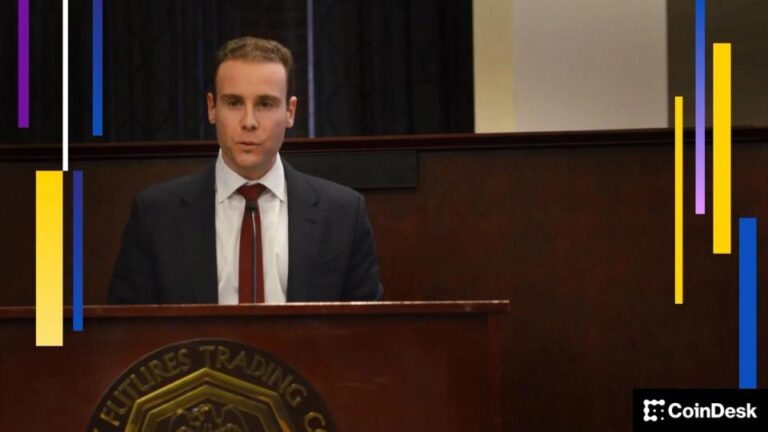
The legal challenges from state governments against certain aspects of prediction markets such as Polymarket and Kalshi received a sharp rebuke from U.S. Commodity Futures Trading Commission Chairman Mike Selig, who is arguing that his federal agency has jurisdiction — not the states.
“To those who seek to challenge our authority in this space, let me be clear, we will see you in court,” Selig said in a video statement posted Tuesday on social media site X. He said his agency filed a legal brief in court to back up the federal role as the leading regulator over this corner of the derivatives markets.
“The CFTC has regulated these markets for over two decades,” he said. “They provide useful functions for society by allowing everyday Americans to hedge commercial risks like increases in temperature and energy price spikes, they also serve as an important check on our news media and our information streams.”
Selig did not mention sports bets in his list of examples, though that’s where many of the legal disputes are focused. States have gone after event-contract platforms with accusations they’ve breached sports-betting laws at the state level, such as in Nevada, Massachusetts and New York. A federal judge in Nevada concluded in November that the state authorities were correct and that the contracts aren’t properly the business of the CFTC, though that ruling is under appeal.
Coinbase, the top U.S. crypto exchange, has also sought to enter the prediction markets sector, and it’s currently suing Connecticut, Illinois and Michigan over those states’ attempts to regulate sports betting as gaming.
That’s the setting that Selig is weighing into as he declares “exclusive jurisdiction over these derivative markets.” But until the return to Washington of President Donald Trump, the agency had fought against these companies and some of their contracts, claiming that the sites’ political bets were unlawful and “contrary to the public interest.” But courts had gone against the CFTC in its legal fight with Kalshi, and when Trump’s administration overhauled the agency’s leadership, the fight was abandoned.
In early 2025, the president’s son, Don Trump Jr., joined Kalshi as a strategic adviser. In August, he then joined Polymarket’s advisory board.
In October, Trump Media & Technology Group (DJT), which owns President Donald Trump’s social platform Truth Social, said it was getting into the prediction markets business.
Within weeks of his confirmation by the Senate, Trump nominee Selig said that his agency was resetting its prediction markets approach and would pursue new policies on that front. He said the CFTC “will advance a new rulemaking grounded in a rational and coherent interpretation of the Commodity Exchange Act that promotes responsible innovation in our derivatives markets in line with Congressional intent.”
In the hours after Selig’s Tuesday statement, Utah Governor Spencer Cox responded with his own challenge.
“Mike, I appreciate you attempting this with a straight face, but I don’t remember the CFTC having authority over the ‘derivative market’ of LeBron James rebounds,” he wrote in a response on X. “These prediction markets you are breathlessly defending are gambling — pure and simple. They are destroying the lives of families and countless Americans, especially young men. They have no place in Utah.”
While Utah hasn’t been among states leading legal challenges against the prediction markets, there is a legislative effort there that seeks to target certain sports contracts. Cox advised Selig he’d use every power to “beat you in court.”
And U.S. Senator Elizabeth Warren, the ranking Democrat on the Senate Banking Committee, argued that Selig is undermining state powers.
“President Trump’s CFTC Chair is trying to strip states of their authority to regulate gambling within their borders and hamstring their ability to protect Americans from getting ripped off,” she said in a statement. “The CFTC should focus on ensuring our derivatives markets don’t blow up the economy again, not helping corrupt political insiders cash in.”
UPDATE (February 17, 2026, 17:59 UTC): Adds response from Utah governor. UPDATE (February 17, 2026, 21:30 UTC): Adds statement from Senator Warren.
Nakamoto (NAKA) has signed definitive agreements to acquire media and events firm BTC Inc and asset management firm UTXO Management.
The all-stock deal is — NAKA will issue 363. million shares for the purchase — is valued at approximately $107.3 million and expected to close in the first quarter of 2026, according to a Tuesday press release.
BTC Inc runs several high-profile bitcoin media properties, including Bitcoin Magazine, The Bitcoin Conference, and the enterprise-focused Bitcoin for Corporations program. UTXO, meanwhile, advises 210k Capital, a hedge fund allocating capital into bitcoin-related public and private markets.
“We intend to operate a portfolio of companies across media, asset management, and advisory services that can scale with Bitcoin’s long-term growth,” said David Bailey, CEO of Nakamoto. “This transaction signifies the first step of the company we intend to build, and we’re just getting started.”
The transaction has raised eyebrows among some market watchers due to the steep discount between the original pricing and the current execution. One user on X pointed out that Nakamoto was originally set to pay over $400 million based on the agreed $1.12 share price, but with the stock now trading below 30 cents, the acquisition is closing at roughly $107 million.
Bailey, who also leads BTC Inc, is central to all three companies involved, making this a related-party transaction. A special committee of independent directors approved the deal with input from outside legal and financial advisers.
NAKA shares are flat on Tuesday, trading at just $0.30 versus the roughly $2.00 level prior to converting to a bitcoin treasury strategy (when the company was named Kindly MD).
The crypto market has been lighting up like a rocket launchpad, and the momentum isn’t slowing. Coins like Zcash and Monero are showing that investors are chasing privacy and scarcity narratives, driving fresh waves of buying interest. With regulatory pressures tightening and the hunt for undervalued gems accelerating, timing is everything. Those who jump on early tend to ride the trend, while reactive investors scramble after the fact.
APEMARS is entering the scene with a mission-driven presale designed to capture first-mover advantage. Stage 8 of the presale is live at $0.00006651, with an intended listing price of $0.0055. Its structured, story-driven approach and viral referral activation make it one of the top meme coin to buy today, offering early participants unprecedented exposure and the potential for explosive gains.
The Stage 8 presale has already raised over 215k+, selling 11.5B tokens to more than 1,010 holders. This structured entry ensures that momentum builds before exchange liquidity hits, minimizing short-term sell pressure. With a current ROI from Stage 8 of over 8,169% toward the listing price of $0.0055, APEMARS is positioned as a best 100x coin for disciplined early adopters seeking exposure to a trend before mainstream attention arrives.
How $3K Could Scale With APEMARS
A $3,000 investment in Stage 8 would secure roughly 45,093,464 $APRZ tokens at $0.00006651 each. If APEMARS reaches its intended listing price of $0.0055, this position would grow to approximately $248,000. This scenario highlights the power of structured, stage-based presales, where early access compounds gains, and community-driven momentum amplifies returns. Timing the entry while the presale is still live ensures that investors capture maximum first-mover potential before market hype pushes prices higher.
How to Participate in APEMARS Presale: Step-by-Step
Joining the APEMARS Stage 8 presale is straightforward:
Visit the official presale website and connect a supported Ethereum wallet.
Verify your account and ensure KYC completion if required.
Select the number of $APRZ tokens to purchase and confirm the transaction using ETH.
Activate the referral code to gain additional rewards and network benefits.
Monitor your wallet for token allocation updates after the presale stage concludes.
This structured approach guarantees transparency and early exposure, allowing participants to capture momentum before exchange listings create volatility.
Zcash developers formed a new entity, ZODL, rebranding the flagship wallet Zashi. Users need no action, as updates happen automatically, and functionality remains intact. The rebranding reflects a broader shift in governance and mission focus, aiming to evolve ZEC without reliance on ECC’s development fund.
The market responded positively, with ZEC rising 0.59% to $286.04. Investor rotation from privacy-focused tokens and renewed interest in Zcash’s scarcity and privacy narrative have contributed to this modest upward move. Bitcoin news today highlights that privacy tokens continue attracting attention as regulators increase scrutiny, giving ZEC renewed visibility among traders looking for mid-cap altcoin opportunities.
Monero confirmed a bullish reversal via a falling wedge breakout, climbing nearly 4.78% to $333.75. The next resistance sits at $381, with a potential target of $420 if bullish momentum sustains. Dip buyers have returned after XMR’s low of $284 earlier this month, signaling strong support among privacy-conscious investors.
XMR’s adoption on darknet marketplaces and its role as a privacy-first payment solution have amplified demand. This aligns with broader market rotations, where funds are moving from other privacy coins like Zcash and Dash. Bitcoin news today underscores that institutional interest in privacy solutions is rising, creating a fertile environment for first movers in these altcoins.
Conclusion
Zcash and Monero are demonstrating that privacy-centric assets are rallying under increasing regulatory scrutiny. Investors are positioning ahead of mainstream attention, creating trend leadership opportunities across mid-cap altcoins. Market visibility matters, and early movers often capture disproportionate gains while reactive buyers chase momentum.
APEMARS continues to stand out as a top meme coin to buy today, offering Stage 8 participants structured presale access, over 8,169% potential ROI, and a mission-driven narrative that builds community before exchange liquidity arrives. For those exploring early-stage crypto exposure, find all the latest information on the best crypto to buy now, including Stage 8 presale details, rankings, and projected returns to evaluate opportunities before broader market hype accelerates.
For More Information:
Website: Visit the Official APEMARS Website
Telegram: Join the APEMARS Telegram Channel
Twitter: Follow APEMARS ON X (Formerly Twitter)
Frequently Asked Questions For The Best 100x Coin
What makes APEMARS a top meme coin to buy today?
APEMARS combines a structured presale, high-yield staking, deflationary tokenomics, and viral referral incentives. Stage 8 access allows early participants to capture momentum before exchange liquidity drives price volatility.
How can $APRZ investors benefit from Stage 8 presale?
Stage 8 offers pricing at $0.00006651 with a listing target of $0.0055. Early buyers secure high ROI potential while engaging in a community-driven narrative, maximizing first-mover advantage before mainstream exposure.
Why are Zcash and Monero gaining attention now?
Zcash rebranded to ZODL, improving governance visibility, while Monero confirmed a bullish reversal pattern. Both coins benefit from privacy demand amid regulatory scrutiny, attracting speculative and strategic investors.
What is the expected ROI from APEMARS Stage 8 to listing?
Stage 8 tokens have an ROI potential of over 8,169% if the listing price of $0.0055 is reached, making early entry critical for maximizing returns and capturing momentum-driven gains.
How do referral systems enhance APEMARS participation?
Referral activation rewards early promoters with bonus tokens while expanding community engagement. This viral mechanism strengthens momentum, supports network effects, and increases the potential ROI for active participants.
Glossary of Terms
Presale Stage: Structured rounds allowing early purchase at preferential pricing
ROI (Return on Investment): The potential gain relative to initial investment
Deflationary Tokenomics: Supply reduction mechanisms like token burns
First-Mover Advantage: Early participation that captures trend momentum
APEMARS Stage 8 presale presents an early-stage opportunity for crypto investors seeking structured entry and high ROI. With a current price of $0.00006651 and a listing target of $0.0055, early participants can achieve over 8,169% gains. The token leverages a story-driven presale, deflationary supply mechanics, high-yield staking, and viral referral incentives to build momentum before exchange liquidity. Concurrently, Zcash’s wallet rebrand and Monero’s bullish reversal highlight broader market rotations toward privacy-focused assets. Stage-based presales reward disciplined investors while mid-cap altcoins with strong narratives attract trend leadership and speculative interest. This article positions APEMARS as a top meme coin to buy today, connecting structured early-stage exposure with current crypto market opportunities.
Disclaimer
This article is for informational purposes only and does not constitute financial advice. Cryptocurrency investments carry risk. Readers should conduct independent research and consult a professional before investing.
Blockchain advocacy group The Digital Chamber has launched a new unit focused on supporting prediction markets and helping gain regulatory clarity for the sector in the US.
In an announcement via X on Tuesday, The Digital Chamber unveiled the Prediction Markets Working Group, outlining a multi-year plan to bring clarity to what it called a “misunderstood segment of finance.”
The Digital Chamber said the first course of action was sending a letter to Commodity Futures Trading Commission (CFTC) chairman Mike Selig praising his efforts to maintain federal jurisdiction over prediction markets, while also calling for an end to regulation by enforcement.
“In our letter, we applauded Chair Selig’s recent statements regarding the intent for CFTC staff to provide tailored rulemaking and guidance for this rapidly growing segment of the financial and digital asset industries,” The Digital Chamber said.
“For too long, operators in this space have navigated a maze of regulatory ambiguity including unclear overlaps between federal and state regulators,” it added.
Source: The Digital Chamber
Moving forward, the group plans to continue engaging with the CFTC, develop policy principles, submit policy recommendations, publish research and build a coalition of industry stakeholders and participants.
It also mentioned “participating in litigation” via friend-of-the-court briefings to educate courts on what it deems the “CFTC’s historic regulatory exclusivity” over the sector.
Prediction markets are heading to court
The move comes amid intense scrutiny of the sector from state governments and regulators.
Kalshi, one of the leading prediction market platforms, was hit with a civil enforcement action by the Nevada Gaming Control Board on Tuesday. The gaming board is calling for an injunction to stop Kalshi from offering “unlicensed wagering” in the state.
Both Kalshi and competitor Polymarket have seen multiple state regulators push to stop them from offering markets such as sports contracts in their respective states, arguing that they are offering unlicensed gambling products.
Last week, Polymarket filed a federal lawsuit against the state of Massachusetts to preemptively block any potential enforcement action, arguing that the CFTC has primary oversight over the sector, not state governments.
Related: Prediction markets should become hedging platforms, says Buterin
The CFTC chair has also been echoing such sentiments recently, urging state governments to respect the CFTC’s authority and oversight over the sector or risk facing them in court.
“Prediction markets aren’t new — the CFTC has regulated these markets for over two decades,” Selig emphasized in a video posted to X on Monday.
Responding to Selig on Tuesday, Utah Governor Spencer Cox welcomed any possible legal stoushes with the CFTC, labeling prediction markets as a form of gambling, which is “destroying the lives” of Americans.
“Mike, I appreciate you attempting this with a straight face, but I don’t remember the CFTC having authority over the ‘derivative market’ of LeBron James rebounds. These prediction markets you are breathlessly defending are gambling—pure and simple.”
Magazine: Big questions: Should you sell your Bitcoin for nickels for a 43% profit?
Cointelegraph is committed to independent, transparent journalism. This news article is produced in accordance with Cointelegraph’s Editorial Policy and aims to provide accurate and timely information. Readers are encouraged to verify information independently. Read our Editorial Policy https://cointelegraph.com/editorial-policy