Bitmine disclosed Monday that it now holds more than 4.3 million ether, a massive position that places the digital asset treasury firm roughly $480 million underwater as ETH trades below its average purchase price. Bitmine Doubles Down on Ethereum While Paper Loss Nears Half a Billion Bitmine Immersion Technologies said it holds 4,325,738 ETH, acquired […]
Is Trump Good for Crypto Treasuries? Risk, Governance and the New Playbook
As digital assets become more openly politicized in the Trump era, the corporate question has shifted. For public companies that already hold Bitcoin or are considering a “crypto treasury” strategy, the debate is moving away from election-cycle narratives and toward board-level fundamentals: governance, risk limits, compliance posture, auditability, and how much balance-sheet volatility shareholders will tolerate.
Over the past 2–3 months, Washington has delivered a clearer directional signal—friendlier rhetoric and a push to codify market structure—while simultaneously exposing the fault lines that still matter to CFOs: stablecoin incentives, banking competition, and the pace at which regulators can translate “pro-innovation” into law.
A friendlier tone in Washington—still a hard policy problem
Trump-aligned regulators have indicated they want to lay out clearer crypto rules and foster growth, a departure from the enforcement-first posture that characterized much of the prior cycle. But the last few weeks have also underlined how quickly progress can stall when legislation collides with traditional finance.
A White House meeting convened to break a deadlock between banks and crypto firms failed to resolve a central dispute: whether stablecoins and intermediaries should be allowed to pay “interest” or “rewards.” Banks argue yield-like incentives could pull deposits away from the banking system; crypto firms argue restricting incentives would lock in incumbents and slow innovation. The impasse has become a bottleneck for market-structure efforts such as the CLARITY Act and related stablecoin provisions.
For corporate treasuries, that matters less as a policy debate and more as an operational one: regulatory ambiguity can affect banking access, custody arrangements, disclosures, and the willingness of auditors and directors to sign off on material crypto exposure.
The market stress test arrived first: fair-value volatility is the headline risk
Even as Washington tries to move toward clearer rules, the market has reminded public companies why crypto treasuries are fundamentally governance products.
Bitcoin’s sharp early-February decline triggered a fresh round of scrutiny on Strategy (formerly MicroStrategy). Strategy reported $12.4 billion quarterly loss tied to mark-to-market accounting on its Bitcoin holdings. The move shows a structural reality for corporate holders: under fair-value treatment, price swings are no longer an abstract chart—they are an income statement event and a shareholder relations problem.
Crypto-linked firms beyond the corporate-treasury cohort also showed how quickly downturns translate into reported losses and investor pressure. Galaxy Digital, for example, reported a $482 million quarterly loss tied to the drop in Bitcoin prices.
This is the environment boards are navigating: a potentially more supportive federal stance, paired with balance-sheet optics that can deteriorate fast in a drawdown.
Two executive lenses on the same problem: conviction vs governance
To understand how corporate decision-makers are reframing crypto exposure amid politicization and scrutiny, AlexaBlockchain talked to top executives from two prime stakeholders — one from the insurance and risk world, and the other from a crypto treasury operator. Their perspectives illustrate the split between “why this asset class” and “how you hold it responsibly.”
Brian Ruddick, Chief Strategy Officer at Upexi: Fundamentals over sentiment, and a Solana-heavy thesis
Asked what the current moment signals for Bitcoin, Solana, and the crypto market—especially with expectations shifting around a prolonged Trump-driven rally—Upexi’s Brian Ruddick downplayed short-term price action and emphasized adoption metrics:
“I don’t believe current price action signals much for digital assets. This is because, due to their nascency, digital assets are extremely volatile and trade more based on sentiment than on underlying fundamentals. Moreover, these underlying fundamentals, measured by items like daily active users, number of developers, institutional participation, etc, are in secular expansion. Prices will ebb and flow based on sentiment, but over the long-run will follow fundamentals. And, lower prices against improving fundamentals equates to an improved risk reward.”
On how public companies should interpret pullbacks—timing, conviction, and long-term strategy—Ruddick framed the decision as a classic re-underwriting exercise:
“Anytime prices move against you, an investment analyst should re-underwrite their thesis. If that thesis is broken, they should exit the position. If it is not, they should increase their position, given the greater upside. We continue to have extreme conviction that our current financial infrastructure is antiquated, slow, and expensive, that it is being reimagined and replaced by blockchain and internet-based rails, that much of this activity is and will occur on Solana to benefit the price of Solana, and that Upexi as a treasury company can add even more value over time given our multiple compounding value accrual mechanisms. As such, we stay the course, and look forward to continuing to execute and enhance shareholder value.”
On diversification versus concentration, Ruddick made a notably concentrated case—positioning Solana as the long-term “winner” chain:
“We are hyper-focused on Solana, as we believe it is the end game-winning high performance blockchain. It is the first second generation smart contract blockchain, enabling both best-in-class technology for leading performance as well as strong network effects, having launched in 2020. In addition, it has a growing and vibrant ecosystem of users, developers, and decentralized applications spanning many various use cases. And, it is already putting up leading key metrics, such as daily active users, decentralized application revenue, and decentralized exchange volumes.”
And on whether drawdowns slow institutions—or mature them—Ruddick argued that volatility acts as a cleansing mechanism:
“Periods like this flush out excess speculative leverage, weed out bad actors, and lead to improved market structure over the long-run. While large drawdowns feel horrible, they are healthy for such a nascent asset and lead to these various positives, enabling continued progress and future bull markets.”
The through-line is clear: Upexi’s posture is not “Trump is good/ bad for crypto.” It is “fundamentals are improving; volatility is the cost of admission; concentration is a feature, not a bug.”
Jason Bishara, CEO of NSI Insurance Group: Treat it as a governance and diversification decision—watch concentration risk
In an email interview with AlexaBlockchain, NSI Insurance Group CEO Jason Bishara framed drawdowns as typical for emerging asset classes and urged boards to focus on diversification and volatility absorption:
“Like most emerging asset classes, crypto tends to experience periods of intense enthusiasm followed by corrections. New sectors often become overbought as excitement builds around future expectations, and then prices cycle lower as fundamentals, adoption, and business models catch up.
Boards should view price pullbacks in Bitcoin and other digital assets as part of normal market volatility rather than as a failure of the asset class itself. This is precisely why a well-diversified balance sheet matters—one that hedges across multiple asset classes, currencies, and markets. When structured properly, diversification allows companies to absorb volatility in any single market while helping stabilize overall financial performance.”
On politicization and the fiduciary/ compliance angle, Bishara emphasized balance—warning both against zero exposure and against “excessive” exposure that can create shareholder risk:
“Fiduciary and compliance considerations around crypto exposure should be taken seriously by all boards. Holding digital assets as part of a broader diversification or hedging strategy is increasingly accepted in today’s markets. However, as with any investment approach, concentration risk is a key concern.
Having no digital asset exposure at all may leave a company vulnerable as the financial system continues to evolve, while excessive exposure could expose shareholders to unnecessary volatility. The prudent approach is balance—measured exposure within a clearly defined risk framework.
More aggressive strategies, such as deploying a full Digital Asset Treasury (DAT) strategy that results in a change in control or materially alters the company’s risk profile, can raise red flags. Without a clearly articulated business model and governance framework, these strategies can lead to significant stock price volatility and increase the board’s exposure to shareholder liability claims.”
That “change in control” language captures a growing corporate concern: once a crypto treasury strategy becomes the dominant driver of valuation and ownership dynamics, it can start to behave less like treasury management and more like a new business model—without the operational, disclosure, and oversight stack that business-model shifts typically require.
On what differentiates responsible corporate holders during volatility, Bishara pointed to controls and oversight—again tying the outcome to equity volatility:
“Companies managing crypto exposure responsibly typically embed digital assets within a broader, well-governed diversification strategy. These organizations have clear controls, risk limits, and oversight structures in place, and as a result, they tend to exhibit less extreme stock price volatility—protecting shareholders from outsized swings tied to a single asset class.
By contrast, over-exposed or under-governed companies—particularly those pursuing DAT strategies that effectively create a change in control—often experience sharp and unpredictable stock movements. The defining line is governance: when a digital asset strategy materially alters ownership dynamics or corporate control without adequate oversight, volatility increases and risk management breaks down.”
And on separating headline risk from real risk—especially as crypto becomes politicized—Bishara argued for anchoring decision-making in business model and regulatory reality:
“Leadership teams should stay anchored to their core business model, long-term strategy, and the regulatory framework in which they operate. Headline risk and political narratives can be distracting, but they should not override disciplined financial decision-making.
The use of digital assets as part of a responsible hedging and balance sheet strategy is generally accepted by both regulators and shareholders when done prudently. The focus should be on financial fundamentals, governance, and risk controls—not political sentiment.”
What public-company treasuries want from Trump: clarity, not cheerleading
In practical terms, the “Trump effect” for crypto treasuries is less about a rally and more about whether the administration can translate posture into predictable rails:
- Market-structure clarity: Corporate risk committees want rules that reduce the chance of sudden regulatory shocks. The ongoing stablecoin-yield standoff shows how difficult that will be.
- Regulatory execution capacity: Public reporting suggests SEC leadership is exploring innovation-friendly mechanisms, but timelines and specifics still appear in flux.
- Reduced second-order friction: CFOs and boards care about custody, audit sign-off, banking counterparties, and shareholder messaging. A supportive tone helps at the margins; it does not remove volatility.
What KOLs are talking about: “Bitcoin president” narratives vs balance-sheet mechanics
Key opinion leaders have leaned into the politics—some framing Trump as a tailwind—while the corporate conversation is becoming more mechanical.
The most visible example remains Strategy and Michael Saylor, whose company’s mark-to-market loss and continued accumulation keep it at the center of the “crypto treasury” trade. Meanwhile, market participants increasingly debate whether the next phase of corporate adoption will broaden beyond Bitcoin to other assets (including higher-beta treasuries) or retrench toward simpler, governance-friendly policies—an argument that maps closely to the contrast between Ruddick’s concentrated Solana thesis and Bishara’s emphasis on diversification and risk limits.
The bottom line: Trump may be helpful—but governance will decide who survives the headline cycle
If the last 2–3 months delivered a single message to corporate treasurers, it’s that politicization can amplify narratives, but it doesn’t change the core job:
- If you hold crypto, you are running a volatility program on a public balance sheet.
- If you scale exposure, you must defend it under fiduciary duty, disclosure scrutiny, and shareholder litigation risk—especially if the strategy begins to resemble a de facto change in corporate identity.
- And if Washington can’t produce clear, effective law—particularly around stablecoin incentives and market structure—corporate adoption will remain constrained by governance friction even when regulators sound supportive.
In that sense, Trump can be “good for crypto treasuries” only to the extent that he makes crypto less operationally risky to hold—not merely more popular to talk about.
The article “Is Trump Good for Crypto Treasuries? Risk, Governance and the New Playbook” was first published on AlexaBlockchain. Read the complete article here: https://alexablockchain.com/is-trump-good-for-crypto-treasuries/
Read Also: Is X’s InfoFi crackdown a necessary fix for spam—or a reminder that crypto attention markets still run on centralized gatekeepers?
Disclaimer: The information provided on AlexaBlockchain is for informational purposes only and does not constitute financial advice. Read complete disclaimer here.
Image Credits: Shutterstock, Canva, Wiki Commons
End Of An Era: Trend Research’s Ethereum Unwinding Finally Complete After Extended Market Pressure
A recent major Ethereum sell-off is sharply taking over the spotlight in the broader cryptocurrency community. Given the prolonged volatile state of the market over the past few months, Trend Research has officially concluded its massive ETH unwinding, offloading thousands of the leading altcoin.
Massive Trend Research’s Ethereum Unwind Concludes
Ethereum’s price is facing heightened bearish pressure, and several big institutions appear to be dumping their ETH holdings, which is likely to extend the ongoing volatility. The most recent and popular sell-off swelling across the community is that of Trend Research, an Edmonton-based marketing research data collection firm.
Trend Research is marking a significant turning point for Ethereum, with the announcement that the protracted tale of strong selling and position unwinding has finally ended. MartyParty, a crypto commentator and the host of The Office Space, shared this update on the X platform, attracting community attention.
Looking at the on-chain tracking, the company has deposited/liquidated the entire 651,757 ETH into Binance, the largest cryptocurrency exchange in the world. At the time of the transaction, the portion of ETH was valued at a whopping $1.34 billion, with a reported average exit price of $2,055.
According to MartyParty, this caps off a brutal leveraged long position that began unraveling hard when the price of Ethereum experienced a sharp decline. Specifically, the forced selling began at levels of $1,750 earlier in February 2026. After the sell-off, the estimated realized loss clocks in at roughly $747 million, while other trackers estimate it at roughly $745 million, marking one of the biggest public sales from a major player in recent memory.

MartyParty has outlined a breakdown of the action. The commentator highlighted that Trend Research originally built a huge ETH long. This was carried out by borrowing stables on Aave against ETH collateral, then buying more ETH exposure that reportedly peaked near +$2 billion at points.
As the price of Ethereum tanked, the company started moving ETH into Binance in the past days/weeks to repay debt and prevent complete liquidation. Prior batches ranged from 10,000 to 90,000 ETH, and they are increasing. Meanwhile, the final batch removed the rest, basically leaving their wallets empty. However, a few trackers point to tiny remnants like 0.165 ETH left in their wallet.
By making this move, a significant source of sell pressure that had been looming over cryptocurrency for the last week or so is eliminated. However, whether it triggers a relief bounce or if the market simply ignores it hinges on the broader crypto sentiment, including macro, other whales, and ETF flows, among others.
ETH Whales Reviving Buying Pressure
Even with the ongoing pullback, investors’ sentiment has not entirely turned bearish toward the altcoin. CW, a market expert, disclosed that inflows to accumulating wallet addresses seem to have increased despite ETH experiencing a notable drop.
Data shows that large holders or whales have been increasing their holdings, while retail investors continue to offload due to the panic. This divergence represents a shift in ownership, where supply moves from weaker hands to stronger conviction-driven investors.
Featured image from iStock, chart from Tradingview.com
Editorial Process for bitcoinist is centered on delivering thoroughly researched, accurate, and unbiased content. We uphold strict sourcing standards, and each page undergoes diligent review by our team of top technology experts and seasoned editors. This process ensures the integrity, relevance, and value of our content for our readers.
U.S. government isn’t poised to sweep in with bitcoin buys, despite Jim Cramer rumor
President Donald Trump’s U.S. bitcoin reserve doesn’t exist yet, and there is no mechanism in the federal government for the wholesale purchase of crypto.
Keep that in mind when considering this weekend’s speculation about the price point that would cause the White House to push a buy button, thanks in large part to CNBC speculator Jim Cramer. There is no such button.
The president did order a “strategic reserve” established to hold bitcoin, but that didn’t make it spring into existence. The Treasury Department and crypto advisers spent months auditing the federal holdings of crypto (though White House crypto adviser Patrick Witt told CoinDesk last week that they still won’t share a number). But the process hit a snag: The advocates said they still need Congress to establish the stockpile under law.
The crypto sector’s new U.S. law for stablecoin issuers didn’t include it, nor does the sweeping crypto market structure bill currently grinding through the U.S. Senate. Clearing legislation through this Congress — even less controversial matters — is a tall order, and industry lobbyists are currently focused on the bill to finally establish market and oversight regulations for digital assets. A reserve may not even be second on the list of priorities, because crypto tax rules also beckon.
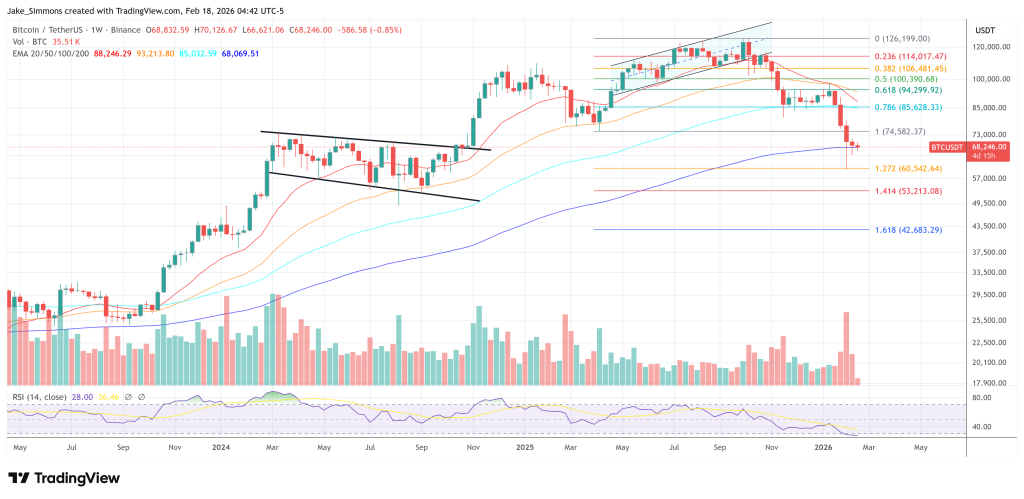
When Cramer suggested on-air that Trump has a plan, saying, “I heard at 60 he’s going to fill the bitcoin reserve,” the crypto markets took some notice. The struggling asset has recently dropped as low as $62,840 but spent some days hovering just under $70,000, and if the U.S. government stood ready to swoop in at $60,000, that could be a big deal. But the rumor isn’t supported by what’s going on with the federal fund.
For now, Trump’s executive order last year to set up the bitcoin reserve and a separate stockpile of other crypto assets waits to be fulfilled. And his order carefully rejected the idea of the government purchasing crypto with taxpayer money (which disappointed the industry at the time). Instead, he directed his administration to stop selling seized assets, so anything grabbed in civil or criminal cases is now allegedly being set aside for the future reserve.
The White House didn’t immediately respond to a request for comment on the weekend speculation. The government’s current bitcoin holding may hover around $23 billion, according to data from Arkham Intelligence on U.S.-associated wallets.
Some ideas have been floated by Trump’s advisers and by lawmakers such as Senator Cynthia Lummis for how the feds could buy bitcoin without tapping taxpayers, but no solutions have yet been chosen. And Lummis’ legislative efforts to enact the reserve haven’t advanced, even as her Senate tenure dwindles after her announcement she’ll retire after this year.
During Congressional hearings last week, Treasury Secretary Scott Bessent was asked whether the government was in a position to bail out bitcoin, and Bessent said he had no such authority. More specifically, though, he said he can’t order U.S. bankers to start buying up crypto.
For government purchases, the industry may be better off looking toward states at the moment. Several state governments pursued bitcoin reserve authorities last year and have been more nimble than the federal government in setting up pockets of their budgets meant for digital assets.
Read More: Why Doesn’t the U.S. Have a Bitcoin Reserve, Yet?
Morgan Stanley backs Cipher (CIFR) and TeraWulf (WULF), but is cool on Marathon (MARA)
Morgan Stanley initiated coverage of three publicly traded bitcoin mining companies on Monday, backing two names tied to data center leasing while taking a more cautious stance on a miner focused on bitcoin exposure.
Analyst Stephen Byrd and his team started coverage of Cipher Mining (CIFR) and TeraWulf (WULF) with Overweight ratings and set price targets of $38 and $37, respectively. Shares of CIFR are higher by 12.4% Monday to $16.51, while WULF is ahead 12.8% to $16.12.
He also initiated coverage of Marathon Digital (MARA) with an Underweight rating and an $8 target. Shares of MARA are marginally higher on Monday at $8.28.
Byrd’s core argument rests on viewing certain bitcoin mining sites less as crypto bets and more as infrastructure assets. Once a mining company has built a data center and signed a long-term lease with a strong counterparty, he wrote, the asset is better suited to investors who value steady cash flow than to traders focused on bitcoin price swings.
“At a macro level, once a bitcoin company has a built-in data center and entered into a long-term lease with a creditworthy counterparty, that DC’s natural investor habitat is not among bitcoin investors but among infrastructure investors,” Byrd wrote, adding that such assets should be valued for “long-term, stable cash flow.”
To make the point concrete, Byrd compared these facilities to data center real estate investment trusts such as Equinix (EQIX) and Digital Realty (DLR), which he described as “the closest comparable companies to consider when valuing DC assets developed by bitcoin companies.” Their shares trade at more than 20 times forward EBITDA, meaning investors are willing to pay over $20 for every $1 of expected annual operating cash flow because those firms offer scale, diversification and steady growth.
Byrd does not expect data centers developed by bitcoin companies to trade at similar levels, “primarily because these data center REITs have growth potential that a single DC asset does not provide.” Still, he sees room for higher valuations than the market currently assigns.
Cipher sits at the center of that view. Byrd described the company’s data centers as suitable for what he called a “REIT endgame.” “We use the phrase ‘REIT endgame’ to describe our valuation approach because, ultimately, these contracted DCs should be owned by REIT-like investors that appropriately value long-term, low-risk contracted cash flows,” he wrote.
In a simple scenario, a Cipher site that shifts from self-mining bitcoin to leasing space to a large cloud or computing customer could resemble a toll road. Cash flows become predictable. The role of bitcoin fades.
TeraWulf earned a similar framework. Byrd pointed to the company’s history of signing data center agreements and to management’s background in power infrastructure. “TeraWulf has a strong track record of signing agreements with data center customers, and the management team has extensive experience in building a wide range of power infrastructure assets,” he wrote.
He expects the firm to convert sites without bitcoin-to-data-center contracts at a present value of about $8 per watt. His base case assumes the company succeeds in roughly half of its planned annual data center growth of 250 megawatts per year over 2028-2032. In a more optimistic scenario, he assumes that the success rate rises to 75%.
The tone shifted with Marathon Digital. Byrd argued that the company offers “lower potential upside driven by bitcoin-to-DC conversions.” He cited Marathon’s hybrid strategy, which combines mining with data center ambitions rather than fully repurposing sites, along with its focus on maximizing exposure to bitcoin’s price, including issuing convertible notes and using the proceeds to buy bitcoin.
Marathon’s limited history of hosting data centers also weighed on the view. “For MARA, bitcoin mining economics are the dominant driver of the stock’s value,” Byrd wrote.
That focus carries risk. “Fundamentally, we see significant risks to profitability of bitcoin mining, both in the near and long terms,” Byrd added, noting that “the historical ROIC of the bitcoin mining business has been unattractive.”
The coverage lands as investors debate whether bitcoin miners should evolve into power and computing landlords. Morgan Stanley’s answer is selective. Where long-term leases and infrastructure discipline take hold, Byrd sees value. Where mining remains the core business, he sees fewer reasons to expect outsized gains.
Analyst Calls Bitcoin Bear Case ‘Weak’, Keeps $150K Target
Bernstein analysts reiterated a bullish long-term outlook for bitcoin, calling the current bitcoin price downturn the “weakest bear case” in the asset’s history and maintaining a $150,000 price target by the end of 2026.
The research and brokerage firm argued that the recent drawdown reflects a crisis of confidence rather than structural damage to bitcoin’s network or investment thesis.
“What we are experiencing is the weakest bitcoin bear case in its history,” the analysts wrote, adding that none of the typical catalysts behind past crypto winters have emerged.
Bernstein said previous bear markets were driven by major failures, hidden leverage, or systemic breakdowns. This cycle, the firm sees no comparable blowups or widespread insolvencies.
Instead, analysts pointed to growing institutional alignment as a key difference. They cited support from a pro-bitcoin U.S. political environment, expanding adoption of spot BTC ETFs, rising corporate treasury participation, and continued involvement from large asset managers.
The firm argued that bitcoin’s broader adoption story remains intact despite market weakness.
Bernstein also addressed criticism that bitcoin has lagged gold during the latest period of macro volatility. They said BTC continues to trade primarily as a liquidity-sensitive risk asset rather than a mature safe haven.
They noted that elevated interest rates and tighter financial conditions have concentrated gains in select areas such as precious metals and AI-linked equities.
Bernstein said BTC ETF infrastructure and corporate capital-raising channels remain positioned to absorb renewed liquidity if conditions ease.
Reporting from The Block helped with the coverage of this analysis.
Bernstein stays bullish on bitcoin; quantum fears dismissed.
The analysts also pushed back against claims that BTC is losing relevance in an economy shaped by artificial intelligence.
They argued that blockchains and programmable wallets could play a central role in an emerging “agentic” digital environment, where autonomous software agents require global, machine-readable financial rails. Traditional banking systems, they said, remain constrained by closed APIs and legacy integration barriers.
On quantum computing, Bernstein acknowledged that future cryptographic threats warrant preparation but said BTC is not uniquely exposed.
The firm argued that all critical digital systems face similar risks and will transition toward quantum-resistant standards together.
These thoughts echo that of Strategy, on Strategy’s fourth-quarter 2025 earnings call, Executive Chairman Michael Saylor said the company will launch a Bitcoin Security Program aimed at coordinating with the broader cyber and crypto community.
The message echoed Strategy’s view that quantum computing is not an immediate threat, but a future engineering challenge that the network will have time to address.
Saylor framed quantum fears as the latest version of “FUD,” arguing that many major industries still rely on the same cryptographic foundations BTC uses today. He pointed to ongoing global investment in quantum-resistant research and said the Bitcoin ecosystem is already exploring upgrades that could strengthen the protocol if needed.
He emphasized that any major change would require broad global consensus, consistent with Bitcoin’s history of adapting through technical and regulatory pressure.
Bernstein added that BTC’s transparent codebase and the growing involvement of well-capitalized stakeholders position it to adapt alongside other financial and governmental systems.
Bernstein also dismissed concerns about leveraged corporate bitcoin accumulation and the risk of miner capitulation.
The analysts said major bitcoin-holding firms have structured liabilities to withstand prolonged downturns.
They pointed to comments from Strategy executives that only an extreme scenario — BTC falling to $8,000 and remaining there for five years — would require balance sheet restructuring.
Bernstein maintained that the selloff represents sentiment weakness rather than systemic failure, and reiterated its forecast for bitcoin to reach $150,000 by the end of 2026.
At the time of writing, BTC is trading slightly below $70,000.
Vitalik Buterin’s Call for ‘Sovereign’ Stablecoins Meets Its Match in Bitcoin Hyper’s SVM Infrastructure
Quick Facts:
- Vitalik Buterin challenges DeFi to move away from centralized stablecoins ($USDC/$USDT) toward automated, decentralized models to reduce systemic risk.
The computational requirements for these ‘sovereign’ stablecoins favor high-throughput environments like the Solana Virtual Machine (SVM) over congested legacy networks.
Bitcoin Hyper combines Bitcoin’s settlement security with SVM speed, raising over $31M to build the infrastructure needed for next-gen DeFi.
Ethereum co-founder Vitalik Buterin just threw a wrench into the comfortable consensus of decentralized finance (DeFi). His target? The sector’s massive reliance on centralized stablecoins like $USDC and Tether. In recent commentary regarding the future of on-chain stability, Buterin argued that the industry’s heavy dependence on asset-backed models introduces a single point of failure that contradicts the core ethos of crypto.

Instead, he advocates for ‘automated’ or algorithmic alternatives, mechanisms that maintain pegs through math and game theory rather than bank deposits.
That pivot matters. It signals a shift in how institutional capital views DeFi risk. The current model is efficient but fragile. Buterin’s proposed ‘governance-minimized’ future is resilient, sure, but it demands immense computational throughput to manage real-time liquidations and stability mechanisms. Right now, Ethereum struggles to support high-frequency algorithmic stability without pricing out users during volatility spikes. This suggests that the bottleneck for true DeFi innovation isn’t liquidity, but execution speed.
While the market digests what moving away from centralized reliance actually looks like, smart money is quietly rotating. They’re hunting for infrastructure capable of supporting this high-computational future. The focus isn’t just scaling transaction counts; it’s about fundamentally altering execution environments. Leading the pack? Bitcoin Hyper ($HYPER). It’s building the rails for this next generation of decentralized finance by merging Bitcoin’s security with the Solana Virtual Machine’s (SVM) speed.
Bitcoin Hyper Integrates SVM to Solve The ‘Trilemma’ of Scalable DeFi
While Ethereum developers debate theoretical frameworks, the necessary infrastructure is being built elsewhere. Bitcoin Hyper has staked its claim as a first-mover in the ‘Bitcoin Renaissance,’ planning to deploy a Layer 2 architecture that directly addresses the latency issues plaguing complex DeFi applications.
By integrating the Solana Virtual Machine (SVM), the protocol delivers transaction speeds that ostensibly outpace Solana itself. And the kicker? It does this while anchoring finality to the Bitcoin network.

That architecture is critical for the ‘alternative models’ Buterin envisions. Algorithmic stablecoins and complex derivatives require sub-second state updates to prevent de-pegging events, a speed that the Ethereum Virtual Machine (EVM) often fails to deliver under load. Bitcoin Hyper’s modular approach separates the execution layer (SVM) from the settlement layer (Bitcoin), allowing for high-frequency trading and lending protocols to operate with low costs.
Using a decentralized Canonical Bridge, the project ensures that while execution is rapid, the underlying asset security remains tied to Bitcoin’s proof-of-work consensus. This mix of ‘Rust-based programmability’ and ‘Bitcoin hardness’ allows developers to build the sovereign financial tools Buterin describes, but on the world’s most secure blockchain rather than a congested general-purpose network.
EXPLORE THE $HYPER PRESALE
Whales Gather as Presale Capital Surges Past $31M
The market’s appetite for high-performance Bitcoin infrastructure is showing up in the capital flows surrounding Bitcoin Hyper’s early stages. Check the official presale page, and you’ll see the project has successfully raised over $31M. That figure underscores significant demand for Layer 2 solutions that go beyond simple payment channels. With tokens currently priced at $0.0136753, the valuation offers an interesting entry point relative to established L2s like Stacks or Optimism.
Deep-pocketed investors (whales) appear to be positioning themselves ahead of the token generation event (TGE). There have been multiple six-figure purchases throughout the presale, the largest hitting $500K. Now this doesn’t mean success, but it does show smart money sees potential and that’s reassuring.
This accumulation pattern often precedes broader retail interest, particularly when technical catalysts, such as the launch of mainnet staking with high APY incentives, are on the horizon. Bitcoin Hyper confirmed a 7-day vesting period for presale stakers, a mechanism designed to mitigate post-launch volatility while rewarding long-term participants.
If you’re tracking ‘smart money,’ the combination of massive presale volume and specific whale entries suggests a market segment betting heavily on the convergence of Bitcoin security and SVM speed.
GET YOUR $HYPER HERE
This article is for informational purposes only and does not constitute financial advice. Cryptocurrencies are volatile; invest only what you can afford to lose.
Figure Heloc becomes 10th biggest crypto — but critics say it shouldn’t be there – DL News
- Figure Heloc becomes 10th-largest crypto.
- It’s controversial.
- Critics argue that the token’s lack of onchain use means it shouldn’t be counted with other cryptocurrencies.
Figure’s Home Equity Line of Credit token, or Figure Heloc, is getting big.
The asset, which represents loans taken out through Figure against real estate, has grown to more than $15 billion in recent months, making it the 10th-largest crypto token listed on platforms like CoinGecko.
Yet as its supply swells, critics argue it shouldn’t be compared to other crypto assets such as Cardano’s ADA and the $16 billion memecoin, Dogecoin.
They argue that the token’s lack of onchain use and poor liquidity raises questions about whether it should be counted among similar tokens that are used more frequently and widely.
“We’re unsure how $12 billion in assets are being traded when there are so few assets in the chain to trade them against,” 0xngmi, the pseudonymous head of DefiLlama, said in September.
“As it seems that a majority of holders are not transferring these assets with their keys, are they just mirroring their own internal database into the chain?”
The problem is that anyone with a large amount of cash or financial derivatives could spin up a token backed by those assets and claim to have the largest blockchain-based real-world asset, even if those assets aren’t actually being traded and the issuing entity controls the vast majority, if not all, of them.
Figure CEO Mike Cagney has hit back at the criticism, maintaining that Figure Heloc and the other assets his firm issues should be classified as blockchain-based real-world assets.
“Figure loans are on Provenance. They are traded every day,” he said. “They now are used as collateral in Figure Markets. While they aren’t BTC, they are assets on a public chain.”
RWA surge
The growth of Figure’s controversial token comes as interest in tokenising traditional financial assets and putting them on blockchains mounts following a surge in interest from Wall Street.
There’s more than $17 billion worth of these so-called real-world assets in circulation, according to blockchain data provider DefiLlama. RWA.xyz, another data provider, puts that figure at over $23 billion.
Figure, a buzzy fintech firm that uses its Provenance blockchain to streamline its home equity loan service, places itself at the intersection of crypto and traditional finance.
The firm says putting loans on blockchains can reduce costs and increase liquidity and efficiency.
“By taking historically illiquid assets — such as loans — and putting these assets and their performance history onchain, blockchain can bring liquidity to markets that have never had such,” Cagney said in a September letter.
More nuance
One answer to the controversy surrounding Figure Heloc is more nuance from data providers.
Since September, RWA.xyz has changed how it records blockchain-based real-world assets. It has split them into distributed and represented, separating assets that can be bought and sold by investors from those primarily used for recordkeeping and transparency.
The platform has put Figure Heloc into the “represented” category alongside Broadridge DLR, a blockchain-based repo platform that hosts $350 billion in onchain real-world assets.“We’re cooking up new metrics to show the nuance on things like Tradable and Figure,” Adam Lawrence, co-founder of RWA.xyz, said on X.
“They’re legitimate, institutionally-focused companies that will ultimately drive a majority of volume in crypto.”
Tim Craig is DL News’ Edinburgh-based DeFi Correspondent. Reach out with tips at tim@dlnews.com.
Is the Bottom In? XRP Technicals Point to Fragile Stabilization After $1.37 Flush
At the start of February’s second week, XRP entered a critical make-or-break phase, trading between $1.40–$1.44 after a sharp retracement from January’s $2.40 peak. Volatility Triggered by Japanese Election Results At the start of the second week of February, XRP entered a critical make-or-break window as the digital asset attempted to cement a bottom following […]