


The International Monetary Fund (IMF) says tokenization could fundamentally reshape how financial markets operate, marking one of the strongest acknowledgments yet from a global policymaker that blockchain-based infrastructure is moving into the financial mainstream.
In a blog published Thursday, Tobias Adrian, the IMF’s financial counselor and director of its Monetary and Capital Markets Department, said tokenization is more than a niche crypto innovation. By bringing assets, settlement and recordkeeping onto a shared ledger, tokenization could compress today’s multi-day settlement process into near-instant transactions.
Adrian also warned that tokenization shifts risks away from traditional financial intermediaries and toward the underlying infrastructure, including smart contracts, distributed ledgers and service providers. Without common standards and coordinated regulation, tokenized financial markets could become fragmented across incompatible platforms, creating new sources of systemic risk.
Source: IMF
The report comes as financial institutions accelerate efforts to integrate tokenization into traditional markets. The Clearing House, whose owners include JPMorgan Chase, Bank of America, and Barclays, reportedly plans to launch a tokenized deposit network in early 2027 to keep deposits within the regulated banking system while enabling faster, programmable payments.
The IMF’s assessment aligns with recent research from PwC, which found that tokenization could address longstanding inefficiencies in traditional finance, including payment settlement and the transfer of asset ownership. It also follows a May report from Moody’s showing that traditional financial institutions are actively preparing for a shift toward tokenized finance.
Related: Tokenization makes finance more efficient but introduces risks: IMF
Regulators race to define tokenized finance
The IMF report emphasized the growing role of regulators in shaping tokenized finance. Adrian said policymakers have a narrow window to determine how tokenized markets evolve, arguing that decisions on settlement assets, governance, interoperability and the role of central banks will help determine whether tokenization makes the financial system more efficient or introduces new systemic risks.
In the United States, the Securities and Exchange Commission has taken steps to clarify how existing securities laws apply to tokenized assets rather than creating a separate regulatory framework.
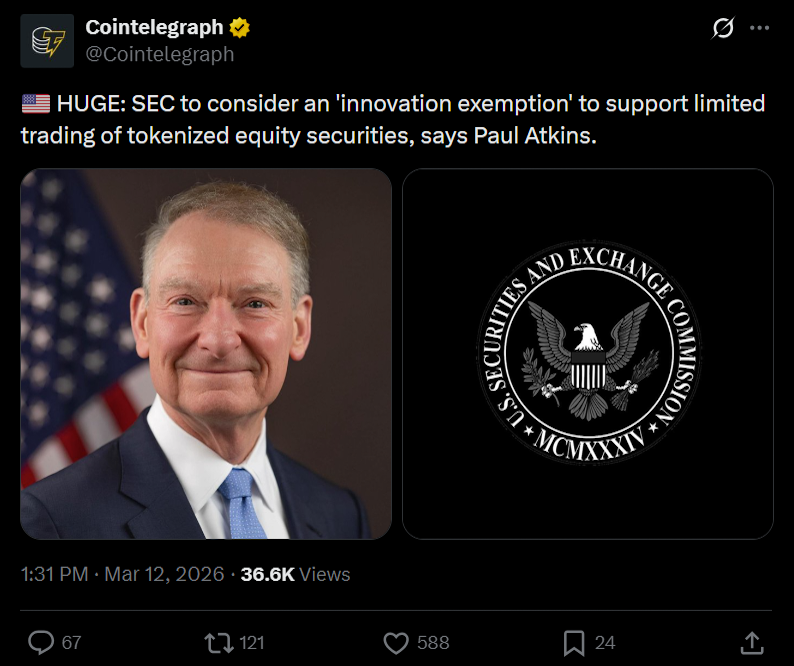
Source: Cointelegraph
The agency has also signaled it is considering an “innovation exemption” that could allow market participants to test blockchain-based trading platforms for tokenized securities while a longer-term regulatory framework is developed.
Magazine: Can Robinhood or Kraken’s tokenized stocks ever be truly decentralized?