
World Liberty Financial, a DeFi platform backed by the Trump family, has put forward a governance proposal that would require holders of unlocked WLFI tokens to stake them to vote, while offering staking rewards to those who actively participate in governance.
Under the plan introduced on February 26, WLFI holders must lock their tokens for at least 180 days to take part in governance voting.
Participants who cast at least 2 governance votes during their lock-up period would receive an estimated 2% annual return paid from the project’s treasury.
Voting power would be measured by both stake size and remaining lock-up duration using a non-linear formula to limit concentration among the largest holders. The system also links staking to deposit incentives on USD1, World Liberty’s flagship stablecoin.
The proposal also establishes Node and Super Node tiers for larger stakers, offering additional incentives such as access to licensed market makers for 1:1 USD1 stablecoin conversions and prioritized partnership engagement.
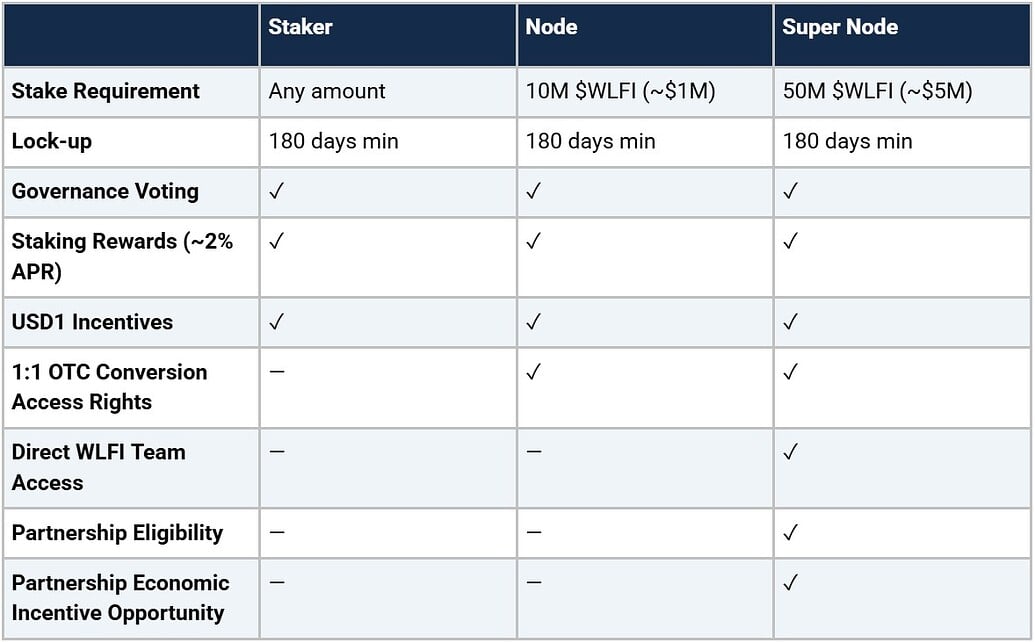
To become a “Node,” users must stake at least 10 million WLFI, valued at roughly $1 million at current prices.
These participants would gain access to licensed market makers facilitating 1:1 conversions of supported stablecoins such as USDT and USDC into USD1, as well as USD1 off-ramps into US dollars.
The move would redirect arbitrage profits from institutional market makers to committed token holders, while strengthening demand for USD1 and tying governance power to long-term capital commitments.
To become a “Super Node,” participants must lock up a minimum of 50 million WLFI. In return, holders would receive priority access to partnership discussions with the platform’s leadership, though commercial agreements remain subject to separate review.
The proposal will be put to a seven-day vote and must secure participation from at least one billion eligible tokens to be valid.
Staking-based governance models have gained traction across decentralized finance projects as developers seek mechanisms to align long-term incentives without relying on centralized oversight.