

US President Donald Trump’s advisory group is looking at a plan to issue a US dollar-backed stablecoin to help people in Gaza who face severe cash shortages and broken banking services.
The plan is being talked about by the Board of Peace and a handful of outside advisers. Based on reports by the Financial Times, the pitch aims to let aid and basic trade carry on even when ATMs and regular banks are offline.
$1 Billion Membership
Membership in the board requires a $1 billion contribution, according to reports, a condition that has fueled debate over influence and oversight. Trump announced the assembly of the board in January.
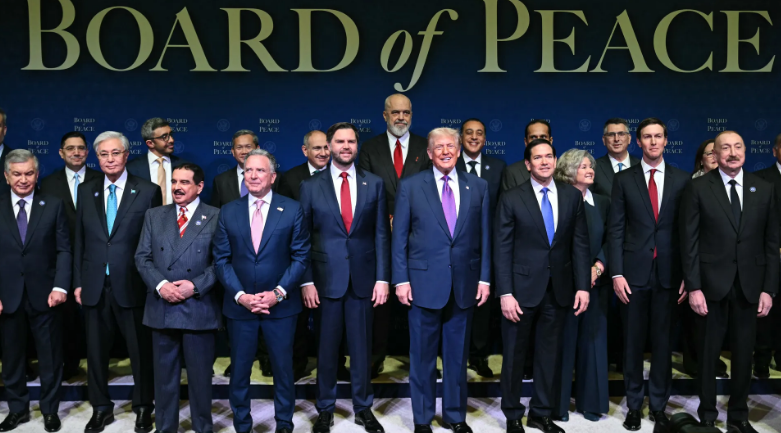
The inaugural Board of Peace meeting in D.C. Image credit: Saul Loeb/AFP via Getty
The effort has technical backers. One name tied to early planning is Liran Tancman, who has been linked to discussions with the territory’s technocratic team, the National Committee For The Administration Of Gaza.
They have talked about a currency token that would be pegged to the dollar, with reserves and systems that would allow people and aid groups to buy food, medicine, and fuel without needing functioning local banks.
Officials advising Donald Trump’s “Board of Peace” are exploring a US dollar-backed crypto stablecoin for Gaza.
According to the Financial Times, this crypto concept is in an exploratory phase, but it could spell the rebuilding of Gaza being tied to a crypto experiment.
— More Perfect Union (@MorePerfectUS) February 23, 2026
Stablecoin Support For Transactions
Supporters say a token could cut some friction. When cash runs low and banks are down, people cannot get what they need. A simple digital token held on phones could move value quickly between traders and charities.
It might also let international donors send help with fewer middlemen. There are questions about how to store the reserves, who would audit them, and what legal system would enforce payments. None of those issues has been solved.
BTCUSD trading at $63,123 on the 24-hour chart: TradingView
Concerns About Control And Isolation
Critics warn of political and practical risks. Some worry that a special token for the strip could deepen separation from nearby markets and make coordination with the West Bank harder.
Others point to patchy internet access and the risk that a digital system could be shut down or manipulated during fighting. There is also debate over which institutions would hold the funds and who would be allowed to issue or burn tokens if things go wrong.

Image: iQoncept/Shutterstock
How It Would Work In Practice
Reports say the plan is still preliminary and that no issuing authority has been chosen. Proposals vary. One model uses a trusted third party outside the region to hold dollar reserves and run the ledger. Another relies on local partners to manage day-to-day distribution.
In both cases, safeguards have been suggested: independent audits, multi-party control of reserves, and strict rules for spending on essential goods only. These are ideas on paper more than firm plans.
Featured image from Crypto Valley Journal, chart from TradingView

Editorial Process for bitcoinist is centered on delivering thoroughly researched, accurate, and unbiased content. We uphold strict sourcing standards, and each page undergoes diligent review by our team of top technology experts and seasoned editors. This process ensures the integrity, relevance, and value of our content for our readers.